THE HOUSE IS BLACK: 4 FILMS BY KIM KI-YOUNG

banner

It’s worth noting that the period considered to be Korean cinema’s golden age is also the first time in the nation’s history that there was some semblance of a fully operating film industry. Flanked by a civil war on one end and censorship policies on the other, the decade long bout – most would agree that it began sometime in the late 1950s and ended at the start of the ‘70s – boldly captured something of the ambiguous desires of a nation just learning to handle their own nascent sovereignty. The numbers alone are telling: 18 indigenous releases in 1954, 74 in 1958, and 229 in 1969. Free from conscription, the men who came to helm the camera during this time were of the young and educated crop. Large tax cuts and a rising influx of Western cultural goods helped create the necessary ferment that would enable these fresh faces to go on to produce highly stylized and startlingly mature works.

Their films ran the gamut: realist works like Yoo Hyeon-mok’s AIMLESS BULLET (1961) – think Cain/Chandler meets early Rossellini/De Sica – jived well with the cynical post-war crowd; literary adaptations, best exemplified by Kim Su-Yong’s SEASHORE VILLAGE (1965) and Shin Sang-Ok’s THE MOTHER AND HER GUEST (1961), examined agrarian lifestyles and traditional values, suitable for a people burnt out from years of ideological tug-o-wars; Lee Man-Hee’s THE MARINES WHO NEVER RETURNED (1963) and Shin Sang-Ok’s RED MUFFLER (1964) ushered in well-crafted war epics that were less preoccupied about promulgating a political slogan than creating interesting images; others like Han Hyeong-Mo’s MADAME FREEDOM (1956) made their marks as cultural harbingers, often depicting women in more progressive roles trying to rewrite the social codes.

Among these figures, Kim Ki-Young may loom the most interesting. If he’s considered a cult director today, that was hardly the case back then, when his 1960 horror-thriller, THE HOUSEMAID – which thanks to Martin Scorsese’s fundraising efforts, was restored by the Korean Film Archive in 2008 – became a blockbuster and critical hit, not uncommon back then when success went both ways. While his peers were often keen on interpreting the shifting political and daily realities of their lives by way of nostalgia and pathos (hence the popularity of “literary” films and soap operas), Kim insisted on developing a filmic mode that would anchor his works in the present. The surrealist and German expressionist traditions, in this way – if they had any truck with Korean filmmakers during this time – find their clearest iteration in Kim’s oeuvre. A disregard for nicely delineated plot points and penchant for drawing characters on the brink of lunacy quickly set the director apart from the usual mold. Things needed to be, as it were, more slovenly. The pacing, if erratic in his films, offered instead an imperative, a sense of urgency through which characters pursued moral trials within a constrained time and space. Hitchcockian psychology abounds in these works.

By the time the ‘70s rolled around, the government led by Park Chung-Hee, an evangelist of aggressive modernization, clamped down on film content, abruptly tapering off production that took a decade to achieve, and soon demanding that the film industry not only meet a certain quota (in order to bring in foreign films) but produce works with varying degrees of anti-communist propaganda. Kim was in the middle of all this. For an auteur who thrived under a considerably lax industry code, Kim suddenly found himself in a creative pickle not dissimilar to the Hollywood directors of old. Yet the kinds of frenetic narratives he wove in the ‘50s and ‘60s enabled him to slap even more distorted visions of reality on his films of the twilight ‘70s. Moreover, few have devoted themselves like Kim in bringing to the screen the rich, folkloric tradition of Korean shamanism, a neglected heritage, and renewing its currency within a viciously changing nation more known for its Buddhist and Confucianist views. Between the Dionysian and Apollonian wells, Kim drank from the former each time. Though Kim’s struggle with the production codes of the ‘70s suggest that his films may be somewhat subpar compared to his earlier efforts, the contrary remains more accurate, as though the stricter the regulations, the more unhinged his films became. Apparently, he worked well in an otherwise decadent age.

Largely forgotten through the eighties, Kim’s films would be rediscovered on VHS by cinephiles in the early nineties, eventually being invited to attend a comprehensive retrospective of his films at the 2nd Pusan International Film Festival in 1997. The revival was short-lived, as a year later, amid production on a new film, Kim and his wife died in their home, an electrical short-circuit setting their abode ablaze.


goryeojang_banner GORYEOJANG
Dir. Kim Ki-Young, 1963
Korea, 90 min.
In Korean with English subtitles.

FRIDAY, MAY 2 – 7:30 PM
SUNDAY, MAY 4 – 5:00 PM
SUNDAY, MAY 11 – 5:00 PM
SATURDAY, MAY 24 – 7:30 PM

Let the good and bad all prosper! Let it rain! Let it rain!

Those who’ve seen Keisuke Kinoshita’s BALLAD OF NARAYAMA – and Shoei Imamura’s remake of it by the same name – will be familiar with the story here. In a small, mountainous village, a long-standing drought leads the village leaders to decree that anyone over 70 years should be carried up to and abandoned on a neighboring mountain peak. Authority, unsurprisingly, rests strongly in the hands of a few shamans and a cohort of conniving brothers who have monopolized the village’s water supplies. Deeply affected are the brothers’ former in-laws: an elderly mother, one of those who must be left to die on the peak, and her crippled son, who must take her up there. Stuck between a rock and hard place, the scapegoat son finds himself knocking down his moral pillars, unable to adequately salvage both duty and survival.

GORYEOJANG reveals Kim’s fascination with ethical dilemmas. Much of the narrative is indebted to the Biblical accounts of Joseph and his brothers, and Abraham and Isaac but fleshed out in Freudian fracas. Spindly branches splay out from trees amongst a background awash in swatches of black and grey; And from all the bleak images of poverty and desperation is one of the tenderest portraits of motherly and filial love. A prime – and the only – look at the golden ‘60s in this series.

*Unfortunately, there is approximately 20 minutes of lost footage in the film; fortunately, the soundtrack survives, and is played to black leader to interesting effect.


iodo_banner1 IODO
Dir. Kim Ki-Young, 1977
Korea, 110 min.
In Korean with English subtitles.

SUNDAY, MAY 4 – 7:30 PM
SATURDAY, MAY 10 – 10:00 PM
FRIDAY, MAY 16 – 7:30 PM
TUESDAY, MAY 20 – 10:00 PM

They aren’t exactly mermaids, but the female divers of Jeju Island are charming in their own right; always smiling, and ready to crack jokes (they also catch the tastiest mussels). Like the women of the Amazon and Sapphos, these blue-collar sea farmers form their own autonomous mythology, and Iodo, a large rock-island, is where they are laid to rest, according to the locals. Kim’s film departs from here.

Told through a slew of foreboding flashbacks, the film follows a troubled travel agent who sets off to Jeju to find his missing colleague. Kim’s freewheeling camera – a bevy of zooms and quick pans – and unexpected cutting keeps things interesting. What’s palpable is the friction between the wild sprawl of the sea and the bustling city-center, as a descent into Hades goes haywire. A weird cross between Carax’s POLA X, Zulawski’s POSSESSION and Polanski’s CHINATOWN, IODO gives claim to frenzy as an aesthetic ideal.


insect woman_banner1

INSECT WOMAN
Dir. Kim Ki-Young, 1972
Korea, 110 min.
In Korean with English subtitles.*

THURSDAY, MAY 1 – 10:00 PM
SATURDAY, MAY 17 – 10:00 PM
SUNDAY, MAY 25 – 5:00 PM

INSECT WOMAN (Kim Ki-Young, 1972) from Spectacle Theater on Vimeo.

Besides the obvious (being sex), one suspects that Kim’s preference for maids as his principal protagonists has much to do with the the ways in which their bodies bear testament to to both political and social changes of the time. With more women assuming a place in the family as a substantial breadwinner under Park’s programmatic fiscal policies, the way is paved for Kim to let loose his vision of the shape-shifting figure. At once house-keeper, mistress, and taboo’s spokesperson, the maid is the intervening force between the traditional husband/wife dyad, and who in the case of INSECT WOMAN must act on behalf of her employer’s orders to “cure” her husband of his impotency. This absurd reversal of roles only heightens how far one goes to attain material security.

Bringing the rules of the jungle into the home, the prime marker of bourgeois solidarity, Kim makes a sordid mess of burgeoning middle-class values (the house as a zoo), castigating what he sees as a blind eye toward the basic tenets of human survival. Sex (as pleasure and procreation) and economy interchange and mingle under one roof as the three characters play out their desires on each other, each offering a particular strength – or more accurately, capital – that the other lacks. Where in IODO the city-dweller makes his way out to the cornfields on some humanistic claim to discover the truth, there is no such pretension here. Moral categories simply lose their prerogative. Kim at his most Buñuel-esque.

* English subtitles over hardcoded Spanish subs.


promise_banner PROMISE OF THE FLESH
Dir. Kim Ki-Young, 1975
Korea, 95 min.
In Korean with English subtitles.

SATURDAY, MAY 10 – 7:30PM
SUNDAY, MAY 11 – 7:30 PM
TUESDAY, MAY 20 – 7:30 PM

A remake of a lost melodrama from the ‘60s, PROMISE OF THE FLESH is less promise than an always already broken covenant. As is always the case for Kim, death and sex are tight bedfellows, the twin driving forces behind this tale, which seems to teeter relentlessly between tearjerking drivel and psychosexual mess.

Good behavior earns a middle-aged woman some respite from the small cell – imprisoned for murder of a would-be rapist – and onto a train to visit her hometown. Along the way, an attractive young man catches her attention, and a tight bond is immediately formed. She travels with her parole officer (since, à la Freud, two characters are never enough), who in one of cinema’s stranger moments, weds the delinquent to the young man atop a sullen hill. Bearing the weight of a lifetime of unsuccessful romances, she must go back to prison, but not before making her now husband promise to meet her on the same spot in two years. The promise – for love, for a house, for children – is nothing more than a few spoken words, but it is the only contract in town that means anything.


IN AND AROUND COLLABORATIVE PROJECTS INC.

COLAB_Series_banner

Organized by Laura Kenner and Rachel Valinsky

Spectacle is pleased to host this survey of film and video works generated in and around famed no-wave NYC artists’ group Collaborative Projects, Inc., aka Colab. Organized by Laura Kenner and Rachel Valinsky, the series runs in conjunction with springtime programs at James Fuentes Gallery, ABC No Rio, The Lodge Gallery, and Cuchifritos Gallery + Project Space, commemorating Colab’s 1980 exhibition/action The Real Estate Show.

The programs in this series include:
New Cinema Redux – Wed May 7 8PM
Text / Landscape / Object – Wed May 14 8PM
Girls Gone Wild – Sun May 18 7:30PM, Fri May 23 7:30 PM
Artists’ Cable TV – Fri May 9, 10PM

“In and Around Collaborative Projects Inc.” focuses on the tremendous output of film and video produced by a wide range of artists working within New York City’s downtown alternative art scene in the late 1970s to mid 1980s. Loosely structured into four programs that seek to suggest the variety of styles and strategies distributed through cinema and cable television networks, the series presents work from over 50 artists working within, outside of, and around a hub of collective artistic activity better known as “Colab” (est. 1978). These screenings celebrate the low-budget, experimental grit of this brief span of underground filmmaking brought about by the availability of recording systems such as Super 8 film, Sony Portapak, and more importantly, the raw need to produce.

Showcasing an array of documentary and narrative film, poetic experiments, performance art videos, live programming, and independent news interventions, “In and Around” positions this filmic output as an intersecting and overlapping period of production that, despite all efforts, resists categorization. Rather, it reflects on the prolific conditions of the time, which encouraged an inclusive approach to independent and collaborative operations, recognized filmmaking as collective activity shaped though technology, and permitted an active engagement with the outside world.


COLAB_NewCinemaRedux_banner

PROGRAM 1: NEW CINEMA REDUX

WEDNESDAY, MAY 7 – 8:00 PM

Special Guests TBA

If we just made our own little movies, and showed our movies at so-called legit places, we would have disappeared in the general consensus of independent of avant-garde film. By creating the New Cinema and making movies in Super 8, and by showing them in rock clubs, we made the movies stand out.” – Eric Mitchell

The New Cinema was a movie theater dedicated to screening a proliferation of low-budget, Super 8 narrative films emerging out of the downtown scene. Operating only for a brief period from 1978-1979, the project space provided numerous artists a way to showcase their work while announcing a new kind of cinema for a new kind of filmmaker. Founded by Eric Mitchell, Becky Johnston and James Nares, the New Cinema screened works at an astonishing rate matched only by the efficiency of simple moving picture technology and the creative drive of burgeoning downtown artists.

“New Cinema Redux” features three films originally shown and premiered at New Cinema during its short-lived existence at 12 St. Mark’s Place: John Lurie’s Men in Orbit (1979), Michael McClard’s Motive (1979), and Eric Mitchell’s Kidnapped (1978). All three of these films were shot on Super 8, transferred to and edited on video, and projected on an Advent screen at New Cinema. These films offer a glimpse at the rugged synthesis of downtown actors, artists, and no-wave musicians working in and around New York’s underground punk scene in the late 1970s.

MEN IN ORBIT
Dir. John Lurie, 1979
USA, 40 min.

“The $500 budget prevented me from filming in space.”
– John Lurie

A sci-fi povera film, with a DIY, expedient aesthetic, and shot on Super 8, Men in Orbit features Lurie and Eric Mitchell as tripped out, chain-smoking astronauts in a decrepit New York room (Lurie’s apartment at the time) that has been transformed into a spacecraft. “Acting on LSD is not acting at all,” commented Lurie, “is more the capturing of a weird event.” With James Nares as cinematographer, the film achieves a visceral, weightless quality by floating the camera, constantly, above the scene. “Outer space” ambient noise fills the film – static pouring out of broken TVs and radios.

MOTIVE
Dir. Michael McClard, 1979
USA, 60 min.

Kathy Acker: Ahh, Michael, what was your motive in making Motive?
Michael McClard: That’s really a terrible question Kathy.
– Interview in Bomb Magazine

First premiered at New Cinema in April 1979, Motive is a Super 8 feature film portraying a punk psycho-killer (Jimmy de Sana) as he plots to rig the Museum of Modern Art’s men’s room to electrocute random users. Produced by Michael McClard and Liza Béar.

KIDNAPPED
Dir. Eric Mitchell, 1978
USA, 62 min.

Eric Mitchell’s Kidnapped (1978) follows a gang of chatty intellectual junkies/nightclubbing terrorists as they plot to abduct the real life owner of the Mudd Club, Steve Mass. Notably the first film screened at the New Cinema upon its opening, Kidnapped is a washed-out, cut up, no wave derivative of Andy Warhol’s Vinyl that quickly became a staple in the theater’s programming series.

“Kidnapped seems almost an homage to Vinyl, one of the few vintage Warhol’s that’s screen these days– but Mitchell’s random compositions, on screen direction, and impoverished location shake the mothballs of the Factory aesthetic. Its actually witty when he stages a violently sadistic dance number to Devo’s “Satisfaction,” and the film’s washed out, slightly warped images are well framed by the St. Mark’s Place store front Eric Mitchell calls the New Cinema. The surrealists thought that all movie house should be afflicted with the same degree of decay as the films they showed. It’s an equation that Kidnapped nearly balances.”
– J . Hoberman, Village Voice, 1979


COLAB_TextLandscapeObject_banner

PROGRAM 2: TEXT / LANDSCAPE / OBJECT

WEDNESDAY, MAY 14 – 8:00 PM

Liza Béar, Andrea Callard, Coleen Fitzgibbon in attendance!

“Text / Landscape / Object” explores the poetic and personal short films of three distinct female filmmakers’ works from the mid 70s to early 80s. Mining the relationships between image and text, landscape and object, Liza Béar, Coleen Fitzgibbon, and Andrea Callard each take a unique approach toward developing a highly personal idiom of the image in motion using both film and video. This program is roughly divided into three categories that often seep into one another: experiments in video poetics and communication (Béar) and examinations of found text and speech (Fitzgibbon); landscapes as real and imagined, dreamt and mirage-like (Béar and Fitzgibbon); and the relationship of everyday objects to bodies in space (Callard).

DICTIONARY
Dir. Coleen Fitzgibbon, 1975
USA, 4 min.

Filmed in several parts, Dictionary is a hyper-kinetic work, which runs through the R and the Un- sections of Webster’s Dictionary, using a microfilm camera to photograph and preserve paper documents on a roll of 16mm film. Fitzgibbon contemplates: the yellow notebook and blade-less knife handle were missing when the blue car impacted the red car.

TIME (COVER TO COVER)
Dir. Coleen Fitzgibbon, 1975
USA, 9 min.

A schizophrenic look at the news: in Time, Fitzgibbon filmed, cover to cover, micro text film of the November 1974 issue of the US, English language monthly periodical, Time, overlaying rapid, constantly scrolling shots, with a muffled, cut-up voiceover soundtrack of Daniel Ellsberg interviewed by Tom Snyder on the Pentagon Papers.

EARTHGLOW
Dir. Liza Béar, 1983
USA, 8 min.

“In the beginning / Was the word processor.” Liza Béar’s Earthglow (1983) is a poetic film where words take the place of images to trace the artist/writer’s inner monologue. Through changes in color, type, placement and movement of words within the frame (that foreshadowed digital fades, slides, and other transition techniques…). Béar’s poetry, like a “Proustian sentence” takes the viewer/reader through warm Pacific suns, movie theaters, city streets (honking and street noise play in the background), recollections of a desert landscape, airplanes and deep sleep, always through the reflexive allusion to the process of writing. As “she strain[s] to remember her thoughts,” a “story line or board” emerges. Electronic engineering by Bruce Tovsky.

A city dweller attempting to write a poem about a desert trip is distracted by a recent argument. Earthglow, whose only images are words, uses character animation to convey the writer’s internal dilemma through the shuttling of words across the screen, as well as color changes and ambient sound. Using an analogue character and switcher in a live edit, parts of the text are keyed in real-time and others are pre-recorded. On the score, an off-air burst from a Billie Holiday blues song (whose lyrics infiltrate the words of the poem) disrupts the strains of César Franck’s Violin Sonata. Earthglow is a film about the writing state of mind; past and present perceptions are reconciled in the act of writing.”
– Liza Béar

FOUND FILM FLASHES
Dir. Coleen Fitzgibbon, 1973
USA, 3 min.

Fitzgibbon’s Found Film Flashes crafts an elliptical evocation of desire and sexual spectacle out of found footage. Strewn with fragments of black and white shots, Found Film Flashes is a collage of recurring speech fragments, where sound and image are particularly disjunctive. Voice over provides a commentary on an audiotape, while an obsessive, repetitious voice returns to the phrase, “It’s about tonight, it’s about tonight.”

TRIP TO CAROLEE
Dir. Coleen Fitzgibbon, 1974
USA, 4 min.

Trip to Carolee runs quickly through still images of things passing: an apartment, a typewriter, a bridge, the road, as Marjorie Keller and Coleen Fitzgibbon drive to Carolee Schneeman’s. Fitzgibbon paints an intimate portrait of the travel between the city and the country and back, tracing her surroundings in accelerated, yet attentive ways.

LOST OASIS
Dir. Liza Béar, 1982
USA, 10 min.

Shot in 1982 in a bizarre Californian landscape, Lost Oasis, is an ambulating narrative with the desert at its core. This short film takes on the airs of a mirage as a loosely structured and evocative drama unfolds. Lost Oasis sets up a strange parallel reality where time moves slowly through the desert, in search of a lost oasis. Starring Michael McClard.

FLORA FUNERA (FOR BATTERY PARK CITY)
Dir. Andrea Callard, 1976
USA, 4 min.

In Flora Funera (for Battery Park City), Callard explores intimate games and noises as she repeatedly tosses rocks against exposed stakes of rebar.

LOST SHOE BLUES
Dir. Andrea Callard, 1976
USA, 4 min.

In Lost Shoe Blues, Callard ventures outside her studio to survey the clover of Battery Park while singing a round with herself on the film’s soundtrack.

FRAGMENTS OF A SELF PORTRAIT #1
Dir. Andrea Callard, 1976
USA, 2 min.

Callard clomps up flight after flight of stairs with giant white casts on her feet. Each pounding step echoes. When she finally removes the casts, they splinter and collapse and her bare feet emerge as though from cocoons. She enters her studio, abandoning the “fragments,” and inviting the viewer to leave behind the carapaces she wears to protect and hide the self inside.

DRAWERS
Dir. Andrea Callard, 1974
USA, 12 min.

In Drawers, Callard playfully pulls the drawers of a white chest open, repeatedly hoisting a string of clothes and fabric tied together in a Rapunzel-like fashion out of the drawers until all have been emptied.


COLAB_GirlsGoneWild_banner

PROGRAM 3: GIRLS GONE WILD

SUNDAY, MAY 18 – 7:30 PM – Cara Perlman and Cave Girls in attendance!
FRIDAY, MAY 23 – 7:30 PM

“Girls Gone Wild” showcases a series of films that criticize stereotypical female roles through a literal embodiment of a motley crew of characters– Barbie dolls, Amazonian women, strippers, Neanderthals, and dominatrices. Featuring over 20 female filmmakers—and one brave man—these artists write their own definition of post-feminist practices with the crude sincerity of DIY techniques. Including: Tina L’Hotsky’s Barbie (1977) and Snakewoman (1977), Cara Perlman and Jane Sherry’s Topless (1979), Scott and Beth B’s G-man (1978), and the prehistoric collaboration Cave Girls (1981).

BARBIE
Dir. Tina L’Hotsky, 1977
USA, 15 min.

Writer, filmmaker, and downtown New York club scene celebrity Tina L’Hotsky stars and directs in Barbie, a surrealistic portrait of the artist as a plastic doll. Coming home from a shopping trip, Barbie takes her groceries out of a bag and unwraps a Barbie doll. “She fries up the Barbie doll and eats it.” L’Hotsky stated, “The end.” Filmed in slow motion and set to a hypnotic soundtrack, Barbie is a slice of dark comedy that pushes the consumption of representation to the point of cannibalism.

SNAKEWOMAN
Dir. Tina L’Hotsky, 1977
USA, 30 min.

Snakewoman stars downtown legend Patti Astor as the woman who must conquer the wild after her plane crashes into the jungles of Upper Volta. Shot in a satirical 1940’s styled adventure story with Marvin Foster, Eric Mitchell and David McDermott as the natives. “We shot Snakewoman entirely on location in Central Park for five hundred dollars” Astor said, “it’s our homage to the 40’s jungle movies.”

TOPLESS
Dir. Cara Perlman, Jane Sherry, 1979
USA, 16 min.

Topless, a collaborative film by then roommates Cara Perlman and Jane Sherry, is a faux documentary tracing Jane’s activities as a topless dancer in a New York City nightclub–where she was in fact working at the time. At once a humorous take on the subject and a serious attempt to examine the economy of flesh, Topless delves into the power play that defines the sex economy and its relation to the culture more widely. Combining fact and fiction through the mixing of real actors and cardboard cutouts of clientele, the film is a glimpse into the endless string of anonymous encounters and cash flow in the exotic dancing world. Shot in Super 8mm film, Topless is a bold, rebellious look at the limits of acceptable behavior, with a raw aesthetic, derivative of porn, and a soundtrack which includes the song, “Push-Push-in-the-Bush” and electronic video game noises.

G-MAN
Dir. Scott and Beth B, 1978
USA, 28 min.

Scott and Beth B.’s G-Man (1978) combines the real violence of global terrorism with the imagined violence of sadomasochism to produce an interwoven narrative of dependency and control. Retrospectively characteristic of the no-wave film aesthetics of its time, G-Man is part documentary/part narrative filmmaking with jolting cut-ups, a gritty mechanical soundtrack and shaky camera movements. The film follows anti-hero Max Karl (Bill Rice) as he splits his time between being commanding officer of the New York Arsons Explosive Squad and being commanded by a dominatrix at a whorehouse. Karl tentatively outlines his requirements in a contractual agreement between the Superior and the sub, stressing his need for “somebody that’s really powerful, somebody that can dominate me. I’m in a situation where I tell someone what to do…and I want somebody to… (trails off)” Soon he is stripped naked in a wig and being humiliated on all fours. Between scripted segments, the B’s insert photographic stills of homemade bombs and videos of explosions, zooming out of the image just enough to reveal its projection on a television screen–shifting the focus from what is being displayed to how it is being mediated and distributed. “One thing that we were trying to get at,” Scott B. commented, “was the idea that essentially control is violence. Whether it’s enforced with violence or with the threat of violence, that’s the nature of power.”

CAVE GIRLS
Dir. various, 1981
USA, 32 min.

“Tonight we are proud to present to you for the first time on television, evidence which will leave no doubt of the existence of Cave Girls.”
– Opening Monologue, Cave Girls (1981)

Originally filmed for the “Potato Wolf” cable television series, Cave Girls (1981) is a collaborative work that seeks to establish a relationship between pre-historic women and the mediated image. Ghostly, hypnotic and blurred video of a tech-savvy tribe of women are interspersed with shots of crewmembers during the film’s production, fuzzy SoHo hang sessions, mechanical apparatuses, and scenes from the overgrown backyard of ABC No Rio. Featuring music from Bush Tetras and Y-Pants, with artists Cara Brownell, Ellen Cooper, Ilona Granet, Marnie Greenholz, Julie Harrison, Becky Howland, Virge Piersol, Judy Ross, Bebe Smith, Kiki Smith, Teri Slotkin, Sophie VDT.


COLAB_Cable_TV_banner

PROGRAM 4: ARTISTS’ CABLE TV

FRIDAY, MAY 9 – 10:00 PM

Early on in its founding, Collaborative Projects’ broad-based group produced weekly public-access cable TV series – or “artists’ cable television” – in an effort to provide an alternative to mainstream media news programming. This screening showcases samplers and selections from just a few of these projects, including All Color News (1977-78), Potato Wolf (1978-84), and Communications Update, produced by the Center for New Art Activities, Inc (1979-1992, directed by Liza Béar and Michael McClard). Presenting a dizzying array of situational comedies, news, commercials, satirical skits, television allegories, “Artist’s Cable TV” celebrates these programs’ varied approaches to live theater, improvised events, and pre-recorded videotapes.

ALL COLOR NEWS SAMPLER
Dir. Colab/various, 1977
USA, 22 min.

“I just want to let you know that I was turning the channel changer and I came across your show a short while ago, and it is, like, the weirdest fucking show I’ve seen, like, recently.”

“Well is that a compliment or an insult?”

“Well ya know it’s both, like, its uh… I mean technically the worst thing I’ve ever seen but yet that’s really kind of interesting, ya know it’s an interesting change.”
Caller on “All Color News,” 1978

In May 1977, members of the soon-to-be incorporated Collaborative Projects organized and produced All Color News, a video cut-up and radical alternative to mainstream news channels. The group aimed to present a wide range of gritty and provocative events habitually ignored or censored by public broadcasters—seeking stories on the streets of New York, conducting interviews with public officials and offering counter-positions to sensationalized topics. “Ordinary situations and events,” reads one proposal, “by virtue of their commonness, tend to have greater social relevance than isolated, extraordinary occurrences. We make no pretense of objectivity.” This particular sampler features John Ahearn’s documentary footage of a crowded subway, Tom Otterness’ gross-out exposé of health violations in a Chinatown butcher shop (“Is that a rat right there?” “Yeah, these are the trays where they keep the meat…”) and Scott and Beth B.’s interview with an Arsons and Explosive Squad Inspector—a figure who would later be the inspiration for the lead character in the pair’s no-wave classic G-Man. In programming a dizzying array of peripheral events where there is something for everyone, All Color News is an overlooked time capsule of an earlier New York that received little or no coverage.

COMMUNICATIONS UPDATE SAMPLER (selections below)
Dir. Various, 1982
USA

“The immediacy of a weekly outlet provides a good way of sharing an on-going investigation with those lucky enough to live in the right neighborhoods; it allows for an active role in the making of information as artists and as citizens.”
– Liza Bèar, January 1983. Press release.

Running continuously from 1979 to 1992, Communications Update (later called Cast Iron TV) was a weekly artist public access series coordinated by Liza Bèar and produced by Center for New Art Activities, Inc. Spawning from an interest in both local and international communication politics, C-Update/Cast Iron TV ran parallel to and beyond All Color News and Potato Wolf, featuring artists and filmmakers collaborating across all three series. Organized by Liza Bèar for the 1982 Spring Series, this sampler includes: Ron Morgan and Milli Iatrou’s The Reverend Deacon B. Peachy, Eric Mitchell’s A Matter of Facts, Robert Burden and Ditelio Cepeda’s Crime Tales, and Mark Magill’s Lighter Than Air.

THE REVEREND DEACON B. PEACHY (Ron Morgan and Milli Iatrou), 4 min.

An eight sermon televangelist satire chronicling the self-conscious Southern Reverend’s efforts to establish an electronic pulpit on New York TV.

“Does video destroy the preacher? Does the preacher destroy video? Do you want to buy the Brooklyn Bridge? Form-fiends beware—this is not for you.” (Soho Weekly News, 1982)

A MATTER OF FACTS (Eric Mitchell with Squat Theater), 18 min.

Starting with a scene from Squat Theatre’s “Mr Dead and Mrs Free” shot in their storefront theatre on West 23rd Street, Chelsea, New York, “A Matter of Facts” draws a parallel narrative which follows the characters from the theatre into real life.

CRIME TALES (Robert Burden/Dictelio Cepeda), 11 min.

On location in Union Square, New York; hard facts and hard humor about a hard way of life. Music by E.J. Rodriguez.

LIGHTER THAN AIR (Mark Magill), 14 min. (excerpt)

A scientific comedy on helium, buoyancy, nuclear fusion and lighter than air travel.

POTATO WOLF (selections below)
Dir. Colab/various, 1978-84
USA

Potato Wolf was a live, weekly half-hour public access cable television show on Manhattan Cable Channel C, produced by Collaborative Projects (“Colab”). Videos were originally created on now obsolete formats such as Sony Portapak, Super 8mm film, or ¾” U-Matic in the live cable studios of ETC (now Manhattan Neighborhood Network) and also at Young Filmmakers. Active from 1979 to 1984, Potato Wolf presented a variety of programs (“The Human Commodity,” “Anybody’s Show,” “News News,” “Nightmare Theater,” to name a few), in which Colab members would participate, improvising with acting, set design, costumes, music, etc.

RAPTURES OF THE DEEP, 21 min.

“Live from outer space comes an image of the earth as it truly lives: an oceanic orb.” With Alan Moore, Virginia Persol, Peter Fend, Kiki Smith, Ellen Cooper, Judy Ross, Jim Sutcliffe, Mitch Corber, Ilona Granet, Bobby G, Mindy Stevenson, Christy Rupp, Carol Parkinson, Robert Klein, Terry Mohre, and Peter Mohnnig

“Sizzling television. Another attempt at RAW FOCUS”

NEWS NEWS, 10 min.

Concept by Coleen Fitzgibbon; sound by Julie Harrison; stage manager: Cara Brownell. With Mike Robinson, Peter Fend, Taro Suzuki, Babs Egan, Jim Sutcliffe, and others.

NIGHTMARE THEATER, 7 min.

“Call in your nightmare.”Directed by George Shifini; Produced by Alan Moore; Crew: Mary McFerran, Mitch Corber, Maria Thompson, Christy Rupp, Dan Asher, Julie Harrison, Tim Burns, Mindy Stevenson & Brian Piersol; music by Carol Parkinson; Cast: Bradley Eros, Nancy Girl, Peter Cramer, Sophie Viel, Lee Gordon, Jim Sutcliffe, Marcel Fieva, Maria Thompson, Sally White & Albert Dimartino

ROCK, RAGE & SELF DEFENSE: AN ORAL HISTORY OF SEATTLE’S HOME ALIVE

Rock_Rage_SD_BannerROCK, RAGE & SELF DEFENSE: AN ORAL HISTORY OF SEATTLE’S HOME ALIVE
Dir. Leah Michaels and Rozz Therrien, 2013
USA, 60 min.

MONDAY, MAY 12 – 7:30 PM
Filmmakers Leah Michaels and Rozz Therrien in attendance! This screening will be followed by a Q&A with the filmmakers and a panel with local writers, artists and activists Rebecca Andruszka, Laina Dawes, Mikki Halpin and Tracy Hobson, moderated by the filmmakers.

Screenings also on:

FRIDAY, MAY 23 – 10:00 PM
MONDAY, MAY 26 – 8:00 PM

Special thanks to Mikki Halpin.

With no background in filmmaking but wholly inspired to share the story of a grassroots, self-defense collective called Home Alive, Leah Michaels and Rozz Therrien fund-raised about $10,000 to make the documentary ROCK, RAGE & SELF DEFENSE: AN ORAL HISTORY OF SEATTLE’S HOME ALIVE. While students at the University of Washington in a class called “Making Scenes, Building Communities: Girls and Boys Play Indie-Rock,” Therrien and Michaels were assigned to build oral histories on two women, Cristien Storm and Zoe Abigail Bermet, founding members of Home Alive. While researching for their projects, they found there was almost no background information on Home Alive, except that it was formed in the wake of Mia Zapata’s murder.

Therrien: It was just “this woman was murdered and some of her friends got together.” There was no sense on how the community responded outside of her friends, and how it felt during that time. This is what we got when we did a general Google search and through Wikipedia. There was nothing about the theory or how they approached self-defense.

Michaels: There was no real information out there so when we had these interviews, both women were incredibly amazing and honest in their personal histories and about Home Alive. I think that both of us were both shocked and inspired and also a bit confused as to how we both didn’t know about it. We were like, “How is this not a huge thing? How did people not really know about this at all?”*

In the aftermath of the brutal rape and murder of Mia Zapata, soulful lead singer of popular punk rock band The Gits, a group of Zapata’s friends with other women in the Seattle arts and music community formed Home Alive, a collective turned non-profit that provided free or low-cost self defense classes. Home Alive was originally formed as a direct response to what happened to Zapata and an outlet for the grief, fear and rage of the people close to her. For the larger community, the collective served as an empowering and politicizing support network and a practical way to increase a sense of safety for women in the scene.

People shared stories and fears of stranger assault, but just as importantly, about other forms of violence as well. Childhood sexual abuse. Date rape. Intimate partner violence. Street harassment. It soon became evident that all these abuses were connected. The talk turned to ways to keep themselves and their communities safe.

The women tried out the self defense classes they could find locally, and found them lacking. First, they were expensive; second, they offered restrictive rules that the women experienced as unhelpful and unrealistic. For musicians and artists, for people employed as bartenders or sex workers, for those without safe and reliable housing, it wasn’t useful to be told to dress conservatively and never walk alone at night. They realized that if they wanted relevant, affordable self defense training, they’d have to create it themselves. (From Home Alive’s website)

Though they dissolved as a non-profit in 2010 due to financial ups-and-downs, Home Alive continues to operate once again as a volunteer collective, providing classes at high schools and various organizations. They also provide their entire curriculum through their website.


PANEL PARTICIPANTS

REBECCA ANDRUSZKA is Chair of the board of directors of RightRides for Women’s Safety, which was founded 10 years ago by two women who decided to offer safe rides in direct response to assaults on women walking home by themselves late at night in northern Brooklyn. Currently on hiatus, RightRides is in strategic planning mode and seeking community feedback.

Rebecca is currently in a senior development position at a national advocacy organization, an active Activist Councilmember at Planned Parenthood of NYC Action Fund, and a regular volunteer for other local social justice organizations. She also authors monthly columns at The Daily Muse and ProfessionalGal about working in the non-profit sector.


LAINA DAWES is the author of What Are You Doing Here? A Black Woman’s Life and Liberation in Heavy Metal (Bazillion Points Books, 2012). A music and cultural critic and concert photographer, her writings and photography can be found in various print and online publications such as Wondering Sound, Noisey, Flavorwire, MTV Iggy, NPR, The Root, The Wire UK, Bitch and Metal Edge magazine. She also runs the blog Writing is Fighting and is a contributing editor for Blogher.com’s Race & Ethnicity section.

An accomplished public speaker, she has been a guest lecturer at colleges and universities and spoken at music and academic conferences in both the United States and Canada. Laina is currently a graduate student in the Liberal Studies department at the New School for Social Research in New York City.


MIKKI HALPIN is a writer, zine maker, and activist who supports independent feminist filmmaking. Halpin is the author of It’s Your World – If You Don’t Like It, Change It: Activism for Teenagers and The Geek Handbook. Halpin writes mainly on culture, pop culture, and politics and has contributed articles to numerous publications including Teen Vogue, Glamour and Wired. She is currently working on a new edition of The SCUM Manifesto by Valerie Solanas with The Feminist Press. More information is available at her website: http://mikkipedia.net/


TRACY HOBSON is the Executive Director of the Center for Anti-Violence Education. Ms. Hobson joined CAE as Board Co-chair in 2004, and stepped into her current role as Executive Director in 2005. In 2009, Ms. Hobson received a commendation from the Brooklyn Borough President in honor of Pride Month, for her leadership of CAE and the organization’s vital role in Brooklyn’s vast LGBT community. In the same year, she was also honored by LAMBDA Independent Democrats for contributions to Brooklyn’s LGBT community. In 2012 Tracy received a commendation from NYC Comptroller John C. Liu for bringing change to the lives of New Yorkers affected by violence.

Previously, as Assistant Vice President within Diversity & Inclusion at Credit Suisse, Tracy created Employee Networks for women, people of color, working parents, and LGBT individuals. Other key accomplishments include adding sexual orientation and gender identity to the nondiscrimination policy, and providing domestic partner benefits to all employees globally. Tracy is a graduate of Smith College. She has also completed the Middle Management Program at Columbia Business School’s Institute for Not-For-Profit Management. At CAE, Tracy has trained in goju karate for fifteen years and in tai chi for five years.


ABOUT THE FILMMAKERS
therrien_michaels_small

LEAH MICHAELS is a graduate of the University of Washington where she received her B.A. in History. Now based in Baltimore, Michaels has been working on completing her first film with co-creator Rozz Therrien. Michaels hopes the film will honor the story of Home Alive, and inspire the use of art with community action as a means to counter the culture of violence.

ROZZ THERRIEN is a recent graduate from the University of Washington where she majored in American Ethnic Studies. Now based in Boise, she has spent the past two years working on her first film with co-creator Leah Michaels. As the film reaches completion, Therrien hopes the film’s message of community organizing will inspire a stronger sense of social responsibility. Therrien looks forward to exploring other avenues of D.I.Y. filmmaking and combining her passions of travel and film.

http://homealivedocumentary.tumblr.com/

ROCK, RAGE & SELF DEFENSE premiered in October of last year at the Musicians for the Equal Opportunities for Women (MEOW) Conference in Austin, Texas, and Spectacle is very excited to bring it to Brooklyn!

*Excerpt from an interview with Laina Dawes in Bitch Magazine. Read it here.

PSYCHEDELIC DIARIES: THE SHORT FILMS OF ÉTIENNE O’LEARY

EOL_BANNER

PSYCHEDELIC DIARIES: THE SHORT FILMS OF ÉTIENNE O’LEARY
Dir: Étienne O’Leary, 1966-1968.
Total program time: 68 min.

SATURDAY, APRIL 5 – 10PM
SUNDAY, APRIL 20 – 5PM
MONDAY, APRIL 28 – 10PM

Special thanks to ICPCE

Despite an entire filmography of only three experimental short films, Étienne O’Leary’s work is a vibrant, majestic reflection of late 60s youth culture and avant-garde film techniques, including some pioneering editing tricks that still seem fresh and invigorating today.

A 60s French dandy by way of Montreal, O’Leary became intoxicated by the sights and sounds of bohemia and formed an alliance with the Zanzibar Group (his films are populated by French underground luminaries like Pierre Clementi, Jean-Pierre Bouyxou, and Michel Auder). A student of the New York underground and surrealism, O’Leary uses a variety of notebook-style shooting, image layering, and fast cutting to capture the era’s heady decadence and political possibilities. Adding to the trippy visuals, O’Leary composed his own singular soundtracks with a myriad of found instruments and tape recorders, a new music genre in and of themselves.

O’Leary’s shorts were shown at various European galleries and happennings (French artist Jean-Jacques Lebel was a big champion of his work), but since the late 60s remained lost until they were recently rediscovered in the vaults of the Cinémathèque québécoise. A product of his time in the best possible way, O’Leary’s films are the cosmic nexus aligning Warhol’s Factory, Jonas Mekas’s home-movie poetics, and Kenneth Anger’s pop subversion.

Read the last known interview with Étienne O’Leary here.


DAY TRIPPER
Dir: Étienne O’Leary, 1966.
France, 9 min.

O’Leary debut is a staccato black-and-white impression of shared intimacy and late-night mind expansion. A tapestry of party and beach scenes are inter-cut with a lover’s stoned, seductive dancing. The soundtrack mixes screeching, crashing pianos with cut-up tape effects and samples from Nancy Sinatra, The Who, and Screaming Jay Hawkins’s manic “I Hear Voices.”

“May Ray said that Day Tripper was a film he wished he had made. I was flattered.” -Etienne O’Leary


HOMEO
(aka Homeo: Minor death: Coming back from goin’ home)
Dir: Étienne O’Leary, 1967.
France, 38 min.

A travelogue of sorts, O’Leary second work blends cityscapes, nature, summer holidays, and charismatic portraits all together, with everything awash in radiant colors. The droning harmonium soundtrack provides a continuous pulse, with occasional flutters that match the quasi-spiritual vision quests. Most significantly, Homeo foregrounds O’Leary’s radical approach to in-camera editing, with rapid-fire cuts bringing photographs and magazine ads to vibrant life alongside friends’s eternal wanderlusts.

“An object-lesson in the cinematic intensification of images drawn from day-to-day reality, in which home movie footage is rendered rock’n’roll poetry through montage.” -Cork Film Centre


CHROMO SUD
Dir: Étienne O’Leary, 1968.
France, 21 min.

O’Leary final and most fully realized short is a hallucinogenic nightmare of May ’68 riots, sadist fantasies and drug-fueled freak outs. The friendly faces and playful eroticism from before have now grown threatening and perverse. This is O’Leary at his most subliminal and transcendent, with flashing edits and dense layers of juxtaposed dissolves creating entire universes in just a few frames, all of which are augmented by a sonic collage of disembodied moaning vocals, prepared piano, and tinkering electronics.

Taking Chromo Sud as a whole, one can’t help draw parallels to the future psychedelic art and music of experimental band Black Dice or even the 80s work of Toshio Matsumoto, who all seem to be tapping in to the same far-out mainline O’Leary rode for 21 mesmerizing minutes.

Chromo Sud, his most sinister work by far, owes as much to Kenneth Anger as to Mekas, presenting the libertarian impulses of the time in as orgiastically morbid and sadistic a vein as Anger’s Scorpio Rising biker culture… a testament to the transformative powers of editing and the control it gives the filmmaker in shaping his own reality from the world around him.” —Experimental Film Club

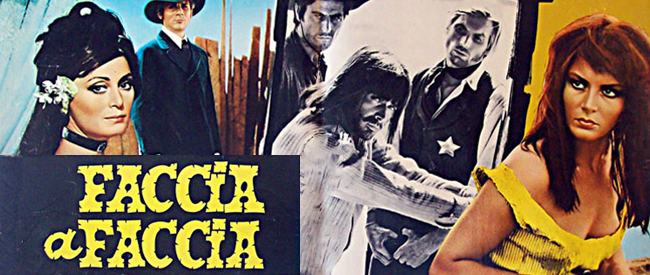
FACCIA A FACCIA

faccia_banner

FACCIA A FACCIA
a.k.a. Face to Face
Dir. Sergio Sollima, 1967
Italy and Spain, 107 min.
In Italian and Spanish with English subtitles.

SATURDAY, APRIL 19 – 10:00 PM
MONDAY, APRIL 28 – 7:30 PM

Sergio Sollima is less well known in the US than the other two Sergios who made their names in spaghetti Westerns in the 60s, namely Sergio Leone with his DOLLARS trilogy and Sergio Corbucci with DJANGO, but his work resonated strongly in Italy and provided the leftist militants there with some of their iconography.

Between 1966 and 1968 Sollima directed his “political trilogy,” which comprises LA RESA DEI CONTI (The Big Gundown), FACCIA A FACCIA (Face to Face), and CORRI, UOMO, CORRI (Run, Man, Run). All three star Tomas Milian, whose other work in the genre includes films by Corbucci and Giovanni Fago. Fago’s morality western VENGEANCE IS MINE was part of Spectacle’s Unearthed Spaghetti Western Treasures series last September, and this April we strike another tragically overlooked motherlode.

FACCIA A FACCIA stars Gian Maria Volonté (better known for his work with Elio Petri in INVESTIGATION OF A CITIZEN ABOVE SUSPICION and THE WORKING CLASS GOES TO HEAVEN and with Sergio Leone in A FISTFUL OF DOLLARS and FOR A FEW DOLLARS MORE) as Brad Fletcher, a Texan history professor teaching in Boston during the Civil War. Because of his illness (tuberculosis mixed with impotent intellectualism) he has to move back south. After his return, he is kidnapped by Bennett, a dark, mustachioed bandit played by Tomas Milian, who takes him to his commune, Pietra di Fuoco—home to all kinds of outcasts of “modernity and reality.” Bennett is the chieftain of this band of the expropriated. After Fletcher takes charge in Bennett’s absence, the people of Pietra di Fuoco eventually end up rejecting Fletcher’s proselytizing intellectual authority.

Although Bennett is a similar character, Milian doesn’t reprise his role of Cuchillo from the trilogy’s other two installments. Cuchillo (Spanish for ‘knife’) became an unwitting third-world proletarian hero, elevated to the level of Che Guevara by the militants of Lotta Continua, Italy’s premiere amorphous leftist street-fighting force of the 60s and 70s, whose flags bore the image of his face.

With a score by Ennio Morricone and “authentic period detail with a baroque expressionist vision,” FACCIA A FACCIA is not to be missed.

THREE YUGOSLAVIAN COMEDIES BY DUŠAN KOVAČEVIĆ

Acclaimed playwright, screenwriter, and director Dušan Kovačević is one of the most beloved writers to have emerged from former Yugoslavia, though his works and their acclaimed cinematic adaptations are barely known in the United States and even more rarely screened. Though probably best known for writing the source novel of Emir Kusturica’s Palme d’Or-winning epic UNDERGROUND (1995), Kovačević might be best represented by this trio of comedies, two directed by Slobodan Šijan (STRANGLER VS. STRANGLER), which star such legends of the Yugoslavian screen as Danilo ‘Bata’ Stojković, Pavle Vuisić, and Bogdan Diklić. All of them are uproarious satires of the region’s history, character, and politics.

Each of these films are monumental classics of their now-defunct country of origin: in fact, THE MARATHON FAMILY, WHO’S SINGIN’ OVER THERE? and BALKAN SPY, are, respectively, the three highest-rated Yugoslavian films on the IMDb. Nevertheless, they’ve barely been screened in the United States and, to the extent that they circulate at all, do so in very poor translations. For all of the films, Spectacle has thoroughly overhauled the translation, comedic timing, and formatting of previously extant subtitles to introduce the films to our audiences as they’re unlikely to see anywhere else.


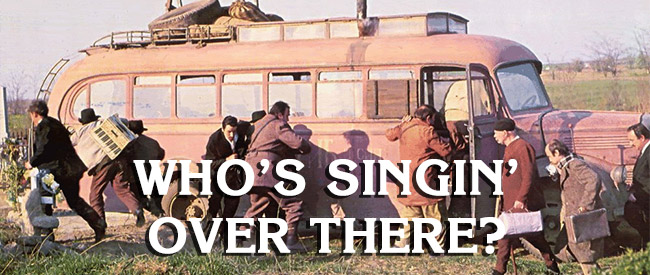
singin-banner WHO’S SINGIN’ OVER THERE?
Dir. Slobodan Šijan, 1980.
SFR Yugoslavia, 86 min.
In Serbian with original English subtitles by Spectacle.

SUNDAY, APRIL 6 – 5:00 PM
FRIDAY, APRIL 11 – 10:00 PM
WEDNESDAY, APRIL 23 – 7:30 PM

Based on an original screenplay by Kovačević.

This highly quotable classic, which screened Un Certain Regard at the 1981 Cannes Film Festival, charts the journey of a ramshackle bus across the Yugoslavian countryside toward Belgrade on April 5, 1941. Lorded over by an impetuous conductor and his numbskull son, the passengers constitute a vertiable ship of fools, misfists, and outcasts: among them a disgruntled WWI vet, a goofy hunter, a fatalistic consumptive, libidinous newlyweds, a suave pop singer, and a pair of young gypsy musicians — the source of pointed social tensions — whose folk numbers provide the film’s Greek chorus.

A prime example of the Aristotelian Unities in screenwriting, it follows the little scrapheap-that-could through encounters with highwaymen, funerals, soldiers, and other odd situations, rolling inexorably toward an unexpectedly resonant conclusion.

Fondly remembered to this day, WHO’S SINGIN’ OVER THERE? was declared by the Yugoslavian Board of the Academy of Film Art and Science (AFUN) to be the best Yugoslavian film made between 1947 and 1995.


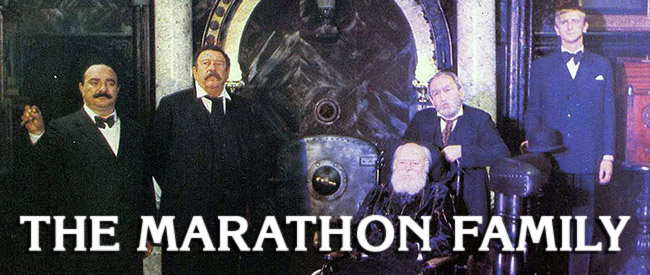
marathon-banner THE MARATHON FAMILY
Dir. Slobodan Šijan, 1982.
SFR Yugoslavia, 92 min.
In Serbian with original English subtitles by Spectacle.

MONDAY, APRIL 7 – 10:00 PM
THURSDAY, APRIL 24 – 7:30 PM
SUNDAY, APRIL 27 – 5:00 PM

Adapted by Kovačević from his play Maratonci trče počasni krug (1973)

Šijan and Kovačević followed up the smashing success of WHO’S SINGIN’ OVER THERE? with the arguably even greater THE MARATHON FAMILY (the Serbian title translates to, “The Marathoners Run the Victory Lap”), based on one of Kovačević’s earliest plays. Set in a small village in 1935, it explores the offbeat personal and political tensions amid a family of six generations of contemporaneously-(mostly-)-living undertakers.

THE MARATHON FAMILY is as grim and anarchic — not to mention hilarious — as anything Šijan and Kovačević have ever done, and no less rooted in recent history of social relations. It represents various points of transitions: the assassination of King Alexander I of Yugoslavia, portrayed through the actual newsreel on which it was captured; the transition to sound film in Yugoslavia’s cinemas; and, among the family, tensions over the ailing business affairs of their cemetery and the economic motivation to pursue new crematorium technology. Due to the latter, the family also becomes mixed-up with a local gangster, whose team of grave robbers refurbish old coffins — and naturally, the undertakers are also behind on their payments. Meanwhile, the youngest, most dim-witted member of the Marathon family becomes romantically ensnared with the gangster’s disturbed daughter, whose behavior grows increasingly erratic when she’s fired as the cinema’s pianist.

Barreling through comedy, tragedy, death, pornography, murder, incineration, and historical sea change, THE MARATHON FAMILY is at once as tar-black and uproarious as movies get.


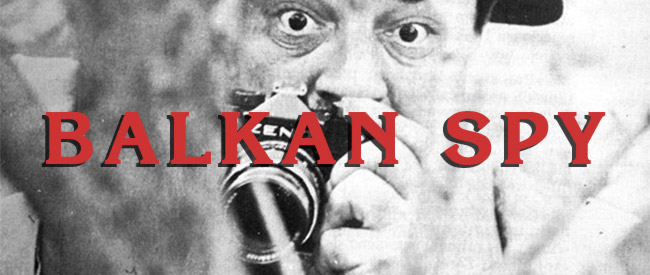
balkan-banner BALKAN SPY
Dir. Dušan Kovačević & Božidar Nikolić, 1984.
SFR Yugoslavia, 95 min.
In Serbian with original English subtitles by Spectacle.

MONDAY, APRIL 7 – 7:30 PM
TUESDAY, APRIL 15 – 7:30 PM
SATURDAY, APRIL 26 – 10:00 PM

In this major Eastern Bloc comedy classic, Bata Stojković delivers his quintessential performance as Ilija Čvorović, an ex-convict and former Stalinist now turned upright patriotic citizen of the Socialist Federal Republic of Yugoslavia. From the outset, Ilija becomes increasingly paranoid after being summoned to the police to answer a few harmless questions about his and his wife’s subletter, Petar. Čvorović is convinced that the tenant, a debonair Parisian tailor, must in fact be a spy and a threat to national security and the Socialist state. Furthermore, Ilija is convinced that the growing attraction between Petar and his daughter is a manipulative tool in the tailor-spy’s insidious capitalist schemes. And perhaps foremost, Ilija is certain that he is being set up by Petar to take the fall and that the police already suspect him as an accomplice.

Perhaps most readily understood as a madcap Yugoslav predecessor to OBSERVE AND REPORT, BALKAN SPY is a gut-busting cocktail of extreme paranoid personality disorder and warped vigilance. Stojković manages to bring an unlikely charm to his role as a disturbed, short-fused maniac even as he berates friends and family for overlooking the perceived obviousness of the baroque plot that has been set against them. It’s a hilarious and meaningful send-up of Cold War-era tensions, the Socialist state, and the Serbo-Croatian character that transcends its time and locale in it’s ability to inspire laughs.

MAN IN MAN: GAY PORN CLASSICS FROM HAND IN HAND STUDIOS

Bijou Video is a Chicago-based distributor specializing in restoring vintage gay pornographic films. In conjunction with Bijou, Spectacle is proud to present a collection of diverse, romantic hardcore features from prominent 70s NY production company Hand in Hand Studios, adding some much-needed tenderness and mustaches to the current climate of vintage porn exhibition in this city.


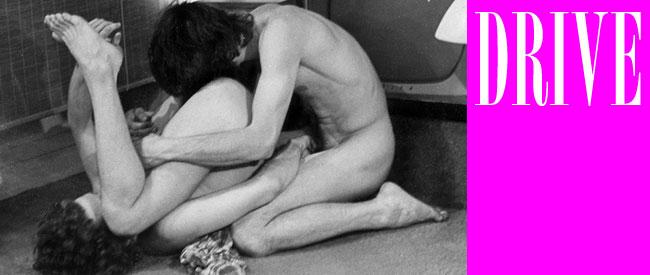
DRIVE-banner DRIVE
Dir. Jack Deveau, 1974
USA, 76 min.

TUESDAY, APRIL 1 – 10:00 PM
WEDNESDAY, APRIL 9 – 10:00 PM
TUESDAY, APRIL 22 – 7:30 PM

Murderous madwoman Arachne plots to kidnap a scientist who has developed a drug that eradicates the sex drive, in a scheme to rid the world of sex. Featuring a cast of fifty, authentic disco settings, secret agents, Dietrich impersonation, a gorilla suit, castration, and extreme fisting.

[Trigger Warning: problematic transgender representation.]


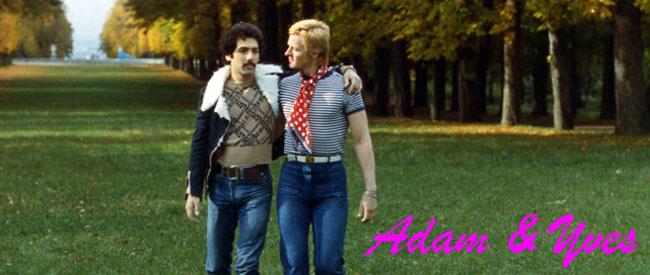
yves-banner ADAM AND YVES
Dir. Peter de Rome, 1974
USA, 90 min.

WEDNESDAY, APRIL 2 – 10:00 PM
TUESDAY, APRIL 8 – 7:30 PM
SUNDAY, APRIL 20 – 7:30 PM

“Well hung, slung from the fork of the muscular legs, the firm vase of his sperm like a bulging pear cradling his handsome glans, two Herculean eggs, swung as he came towards me, shameless, bare.” – extract from “The Platonic Blow” by W.H. Auden, the entire text of which features prominently in this film.

Full of dramatic, artful representations of male beauty and pleasure, leisurely Paris cafe conversations, and romance by firelight, this film contains the last known footage of Greta Garbo (walking in the street!). Plus an interracial bathroom orgy.


IDOL-banner THE IDOL
Dir. Tom DeSimone, 1979
USA, 85 min.

SUNDAY, APRIL 6 – 7:30 PM
TUESDAY, APRIL 15 – 10:00 PM
THURSDAY, APRIL 24 – 10:00 PM

Told in flashback from a funeral, THE IDOL is a romantic delight. Hunky, straight college athletes long for one another, screw in the showers and fall in love. Jockstraps, repressed desires, questionable coaching methods, outstanding musical choices and one truly bizarre hairstyle. Love is in the air.

bijouclassics_spectacle_banner_72dpi

NOUVEAU ROMAN CINEMA: MARGUERITE DURAS

duras-banner-3In Observation of the Marguerite Duras Centennial

This month Spectacle introduces NOUVEAU ROMAN CINEMA, a bimonthly throughline of series exploring the exchange between cinematic art and the nouveau roman of the 1950’s and 60’s. Though many of its writers are known for their collaborations with established arthouse quantities like Alain Resnais or Wim Wenders, the selections emphasize efforts in which the authors direct their own material — either self-adaptations or works created directly for screen — or are otherwise inextricably part of the film’s cinematic authorship.

While selecting the most illuminating instances of the nexus between literary and cinematic style, the choices also err on the side of the obscure and under-seen. Many of the works will be newly translated or subtitled specifically for these screenings.

Upcoming screenings will spotlight the work of Alain Robbe-Grillet, Nathalie Sarraute, Peter Handke, and Georges Perec.

MARGUERITE DURAS
Destroy She Said (1969) • India Song (1975) • Le Camion (1977)
Baxter, Vera Baxter (1977) • Agatha et les lectures illimitées (1981)

The most prolific of all Nouveau Roman author/filmmakers, Marguerite Duras’s (b. April 4, 1914) career behind the camera has been unfairly overshadowed by Robbe-Grillet’s titillating arthouse provocations and her own Oscar-nominated screenplay for Resnais’s HIROSHIMA, MON AMOUR. It was on the latter that she received her greatest initial exposure to the film industry. (Previously, René Clément had adapted her novel THE SEA WALL for the screen as THIS ANGRY AGE.)

Between 1967 and 1985, Duras directed 19 films: primarily features, plus a number of shorter featurettes and four short films. Throughout these she established recurring collaborations with luminaries of French cinema including Gérard Depardieu, Delphine Seyrig, Bulle Ogier, and Michael Lonsdale, plus then-assistant director Benoît Jacquot and cinematographers Bruno Nuytten and Pierre Lhomme.

Beginning with debut feature DESTROY SHE SAID, which was a hit at the seventh New York Film Festival and subsequently included in Amos Vogel’s Film as a Subversive Art, Duras rethought all recognizable cinematic conventions in both form and storytelling. During this period there was a reciprocal exchange between the films and their printed counterparts, whether in the form of novels, stage plays, or hybrid forms — and between the content of the works themselves. One might say this is foreshadowed in a work like DESTROY SHE SAID, one of the great post-1968 comedown works in French cinema, in which the characters gradually seem to assume ambiguous, shifting identities and social/romantic relationships; the camera wanders off expected course, and phantom sounds suggest presence where the camera displays its lack.

Duras’s masterpiece INDIA SONG is the consummate realization of a technique she had previously experimented with WOMAN OF THE GANGES in which the image and soundtrack are dissociated, featuring narration rather than syncronized dialog. The technique is later taken to more minimal extremes in the breathtaking AGATHA ET LES LECTURES ILLIMITÉES, which features only two characters whose disembodied voices plea directly toward each other though they appear silent and alienated within the frame. In between, the Palme d’Or-nominated LE CAMION blurred fiction and documentary, narrative and essay unlike any film before or since. And we’re also pleased to show BAXTER, VERA BAXTER, a rarely seen gem among Duras’s filmography, pairing Depardieu and Seyrig.

Subtitled prints of Duras’s films are extraordinarily rare, and no subtitled versions are available on home video anywhere in the world. Therefore, subtitles have been prepared especially for these screenings, which are timed to coincide with Duras’s 100th birthday, April 4, 2014.

In presenting this series, we are indebted to the generosity of Duras’ son, Jean Mascolo. Many special thanks also to Michèle Kastner and Carolyn Lazard.


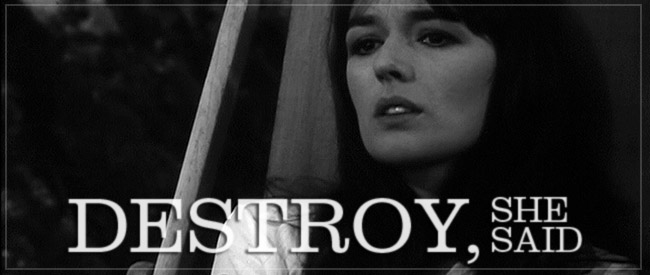
DURAS-DESTROY-BANNER DESTROY SHE SAID
(Détruire dit-elle)
Dir. Marguerite Duras, 1969
France, 93 min.
In French with new subtitles by Spectacle.

FRIDAY, APRIL 4 – 10:00 PM
THURSDAY, APRIL 17 – 7:30 PM
TUESDAY, APRIL 29 – 10:00 PM

“…a hypnotic film about five alienated people isolated in an otherworldly hotel. Enmeshed in ritualistic power games, they continuously exchange personalities as each acts out his own ambiguous charades. A highly stylized, non-logical dialogue creates enigmatic fear; long, uninterrupted takes and the absence of close-ups evoke ennui and distance.”
-Amos Vogel, “The Destruction of Plot and Narrative,” Film as a Subversive Art

The following is stated by Duras in a 1969 interview with Jacques Rivette and Jean Narboni:

Can I read you what I say in the trailer? I’m going to read it, someone asks me the question:

Q: “Where are we?”
A: “In a hotel, for example.”

Q: “Could it be some other place?”
A: “Yes. It is up to the viewer to choose.”

Q: “Don’t we ever know what time it is?”
A: “No, it is either nighttime or daytime.”

Q: “What’s the weather like?”
A: “It’s a cold summer.”

Q: “Is there anything sentimental about it?”
A: “No.”

Q: “Anything intellectual?”
A: “Perhaps.”

Q: “Are there any bit players?”
A: “They have been eliminated. The word ‘hotel’ is said, and that ought to be enough to represent a hotel.”

Q: “Is it a political film?”
A: “Yes, very much so.”

Q: “Is it a film where politics are never spoken of?”
A: “That’s right. Never.”

Q: ”I’m completely lost now… What do you mean by ‘capital destruction’?”
A: “The destruction of every power …”

I’m perhaps going to change that a little …

A (con’t): “the destruction of all police. Intellectual police. Religious police. Communist police.”

Q: “What else?”
A: “The destruction of memory.”

Q: “What else?”
A: “The destruction of judgment.”

Q: “What else?”
A: “I am in favor of … closing schools and universities, of ignorance …”

I added the word “obligatory,” but this would amount to decreeing something. I go on:

A (con’t): ”I’m in favor of closing schools and universities. Of ignorance. Of falling in line with the humblest coolie and starting over again.”

Q: “Well, I’m going to … Is it a film that expresses hope?”
A: “Yes. Revolutionary hope. But at the level of the individual, of inner life. Without which … look around you. It is completely useless to make revolutions.”

-Marguerite Duras

“The dramatic power of the film, and its way of haunting one for days, are not surprising; what is, however, is the degree of visual virtuosity that Mme. Duras achieves. In short, here is a ‘difficult’ film which more than compensates for the demands it makes on the viewer.”
-Richard Roud, The Guardian

“I’m not sure that I can reasonably explain the pleasure I take in Marguerite Duras’s DESTROY SHE SAID.”
-Roger Greenspun, The New York Times


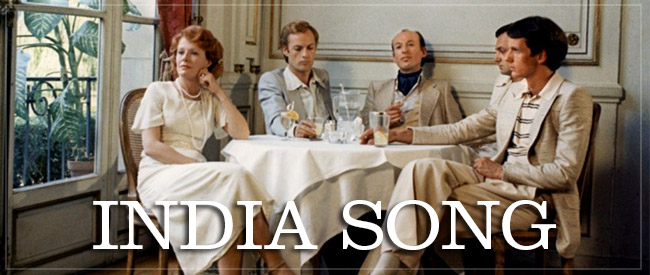
DURAS-india-BANNER INDIA SONG
Dir. Marguerite Duras, 1975
France, 111 min.
In French with new subtitles by Spectacle.

FRIDAY, APRIL 4 – 7:30 PM
SATURDAY, APRIL 12 – 7:30 PM
MONDAY, APRIL 14 – 7:30 PM
TUESDAY, APRIL 22 – 10:00 PM

“INDIA SONG is a film that presents a reflection and re-reflection of itself. It devours both its dead self and repeats and devours the interior space which Duras presents.”
-Gill Houghton

Duras’s most highly regarded masterpiece is a romantic phantasmagoria set in the French Embassy amid a reimagined colonial India circa 1937. Lacking synchronized sound, its narrative unfolds through a multiplicity of voices presumably belonging to the mute figures on screen. They speak of a doomed love affair between Anne-Marie Stretter (Delphine Seyrig) and her lover, Michael Richardson (Claude Mann), and a number of other admirers — amid, we’re told, the smell of flowers and leprosy. A shrine to Stretter surrounding by smouldering incense signifies that it’s not necessarily the present being narrated, but a tragic past. Like Duras’s celebrated screenplay for HIROSHIMA, MON AMOUR, INDIA SONG skeptical of its own historical representation, in this case of European colonialism; and yet is a formally and structurally far more radical work. The film’s folding of time and space, living and dead, night and day, interior and exterior has variously been compared to an “echo chamber” or a consuming, vampiric form of cinema. Amy Taubin has declared it one of the greatest films ever made, and Molly Haskell has described as “the most feminine film I have ever seen, … a rarefied work of lyricism, despair, and passion, … imbued with a kind of primitive emotional hunger.”

Preview the film’s title song, lyrics by Marguerite Duras, arranged by Carlos D’Alessio, and performed by Jeanne Moreau:

[soundcloud url=”https://api.soundcloud.com/tracks/5591707″ params=”color=000000&auto_play=false&hide_related=false&show_artwork=true” width=”100%” height=”166″ iframe=”true” /]


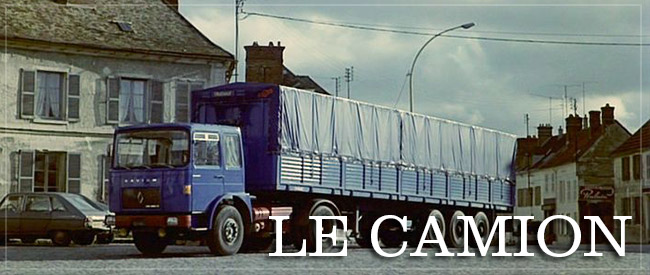
camion-banner LE CAMION
Dir. Marguerite Duras, 1977
France, 76 min.
In French with English subtitles.

SUNDAY, APRIL 13 – 5:00 PM
THURSDAY, APRIL 17 – 10:00 PM
MONDAY, APRIL 21 – 7:30 PM
SATURDAY, APRIL 26 – 7:30 PM

“Remarkable for its precise balancing of interior and exterior, sound and image … a conceptual and comic road movie.”
-Amy Taubin, Artforum

Nominated for the 1977 Palme d’Or, Duras’s LE CAMION blends fiction and documentary, narrative and essay. In this minimal, nocturne feature, Depardieu and Duras sit at a nondescript table reading the script for an unrealized film about long distance truck drivers. Throughout, images of lorries moving through French landscapes.

“One of Marguerite Duras’ most radically minimalist features, this also happens to be one of her best, as well as one of her most accessible.”
-Jonathan Rosenbaum


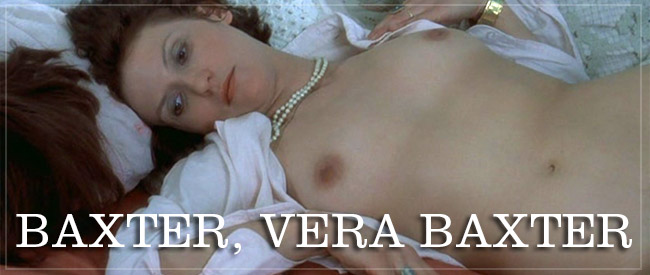
baxter-banner BAXTER, VERA BAXTER
Dir. Marguerite Duras, 1977
France, 91 min.
In French with English subtitles.

SATURDAY, APRIL 12 – 10:00 PM
MONDAY, APRIL 21 – 10:00 PM
TUESDAY, APRIL 29 – 7:30 PM

“A thousand years ago, it is said that there were women in the forests that fringed the Atlantic. Their husbands were nearly always a long way off , fighting for their lord or on a crusade, and they were sometimes alone for months waiting in their huts in the middle of the forest for their men to return. That was how they ended up talking to the trees, the sea and the animals of the forest. They were called witches. And they were burned. One of these women, it is said, was also called Vera Baxter.”

One of Duras’ strangest and most obscure films, BAXTER, VERA BAXTER tells the story of a woman captive to her fidelity to her philandering husband and eventually forced into an adulterous relationship to settle his gambling debt. Though melodramatic in conception, the film is equally as radical and anti-bourgeois as anything Duras had ever done. It essentially takes place in one room between two characters: Vera, played by Claudine Gabay, and an unknown confidant played by Delphine Seyrig, whose questioning teases out the history of Vera’s plight. Approximately 85 of the film’s 91 minutes ride over a bed of Carlos d’Alessio’s score, consisting of only two chords repeated ad infinitum — an alternately maddening and exhilarating exercise.

“A satirical and feminist poem on the death of the bourgeois couple. … Duras pushes the spectators to their limits.” -Laura Adler, Marguerite Duras: A Life


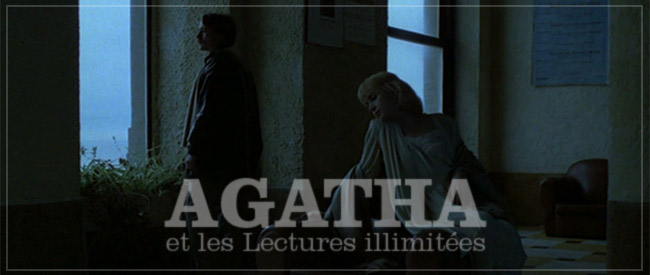
duras-agatha-banner AGATHA ET LES LECTURES ILLIMITÉES
Dir. Marguerite Duras, 1981
France, 83 min.
In French with new subtitles by Spectacle.

WEDNESDAY, APRIL 9 – 7:30 PM
MONDAY, APRIL 14 – 10:00 PM
SUNDAY, APRIL 27 – 7:30 PM

“We see a man and a woman. They are silent. In the drawing room there are two travelling bags and two overcoats, but in different places. They have therefore come there separately. They are thirty years old. One might say they look alike.” -from the text

“In AGATHA, incest, the last middle-class taboo, is not at all experienced as a crime.”
-Michel Mesnil

Among the most resolutely minimalist narrative features ever made, the breathless and beautiful AGATHA ET LES LECTURES ILLIMITÉES is an interior exploration of an incestuous relationship between brother and sister who have convened to share final, parting words on their affair. Continuing Duras’s earlier work with disembodied narration, the film’s images consistent entirely of stark compositions and stunning tracking shots within the vacant lobby and surrounding environs of a seaside hotel on the Normandy coast. In wistful stream of elliptical voiceover, the two characters speak of past incident, current current circumstance, personal revelation. Occasionally, an actress and actor representing the longing siblings appear silently and reflectively within the frame. At once enrapturing and coolly distant, AGATHA folds text, photography, location, performance, editing, and music into a unique kind of narrative total cinema that quietly, assuredly disregards all storytelling conventions.

The woman on screen is portrayed by Bulle Ogier, a recurring cast member of Duras and Jacques Rivette, and voiced by Duras herself. The unnamed brother is both depicted and spoken by Yann Andréa, a platonic companion and subsequent key collaborator of Duras who had recently become acquainted with her through admiring correspondence. When the pair met, Duras fell in love with the forty-years-younger Andréa, but despaired to learn of his homosexuality. Her unrequited longing for Andréa is said to inform the tone of AGATHA’s text.

As a bit of trivia: a conspicuous name in the barebones credits, unpublished on IMDb, is second assistant cameraman Darius Khondji, the Persian-French cinematographer of Se7en, City of Lost Children, and Amour. This places Agatha as his earliest screen credit, and the haunting, muted look of the film may very well have influenced his subsequent work.

MARCH MIDNIGHTS

SATURDAY, MARCH 1: MORON MOVIES

FRIDAY, MARCH 7: LET ME DIE A WOMAN
SATURDAY, MARCH 8: EVERYTHING IS TERRIBLE

FRIDAY, MARCH 14: A NIGHT TO DISMEMBER
SATURDAY, MARCH 15: SLAYGROUND

FRIDAY, MARCH 21: THE BRUTE MAN
SATURDAY, MARCH 22: ORIGINAL SINS

FRIDAY, MARCH 28: GO DOWN DEATH
SATURDAY, MARCH 29: GO DOWN DEATH


Feeling left out? Can’t find common ground with your kids during those long, awkward dinners of meatloaf and self-loathing? Criminally unversed in the works of David A. Prior? Missing all those CANDY SNATCHERS references around the water cooler? Be honest, would you even be able to recognize an INTREPIDOS PUNK if you saw one?

Feeling woozy, it’s getting dark, this is the end…

NOT QUITE.

Spectacle Presents MANDATORY MIDNIGHTS (aka Turkish Netflix)! Fall in love for the first time or all over again with the best of Spectacle Midnights! Every month The Spectacle is showcasing one of our beloved midnight classics like ROCK N ROLL HOTEL, KILLER WORKOUT, HOLOGRAM MAN and so many MORE!!! Don’t yawn your way through another screening of Rocky Horror, half heartedly throwing rice and lip syncing through tears of boredom. Come get kicked in the chest by the AMERICAN HUNTER and lose a quart of blood to a BLOODSUCKER FROM OUTER SPACE!

You haven’t seen a Spectacle Midnight until you’ve seen it twice! Come Get Weird and Stay Weird at MANDATORY MIDNIGHTS!

MANDATORY MIDNIGHTS presents:

MoronMoviesBanner MORON MOVIES
Dir. Len Cella, 1985
USA, 58 min.

SATURDAY, MARCH 1 – MIDNIGHT

Sometime between “The Table’s Turned on the Gardener” and “The Hangover” came Len Cella’s MORON MOVIES. These really short films prefigure YouTube while recalling the gag films of early cinema. Originally shown on the Tonight Show and eventually on TV’s Bloopers & Practical Jokes, MORON MOVIES constitute an unparalleled cinematic joke book. Len Cella stars in his own micro masterworks (most clocking in under a minute) and imbues each with his own curmudgeonly outlook and grouchy charm. Crude, absurd, clever, brief, and absolutely hilarious — The Spectacle is proud to present the work of a great American humorist and filmmaker, Len Cella’s MORON MOVIES.
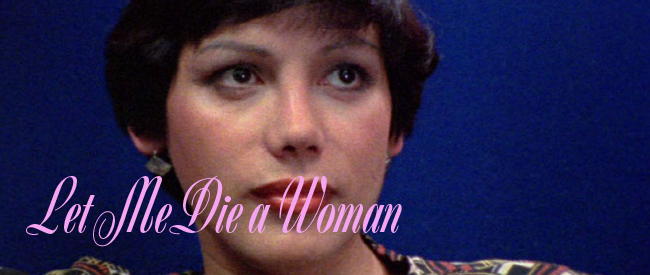


WOMAN BANNER LET ME DIE A WOMAN
Dir. Doris Wishman, 1977
USA, 79 min.

FRIDAY, MARCH 7 – MIDNIGHT

Wishman’s sole foray into non-fiction is a disorienting, explicit, forward-thinking time capsule of sex-changes in the 70s. Combining interviews with noted surgeon Dr. Leo Wollman and his patients, soft porn dramatic re-enactments, and graphic surgery footage, LET ME DIE A WOMAN manages to be both exploitive and enlightening. Amidst its sleazy shocks and ramshackle sets, the subjects’ sincere desire to tell their story earns our genuine empathy. Like all of Wishman’s films, WOMAN is one of a kind, and must be seen to be believed.

Courtesy of Something Weird Video.


EIT_bannerTHE RISE AND FALL OF GOD
Dir. Everything is Terrible!, 2013
USA, 60 min.

SATURDAY, MARCH 8 – MIDNIGHT

In our short time on this planet, Spectacle has played host to a veritable Who’s Who of Who On Earth? type guests – bodybuilding computer hackers, stop-motion royalty, literal Oscar winners, sonic gurus, political revolutionaries, etc. – and now, we can add one more to that list as we welcome the found footage titans of EVERYTHING IS TERRIBLE! for the New York premiere of their cut-and-paste sermon THE RISE AND FALL OF GOD!

Join us for an evening of deep spiritual reflection as we examine the apocalypse, eternal punishment, images of the divine in everything from snack food to slop buckets. EVERYTHING IS TERRIBLE! takes the wheel for an entire evening of guilt and death bed recanting.

See you in Hell.

Everything Is Terrible! is this world’s only psychedelic found footage comedy website that tours the earth with face-melting live shows that include puppets, Jerry Maguires stacked to the heavens, and adoring cloaked followers begging EIT! for more!

Find DVDs, the Daily Terrible, and more at everythingisterrible.com
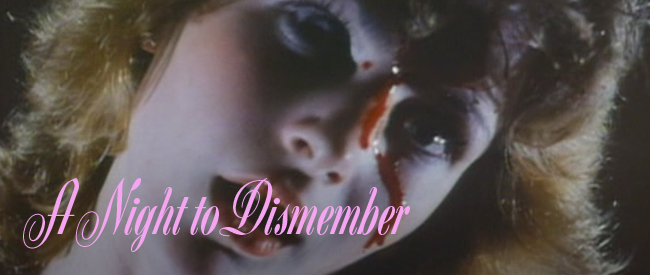


DISMEMBER BANNERA NIGHT TO DISMEMBER
Dir. Doris Wishman, 1983
USA, 69 min.

FRIDAY, MARCH 14 – MIDNIGHT

It’s almost impossible to adequately explain the effect A NIGHT TO DISMEMBER has on the brain. Wishman had completed her first foray into 80s horror when the processing lab declared bankruptcy and a disgruntled employee destroyed most of the footage. Contractually bound to distributors, she finished the movie by any means necessary – using every frame of the remaining footage, re-writing the script, and shooting new scenes. What remains is a singular achievement in the history of motion pictures. It’s a non-stop, blood-soaked, nudity-packed assault on the senses, and like all great train wrecks, it’s impossible to look away.


Slayground_banner

SLAYGROUND
Dir. Terry Bedford, 1983
US/UK, 89 min.

SATURDAY, MARCH 15th – MIDNIGHT

Kinda-but-not-really adapted from a novel by noir hero Donald Westlake (alias Richard Stark), you can see three different movies cannibalistically clawing at each other in Terry Bedford’s Slayground : a gritty potboiler, a moody midlife relationship drama, and a slasher picture. After putting undue faith in an untested getaway driver who ends up flip-crashing into an Oldsmobile carrying an innocent young girl, Stone (Peter Coyote) flees the United States. But the victim’s industrial hockey magnate father calls up some dodgy underworld contacts, and soon the worst of the criminal worst are seeking retribution for her life. It doesn’t take long for Stone to realize he’s about three names down the list.

Stone successfully fakes his own death, but it makes no difference. As he hides out in the UK, the screenplay assumes Stone’s struggle to find the meagerest shred of an identity – any identity, let alone one worth preserving. The final showdown takes place at a derelict amusement park, where Stone’s estranged friend Terry (Mel Smith) leads him in the hopes that the men will be able to reconnect – but they’re not alone. Between the lines of dialogue conspicuously missing from the characters’ conversations – probably cut to make more room for car chases and murder scenes – and the intensity of its jerry-rigged brutality, Slayground adds up to a breathtaking monument to grotesquerie, hopelessness and nihilism. Like a giallo remake of Fritz Lang’s Scarlet Street vomited through an old VCR, the film will linger in your mind late at night for its bookending, psychedelic-action set pieces.


brute man_banner THE BRUTE MAN
Dir. Jean Yarbrough, 1946
USA, 58 min.

FRIDAY, MARCH 21 – MIDNIGHT

Never has the callous disregard for human tragedy backfired so magnificently. Hired to play the eponymous lead character because of his grotesque facial deformities, star Rondo Hatton winds up delivering a subtle, soulful performance—the actor adding much shading and depth that was obviously not in the script compared to the rest of the movie.

Hatton is the only character who feels “real”—everyone else is a wiseacre (especially the cops), a stiff bourgeois suburbanite, a saint, or a damn fool. Meanwhile, like with all good serial killer flicks, The Brute Man stacks the deck against the victims: Never are they kind or decent people, but snooping and meddling jerks that deserve to get their necks snapped.

In this bleak (but fun) noir-horror mash-up, a series of brutal murders—with the victims’ spines crushed—has paralyzed a city with fear, and the police are clueless. They know the killer is ‘The Creeper’, but have no idea where the hideously ugly maniac could be. When the majority of victims are found to be old college pals, the authorities suspect someone from their past seeking revenge…

Like Tod Browning’s FREAKS or Michael Winner’s THE SENTINEL or some of Coffin Joe’s movies, 1946’s THE BRUTE MAN is sleazy and exploitative—in other words, wonderful—in how it uses genuine human deformity for our entertainment and sick fascination, if not our empathy and relief.

In this case, star Rondo Hatton (RIP, 1894-1946), whose infamous mug was courtesy of the disease acromegly (a pituitary gland disorder), had acting ability that was genuine, guileless and directly from the soul. His inner pain turns the tables, making the murderer the most sympathetic character in the film.

Hatton’s character’s authenticity is solidified by his ‘mad love’ for a blind chick he meets while hiding out in her apartment. His dialog with her is contradictory and obtuse, but the way it is delivered is exquisite: dopey scripting approaches the level of intricate Mamet inarticulateness, and the overall screenplay begins to feel as if Charles Bukowski had a hand in it, with Hatton’s merciless assassin coming off like a slightly more-homicidal/less-alcoholic Henry Chinaski, a lonely, ugly but sensitive slob/everyman (living below Skid Row!), at odds with the world and only wanting to be left alone—left alone so he can kill!

Meanwhile, the flick’s zero budget engenders an artlessness that becomes a strict formalism—a dream-like aspect increased by the relentless use of stock (or recycled) footage in a variety of neo-montages. And at only 58 minutes, man-oh-Manischewitz, does this picture move! Blink, and you’ll miss the ending!

The last film of Rondo Hatton’s long career, THE BRUTE MAN was originally produced by Universal, but unceremoniously dumped by the studio after the actor’s death. They were already under fire for ‘exploiting’ Hatton’s deformity, and didn’t want any more hassles.

Celebrate B-movie deity Rondo Hatton at the Spectacle at Midnight! Or else The Creeper might get you…
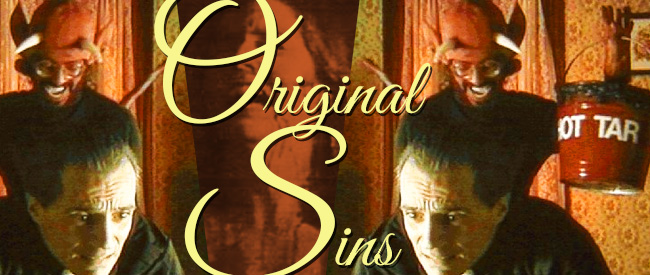

ORIGINAL_SINS_BANNER

ORIGINAL SINS
Dir. Howard S. Berger & Matthew M. Howe, 1996
Italy/USA, 108 min.
In English.

SATURDAY, MARCH 22 – MIDNIGHT

HOSTED BY SCOOTER MCCRAE!

“What can I say about ORIGINAL SINS that will make you, dear potential viewer, realize that you NEED to see this insanely bizarre, once-in-a-lifetime cinematic festival of atrocious taste (graced with a magnificently dark sense of humor) made by talented moviemakers with ZERO sense of social responsibility?  I’m loathe to get too specific with plot points as I’m not a spoiler-heavy kinda’ guy, but if you’ve ever wanted to see a movie where a trio of lovely religious ladies become naked sex slaves to a Jesus apparition, a crummy death metal band summon a furiously frivolous demon from Hell for reasons too stupid for me to type (did I mention that yours truly plays said demon?), and NOTHING is considered too sacred to be metaphorically ass-raped before your disbelieving and sin-drenched eyeballs (oh good lord, the comatose girl….!), then ORIGINAL SINS is the depraved no-holds-barred double-barreled blast of low-budget moviemaking FUCK YOU that you need to experience in a room full of people so you can just keep on repeating (to comfort your immortal soul before it thumps its way into the lowest portals of Hell) ‘it’s only a movie…. It’s only a movie…….!’

Still not enough for you?  This fucking monstrosity was banned from video release in the U.K. for three consecutive years before it was finally released over there (with a little bit more than 6 minutes chopped out of it).  And it damn near caused a riot at the FantaFestival in Rome back in 1994 after a chaotic sold out screening that led to a second screening needing to be added to appease the angry crowds.  Was the Pope himself in attendance?  I cannot be sure as I was not there myself, but since he’s long since dead I can only assume he was present (even if it finally took 11 years for John Paul II to pass on).

Released on video in the U.S. by Something Weird Video for a short window of time back in 1996, it quickly disappeared and has never been available here ever since. This rare screening will feature at least one of the two writer/directors in attendance (there’s a chance, schedule permitting, that they will both be attending), and I will be there as well to help answer whatever questions you might have about the whole sordid and wonderful production.  If you’ve attended past events I’ve hosted at the Spectacle, you’ll know what to expect in terms of attitude, enjoyment and refreshments.  Looking forward to seeing you there- if you dare!” -Scooter McCrae
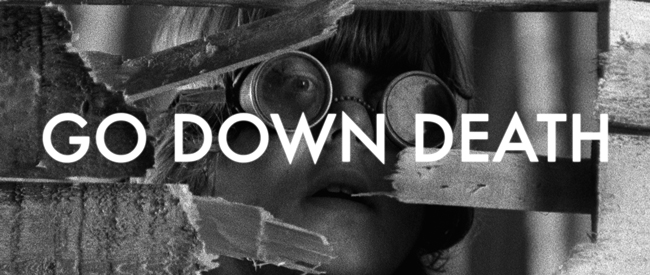


Go Down Death

GO DOWN DEATH
Dir. Aaron Schimberg, 2013
USA, 87 min.

ONE WEEK WORLD THEATRICAL PREMIERE RUN!
FRIDAY, MARCH 28 – THURSDAY, APRIL 3, 2014
CLICK HERE TO PURCHASE TICKETS

FRIDAY, MARCH 28 and SATURDAY, MARCH 29
10:00 PM (Filmmakers in attendance!) and MIDNIGHT (In SMELL-O-VISION!)

For its first–and only?–narrative feature run, Spectacle is pleased to present Aaron Schimberg’s staggering debut feature GO DOWN DEATH. Acclaimed as one of the most distinctive, visually stunning, and greatest undistributed films of the past year, it sits uneasily among rote indie festival programming. Naturally, we feel we make a great pair.

GO DOWN DEATH is a wry, sinister realization of a strange new universe, a cross-episodic melange of macabre folktales supposedly penned by the fictitious writer Jonathan Mallory Sinus. An abandoned warehouse in Greenpoint, Brooklyn, stands in for a decrepit village haunted by ghosts, superstition, and disease, while threatening to buckle under rumblings of the apocalypse. Soldiers are lost and found in endless woods; a child gravedigger is menaced by a shape-shifting physician, a syphilitic john bares all to a young prostitute, and a disfigured outcast yearns for the affections of a tone-deaf cabaret singer. Highlighted by offbeat narrative construction, stunning black-and-white 16mm cinematography and immaculately detailed production design, GO DOWN DEATH is a distinctively original film informed by American Gothic, folk culture and outsider art.

Accompanying the weeklong run will be appearances by writer/director Aaron Schimberg, producer/editor Vanessa McDonnell, and other surprises and performances including a pair of live SMELL-O-VISION midnights concocted specially for Spectacle’s audiences.


CRITICAL PRAISE FOR GO DOWN DEATH

#1 Best Undistributed Film of 2013
– Christopher Bell, IndieWire’s The Playlist

“An astonishing, out-of-nowhere film. Amidst all the cookie-cutter indies, Aaron Schimberg’s GO DOWN DEATH casts a mysterious spell. A dreamy, highly stylized affair recalling early David Lynch. Highly recommended.”
– Scott Macaulay, Filmmaker Magazine

“A unique, strange, unforgettable film, a half-remembered dream that will trouble and beguile the subconscious long after you’ve moved on. (A-)”
– Gabe Toro, IndieWire’s The Playlist

“One of the best films of the year! An uncompromising feast of vision and atmosphere.”
– Kentucker Audley, NoBudge

“Robert Altman meets Tod Browning…an immaculate, offbeat triumph. Rarely do homespun independent filmmakers convey such a distinctly original vision.”
– Jon Dieringer, Screen Slate

“Irresistible! Evokes the great novels of William Faulkner, even as GO DOWN DEATH offers us a resolutely modern filmic experience. Schimberg appropriates the language of cinema and obeys only the rules he sets out for himself. The result is a thrilling leap into the unknown.”
– Simon Laperrière, Fantasia

“GO DOWN DEATH is as eccentric and daring as American indie cinema gets.”
– Matthew Campbell, Starz Denver


FEMINIST HOLLYWOOD TAKEOVER

FHT banner

Feminist Hollywood Takeover is a series of shorts by female filmmakers who have deconstructed the predictable roles we tend so fondly remember when we think of old Hollywood films. Daringly, each film rebels against the tired archetypes of the mammy, tragic heroine, and hetero-glamourpuss comprising a joint rejection of oppressive stereotypes, and starring some of the most iconic Hollywood starlets to grace the silver screen.

Special thanks to Women Make Movies!

MONDAY, MARCH 10 – 7:30 PM
FRIDAY, MARCH 14 – 7:30 PM
WEDNESDAY, MARCH 19 – 10:00 PM

LIP
Dir. Tracey Moffatt, Edited by Gary Hillberg, 1999
Australia, 10 min.

Australian artist, Tracey Moffatt, takes aim at Hollywood’s portrayal of black women in a cheeky montage of (surprise) maids throughout film history. Moffatt recontextualizes your favorite actresses as pegs in a machine of oppressive stereotyping and bigotry, in this strangely hilarious short, which sheds a familiar yet refreshing light on #whitegirlproblems. With clips including a young Elizabeth Taylor, Barbra Streisand, and Patty Duke, among others, LIP is like a trip down memory lane with modern criticism instead of nostalgia.

THRILLER
Dir. Sally Potter, 1979
UK, 34 min.

Performance artist, experimental filmmaker, composer, dancer, and general badass Sally Potter eschews the typical Hollywood narrative with a deconstruction and rewriting of Puccini’s LA BOHEME. A staple of feminist film theory, THRILLER is one of Potter’s first international successes as a filmmaker in a career that includes such undertakings as ORLANDO and YES. In Potter’s version of Puccini’s legendary opera, Mimi, the tragic heroine who is supposed to die by the end of the opera, is granted the agency to question her own life story and the reasons behind her death. She juxtaposes her own role in the story with that of her female foil, Musetta, the “easy” woman, and challenges the idea that the “good” girl should always be youthful, weak and distressed.

MEETING OF TWO QUEENS
aka Encuentro entre dos reinas
Dir. Cecilia Barriga, 1991
Spain, 14 min.

Cecilia Barriga’s culty video montage tells the story of two queens who fall in love, unwittingly played by Marlene Dietrich and Greta Garbo. Clipped from their most iconic works, the Chilean born video artist manipulates scenes from the legendary actresses to turn two of the most well known Hollywood starlets in film history into a silent-film style lesbian fantasy. Barriga drives the narrative using common motifs such as the cigarette and the one-eyed glance from beneath a wide brimmed hat, motifs which are familiar to us, but recontextualized within a queer narrative. Major points for including a rainmaker in the soundtrack.