STAY TUNED: An Evening with SMASH TV

smashtvbanner650x275

WEDNESDAY, JULY 24 – 7:30 PM (Memorex) – 10:00 PM (Skinemax)

Join us on Wednesday, July 24th as Smash TV hijacks the Spectacle Theater for a night of AV insanity. We’ll be showing both Memorex and Skinemax, as well as debuting two new hour+ video mixtapes of our favorite videos after each.

A nostalgic night dedicated to the art of the edit: music videos, mashups, hilarity, terror, insanity, and more! If early 80s MTV and early 2000s Adult Swim had a baby, it would look something like SMASH TV.

Join us for this insane 5 hour marathon. If you’re an 80s kid that grew up glued to the TV set and have a sense of adventure, then STAY TUNED.

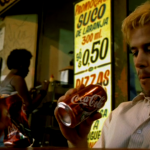
7:30 PM – Memorex is the advertising industry’s collective wet dream. A 50 minute VJ odyssey and a tribute to an entire generation who grew up with only a TV and a VCR for a babysitter.

Sourced from over forty hours of 80s commercials pulled from warped VHS tapes, Memorex is a deep exploration of nostalgia and the cultural values of an era of excess. It’s a re-contextualization of ads – cultural detritus, the lowest of the low – into something altogether more profound, humorous, and at times, even beautiful.

Digging up long forgotten memories for a generation who spent their formative years glued to the boob tube, Memorex is a veritable nostalgia nuke for children of the 80s. Endless beach parties,Saturday morning cartoons, claymation everything, sleek cars, sexy babes, toys you forgot existed, station idents, primitive computer animation, all your favorite sugary cereal mascots, and so much more. An ode to the hyper consumerism and sleek veneer of a simpler time.

10:00 PM – Skinemax is Koyaanisqatsi for a generation raised on late night television and B-movie VHS tapes. It’s long form entertainment for short attention spans. An hour long VJ odyssey, it will move your body and warp your mind.

A nostalgic look back at a half remembered childhood growing up in the 80s and early 90s, Skinemax takes a close look at the culture of that era. The images that motivated, delighted, and terrified us on the silver screen, set to propulsive modern music that pines for a simpler time.

EPHEMERA: SEX, THE PREDATOR, AND YOU.

EPHEMERA5

EPHEMERA: SEX, THE PREDATOR, AND YOU.
1947-1973.
Approx. 80 min. USA.

THURSDAY, JULY 11 – 7:30 PM
THURSDAY, JULY 25 – 10:00 PM

No outlet served post-war American culture’s ebullient pride and prosperity better than that of the now-infamous educational film. Today these didactic artifacts are relegated to sideshow status by the likes of Pee-Wee’s Playhouse, Weird Al, MST3K and Adult Swim, all of whom freely lampoon such easy targets for their comically dated sensibilities.

Our monthly EPHEMERA program aims to present these documents to a contemporary audience in perhaps a more even light, ideally free from the ironic framing that can easily overwhelm some of their more interesting details. Fortunately… the humor is irrepressible.

July’s installment SEX, THE PREDATOR, AND YOU focuses on the common themes of adolescent sexual education and awareness. After a program of didactic shorts that run the gamut from hand-holding to menstruation-training will be the mashup BOYS BE AWARE, a home-made combination of two infamous, classically-homophobic Sid Davis atrocities that use the exact same script: Boys Aware (1973) and Boys Beware (1961). This edit switches between the two liberally, providing an interesting look at how the same piece of undeniably dated writing is manifest in two markedly different eras.

Finishing up the program will be the entirety of the notorious 1964 paranoia-bomb THE CHILD MOLESTER, a PSA so dark and foreboding that it seems equally inappropriate for children, teens, parents and even child molesters.

*WARNING: ‘THE CHILD MOLESTER’ FEATURES EXTREME IMAGERY*

Sources for SEX, THE PREDATOR, AND YOU include: As Boys Grow (1957), Boys Aware (1973), Boys Beware (1961), The Child Molester (1964), Dating Do’s and Don’ts (1949), Going Steady (1951), How Much Affection? (1958), Human Reproduction (1947), Molly Grows Up (1953), Physical Aspects of Puberty (1953), Social-Sex Attitudes In Adolescence (1953), What To Do On A Date (1950).

Special thanks to the Internet Archive, Rick Prelinger and everyone at the Prelinger Archive.

Rick Prelinger began collecting “ephemeral films”—all those educational, industrial, amateur, advertising, or otherwise sponsored—in 1982, amassing over 60,000 (all on physical film) before his Prelinger Archive was acquired by the Library of Congress in 2002. Since then, the collection has grown and diversified: now it exists in library form in San Francisco and is also gradually being ported online to the Internet Archive (http://archive.org), where 4,439 of its films are currently hosted (as of this writing).

Of course, the content of the Prelinger Archive’s films varies in accord with the variety of mankind. Historic newsreels, mid-century automobile infomercials, psychological experiments, medical procedurals, big oil advertisements, military recruitment videos, political propagandas, personal home videos, celebrity exposes, amateur narratives, scientific studies, war bulletins, instructional films, special interest op-eds, safety lessons, hobby guides, travel destination profiles and private industry productions all sit comfortably together in one marginalized category.

JULY MIDNIGHTS!

 See also our July J.R. BOOKWALTER Midnight Series!

SATURDAY JULY 13th

TNT JACKSON
Dir: Cirio H. Santiago, 1974.
72 min. USA.

A staple of the early 70s drive-in circuit, TNT JACKSON was schlock producer kingpin Roger Corman’s attempt to cash in on the blaxsploitation craze and remains a fitting example of the kung fu craze muscling its way into every 70s genre.

Martial arts expert Diana ‘TNT’ Jackson travels to Hong Kong to search for her brother’s killer. She soon discovers an underworld heroin smuggling operation that may lead her to the murderer.  Will she karate chop her way through an army of henchmen and come face-to-face with her brother’s assailant?

Starring afro-haired ass-kicker Jean Bell (the first African American Playmate) in a script originally written by legendary character actor Dick Miller (before Corman had it rewritten), the film makes zero attempts at production values and plot imagination (essentially the same setup as SISTER STREET FIGHTER) but does features a criminal amount of funky 70s wardrobes, cheesy kung-fu ‘whooshes’, and a completely illogical topless fight scene that ranks at the top of exploitation’s most gratuitous, trashy moments.

If Pam Grier is too expensive, then you best call TNT Jackson!


HATCHET-BANNER

SATURDAY JULY 20th

HATCHET FOR THE HONEYMOON (Il rosso segno della follia)
Dir. Mario Bava (1970)
88 min.
English dub (no subtitles)

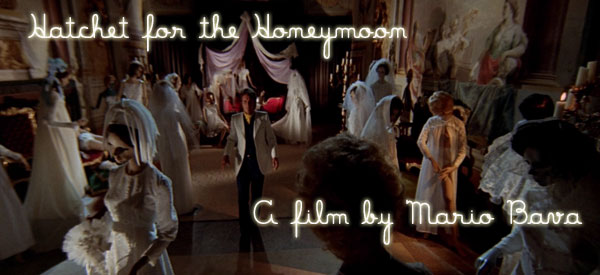
Mario Bava was never one to stick to the rules, even rules he invented himself. Often overlooked due to the lack of murder mystery elements (the killer is revealed at the beginning of the film),Hatchet For The Honeymoon sidesteps giallo tropes in place of dark satire on Italian high society and supernatural elements, all among the backdrop of Bava’s trademark visual style. Stephen Forsyth’s portrayal of a wealthy bridal shop owner driven to murder has since been compared regularly to Christian Bale’s performance in American Psycho — while it may not be the gorehound’s favorite Bava film, it’s perfectly suited for fans of urbane sharp-dressed psychopaths as well as baroque late 60s set pieces. Newly remastered in high-definition from the 35mm print, the film has never looked better, as Bava is both director and cinematographer and the film shows his trademark use of color and symbolism in every frame.


killerworkout-banner

SATURDAY JULY 27th

MANDATORY MIDNIGHTS (aka MIND CURFEW)

presents

KILLER WORKOUT
David A. Prior, 1987
USA 85 min.
English

Feeling left out? Can’t find common ground with your kids during those long, awkward dinners of meatloaf and self-loathing? Criminally unversed in the works of David A. Prior? Missing all those CANDY SNATCHERS references around the water cooler? Be honest, would you even be able to recognize an INTREPIDOS PUNK if you saw one?

Feeling woozy, it’s getting dark, this is the end…

NOT QUITE.

The Spectacle Presents MANDATORY MIDNIGHTS (aka Turkish Netflix)! Fall in love for the first time or all over again with the best of Spectacle Midnights! Every month The Spectacle is showcasing one of our beloved midnight classics like ROCK N ROLL HOTEL, KILLER WORKOUT, HOLOGRAM MAN and so many MORE!!! Don’t yawn your way through another screening of Rocky Horror, half heartedly throwing rice and lip syncing through tears of boredom. Come get kicked in the chest by the AMERICAN HUNTER and lose a quart of blood to a BLOODSUCKER FROM OUTER SPACE!

You haven’t seen a Spectacle Midnight until you’ve seen it twice! Come Get Weird and Stay Weird at MANDATORY MIDNIGHTS!

THIS MONTH…

Summer is here and it’s time to feel the burn with KILLER WORKOUT.

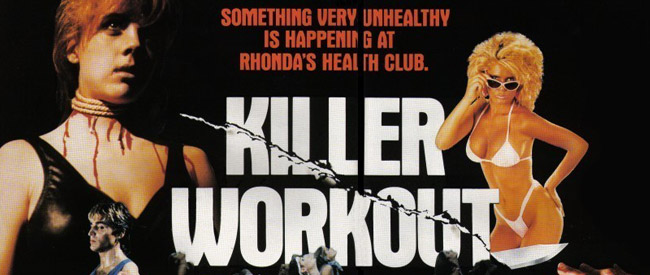
The 1980s will always be remembered more or less for two major contributions toward the betterment of humankind: the slasher film and aerobic exercise-AND NOW MANDATORY MIDNIGHTS HAS BOTH. It took the genius of prolific, high-octane filmmaker David A. Prior(Sledgehammer, Deadly Prey) to make it happen! KILLER WORKOUT is a one stop, high impact cardio assault sure to turn your flabby midnight grey matter into a chiseled mental six pack.

After a freak tanning bed accident kills her sister, Rhonda decides to open Rhonda’s Workout- a fresh and fun aerobics studio where the buff get buffer and the beautiful get beautiful-er…that is until they start getting dead! There’s a killer loose and it’s up to a grizzled, world weary Detective (David James Campbell) to stop the maniac before Rhonda’s out of customers. What follows is a game of cat and mouse with more twists than a Zumba class, and an ending that you won’t ever forget!

KILLER WORKOUT is more insane and high energy than P90x and it’s got the infectious throbbing soundtrack and pelvises to ensure you’ll never look at your Bowflex the same way again. This is the ultimate oiled up, tanned, toned, aerobic slasher film with a message: hitting the gym can be hazardous to your health.

Come get RIIIIPPPPEEEDD at THE SPECTACLE, only at MIDNIGHT!

EXHAUSTED

exhausted-banner

EXHAUSTED
Dir. Kim Gok, 2008.
USA. 128 min.
Korean with English subtitles.

FRIDAY, JULY 12 – 7:00 PM
FRIDAY, JULY 19 – 7:00 PM
TUESDAY, JULY 30 – 10:00 PM

An unnamed pimp and semi-retarded prostitute live in a dive apartment on the outskirts of a destitute, unnamed, post apocalyptic South Korean city. They have a domestic routine of sorts, eating cheese sticks and porridge, and taking walks along a dirt- and industry-strewn beach that inevitably turn into fights. Occasionally they post signs that read “We have girl”. Eventually a homely young woman takes notice of the prostitute’s powerlessness, and after one of many escape attempts on the part of the whore, rescues her from her provisional refuge among trashed tires on a beach. But she too has intentions for the young woman that prove to be the most degrading and disturbing of all.

TRIGGER WARNING – Graphic Sexual Violence.

FILM AS A SUBVERSIVE ART: The End of Sexual Taboos

FILM AS A SUBVERSIVE ART: THE END OF SEXUAL TABOOS
(Amos Vogel, 1974)

FRIDAY, JULY 6TH – MIDNIGHT

Can film make revolution? What use is it if it can’t? Film critic Amos Vogel’s seminal work, Film As A Subversive Art, published in 1974, is both an argument for and a catalogue of cinema that refuses, rebels and repulses. Film “designed to eradicate the reactionary values of an establishment that had proven its bankruptcy.”

Vogel died in April 2012. In his honor, Spectacle Theater and The New Inquiry will be hosting a series of talks and screenings, taking selections of many of the near-impossible to see films from his book. July’s screening will feature early animated erotica, some abominable Viennese Actionism, a fairy from the Society For Cutting Up Men, and other arousing anachronisms.

AN INJURY TO ONE

injurybanner

AN INJURY TO ONE
Dir: Travis Wilkerson, 2002.
53 min. USA.

MONDAY, JULY 1 – 10:00 PM
SUNDAY, JULY 21 – 10:00 PM

Courtesy of Icarus Films

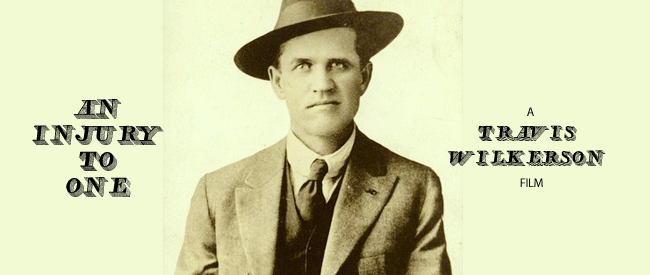
AN INJURY TO ONE provides a corrective—and absolutely compelling—glimpse of a particularly volatile moment in early 20th century American labor history: the rise and fall of Butte, Montana. Specifically, it chronicles the mysterious death of Wobbly organizer Frank Little, a story whose grisly details have taken on a legendary status in the state. Much of the extant evidence is inscribed upon the landscape of Butte and its surroundings. Thus, a connection is drawn between the unsolved murder of Little, and the attempted murder of the town itself.

Butte’s history was entirely shaped by its exploitation by the Anaconda Mining Company, which, at the height of WWI, produced ten percent of the world’s copper from the town’s depths. War profiteering and the company’s extreme indifference to the safety of its employees (mortality rates in the mines were higher than in the trenches of Europe) led to Little’s arrival. “The agitator” found in the desperate, agonized miners overwhelming support for his ideas, which included the abolishment of the wage system and the establishment of a socialist commonwealth.

In August 1917, Little was abducted by still-unknown assailants who hung him from a railroad bridge. Pinned to his chest was a note that read 3′-7′-77″, dimensions of a Montana grave. Eight thousand people attended his funeral, the largest in Butte’s history.

The murder provides AN INJURY TO ONE with a taut, suspenseful narrative, but it isn’t the only story. Butte’s history is bound with the entire history of the American left, the rise of McCarthyism, the destruction of the environment, and even the birth of the detective novel. Former Pinkerton detective Dashiell Hammett was rumored to have been involved in the murder, and later depicted it in Red Harvest.

Archival footage mixes with deftly deployed intertitles, while the lyrics to traditional mining songs are accompanied by music from William Oldham, Jim O’Rourke, and the band Low, producing an appropriately moody, effulgent, and strangely out-of-time soundtrack. The result is a unique film/video hybrid that combines painterly images, incisive writing, and a bold graphic sensibility to produce an articulate example of the aesthetic and political possibilities offered by filmmaking in the digital age. [ICARUS FILMS]

“One of American independent cinema’s great achievements of the past decade.” —Dennis Lim, Los Angeles Times

“An astonishing document: part art and part speculative inquiry, buzzing with ambition and dedication. Takes us from the 19th century to the eve of the 21st, from Butte as land of frontier promise to Butte as land of death and environmental destruction. He wields avant-garde graphics and archival ephemera like a lasso, and his shots of modern-day Butte are allusive still-lifes that defy time and place. This is stirring, must-see stuff.”—Austin Chronicle

“A deft, ambitious exercise in old-school socialist agitprop crafted with the precise mulitmedia flair of a corporate Powerpoint presentation, Travis Wilkerson’s AN INJURY TO ONE retells the gritty class struggles of the previous century through smoothly contemporary digital means.”—The Village Voice

“The most exciting documentary of the season. Passionate, persuasive, and beautifully designed, AN INJURY TO ONE is a model of coherent political filmmaking as convincing in its liberalism as its formalism.”—The New York Sun

“Wilkerson’s austere technique radically responds to the paucity of contemporaneous documentary accounts, performing a powerful act of historical archaeology and reclaiming for the working class its status as subject, not a footnote, of historical events. Wilkerson makes these ghostly historical agents palpable and vocal, asserting the relevance of their story to struggles of today and tomorrow.” —Sundance Film Festival

SK8 NITE 2 with Stale Bagel

ONE NIGHT ONLY

WEDNESDAY, JULY 17TH – 8PM

Spectacle returns for another night of:

S H E N A N I G A N S
S C R A P E S
S W E A R S
T A P E S
C L I P S
F L I P S

as we present SK8 NIGHT 2, hosted by Jayme Lemperle (stalebagel.tumblr.com / ripndip.com). Turn your brain to jello salad as we sift through a cavalcade of all things sk8ing (skating) related. From classic tapes, to Hollywood’s take, to some homegrown heroes. Revel in the spirit of youth and unlicensed popular music! Swap shred stories! Trade decks! Hang out and do whatever!

Jayme Lemperle is a designer and all around cool dude. This is his second skate night at Spectacle. For more of his work please check out: stalebagel.tumblr.com & ripndip.com

POWER & SOCIETY: Two Documentaries by Adam Curtis

curtis_banner

British filmmaker Adam Curtis has been producing documentary works for the BBC for nearly 30 years. Employing collage-film aesthetics towards journalistic ends, his politically subversive works trace complex and unexpected webs of connection between seemingly far-flung historical events.

Curtis has been quoted as saying, “If you ask me what my politics are, I’m very much a creature of my time. I don’t really have any.” Come and decide for yourself, as we present two of Curtis’s films that explore the concept of social control from economic and political perspectives.


century_banner

The Century of the Self
Dir. Adam Curtis, 2002
UK, 240 mins

MONDAY, JULY 8 – 7:00 PM
MONDAY, JULY 22 – 7:00 PM

“This series is about how those in power have used Freud’s theories to try and control the dangerous crowd in an age of mass democracy.” – Adam Curtis

Curtis’s best known and most critically acclaimed work, The Century of the Self traces a thread from the publication of Sigmund Freud’s theories of the mind through their development and exploitation at the hands of his American nephew, Edward Bernays, the founder of public relations, and the resulting creation of the modern “self” as the primary agent of contemporary society.

Originally presented as a four-part mini-series on BBC, we’ll be presenting the film in its entirety with a brief intermission.

Part 1 – Happiness Machines
Part 2 – The Engineering of Consent
Part 3 – There is a Policeman Inside All Our Heads: He Must Be Destroyed
Part 4 – Eight People Sipping Wine in Kettering


nightmares_banner

The Power of Nightmares: The Rise of the Politics of Fear
Dir. Adam Curtis, 2004
UK, 180 mins

MONDAY, JULY 15 – 8:00 PM
MONDAY, JULY 29 – 8:00 PM

“In the past, politicians promised to create a better world. They had different ways of achieving this, but their power and authority came from the optimistic visions the offered their people. Instead of delivering dreams, politicians now promise to protect us from nightmares.” – Adam Curtis

Curtis’s follow-up to The Century of the Self chronicles the simultaneous rise of the neo-conservative and Islamic fundamentalist movements, and how the “War on Terror” was sold to the public through a series of exaggerations and myths.

Originally presented as a three-part mini-series on BBC, we’ll be presenting the film in its entirety with a brief intermission.
Part 1 – Baby It’s Cold Outside
Part 2 – The Phantom Victory
Part 3 – The Shadows in the Cave

THE MAN OF THE YEAR

MOTYbanner

THE MAN OF THE YEAR
Dir. Jose Henrique Fonseca, 2003
Brazil. 116 min.
In Portuguese with English subtitles.

Special thanks to Film Movement

FRIDAY, JULY 12th – 10PM
SATURDAY, JULY 20th – 10PM
SUNDAY, JULY 28th – 7:30PM

Produced (and neglected) in the same wave of favela-flavored arthouse hits as City of God, Carandiru and Lower City, Jose Henrique Fonseca’s The Man Of The Year might trump them all. Barbedly honest and based on a novel by Patricia Melo, Fonseca’s film is a ripping yarn, closer in spirit to the slum noirs and queasy moralities of the American 1950s. Murilo Benicio stars as Maiquel, an easygoing slacker in Rio de Janeiro whose entire life hinges on one banal twist: his decision to bleach his hair. Emboldened by his friends but still something of a blank slate, Maiquel is propelled towards his longtime crush (a spicy, life-loving hairdresser) with newfound gusto.

But when his dye-job provokes a local thug to chide Maiquel in front of his date, the situation spirals into a direct confrontation of classes. When Maiquel kills the man – in a mix of self-defense, pent-up rage and scared-shitlessness – he’s received by the city’s fatcats and police as a stone cold hero. Soon enough, they start asking him for “favors”. What follows is an odyssey sequenced as tightly as a Swiss watch, but never predictable or browbeating – a steady plunge into wealth and fame for Maiquel and his crew, with Faustian repercussions.

Drenched in color and anchored by unforgettable performances The Man Of The Year goes down like a perfect summer thriller. But Fonseca’s brutally funny inquiry also plugs disquietingly into the price of success – indeed of neoliberal economics in total, in keeping with works like Polanski’s Chinatown and Li Yang’s Blind Shaft. This summer, Spectacle and Film Movement are thrilled to present an unsung classic in a special 10th anniversary release. ‘Before you’re born, maybe God decides how to fuck your life!’

TRIGGER WARNING: This film includes images of murder, spousal abuse, drug abuse and alcoholism.

Fonseca employs interior monologue and Breno Silveira’s impressive visuals to create a convincing dream-like expressionism, describing a world where arbitrary violence and the absence of judicial retribution have stoked a pervasive, godless malaise, wherein all moral, ethical or religious boundaries have dissolved. – Time Out London

Brilliantly shot and filled with an iconoclastic sense of humor, Jose Henrique Fonseca’s O Homem do Ano is the first feature film by a very talented young  Brazilian director. Following the story of a man who becomes a killer in the suburbs  of Rio de Janeiro, The Man of the Year depicts, in a very original manner, a society in convulsion. – Walter Salles

Imagine if the kids of City of God lived beyond the age of fifteen and became everyday citizens. Now imagine if Quentin Tarantino was Brazilian. The result might be Man of the Year, the debut feature from director José Henrique Fonseca, that opens with so much ballsy attitude and stylish verve that you could be forgiven for thinking you were about to watch not only the man, but one of the films of the year. – Jamie Russell, BBC

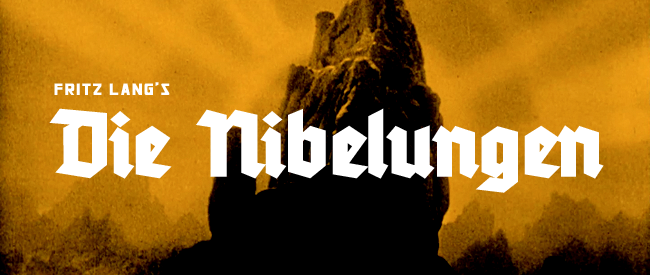
Fritz Lang’s DIE NIBELUNGEN

NIBELUNGEN1 (1)

DIE NIBELUNGEN
Dir. Fritz Lang, 1924
Germany. 280 minutes.
Presented in a new HD restoration

Special thanks to Jason Leaf & Kino Lorber

THE ENTIRE NIBELUNGEN SCREENS SUNDAY, JULY 28! SIEGFRIED BEGINS AT 1:00 PM FOLLOWED BY KRIEMHILD’S REVENGE AT 4:00 PM! DON’T MISS OUT!

Long assailed by shoddy prints and jarring, beyond-incomplete edits, Fritz Lang’s Die Nibelungen is an undersung silent masterpiece, on par with the biggest and most bombastic works of the 1920s. For sheer scale, its only competition might be Gance’s Napoleon, DeMille’s Cleopatra or, indeed, Lang’s own subsequent Metropolis. But whereas that film – which, like both halves of Die Nibelungen, was co-written by Lang’s wife Thea Von Harbou – took a forward creative hurtle in imagining the nuts and bolts of an industrialized dystopia, Die Nibelungen is unabashedly Teutonic, equal parts pastoral daydream and hellish, demon-populated wasteland. Its images weave a snarling, vicious tangle of beauty and cruelty, with subtle flavors of hatred coloring its human drama via Lang’s flair for lovingly crafted overacting.

Die Nibelungen is presented in the exquisite remaster released last year by Friedrich-Wilhelm-Murnau-Stiftung from all available negatives, with the full score originally composed by Gottfried Huppertz. Your stupid job, your skyrocking debt, your lingering text messages – abandon them for five hours and treat yourself to a classic adventure story, a film whose sweep and venom see the summer blockbusters of Nolan, Snyder and Abrams arriving out the other end of a paper shredder. Spectacle and Kino are thrilled to present Die Nibelungen this July, because there’s “epic” and then there’s epic.

NIBELUNGEN2 (2)

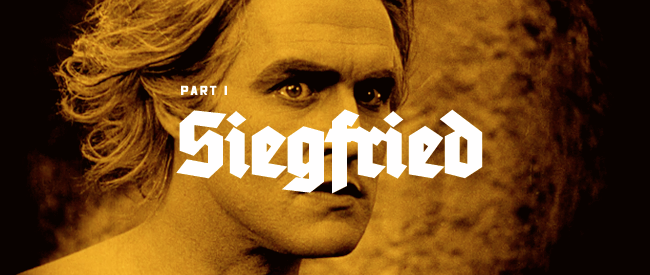
PART I: SIEGFRIED
Dir. Fritz Lang, 1924
Germany. 149 minutes.

SUNDAY, JULY 7TH – 7pm
SUNDAY, JULY 14TH – 7pm
SUNDAY, JULY 28TH – 1pm

Siegfried, the first half, concerns its nominal hero (Paul Richter), an often shirtless young prince who, in Lang’s wildly overgrown concrete forests, learns how to forge his own iron. Broadsword in hand, Siegfried handily slays the dragon Fafnir and bathes in its blood, a signature sequence that sees our hero battling a 60-foot monster operated by nearly a dozen special effects artists, cocked and loaded with a real flamethrower in its skull! The battle with Fafnir begins a serpentine spree of conquest that sees him quickly rising to the top ranks of the savage metalsmith mutants of the mountain, the Nibelungen.

Of the two episodes, Siegfried is the more phantasmagoric – his travels take him from one jaw-dropping vista to another, ultimately joining the elites of Burgundy, where he begins a torturous love affair with the princess Kriemhild (Margarete Schön.) Lang’s first film in this massive gold-plated diptych ultimately becomes a story a pack of crazy-eyed romantics; Siegfried makes for a surprisingly dark-sided hero, equally propelled by a romantic desire and a bottomless thirst for power. The ensuing love triangle between him, Kriemhild and her warrior-princess sister-in-law Brünhild (Hanna Ralph) steers the second episode’s course forever.
NIBELUNGEN3 (1)

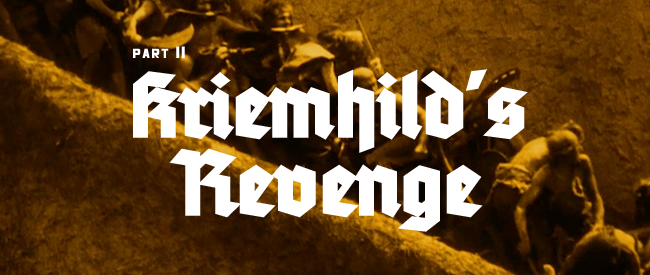
PART II: KRIEMHILD’S REVENGE
Dir. Fritz Lang, 1925
Germany. 131 minutes.

SATURDAY, JULY 13TH – 7pm
THURSDAY, JULY 25TH – 7pm
SUNDAY, JULY 28TH – 4pm

Kriemhild’s Revenge, the ominously titled second half, dwindles whatever fanciful spirit remains down to a nub in its slow march into catastrophe. Kriemhild uses the gold of Siegfried’s Nibelungen comrades as a bargaining chip to keep her own kingdom in check; soon a messenger arrives with a marriage proposal for her – from Atilla The Hun. Kriemhild travels east, and bears the famous death-mongerer a son – but even this is revealed as a mere gesture, part of her overall scheme to exact vengeance on her brother’s in-laws. Piling up dusty corpses on the steps of impossibly grand castles, Kriemhild teases the Hun and Burgundian empires into a bitter, sprawling deathmatch.

The insanity of Brünhild and the superhuman power of Siegfried meld into Kriemhild’s tunnelvision in a flash. For neither the first nor the last time in his career, Lang inverts a character’s deep well of personal pain into a force of blind, corrosive fury leaving none unspared. The director’s obsessiveness – stadium-sized ornamentalism, uncanny double-exposed sunflares, etc – apparently carried into the night of Die Nibelungen’s premiere, when taxis delivered fresh-printed reels direct from his edit station to Germany’s biggest movie theater. It is indeed easy to imagine Lang reworking the film forever; every shot shimmers with perfection.