
& OTHER WORKS: JUSTIN LIEBERMAN

JL_banner

WEDNESDAY, JUNE 26TH – TWO SHOWS – 8PM & 10 PM
ARTIST IN ATTENDANCE!
ONE NIGHT ONLY!

JUSTIN LIEBERMAN: THE DISHWASHER’S SONG & OTHER WORKS from Spectacle Theater on Vimeo.

“& Other Works” is a series of screenings focusing on video and film from contemporary artists, organized by C. Spencer Yeh.

“& Other Works” seeks out artists’ efforts which invite and evoke the cinematic experience, yet are typically looped on crowded walls or locked up in online isolation. “& Other Works” screens beginning to end, in an informal but focused communal viewing experience. In other words – “film, folks, fun.”

For June, we welcome artist Justin Lieberman, who will be in attendance.

THE DISHWASHER’S SONG
Dir. Justin Lieberman, 2002.
17 min. USA.

THE DISHWASHER’S SONG was created over a nine month period while Lieberman worked at the Maharishi Spiritual Center of America in North Carolina. Employed as a  dishwasher (surprise!), Lieberman was tasked with discarding the leftover food from the center’s meal services each night, a ritual he began documenting on video. The resulting culinary downpour conjures thrills from volatile modernist sculpture, to the inventive viscera of gonzo gore movies; an aggregated topography of consumption and meditative essay on the backside of the enlightenment machine.

To cook up the perfect kitchen radio soundtrack, Lieberman plundered via Napster (remember, it’s the early 2000s), collecting and collaging pop music instances of “yeah,” “baby,” and “no.” These three exclamations weave in and out of the fore, composing a colorful choir of cultural cacophony.

Originally presented as a multi-channel audiovisual installation, THE DISHWASHER’S SONG has been adapted into a single-channel work in collaboration with the artist especially for this screening. The mantric excretions of THE DISHWASHER’S SONG build to sustained climax from this presentation; your appetite won’t.

&OW_JLIEBERMAN_SCREEN_3

THE VISITOR
Dir. Justin Lieberman, 2004.
10 min. USA.

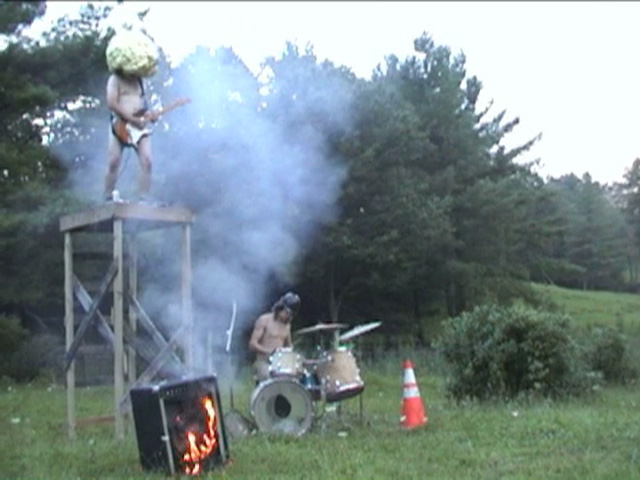
THE VISITOR casts Lieberman as a diapered brain alien crash landing straight into a backwoods summer fantasy informed by Easy Rider, El Topo, Fire in the Sky, and the Joseph Beuys joint I Like American and America Likes Me. A cameo from Brion Gysin’s Dream Machine consummates this compact fable of loving a visit, but hating the life.
&OW_JLIEBERMAN_SCREEN_2

FIRST THOUGHT, THEN SUSTENANCE
Dir: Justin Lieberman, 2007.
11 min. USA.

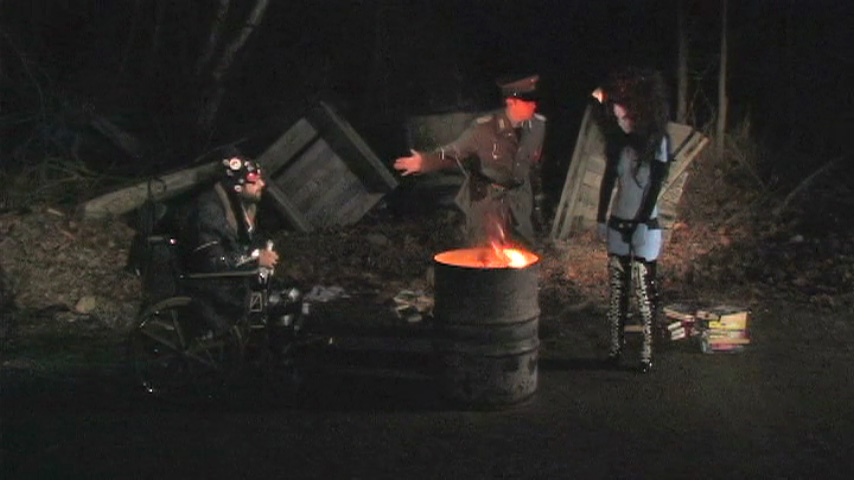
FIRST THOUGHT, THEN SUSTENANCE is described by Lieberman as “something of a structuralist narrative made in collaboration with the artists Jacques Louis Vidal and Kembra Pfahler.” A homeless man in a wheelchair, an SS officer, and a performance artist (Pfahler in full Voluptuous Horror garb) take turns tossing books into a shared oil can fire, while tossing off lines plundered from Bartlett’s Familiar Quotations.
&OW_JLIEBERMAN_SCREEN_1

THE BATH 2051
Dir. Justin Lieberman, 1997.
10 min. USA.

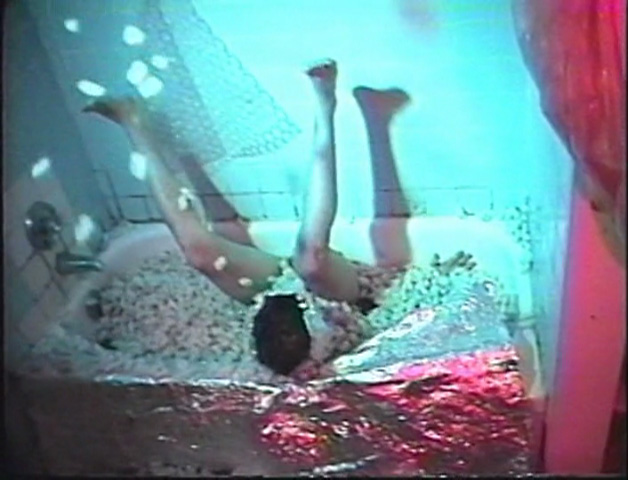
THE BATH 2051 = Aluminum foil Tetsuo cosplay vibes waft through a Jack Smith-haunted bathroom performance document, in Lieberman’s first official video effort.
&OW_JLIEBERMAN_SCREEN_4

Justin Lieberman is an artist, teacher, activist, curator, and critic who has worked extensively in the US and Europe. He has held faculty positions at the School of the Museum of Fine Arts, Boston, Queens College, New York, and Brandeis University, Waltham. He has presented numerous solo exhibitions of his work in New York, Los Angeles, Chicago, Boston, Miami, London, Paris, Brussels, Geneva, Athens, and Klagenfurt, among others. His work has been reviewed in publications including Artforum, Art in America, The Poetry Project Newsletter, Triple Canopy, Frieze, Useless, Art Review, The New York Times, Bomb, Le Monde, and Le Journal, and is the subject of a monograph published by JRP Ringier.

DIRT CITY FLIXX (Never Fahgettaboudit)

dirtcityflixx2

DIRT CITY FLIXX.
2013. Various. Animated.

SATURDAY, MAY 25TH – 7:30pm
ONE NIGHT ONLY!

In a time when the medium of animation is polarized between commercial programming and independent “Art Film,” few examples can be found that epitomize the new wave of independent filmmakers that choose to utilize the medium in ways that eschew any form of targeting; rather they are narrative forms of self-expression that convey the experience of the contemporary artist. As the necessary technology of animation has become more accessible to artists, the medium itself has transformed—much like the comic book–to convey subversive, experimental, and harsh themes and techniques with immediacy previously unavailable. The films showcased here in DIRT CITY FLIXX represent some of the most exciting, funny, violent, stupid, inventive, and dirty sexxy movies coming out of New York City and the internet at large.

DIRT CITY FLIXX contains the work of the following independent filmmakers.

Dennis Morano
Ivo Stoop
Colin Kelly
Alex Wood
Rick Manlapig
Cody Walzel
Vince Cretara
Charlie Judkins
Mike Gallant
with Lavina Yelb’s Pelina

DIARY OF A LOST GIRL – LIVE SCORE BY ANA LOLA ROMAN

ana lola diary 2

DIARY OF A LOST GIRL
Dir: Georg Wilhelm Pabst, 1929.
104 min. Germany.

LIVE SCORE BY ANA LOLA ROMAN

THURSDAY, MAY 23RD – 8PM &10PM
TWO SCREENINGS!
ONE NIGHT ONLY!

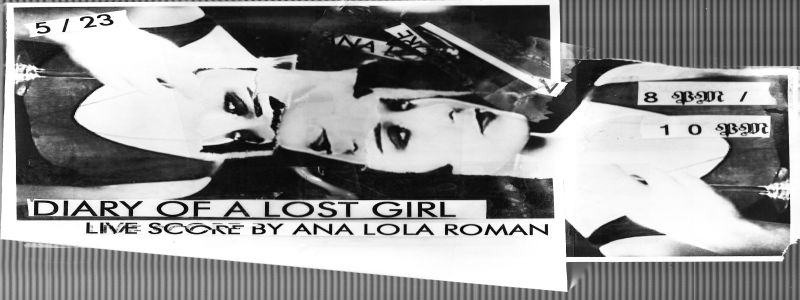
On May 23rd, Ana Lola Roman will provide live electronics, synths, beats, live vocal atmospheres, and drum pads to provide a futuristic, timeless, modular, and modern soundtrack/score to G. W. Pabst’s first Louis Brooks’ film. Roman’s haunting, lush, and minimal flourishes will provide a sound-scape that teeters on suspense, sexuality, raw-eroticism, and danger. This will be a chance to see silent film’s penultimate Muse; the vivid innocence, playfulness, and primal, yet refined beauty of Louise Brooks through Roman’s modern, raw, animistic, refined lens.

Louise Brooks, the silent film star who very well could have been the first to engage in the earliest version of ‘method’ acting, stars in Pabst’s Diary of a Lost Girl. Brooks plays the main character of Thymian, who is forced to face lurid tragedies and brief encounters with scandal and lust.

The premise of the story is disturbingly modern. Diary of a Lost Girl plays on fears we could face at anytime. We see Thymian take on a variety of misfortunes all while forced into a class-system she was not born into and which is clearly beneath her. Modern viewers will first notice that this film, released in 1929, is the first of its kind to deal with problems of exploitation, prostitution, and abandonment. Even before Lolita, or before Taxi Driver, this silent film eerily depicts a new genre of film to come.

Poster by Domokos (Tit’nul) from Future Blondes

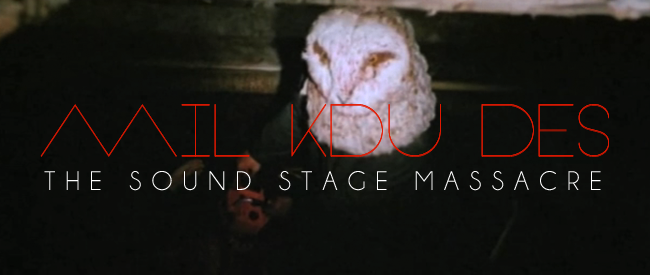
MIL KDU DES: The Sound Stage Massacre

MILKDUDESBANNER

MIL KDU DES present THE SOUND STAGE MASSACRE
Originally directed by Michael Soavi, 1987. Italy.
Approx. 45 min.

THURSDAY, MAY 30TH – 8PM & 10PM
ONE NIGHT ONLY!

THE SOUND STAGE MASSACRE is a heady re-edit directed by MIL KDU DES with editing assistance from C. Spencer Yeh of Michael Soavi’s 1987 directorial debut. STAGE FRIGHT: AQUARIUS (a/k/a: DELIRIA, BLOODY BIRD).

When a troupe of actors unwittingly let an escaped mental patient into their humble theater, the only thing that rises faster than the curtains is the body count. Coupled with dealing with an abusive and fame obsessed director the group discover that the maniac in the giant owl mask stalking them in the darkness isn’t the only thing they have to worry about. Also, there’s a lot of dancing and a character named Ferrari.

Rising from the graves of such musical monoliths as ANONYMOUS OWL, FEEL YOUNG, and PUKEALYPTUS comes the first (last?) public performance of Brooklyn’s mysterious and probably handsome – MIL KDU DES.

These unbelievably staggering musical pedigrees are only aided by the fact that members of the band also penned such Hollywood blockbusters as NIGHT OF THE HUMANNIQUINS and ACID WHALE.

Come join Spectacle for an evening spent submerged and steeping in the staggering splendor of theater and “live” “musical” accompaniment! Two sets – 8pm & 10pm! Fog machines! Terror! Surprises! No refunds!

Here’s what the experts are saying:

“Why is the band name spelled like that? Is that on purpose?”
– Jon “Screen Slate” Dieringer, Screen Slate.

“No it’s fine, I’ll just wait and hear it at the show.”
– Lindsey Rhoades, AudioFemme.

#RightBetweenTheEyes


AUTONOMY AND DELIBERATION

Autonomy and Deliberation
2012, Australia
The first feature film by Johann Rashid, Starring THE UV RACE
60 min.

May 22, 2013 at 8:00 and 10:00 PM

Autonomy and Deliberation is a film by Johann Rashid starring The UV Race. Set and shot in Melbourne and other rural Victorian locations in Australia, the film features tons of cameos by members of the most progressive music scenes in the world, including Circle Pit, School of Radiant Living, Eddie Current Suppression Ring, The Twerps, Boomgates, Total Control, Lost Animal, Dick Diver, and Woollen Kits.
In the desperate, post-apocalyptic world of Autonomy and Deliberation, UV Race isn’t a band any more, and have succombed to the darkside of life–gambling, drugs, and prostitution. Main character and lead singer Marcus [Rechsteiner], resolves to get the band back together amid a city full of strange wild creatures.

A triumph of low-budget DIY ethics, that started with little to no script and results in a hilarious and heartwarming journey that is set against the canvas of a full length UV Race album. With a cast of characters with little to no training in acting prior to making the film, we witness each characters’ personalities shatter the barrier of having no experience. In this case, it feels like the triumph of getting the band back together acts as a metaphor for working through the unknown and accomplishing something, much like the experience of creating the film.

Autonomy and Deliberation premiered in October 2012 in Melbourne’s Westgarth Cinema, and the May screening at Spectacle marks the first time the work has been shown outside of Australia. The 8PM show will be followed by a Q&A with the band, The UV Race in the middle of their US tour.

FILM AS A SUBVERSIVE ART: MAY 2013

FILM AS A SUBVERSIVE ART: MAY 2013
SELECTIONS FROM THE CHAPTER ‘EASTERN EUROPEAN LEFT & REVOLUTIONARY CINEMA’
WEDNESDAY MAY 15TH — PROGRAM 1 at 7:30PM & PROGRAM 2 at 10PM

The subversive and revolutionary cinema that emerged from Eastern Europe in the sixties and seventies is an incredibly original, bizarre, opaque, bodily and nihilistic cinema. Free of the Maoist and Internationalist errors that haunt much of the Western left in the period, and somewhat removed from the aesthetic battles typified by the Western “new waves”, many of the films of revolt against actually existing socialism, often created under conditions of censorship (direct and indirect), are surreal to the point of unintelligibility.

Among the most haunting and destabilizing works to emerge from the long sixties, these films are not dogmatic nor “political” so much as non- or anti-polemical. Meandering, frightening, and deeply experimental, these films sometimes feel as though they emerge directly out of desire itself, an explosion of mysterious flows and forces which attempt to smash the bureaucratic maintenance of survival that called itself life in a worker’s nation.

If capitalism pointed to the individual’s accumulation of things as proof of its success, state-socialism preferred to accumulate reports of collective achievement and productivity. Thus this Eastern European cinema opposes itself both to accumulation and political proclamation, preferring disoriented and ecstatic explorations of subjectivities that refuse official conceptions of the collective and bourgeois notions of the individual.

They also have the distinction of rebelling against a dead regime—while the spectacle transforms itself in order to consume its critics, from which you could argue that every regime which is fought against is “dead” if the subversion does not end in its overthrow, the end of state-socialism has been more thorough and total—throwing the question of their continuing power as revolutionary works into stark relief.

In our monthly series, Film as a Subversive Art, we’ve been looking at films from Amos Vogel’s book of the same name. This month we’ll look at films from the chapter “Eastern European Left and Revolutionary Cinema”. Join us for a night of upended totalities, destroyed symbols, naked desires and total tactical opacity.

DUCKTATORS

ducktators

ICARUS FILMS PRESENTS:

DUCKTATORS
Dir: Wolter Braamhorst & Guus van Waveren, 1998.
USA. 46 min.

TUESDAY, MAY 7 – 7:30 PM
FRIDAY, MAY 24 – 10:00 PM

Ducktators is a unique look at the use of cartoons during World War II.

American propaganda during the war had to obey one golden rule: it had to be entertaining. Cartoons proved to be an excellent way to deliver propagandistic and educational ideas in a seemingly innocuous manner to the general public and armed forces alike. Ducktators not only offers a rare glimpse at forgotten cartoon material from this moment in history, but goes further to reveal insights about the psyche of the public at that time.

The film blends documentary war footage with animated material and music from the period. The attack on Pearl Harbor, for instance, is intertwined with a Japanese cartoon about the attack. As the 1940s was the period during which the American cinema was most heavily attended, the screening of these cartoons every week guaranteed that most Americans would be exposed to the messages.

Among those interviewed in the film are Sody and Bob Clampett, the wife and son of animator Bob Clampett, and Chuck Jones.

“Legendary animator Chuck Jones, together with the wife and son of cartoonist Bob Clampett, plus historians and scholars discuss these extensively excerpted works as seen in their proper context.” – Booklist

Description courtesy of Icarus Films.

KINETIC CINEMA: ELEANOR ANTIN’S BALLERINA FILMS

KC-MAY-BANNER

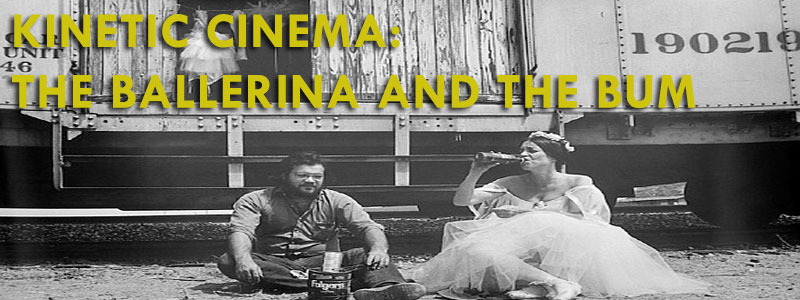
THE BALLERINA AND THE BUM and THE LITTLE MATCH GIRL BALLET
Dir. Eleanor Antin, 1974/1975
USA, 80 minutes total
English

WEDNESDAY, MAY 8 – 8:00 PM

Eleanor Antin – performance artist, photographer, and filmmaker – often creates an alternate persona in her video work, and in The Ballerina and the Bum and The Little Match Girl Ballet, she recreates herself as a professional ballerina from the middle of nowhere, desperate to make it in the big city. In the first film, Antin’s ballerina plans to walk across the country in order to make it as a dancer in the Big City; she meets the titular bum, and dreams of success. In the thematic sequel The Little Match Girl Ballet, that dancer has finally made it! She describes her path to glory to a silent audience, and acts out a ballet to Stravinsky, playing all the parts. In these two films, Antin discusses ideas of identity, fame, and representation, all while tying it back to dance.

EPHEMERA: WHAT WAS NEW YORK?

EPHEMERA3

EPHEMERA: WHAT WAS NEW YORK?
1939-1969, TRT: 90m, Color/B&W, USA.
MONDAY, MAY 13 – 8:00 PM
TUESDAY, MAY 28 – 8:00 PM

As one of the most characteristically diverse places on the planet, New York City’s 20th-century history has produced sights and sounds of an astonishing breadth. May’s EPHEMERA program WHAT WAS NEW YORK? offers a curated selection of moments from the history of NYC as it has been captured on celluloid. From specific transit exposés to neighborhood profiles, this edit utilizes a variety of framing contexts interchangeably to present an appropriately-scattered portrait of a location in constant flux; its assembly chronological yet timeless.

Preceding the feature program is LIVE AND LET LIVE (1947, 10m, Color, USA), an innovative safety awareness film produced by the Aetna Casualty & Surety Company that utilizes brightly-colored model cars to demonstrate traffic scenarios via tabletop stop-motion animation.

Sources for WHAT WAS NEW YORK? include: Around The World In New York (1940), Arteries Of New York City (1941), Coney Island (1940), For The Living (1949), R.F.D. Greenwich Village (1969), Story Of A City (1947), Story Of Newspaper History In The Making (1945), The City (1939), Third Avenue El (1950) and Village Sunday (1960), as well as many private home movies.

Special thanks to the Internet Archive, Rick Prelinger and everyone at the Prelinger Archive.

Rick Prelinger began collecting “ephemeral films”—all those educational, industrial, amateur, advertising, or otherwise sponsored—in 1982, amassing over 60,000 (all on physical film) before his Prelinger Archive was acquired by the Library of Congress in 2002. Since then, the collection has grown and diversified: now it exists in library form in San Francisco and is also gradually being ported online to the Internet Archive (http://archive.org), where 3,801 of its films are currently hosted (as of this writing).

Of course, the content of the Prelinger Archive’s films varies in accord with the variety of mankind. Historic newsreels, mid-century automobile infomercials, psychological experiments, medical procedurals, big oil advertisements, military recruitment videos, political propagandas, personal home videos, celebrity exposes, amateur narratives, scientific studies, war bulletins, instructional films, special interest op-eds, safety lessons, hobby guides, travel destination profiles and private industry productions all sit comfortably together in one marginalized category.

FILM AS A SUBVERSIVE ART: APRIL 2013

FILM AS A SUBVERSIVE ART: APRIL 2013
SELECTIONS FROM THE CHAPTER ‘WESTERN LEFT & REVOLUTIONARY CINEMA’
TUESDAY APRIL 30TH — 7:30 & 10PM

The revolutionary moment of the sixties is as dead as anything, and good riddance. Though we may yearn for that level of revolutionary fervor, we’re glad to see the backs of all those patriarchal Maoist puritans, misogynist homophobic “free love” partisans and statist non-violence ideologues (ok, maybe those fuckers are still around). But what of the films they left behind? What of the documents of their struggles? Do those have any power remaining to subvert, or are they merely that, documents?

In our monthly series, Film as a Subversive Art, we’ve been looking at films from Amos Vogel’s book of the same name. In February we looked at Third World revolutionary cinema, this month it’s revolutionary cinema from “The West”.

Increasingly, we’ve been confronted with the question of these films’ relevance, their subversive power, their meaning and their value 40-50 years after the fact. This month we’ll see dystopian statist political prisons, listen to manifestos from the lips of long-dead revolutionaries, witness insurrectionary violence, staged and actual, and a plethora of rebellious aesthetic upendings.

What good are old political statements? What is the difference between ‘subversive’ and ‘revolutionary’, and what are either worth? What, if anything, can these films do politically? And do they point toward a potential revolutionary use for cinema today?

We will definitely answer all of these questions entirely to your satisfaction. (And stoke the fires for that loveliest of days, the First of May.) With introductions by New Inquiry editor Willie Osterweil and members of the Anti-Banality Union, makers of Police Mortality.