EL DEPENDIENTE

dependiente-banner

EL DEPENDIENTE
Dir. Leonardo Favio, 1969.
78 min. Argentina.
In Spanish with English subtitles.

TUESDAY, NOVEMBER 12 – 10:00 PM
SUNDAY, NOVEMBER 24 – 7:30 PM
SATURDAY, NOVEMBER 30 – 7:30 PM

Next month we launch our third annual Best of Spectacle, a look back at some of our highlights from the previous year. In anticipation, we revisit a gem from 2012 that didn’t make last year’s series.

Despite being considered by a handful of Spectacle programmers as one of the greatest movies we’ve ever shown, El Dependiente played to empty houses: here’s your chance to catch up with a guaranteed mindblowing, where-has-this-movie-been-all-my-life experience.

El Dependeinte is the third feature directed by Leonardo Favio, Argentina’s own Gainsbourgian renaissance man with the dual distinction of being a ’60s and ’70s pop icon and accomplished filmmaker. Whereas his first two features bear out of the influence of his mentor, Leopoldo Torre Nilsson, and Robert Bresson (and Crónica de un niño solo strongly suggesting Vigo’s Zéro de conduite), El Dependiente is another beast entirely that can perhaps only be compared to the startlingly similar Eraserhead (1977) in its suffocating portrayal of abject dread brutally punctuated with disturbing, absurdist humor.

Walter Vidarte plays the title clerk, who works in a hardware store in a desolate provincial town. He ashamedly finds himself indulging in fantasies of the accidental death of his kind employer so that he one day might inherit the store. Each night on his way home he becomes transfixed by a gorgeous young woman lurking under the street light. His approaching her eventually leads to a string of muted nocturne encounters in the girl’s dilapidated coutryard that grow increasingly anxious under the auspices of her doting, manically overbearing mother.

Filmed in a stark chiaroscuro rife with vast, empty spaces, eerie ellipses and an almost palpable sense of the forlorn curdling into a brooding menace, El Dependiente is, despite its considerable humor and charm, an ever-tightening knot in the stomach and one of the most abstruse, perplexing anti-date movies ever made.

PRAXIS MAKES PERFECT: THREE FILMS BY MARGARETHE VON TROTTA


von Trotta banner

Margarethe von Trotta’s last two films, VISION: FROM THE LIFE OF HILDEGARD VON BINGEN from 2010 and HANNAH ARENDT, released earlier this year, are both portraits of contemplative women. In contrast, this set of three films from the first decade of her career deals with praxis, and courageous women who make the leap to it.

All made in the wake of the revolutionary violence that followed the splintering of the student movement and the extraparliamentary opposition in Germany in the late 1960s, these films represent three different approaches to an analysis of the possibilities this violence opened up and those that it closed off.

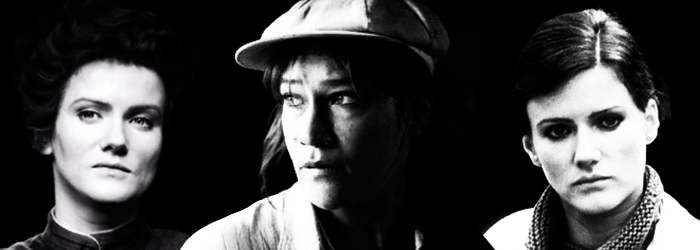
They all have a factual basis: THE SECOND AWAKENING OF CHRISTA KLAGES was inspired by the case of a Munich kindergarten teacher who robbed a bank to save her daycare center from debt, and whose 1975 trial a protesting von Trotta was arrested at. THE GERMAN SISTERS, a thinly veiled account of RAF-member Gudrun Ensslin’s relationship with her reformist sister, offers a stark portrayal of Ensslin’s experience in a maximum security prison and her sister’s quest to prove that her controversial death could not have been a suicide. Finally, ROSA LUXEMBURG recounts the life of the fiery orator and revolutionary, her disappointment with the German Socialist Party’s opportunism during the war, her work with Karl Liebknecht leading up to the Spartacist uprising, and her brutal murder during its bloody suppression in 1919.

More than simple attempts to reclaim maligned or abused historical figures, these films can be seen as examinations of the systemic violence embodied in institutions like marriage, rent, legislative bodies, and prisons, and of the more or less revolutionary responses it can prompt.


Second Awakening banner THE SECOND AWAKENING OF CHRISTA KLAGES
a.k.a. Das zweite Erwachen der Christa Klages
Dir. Margarethe von Trotta, 1978
West Germany, 89 mins.
In German with English subtitles.

SATURDAY, NOVEMBER 2 – 10:00 PM
MONDAY, NOVEMBER 25 – 7:30 PM

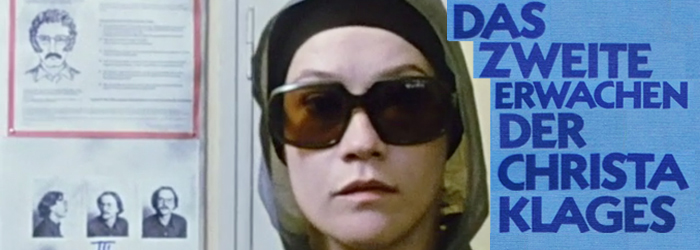
To save her kindergarten from being replaced with a strip club, Christa Klages grabs the rentier-bull by the money-horns, acknowledging that real justice is something to be wrested from a reluctant society by force. Let down by a mild, too-honest protestant priest, whose sermon about martyrdom in Brecht’s Mother Courage underlines his own cowardliness, and shadowed by a resentful bank clerk whose smug volunteer police work infuriates the viewer at every turn, Christa finally finds solidarity and tenderness in a forgotten childhood friendship.

THE SECOND AWAKENING is Von Trotta’s first solo film, having collaborated with Volker Schlöndorff on THE LOST HONOR OF KATHARINA BLUM in 1975 and COUP DE GRÂCE in 1976.

Special thanks to MKS Video.


German Sisters banner THE GERMAN SISTERS
a.k.a. Die bleierne Zeit, Marianne and Juliane
Dir. Margarethe von Trotta, 1981
West Germany, 102 mins.
In German with English subtitles.

SUNDAY, NOVEMBER 10 – 5:00 PM
SATURDAY, NOVEMBER 16 – 7:30 PM

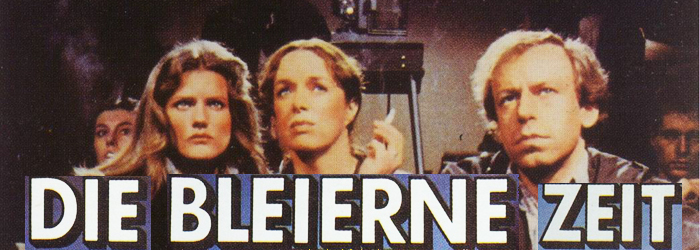
DIE BLEIERNE ZEIT gets its title from a poem by Hölderlin and conjures the oppressive atmosphere of postwar Germany, with the bleak and aimless consumer society being built through the “economic miracle” and the heritage of fascism that the majority of Germans were reluctant to address. Its Italian title, ANNI DI PIOMBO, became the phrase used to describe the wave of revolutionary violence and ensuing repression in Italy in the 70s. The overcast skies and modern prison blocks, along with the black and white newsreels of extermination camps and third-world misery that radicalize the Ensslin sisters, make for an overall cinematic texture that is just as leaden as the title promises.


Rosa Luxemburg banner ROSA LUXEMBURG
a.k.a. Die Geduld der Rosa Luxemburg
Dir. Margarethe von Trotta, 1986
West Germany, 120 mins.
In German with English subtitles.

WEDNESDAY, NOVEMBER 6 – 7:30 PM
SUNDAY, NOVEMBER 17 – 7:30 PM

It seems to me that this whole madhouse, this moral mire in which we now crawl, can in an instant, as if by magic, be changed into something great.

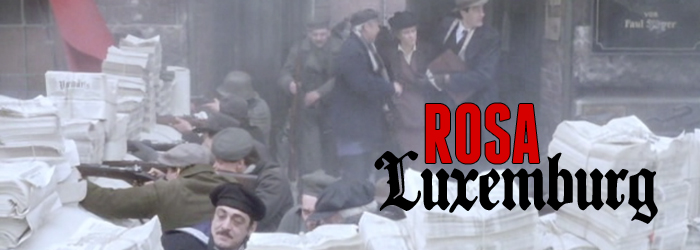
Almost thirty years before von Trotta cast Barbara Sukowa as famed political philosopher Hannah Arendt, the two of them gave cinematic expression to the life of a revolutionary theorist more impatient to grasp the reins of the historical process. Sukowa’s portrayal of “Red Rosa” is fiery and rousing, and her exhortations for the proletariat to smash the bourgeois order are so emphatic that the crowd should immediately file out of the cinema and do it.

Luxemburg has been invoked as a hero and martyr by many institutional forms of the German left, including the East German Socialist Unity Party and the present-day parliamentary party Die Linke. However, Luxemburg was critical of participation in any form of bourgeois democracy, and her intransigence is underscored in von Trotta’s film.

Lizzie Borden’s WORKING GIRLS

workinggirlstitle650-left
WORKING GIRLS
Dir. Lizzie Borden, 1986
USA, 93 min.

SATURDAY, NOVEMBER 2 – 7:30 PM
SUNDAY, NOVEMBER 10 – 7:30 PM
MONDAY, NOVEMBER 25 – 10:00 PM

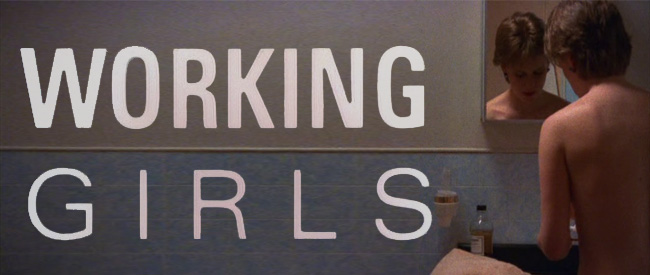
Independent filmmaker Lizzie Borden, director of the underground feminist classic BORN IN FLAMES (1983), directed her next feature WORKING GIRLS in 1986. Taking a more widely accessible approach in style and story structure, WORKING GIRLS follows three prostitutes working in an upscale brothel through one long day at work. The film is told largely through the eyes of Molly (Louise Smith), a woman with an Ivy League education who’s lying to her live-in girlfriend about her new job. Gina plans to open her own beauty salon when she’s saved enough money, and Dawn is a young law student trying to finish her homework in between clients.

Borden spent six months interviewing prostitutes in various economic situations to find out about the conditions in which they worked and how they felt about their jobs. WORKING GIRLS was made partly in response to some feminists’ anti-pornography stance and the Canadian documentary/exposé NOT A LOVE STORY (1981) which condemned pornography and, in Borden’s view, made many women working in the sex industry feel bad about their choices.

In this culture one hears constantly about the sacrifice you have to make for doing prostitution. I’ve been attacked by everyone: by feminists who say, ‘You’re soft-peddling prostitution; prostitution is wrong’; and by spiritual women who say you can’t have all these sexual encounters without doing damage to your soul. But nobody criticizes the forty-hour workweek. Nobody criticizes the fact that for the most part people are trained into positive thinking about jobs that don’t make use of half their talents. There are bad things about prostitution, but they’re not the ones you see in the movies.

Incredibly smart and insighful WORKING GIRLS is a film about a group of women choosing prostitution as a means to support themselves, and it succeeds at expressing a message that is neither pro- nor anti-prostitution. Through its screenplay (co-written with Sandra Kay), direction and camerawork, it reveals sex work as a normal job for many, with long hours, less than desired pay, a ringing phone, and a micro-managey boss (Madam). (Can work ever be sexy?) In addition, it consciously attempts to shift the camera-eye from a male gaze by avoiding voyeuristic approach in the cinematography.

There’s no shot in the film where you see Molly’s body the way a man would frame her body to look at it, except when she’s looking at herself that way…

WORKING GIRLS is the realest movie about sex work (and perhaps work under capitalism) we’ve seen in awhile — by no means an erotic film, it will likely make you blush and laugh awkwardly for its directness.

Quotes from Lizzie Borden in “Interview with Lizzie Borden.” Author(s): Scott MacDonald and Lizzie Borden. Feminist Studies, Vol. 15, No. 2, The Problematics of Heterosexuality (Summer, 1989), pp. 327-245.

EDITH CARLMAR: The Comedies

Edith Calmar

A singularly witty and dexterous auteur, Norway’s pioneering female filmmaker Edith Carlmar is ripe for a reappraisal in world cinema. Carlmar and her husband Otto co-managed their own production company, Carlmar Film A/S, with which they collaborated with a diverse community of technicians, artists and performers – including the then-teenage Liv Ullman, whose debut lead at 21 was Edith’s final film as director, The Wayward Girl. Making ten movies in as many years, the Carlmars built an astonishing resume in the 1950s before abandoning filmmaking forever when they were at the top of their game.

Today Edith’s legacy suggests a nearly clear split between flinty, ice-cold film noirs – often evincing a rare female perspective – and romantic comedies that’ll make your jaw drop even today with their sexual candor. She was in particular a master of eroticized close-ups and devastating quiet moments, never flinching from emotions (pleasurable or painful) most American directors wouldn’t touch with a fork.

That said, Carlmar Film A/S was an unabashedly commercial enterprise, at a time of deeply felt prudishness in Norway. The Carlmars made hits for a popular audience, and proudly paid all their grants back to the government. Never betraying her blue-collar roots, Edith left the distribution rights to her entire catalog to FILMVETERANENE, a union of Norwegian industry veterans. Alongside them, Spectacle is thrilled to team up with the Norwegian Film Institute to blow the dust off these classics of Scandinavian cinema this autumn.

Carlmar_small

( Series poster by Adria Mercuri )


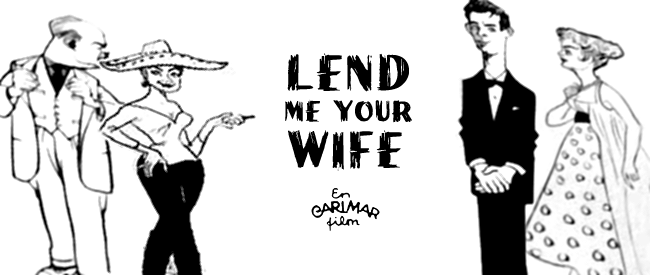
Lend Me Your Wife

LEND ME YOUR WIFE
(Lån meg din kone)
dir. Edith Carlmar, 1958
83 mins. Norway.
In Norwegian with English subtitles.

SATURDAY, OCTOBER 5 – 7:30pm
TUESDAY, OCTOBER 15 – 10pm 

Bjorn, a clueless and coiffeured young executive in Norway’s most prestigious company for all things baby – toys, diapers, pacifiers – is angling for a promotion. There’s just one little problem: his company trades on an especially conservative imprimateur, and no young executive can advance himself without proving beyond a shadow of a doubt his own family-man status. For poor Bjorn, this means going out and finding a fake “wife” whom he can bring to company functions. Anita, the wife of Bjorn’s woebegotten best friend, is more than game – but her addition to the seedy society of top-brass cocktail parties proves too much for both her husbands (fake and otherwise) to bear. As the young businessman falls deeper and deeper into his “innocent” white lie, his “wife” becomes the toast of the company for the widowed, horndog CEO – while his daughter falls head over heels for Bjorn, in a classic “complication comedy”.

Carlmar’s final comedy approaches male-female relations with a razor-sharp skepticism, immediately sniffing out both the perverse (the boss’ obsession with his young, hotshot executive’s sexpot wife) and profound (Bjorn’s longing for a sweet, innocent girl) in equal measure. The filmmaker pulls no punches in her depiction of a backwards society that calls on men to be fake-macho and women to be fake-whorish in order to achieve higher career aspirations, the only relief doled out to the audience who are (rather generously) in on all the jokes. Lend Me Your Wife is a bruising, scintillating comedy in the tradition of Billy Wilder and Preston Sturges, sure to resonate with anyone ducking for cover in the eternal war between men and women.


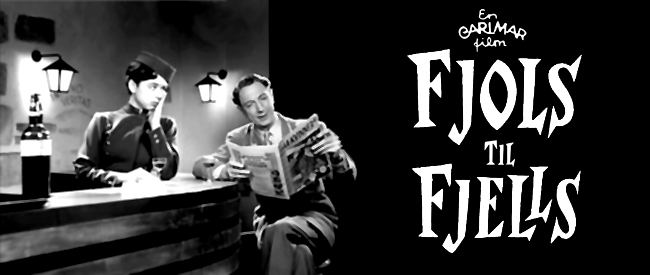
Fjols te Fjells

FJOLS TIL FJELLS
(Morons in the Mountains)
Dir. Edith Carlmar, 1957
90 mins. Norway.
In Norwegian with English subtitles.

TUESDAY, OCTOBER 8th – 10pm
SUNDAY, OCTOBER 13th – 7:30pm

“You are a disgrace to the Norwegian hotel trade.”

Fjols til Fjells concerns an overworked concierge named Poppe (Leif Juster) at the swankiest ski lodge in the country, who takes on a bellboy to mitigate his stresses. Unbeknownst to Poppe, young “Rudolf” is actually Ruth, the bored socialite daughter of the lodge’s owner, out to prove herself to her skeptical parents and get a taste of the working stiff’s life. At the same time, renowned actor and playboy Teddy Winter checks in – ostensibly for some fresh mountain air, but in fact to prey on his legions of adoring female fans on skiing holiday.

A dour ornithologist checks in as well – only wrinkle is, Poppe can’t tell him and the movie star apart (both characters are played by the same actor.) Hijinks, highballs and even a little romance ensue. Warm-hearted yet remarkably saucy, Fjols Til Fjells was one of the most biggest box office successes in Norwegian cinema and has endured as a cherished TV staple every Easter.


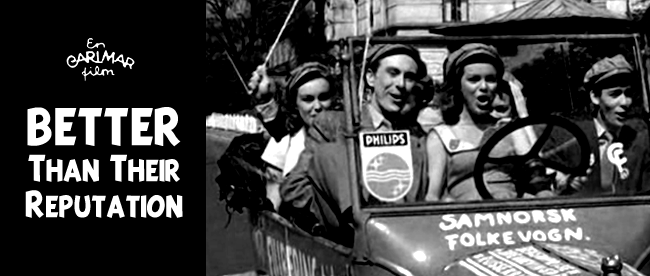
Better Than Their Reputation

BETTER THAN THEIR REPUTATION
(Bedre enn sitt rykyte)
Dir. Edith Carlmar, 1955
87 mins. Norway.
In Norwegian with English subtitles.

WEDNESDAY, OCTOBER 2nd – 7:30pm
SUNDAY, OCTOBER 20th – 7:30pm

A high school story every bit akin to Dazed and Confused or Can’t Hardly Wait, Better Than Their Reputationfollows a sweet-natured French student named Dag in love with his 20-something teacher Tone. But Dag’s love is complicated by his hard-charging overachiever ex, Karin – and her ongoing liaison with Roald, Dag’s best friend. Dag’s classmates are quick to tease, but the film explores the ins and outs of the concept that their skepticism might have more to do with jealousy.

The screenplay (written by Carlmar and her husband Otto) doesn’t miss a step, giving every character just enough gravity to make every class period and Friday night get-together loaded with the potential for an emotional – or comedic – blowout. Encircling the exam-obsessed final month of senior year, Carlmar paints a tender portrait of solidarity among friends nevertheless subject to change. Her teenagers are neither monsters nor squeaky-clean; just, the boys are boorish, and the girls are bored.

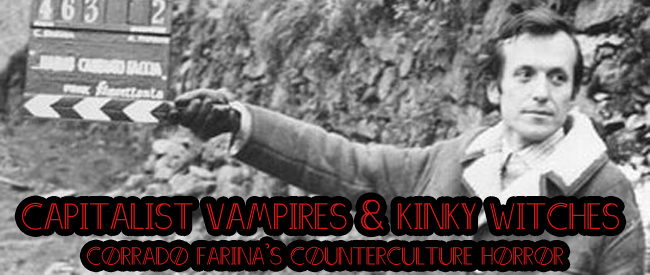
CAPITALIST VAMPIRES & KINKY WITCHES: Corrado Farina’s Counterculture Horror

CORRADO_banner

In the spirit of our annual Spectober horror film series, we present a retrospective on the Italian director Corrado Farina. Primarily known in his native Italy for his work as a novelist and a plethora of directing gigs outside of the film industry (television, news, documentary, industrial, advertising, etc), Farina also made two feature horror films in the early 70s that perfectly encapsulate the era’s counterculture headiness in surreal fashion.

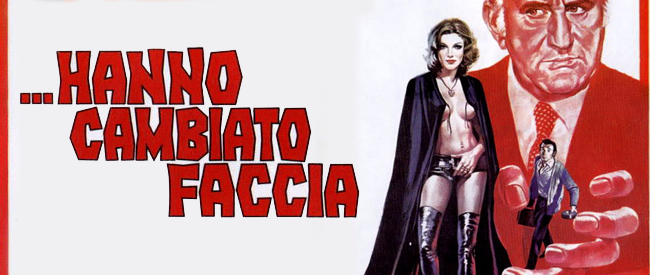
Following a stint at an advertising agency as a copywriter and commercial director, Farina moved to Rome to concentrate on pitching films. THEY HAVE CHANGED THEIR FACE, his first feature, transported the Transylvanian Dracula myth to the Italian countryside for a scathing satire of ‘vampires-as-capitalists.’ His follow-up, BABA YAGA, was even more ambitious, adapting adult comic legend Guido Crepex’s surreal adventures of sexy Valentina and her be-witching compatriots to the big screen.

Farina faced difficulty in getting his third feature off the ground (the subject mater of his proposed third film- a variation on The Phantom of the Opera– eventually became his first novel, A Place In The Dark). Following his dissatisfaction, he soon returned to the world of advertising and documentary, and to this day remains active in Italy’s media landscape: in 2006, Farina and his son, Alberto, completed a documentary called “Motore!” designed to be shown in Turin’s “Museo del cinema” during the Winter Olympic Games!

His successful career notwithstanding, it’s a shame that Farina wasn’t able to secure financing for a third proper horror effort, as both THEY HAVE CHANGED THEIR FACE and BABA YAGA are unique anomalies in Italian horror. Less concerned with scares than exploring themes like anti-establishment and repressed sexuality, Farina employed the classic horror tropes of vampires and witches to channel the political, social, and sexual turmoil of early 70s Italy into two deliciously strange and subversive films.

Working with Italian distributor Videa CDE and US distributor Blue Underground, Spectacle is proud to present a two-film retrospective on a bold but neglected genre contortionist.

Special thanks to Corrado Farina, Alberto Farina, Federica Funaro, and William Lustig


HCF_banner
THEY HAVE CHANGED THEIR FACE
(aka …Hanno Cambiato Faccia)
Dir: Corrado Farina, 1971.
91 min. Italy.
In Italian with English subtitles.

Special thanks to Videa CDE

U.S. PREMIERE!
WITH CUSTOM ENGLISH SUBTITLES CREATED BY SPECTACLE!

FRIDAY, OCTOBER 4TH – 7:30PM
SUNDAY, OCTOBER 20TH – 10PM

Mild-mannered Dr. Alberto Valle is a diligent but low-level employee of a car company. Out of the blue, he is summoned to the estate of Giovanni Nosferatu, the company owner, to discuss a potential large promotion. Following an encounter with a topless hippie hitchhiker, Dr. Valle arrives at the gothic mansion and exchanges pleasantries with Nosferatsu, but then the boss mysteriously disappears for large chunks of time, leaving Dr. Valle to enjoy the company of Nosferatu’s obedient, extremely pale secretary Corrina (played by Deep Red‘s Geraldine Hooper). Soon enough though, Dr. Valle discovers a casket crypt on the outskirts of the villa and a mysterious chamber with newborn children and a large book containing his own baby photo with an inscription: C.E.O.

Complimented by classic vampire film staples (endless heavy fog, superstitious villagers), Farina manages to breathe new life into the genre with a strong current of sly humor throughout the film, including an eerily foretelling running gag involving advertising slogans blasting through speakers whenever Dr Valle uses a household appliance. However, the film’s dark nature comes not from the amount of on-screen deaths, but its scathing political tone.

While infused with a devilish wit and satirical edge (including a showstopper boardroom scene that brilliantly riffs on organized religion, deceptive sloganeering, legalized drug use, Jean-Luc Godard, Federico Fellini, AND Marquis de Sade), THEY HAVE CHANGED THEIR FACE unveils itself as a harsh critique of consumerism as vampirism, portraying corporate heads as bloodsucking capitalists hellbent on ensuring marketplace dominance and the eradication of individual freedom. Instead of biting necks to keep living, its to convert the free spirits to a submissive, business-minded lifestyle. Ultimately, Farina suggests the true horror is that the current system will never be defeated, but inevitably grow and accumulate more lobotomized victims.

Unreleased in America for over 40 years, Spectacle is proud to host the US premiere of a vital piece of 70s Italian horror cinema, complete with custom English subtitles created exclusively for these screenings!


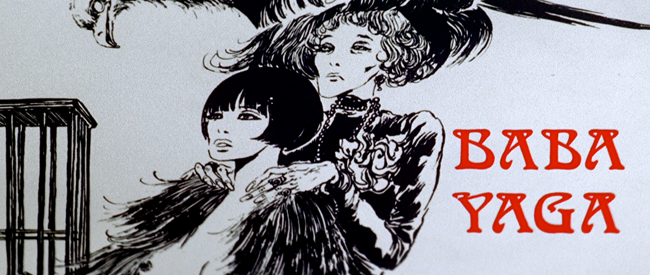
baba-yaga-posterBABA YAGA
(aka Kiss Me Kill Me)
Dir: Corrado Farina, 1973.
91 min. Italy.
Dubbed into English.

Special thanks to Blue Underground

THURSDAY, OCTOBER 3RD – 10PM
SUNDAY, OCTOBER 27TH – 7:30PM

Loosely based on the incredible black & white erotic fumetti comics of Guido Crepax, Farina brings to life the story of Valentina (doe eyed Isabella de Funes), a liberated fashion photographer who finds herself unwittingly thrown into a psychedelic nightmare of sapphic proportions.

On her way home from a soiree one evening, Valentina is almost struck by a vehicle while attempting to save a stray dog. It’s there she crosses paths with the peculiar Baba Yaga (legendary sex symbol Carroll Baker), a mysterious, brooding woman who soon fixates upon her. Unsettled by their encounter, Valentina begins to suffer a surreal collection of erotic and fetish-inspired dreams featuring executions, Nazi soldiers and dark holes with no bottom.

One of the most stylish and hallucinatory horror offerings of the 70s, BABA YAGA sees Farina trying out bold editing techniques (including a sex scene that incorporates Crepax’s comic strips) and interweaving Valentina’s reality with her dreams until their indistinguishable, leading to a kinky and mind-bending climax.

Awash in impeccable, zeitgeist-y costume design and a slick layer of soft core playfulness, BABA YAGA is Euro-mod-sleaze at its most entertaining and bizarre.

SPECTOB3R: More Unknown, Mysterious, and Shocking Films

SPEC3BER-banner

For the third year, Spectacle is proud to present a month-long lovingly-selected series of unknown, mysterious, and shocking films from around the world: SPECTOB3R.
This we’ve cranked out out our leanest, meanest monster yet.
SPECTOB3R is all chiller, ALL CHILLER: Gothic mindbenders? Czech! Freaky Norwegian water spirits? <Exhales bubbles and gives underwater thumbs up>. Spanish horror-rotica? Mmmmm. Satan? Hail yes! Brooke Shields? Duh! Sex Olympics? Go for the gold!

AliceSweetAlicebanner

ALICE SWEET ALICE
(aka COMMUNION)
(aka HOLY TERROR)
Dir. Alfred Sole, 1976.
107 mins. USA.
FRIDAY, OCTOBER 25 – 7:30 PM
SUNDAY, OCTOBER 27 – 10:00 PM

“God always takes the pretty ones.”

Typifying a crucial point in the lineage of international horror is ALICE SWEET ALICE, a stylish and deeply unnerving American giallo that features a mask-wearing, knife-wielding killer, yet predates the slasher craze by a number of years.

Alice is a peculiar, angry 12-year-old in a devout Catholic household with a far-too-perfect sister, absent father, impatient mother, overbearing aunt and licentious, obese landlord. After her sister is burned to death in a pew at her first communion, Alice understandably becomes the prime suspect. Gradually, her strange, volatile behavior escalates, continuing to alarm her family as the unspeakable violence against those around her persists. Is Alice’s deformed, two-faced doll just a toy… or is it also a metaphor?

Perhaps most notable for being the first screen appearance of budding-sexpot Brooke Shields –who plays Alice’s angelic sister Karen– the real star of ALICE SWEET ALICE is the deranged titular character herself, played with disturbing efficacy by a 19-year-old(!) Paula Sheppard (who would later go on to star in 1982’s sci-fi synth-punk opus LIQUID SKY, her only other screen credit). Originally premiering as COMMUNION in 1976, the film was re-titled by skittish censors as ALICE SWEET ALICE upon distribution in 1978, then again as HOLY TERROR in 1981, when it was re-released (after the successes of PRETTY BABY, THE BLUE LAGOON and ENDLESS LOVE) with promotional materials foolhardily inflating Shields’ role.

Literally rounding out the cast is astoundingly weird horror foot-note Alphonso de Noble, the immense, cat-crazy landlord whose revolting on-screen persona was scarcely an act. Also appearing in a couple of Joel M. Reed movies before dying at the age of 31, de Noble was discovered while working as a bouncer at a gay nightclub in New Jersey, where he was alleged to regularly drum up passive income by dressing as a priest and hanging out in cemeteries, soliciting money from grieving family members under the guise of donations to the church.

Alfred Sole’s sole triumph as a writer/director –neither 1972’s porn drama DEEP SLEEP nor 1982’s horror comedy PANDEMONIUM were able to save him from a subsequent career as Production Designer on VERONICA MARS– ALICE SWEET ALICE is an undisputed 1970s horror classic: a film that sustains a disquieting, sinister vibe arguably better than many of its better-known Euro predecessors or subsequent American offspring.

lakeofthedead-banner

LAKE OF THE DEAD
Kåre Bergstrøm, 1958.
Norway. 76 min.
In Norwegian with English subtitles.
THURSDAY, OCTOBER 3 – 7:30 PM
TUESDAY, OCTOBER 22 – 10:00 PM

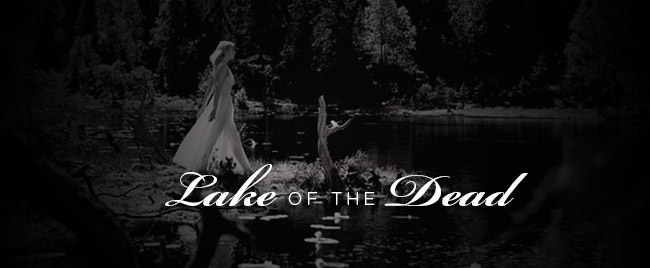
In this Norwegian cinema classic, a group of old friends sets out to visit one’s brother at his cabin in the woods only to find the man missing and his dog apparently killed. As the strangeness of the circumstances settles in, one recalls the legend of a previous inhabitant who killed his sister and her lover before drowning himself in the lake. Now, occupants are said to hear phantasmic cries in the night and feel compelled if by siren song to the lake — and perhaps drawn to repeat the earlier tenant’s crimes. As the characters represent a cross-section of arts, sciences, and humanities, they engage in spirited debate about faith, superstition, and reason; yet it’s not long before pontification gives way to some truly creepy happenings. Smart, atmospheric, and unnerving, LAKE OF THE DEAD is a classy chiller that stands as one of the all-time highlights of international horror cinema.

morgiana

MORGIANA
Juraj Herz, 1972.
Czechoslovakia. 99 min.
In Czech with English subtitles.
FRIDAY, OCTOBER 4 – 10:00 PM
WEDNESDAY, OCTOBER 30 – 7:30 PM

Special introduction by film programmer Irena Kovarova on Wednesday, October 30! Kovarova’s full-career retrospective of Jan Nemec runs November 8 – 14 at BAM.

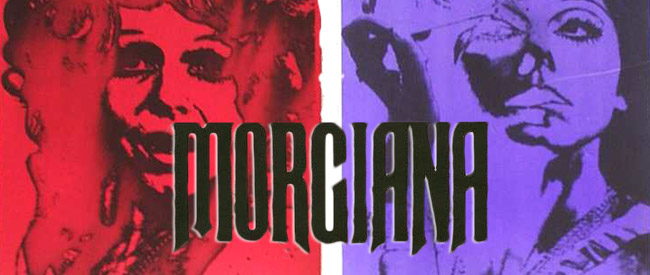
In this florid masterpiece of psychotic cinema, Iva Janzurová plays both sisters Klára and Viktorie, as the brooding Viktorie yearns to undermine her more favored sibling through slow poisoning. Beautifully rendered from Alexander Grin’s novel by Juraj Herz, MORGIANA is a kaleidoscopic rabbit hole of insidious gothic tropes and stunning Art Nouveau production design. Encompassing murder, romance, blackmail, duplicitous wills, and crossed identities, it’s a film best appreciated by casting literal interpretations aside and viewing it in the spirit of something like REPULSION as a surrealistic portrait of a fracturing mind told through roving, wide-angle camerawork, obtuse reflections, nightmare interludes, and a memorable score by Lubos Fiser. Though THE CREMATOR is considered Herz’s masterpiece, MORGIANA is arguably the more staggering achievement and a film often considered the swan song of the Czech New Wave.

Special thanks to David Budský of Ateliery Bonton Zlin and Irena Kovarova.

SATANS_BLOOD_BANNER

SATAN’S BLOOD
(aka ESCALOFRIO)
Dir. Carlos Puerto, 1978
Spain, 82 mins.
SATURDAY, OCTOBER 5 – 10:00 PM
TUESDAY, OCTOBER 22 – 7:30 PM

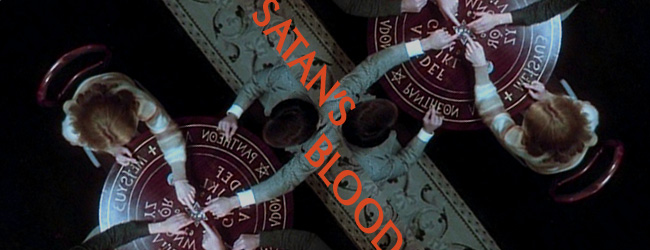
Andres and Ana are a couple living in Madrid. One fine day they decide to pack the car and wrangle their dog and set out for a fun time in the Spanish countryside. Not long into their trip, they encounter another car on the road. The couple in the other car, Bruno and Berta, flag them down. Bruno is excited to see his old college buddy – Andres, but Andres isn’t so sure they know each other. Never-the-less, the two couples set out for Bruno and Berta’s gigantic house for a grand reunion and a nice hot meal. But once they arrive, a storm rolls and in the as the weather gets worse and worse, Andres and Ana decide to stay the night. When the foursome decide to tamper with the spirit world in the form of a Ouija board, things really start to get weird. But that’s the least of their problems. Drug fueled orgies, suicide, creepy living dolls, and a freezer full of who knows what become a disorienting whirlpool and the helpless couple can’t get out. Trapped by a coven of devil worshipers, the film builds to a terrifying, twisting climax.

Produced by none other than Juan Piquer Simon (PIECES, SLUGS) SATAN’S BLOOD is a veritable cornucopia of sin and debauchery. A gothic tale of Satanic panic who’s influence can be seen as recently as Ti West’s throwback jam HOUSE OF THE DEVIL while showcasing the Spanish countryside and a score by Simon regular Librado Pastor.

SNAKE_bannerTHE SNAKE GIRL AND THE SILVER-HAIRED WITCH
(aka Hebi musume to hakuhatsuma)
Dir: Noriaki Yuasa, 1968.
84 min. Japan.
In Japanese with English subtitles.
SUNDAY, OCTOBER 13TH – 10PM
WEDNESDAY, OCTOBER 30TH – 10PM


Based on the Japanese manga comic series by the legendary Kazuo Umezu (and directed with accomplished flair by Gamera/Ultraman helmer Noriaki Yuasa), THE SNAKE GIRL AND THE SILVER-HAIRED WITCH is a delirious, phantasmagorical fantasy-horror relic that screams for re-discovery.

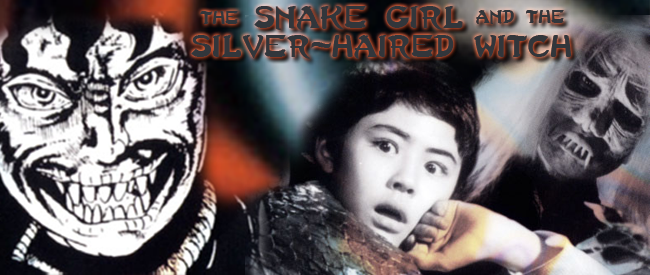
Young girl Sayori leaves the attentive care of an orphanage to live with her distant relatives. Upon arrival, her new father promptly leaves for business and her mother remains strangely quiet. Meanwhile, Sayori begins having visions of someone peeping through her ceiling hole and dropping snakes on her. The dread increases as Sayori discovers another young girl in the house with a macabre, waxy face with cracks on the sides of her mouth. Sayori’s dreams intensify to the point of horrid, Freudian nightmares featuring enormous witches, snakes, spiders, and demons atop lavish heaps of psychedelic dissolves! But after she awakes, she soon realizes that the nightmares are becoming real…

Remarkably subversive and sinister for what was ostensibly a family picture about sibling rivalry, Snake Girl is a demented kids’s film not to be recommended to kids. While the puppetry FX may slide into (adorably) kitsch territory at times, there’s no denying the film’s imagination and occasionally brazen sadistic tone. With the mixture of a young girl’s narrative and FX-laced dream sequences, Snake Girl comes across as a precursorer or sorts to Nobuhiko Obayashi’s funhouse masterpiece Hausu, but made all the more sinister in that it was originally aimed at children!

Wildly inventive and effectively creepy, this is 60s Japanese studio horror of the highest, most surreal order.

symptoms-banner

SYMPTOMS
José Ramón Larraz, 1974.
86 min. UK.
In English.
TUESDAY, OCTOBER 8 – 7:30 PM
FRIDAY, OCTOBER 25 – 10:00 PM

In this somber horror gem, Helen (Angela Pleasance, daughter of Donald) brings Anne (Lora Heilbron, star of Freddie Francis’ THE CREEPING FLESH, 1973) to her family’s creepy, rarely used forest estate where they can unwind from the stress of city life and focus on their writing. The woods may be lovely, dark, and deep, but the promises they keep lead to sex, murder, and insanity!

From Jose Ramon Larraz, the director of the vampire cult classic VAMPYRES (1974), comes SYMPTOMS (1974), part-Lewis Carroll forest fantasia, part-erotic thriller, part-Bergman-esque chamber of trauma, and 100% mental mindfuck. SYMPTOMS fits into a loose series of films by Larraz made in the early 1970s that includes the aforementioned VAMPYRES, as well as WHIRLPOOL (1970), DEVIATION (1971), and THE HOUSE THAT VANISHED (1974), all of which revolve around a small core cast of characters who venture into the woods and find themselves in a surreal, sexual, and psychotic nightmare.

Striking sustained notes of quiet unease that crescendo into madness, SYMPTOMS epitomizes the minimalist narrative, pastoral beauty, ethereal ermines, and genre revisionism that characterized Larraz’s work in this period. As Joseph A. Ziemba wrote online at Bleeding Skull!, “If you’re gonna go crazy, this is the way to do it.”

SEXOLYMPICS-BANNER

THE YEAR OF THE SEX OLYMPICS
Dir. Michael Elliott & Nigel Kneale, 1968
UK, 105 min.
WEDNESDAY, OCTOBER 2 – 10:00 PM
SUNDAY, OCTOBER 6 – 7:30 PM

A 1968 television movie, The Year of the Sex Olympics is the best science fiction film you’ve never heard of, a socio-political satire originally created as a criticism of the hippie/youth movement, but that became a prophecy of contemporary lowest common denominator reality-TV.

Author Nigel Kneale was a major figure in the UK sci-fi/horror genre genres, creating and writing all the well-regarded “Quatermass” films, and many others including Ray Harryhausen’s The First Men in the Moon and Hammer Pictures’ The Abominable Snowman, as well as scripting the non-genre films Look Back in Anger and The Entertainer.

Like Brave New World or Fahrenheit 451, The Year of the Sex Olympics examines a “soft totalitarianism” future, in this case where keeping the population calmed to the point of nullification is the goal, and TV and drugs are the method—not a boot to the face.

This future (“Sooner than you think,” the opening titles warn) is so far-gone that the controllers have created “the Sex Olympics,” where the world’s most beautiful people make love under the cameras—to distract the billions of viewers from doing any fornicating themselves and overpopulating the world further. “Sex is not to do, but to watch,” says one character. In the future this is “Apathy Control.”

When we glimpse the audience of “the Sex Olympics” through the control room’s monitors, they look like blobby ghosts, or fat ghouls.

But trouble’s brewing: the ratings indicate that the viewers are getting bored with the copulation marathons, and something will have to be done.

Since thinking has been discouraged (the chess machines play themselves, only to be watched), people in this world find it harder and harder to express themselves, even if they’re given the chance. It’s a high-tech world full of humans whose thought processes have been stunted—reflected in the almost incomprehensible torrent of slang-laden jargon and slogans spewed.

When the on-air suicide of a distressed designer sends ratings through the roof, the programmers realize they are on to something. “What are we supposed to do? Kill someone every night?!?” demands a conscientious TV exec who doesn’t realize he’s created a formula for success.

As two members of the ruling class begin to question the way things are, trouble and sorrow can only follow, especially after they allow themselves to be ensnared in the Apathy Control’s next project… “In the old days I think they called that ‘despair,’ right?” says a programmer, planning something evil. “It’s a show—something’s gotta happen!”

Don’t let The Year of the Sex Olympics’ sub-Doctor Who budget deter you: As Steven Puchalski has written in Shock Cinema, “What begins like a simple satire of modern sexual openness turns into a powerful dystopian vision of modern voyeurism and inhumanity, with a surprisingly emotional pay-off. Its sci-fi trappings are often crude, with characters talking into plastic wristbands, eating from toothpaste-like tubes, sporting outlandish hairdos, and resembling an Ed Wood production of THE JETSONS. What it lacks in production values, it makes up for in admirably straight-faced performances and bold conceits, in what has to be one of Kneale’s most unpredictably provocative works.”

The shocking thing about The Year of the Sex Olympics is how damn accurate it was in predicting not only the rise of ubiquitous pornography (what do you think Victoria’s Secret ads are anyway?), but the cruel and rotten “reality” shows like Fear Factor, Survivor or Big Brother, where suckers are debased routinely for the masses’ entertainment—and control: if everybody’s in front of their TV on Thursday night, it’s one less thing for the security patrols to worry about.

The film is also prescient in its depiction of a total surveillance state that is unquestioningly accepted—since the concepts of “family,” “home” and “love” have been eliminated, what’s “privacy”? And yes, “Art” has been eliminated, as well.

Starring Kubrick regular Leonard Rossiter and an unbelievably young Brian Cox, The Year of the Sex Olympics was long considered lost due to the incompetence of the BBC, but can be found if you look—like at places like the Spectacle.

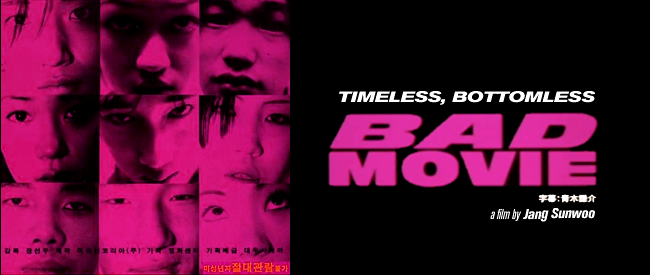
TIMELESS, BOTTOMLESS BAD MOVIE

BadMovieBanner

TIMELESS, BOTTOMLESS BAD MOVIE
Dir. Jang Sun-woo, 1997
South Korea, 144 min.

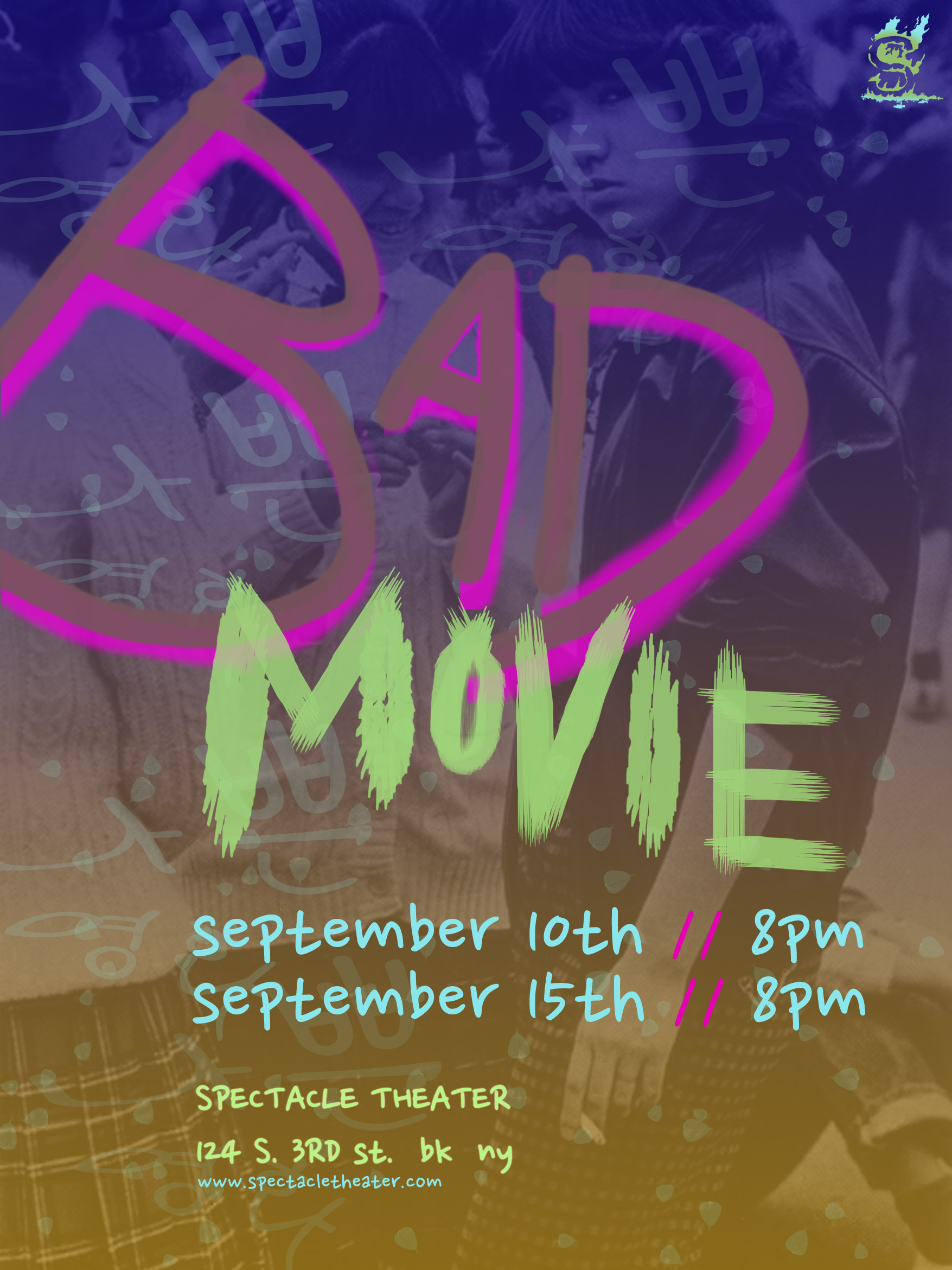
TUESDAY, SEPTEMBER 10th – 8PM
SUNDAY, SEPTEMBER 15th – 8PM

The key is in the title, its praxis succinctly delineated in four words: Timeless, Bottomless Bad Movie (Nappeun Yeongwha) is exactly what it suggests it is, a film purportedly unaffected by time and utterly bad. In this rabbit hole excursion into the urban topography of Seoul (the skirmishes in dark alleyways, the hazing in the high-school restrooms, sexual liaisons in karaoke bars, morning hangovers in motel rooms, the wasted hours spent in the video arcades), where the teenage street urchins of Seoul run amok and the old bums sit defiantly on subway floors, the film operates, as Nicole Brenez has pointed out, between the representational regimes of fiction and documentary.

Timeless, Bottomless Bad Movie cares little for beginnings, ends, and all the particular concerns of a typical, narrative film; nor does it quite work as documentary, not when there are moments so patently contrived. The film was shot amongst three different camera operators working in several different formats (35mm, 16mm and digital video) and purports to bethe brainchild of the kids on screen. But don’t be fooled. The gaudy, ostentatious displays only belie the elaborate arrangement and direction behind it all. The ultimate “makeshift” film. Where are those kids now? Timeless, Bottomless Bad Movie promises to be nothing more than what it says it is, really, truly bad.

badmoviefinal

Poster by Kim Westfall

20 YEARS OF CUFF

CUFF-banner

20 YEARS OF CUFF
Chicago Underground Film Festival is the longest running underground film festival in the world. Founded the same year as the now defunct NYUFF, it remains a vibrant & evolving home for radically dissenting filmmaking, and the defining example for underground film events all over the world. This program brings together legendary shorts from the festival’s first twenty years.

TUESDAY, SEPTEMBER 17 – 8:00 PM
FRIDAY, SEPTEMBER 27 – 8:00 PM

LINEUP & NOTES FROM FESTIVAL DIRECTOR BRYAN WENDORF:

LIGHT FUSE GET AWAY Dir. Ivan Lerner, 1994, 17 min.
When we began work on the first Chicago Underground Film Festival one of the first things we did was place a call for submissions ad in the Film Threat Video Guide which in those pre-internet years was THE source for info on contemporary underground film. We also sent submission info to every film reviewed in the magazine including this video by former Screw editor and current Spectacle programmer Ivan Lerner.

MONDAY 9:02 AM Dir. Tyler Hubby, 1995, 11 min.
Tyler Hubby was one of many graduates of George Kuchar’s Electro-graphic Sinema classes at the San Francisco Art Institute who was a regular fixture during the early years of CUFF. This 16mm film, comprised of a single unedited 11-minute take shot from inside a second-floor apartment is inspired by the idea Michael Snow’s avant-garde classic Wavelength. Although if my memory is correct Tyler didn’t actually actually see Wavelength until AFTER making this. Today Tyler lives in Los Angeles and has edited a number of great independent documentaries like The Devil and Daniel Johnson.

CLIT-O-MATIC: THE ADVENTURES OF WHITE TRASH GIRL
Dir. Jennifer Reeder, 1996, 8 min.
Chicagoan Jennifer Reeder made a name for herself in the 90s underground film scene with this Waters/Kuchar inspired feminist super-hero series she produced as a student at the School of the Art Institute of Chicago. She still lives in Chicago where she’s constantly inspiring new generations of image makers as Associate Professor Moving Image at the University of Illinois Chicago. She continues to screen her experimental narratives around the world including CUFF.

DANCE HABIBI DANCE Dir. Usama Alshaibi, 1998, 3 min.
Usama Alshaibi was a graduate of Columbia College Chicago when he produced this video inspired by Richard Kern’s Submit to Me series. His work has followed two distinct strains exploring his Iraqi heritage and his interest in transgressive sexuality. In 2006 he directed the feature length documentary Nice Bombs about his journey back to Iraq after the fall of the Hussein regime. He is currently pursuing his masters degree at Boulder Art Institute and is completing a new documentary feature American Arab produced with Kartemquin Films.

THE BATS Dir. Jim Trainor, 1998, 8 min.
Jim Trainor was a Manhattan bartender when he made his first amazing animated film The Fetishist which had its world premiere at CUFF in 1997. He followed up with The Bats which firmly established him as one the great contemporary underground filmmakers working in animation. He lives in Chicago now and teaches at the School of the Art Institute and is currently completing his first live action film using human actors to portray the mating habits of wasps.

MEAT FUCKER Dir. Shawn Durr, 1999, 32 min.
Shawn Durr had a brief but important place in the late 90s Chicago underground. Meat Fucker was his best known film. Following in the Kuchar tradition of over the top queer melodrama but upping the ante on the ridiculous. NYUFF’s Ed Halter once referred to his work as “Kuchar on crack” while Chicago experimental film critic Fred Camper compared Meat Fucker favorably to Kenneth Anger’s Fireworks. Shawn followed Meat Fucker with the features Fucked in the Face and The Last Fuck before retiring from filmmaking. He still lives in Chicago.

THE PSYCHOTIC ODYSSEY OF RICHARD CHASE Dir. Carey Burtt, 1999, 6 min.
Another New York filmmaker who was a regular at CUFF at the turn of the millennium. When we showed this film in 1999 to notoriously prickly Chicago Reader film critic Fred Camper at a press screening I remember him looking at me as the film ended and asking “Did you like THAT?” “yes” I nervously responded, “Good, because I think its GREAT!” replied Camper. Camper’s printed review said “The film’s antiliteralism is a wonderful rebuke to our glut of graphically violent movies… Burtt’s playful depiction of the gruesome story encourages us to think about it rather than wallow in it.”

THE FABULOUS STAINS: BEHIND THE MOVIE
Dir. Sarah Jacobson & Sam Green, 2000, 11 min.
The importance of San Fransisco filmmaker Sarah Jacobson to CUFF in our early years can’t be overstated. After attending the festival’s inaugural year with her short I Was a  Teenage Serial Killer, Sarah became a one woman word of mouth PR machine for the festival. Spreading the word about us everywhere she went and encouraging filmmakers she met to send us their work. In our third year we opened with the world premiere of her feature Mary Jane’s Not a Virgin Anymore and in 1998 she presented the first public screening in 15 year’s of Lou Adler’s proto-riot girl comedy Ladies and Gentlemen, The Fabulous Stains. Footage of that screening appears in this documentary co-directed by another SF based CUFF alumnus Sam Green (The Rainbow Man/John 3:16 and The Weather Underground) and originally produced for Jon Pierson’s IFC series Split Screen. Sadly, Sarah died of cancer in 2004 but her legacy lives on through a grant program for women filmmakers set up by Sam and Sarah’s mother.

WUSTENSPRINGMAUS Dir. Jim Finn, 2002, 3 min.
Jim Finn also studied at Columbia College where he was part of the same graduating class as Usama Alshaibi. Wustenspringmaus combines his love of animals and his interest in marxist political theory. Themes he continued to explore in his “Communist Trilogy” of features; Interkosmos, The Juche Idea and La Trinchera Luminosa del Presidente Gonzalo. Today he lives in Boston and is an Assistant Professor at Pratt Institute in New York.

AMERICA’S BIGGEST DICK Dir. Bryan Boyce, 2005, 4 min.
San Francisco’s Bryan Boyce first attended CUFF in 1997 with a little seen comedic short called Lard but he soon became internationally known for his critiques of American culture using appropriation and found footage. He continues to screen his work at festivals like CUFF and Ann Arbor but also releases work directly through his YouTube channel in order to keep his satire timely and fresh.

HOLD ME NOW Dir. Michael Robinson 2008, 5 min.
This karaoke video by prolific experimental film and video artist Michael Robinson was originally produced for the sadly defunct Portland Documentary and Experimental Film Festival (better known as PDX). We showed it at CUFF soon after where it won an award for best music video. For best results sing along.

THE ETERNAL QUARTER INCH Dir. Jesse McLean, 2008, 9 min
Jesse McLean began screening her work at CUFF while she was a student in Pittsburgh. PA but I didn’t actually meet her until she moved to Chicago to pursue her master’s at UIC. Upon graduating she relocated to Iowa City where she continues to be a fixture on the international experimental and underground film and video scene. Her work looks at the intersection of culture, technology and human behavior using a combination of found footage and original material.

THIS IS MY SHOW Dir. Lori Felker, 2009, 15 min.
Chicago based media artist Lori Felker has worn many hats with CUFF over the years. Co-programming and coordinating the festival, serving as projectionist and technical director as well as participating as a filmmaker herself. This video is part of a series of works that celebrate and spoof cable access television. Lori had to leave the projection booth during the 2009 festival to participate in the Q&A after this piece screened. It also received an honorable mention from the jury that year. Lori recently scaled back her CUFF duties to focus on her new position as Visiting Assistant Professor at the University of Illinois, Chicago.

THE STORY OF THE EYE Dir. Nicole Jefferson Asher, 2012, 12 min.
This feminist musical adaptation of the infamous transgressive novel by Georges Bataille screened at the 20th CUFF this past March. It stars and features music composed by performance artist Kevin Blechdom–Kristin Erickson, a member of the faculty of The Herb Alpert School of Music at CalArts and was directed by Nicole Jefferson Asher who has numerous credits in theater, film and television, creating projects for HBO, MTV, Nickelodeon Movies and Spike Lee’s 40 Acres and a Mule Film Works. She is currently writing and directing her first feature Betty, the story of funk singer Betty Davis, the second wife of jazz musician Miles Davis.

TRIGGER WARNING: STROBE EFFECTS

MOLODOST: Films on Soviet Youth

molodot-banner

Molodost: Films on Soviet Youth

“What do you want from life? What do you want from life?” “I just want to contribute to society.” A prominent subject of late-perestroika cinema was the molodezh or the ‘youth’ generation. Similar to current discourse surrounding the “millennial” generation, Soviet youth were often portrayed as either a symbol for hope and reformation, or as lost and apathetic. Disenchantment with old Soviet ideologies led to a questioning of authority, both in the political arena and the home. As the Soviet Union’s cultural symbols lost power, Gorbachev’s implementation of glasnost in the late ’80s simultaneously opened up a floodgate of western music, fashion, and movies, widening the communication gap between youth and authority. The new cultural influences led to various forms of agitation and rebellion: rock music, drugs, and civil disobedience. At the same time, however, it fostered inaction, indifference, and apathy. While perestroika-era films explored a new openness in social and civil critique, they were also overwhelmingly pessimistic and cynical. Paradoxically, and despite such portrayals, Soviet Union’s mainstream culture publicly accepted its youth subculture, and turned it into a symbol, if not an actual catalyst, for radical change. Molodost—meaning the time of youth— explores three different coming of age stories taking place on the cusp of the perestroika era, before the ultimate disillusionment of the Soviet Union. Assa, credited with bringing underground rock music into the mainstream, follows an underground rocker and his relationship with a girl, her Mafioso lover, and the police. Igla often described as a precursor for late Soviet/Kazakh new wave, and also featuring underground rock stars, is a surreal, postmodern cacophony of social collapse and drug use. Lastly, and perhaps the most sobering of the three, Kuryer tells the story of a high school graduate trying to make sense of his life. With no prospect for a college education, a grim mandatory military service awaits in his future.


assa-banner-3 ASSA
Dir: Sergei Solovyov, 1987
Soviet Union, 153 min.
Russian with English subtitles

THURSDAY, SEPTEMBER 5 – 8:00 PM
FRIDAY, SEPTEMBER 20 – 8:00 PM
TUESDAY, SEPTEMBER 24 – 10:00 PM

Assa came to recognition and cult status as one of the first films to bring underground rock culture into the Soviet mainstream, featuring songs by bands such as Aquarium, Soyuz Kompozitorov, Bravo, and Kino (whose lead singer Viktor Tsoi, also featured in Igla, plays himself in the film). Assa reflected a time of change in the USSR, as emphasized in Tsoi’s song “We Wait for Change,” consequently adopted by the real-life Russian opposition movement Solidarnost as its anthem. Set in Crimea during the late 1980s, Assa follows the story of Alika, a young nurse who is romantically involved with Krymov, her much older patient and the leader of an organized crime group. Despite her relationship with Krymov, Alika starts falling for a young rock musician named Bananan (played by the avant-garde artist Afrika). Bananan introduces Alika to his countercultural world of music and art. When the jealous Krymov begins to notice a change in Alika’s emotions toward him, he stages a plan to eliminate Bananan from Alika’s life forever. Assa has a playful, absurdist touch, combining sober moments with dreamlike sequences. Experimental scenes of hand-painted abstract patterns and inter-titles explaining youth slang are interspersed throughout the film. One amusing subplot that develops follows Krymov reading a book of the assassination attempt on Russia’s Tsar Paul I—the “Mad Tsar”. As he reads, a fantasy reenactment plays parallel to the main story. Perhaps this text foreshadows the inevitable fate of the Union: according to the assassins, they were only abolishing a power from Russia that had gone mad.


igla-banner-2 IGLA (aka The Needle)
Dir: Rashid Nugmanov, 1988
Soviet Union, 81 min.
Russian with English subtitles

FRIDAY, SEPTEMBER 13 – 10:00 PM
SATURDAY, SEPTEMBER 21 – 7:30 PM
SUNDAY, SEPTEMBER 29 – 7:30 PM

Igla is a disjointed, narratively unconventional film, and a precursor to the Kazakh new wave. Its beautifully austere and surreal scenes are set in the collapsing, virtually lawless Soviet Union. While Igla touches upon taboos and political subjects such as drug use and organized crime—two of perestroika’s biggest social afflictions—Rashid Nugmanov, Igla’s young Kazakh director, described the film as just a fun project made by a few friends, and more of an homage to “Soviet television” than a social critique. Viktor Tsoi, (Kino’s front man) plays Moro, a stoic and nonchalant young man. Moro travels to Almaty to collect an unpaid debt, getting into trouble with a local gang on the way. Eventually, he finds himself helping Dina, his morphine-addicted ex-girlfriend, and rescuing her from a drug ring led by an insidious doctor (played by Peter Mamonov, front man of the band Zvuki Mu). In an attempt to get Dina clean, Moro takes her to the dry Aral Sea in the Kazakh desert, where she suffers through withdrawal. When they return, however, Dina relapses and Moro confronts the doctor. In the end, Dina’s fate remains ambiguous, as does the direction of Moro’s own future. Igla launched Viktor Tsoi into the mainstream, and many of his songs used in the film became huge hits. His own untimely death in 1990 marked him as a cult icon and symbol for freedom and romance during the end times of the USSR.


kuryer-banner KURYER (Courier)
Dir: Karen Shakhazarov, 1987
Soviet Union, 88 min.
Russian with English subtitles

TUESDAY, SEPTEMBER 3 – 7:30 PM
MONDAY, SEPTEMBER 9 – 7:30 PM
SUNDAY, SEPTEMBER 22 – 7:30 PM

Largely ignored on release, Kuryer eventually came to critical acclaim over the years. Stylistically and narratively more straightforward than the other films in this series, Kuryer explores the frustration of being young and at a crossroads in life—especially if the roads lead to nowhere. It follows Ivan Miroshinokov, a clever young magazine courier struggling to find himself after his parent’s divorce and his rejection from University. Ivan’s admiration for his father begins to wane after he leaves his mother for a younger woman and goes off to Africa to pursue his dreams. Ivan is left to live with his mother, who has a difficult time dealing with the divorce. Through one of his deliveries, Ivan meets Katya, the daughter of an authoritarian professor. Ivan is forced to confront the expectations of Katya’s father and measure up to her elite group of friends, leading him to entirely re-evaluate his prospects in life. Grappling between unattainable dreams and a bleak reality, Ivan’s choices echo the rebellious lost generation, plagued by both their parents’ and their own disappointments with the collapsing Soviet existence.

IMPACT

IMPACTbanner

IMPACT
Dir. Arthur Lubin, 1949
USA, 111 min

TUESDAY, SEPTEMBER 3 – 10:00 PM
SATURDAY, SEPTEMBER 14 – 10:00 PM
MONDAY, SEPTEMBER 23 – 7:30 PM

“Hell hath no fury like a [man] scorned.”

Noir-staple Brian Donlevy stars in Arthur Lubin’s subtle, melodramatic 1949 sleeper IMPACT. Typically relegated to tough-guy supporting roles more suited to his threatening scowl, Donlevy plays very successfully against type as love-struck automotive mogul Walter Williams, a sensitive man who unfortunately puts far too much faith in the wrong sort of gal.

Anything but a strict urban film-noir, Lubin’s sunny, meandering picture progresses from tense romantic thriller to on-the-road action flick, moving through thick swamps of melodrama before landing in courtroom theatrics, ultimately proving to be surprisingly cohesive and affecting.

Despite its B-grade production and modest return, Impact also features an unusual number of on-screen brand/product placements for an era in which the practice remained very uncommon. Pioneering trade journal Harrison’s Reports –a rag that focused on independent theaters long before the independent film movement (and was also notable for an ahead-of-its-time criticism of film advertising)– notes upon its release that in Impact there are “advertising plugs worked in for such products as Blue Ribbon beer, Raleigh cigarettes, Coca Cola, Mission Orange soda pop, Mobiloil gasoline, oil and tires, Gruen watches, and the trade name, Rexall.” Curiously overlooking a Bekins moving van that plays an integral role in one key scene, the review provides evidence that brand exposure was just as offensive to contemporary audiences in its early-stages 65 years ago as it is (to some) in today’s Hollywood™. Interestingly, this aspect of Impact merely enhances the film; more than half-a-century’s distance lends the practice a paradoxical value, illuminating an authentic aspect of late-1940s America not usually seen on the silver screen.

Finally, keep an eye out for a key location also used prominently in a little film called Vertigo…