WAYS OF SEEING: FOUR FILMS BY HARUN FAROCKI

FAROCKI_banner

“Since its invention, film has seemed destined to make history visible. It has been able to portray the past and to stage the present. Film was possible because there was history. Almost imperceptibly, like moving forward on a Möbius strip, the side was flipped. We look on and have to think: if film is possible then history too is possible.”

Harun Farocki, born 1944 in Germany-annexed Czechoslovakia, has made over 90 films in his over-40 year career. Working around the same time as New German Cinema directors such as Fassbinder, Schlöndorff, and Wenders, Farocki strayed away from the popular narrative-feature style of the time. Closer in style and content to directors like Alexander Kluge and Helke Sander—who sought not to make political films but to make films politically—Farocki developed an essay approach, making collages of found, archival, and observational footage to investigate how images and their technologies constitute the conditions for seeing ourselves.

This series focuses on Farocki’s critique of the integrated spectacle (not the Spectacle) and its mediation of all social relations by images. These four films range in tone from the deadly serious to the comically absurd, at times simultaneously. No matter the specific subject matter, Farocki seeks to estrange the spectator from the spectacle through a process that is always pedagogical, but never pedantic.


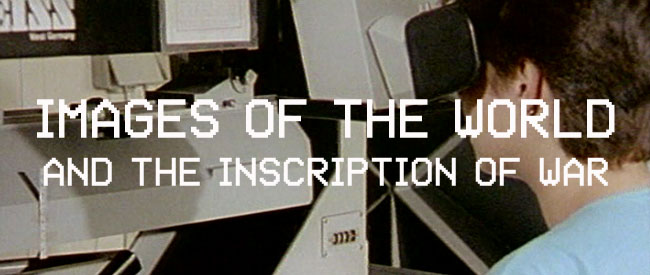
Images of the World and the Inscription of War

IMAGES OF THE WORLD AND THE INSCRIPTION OF WAR
Dir. Harun Farocki, 1989
West Germany, 75 min.
In English and German with English subtitles

MONDAY, JANUARY 13 – 7:30 PM
THURSDAY, JANUARY 30 – 7:30 PM

The most explicit essay-film of the series, Images of the World explores the dichotomy between looking and seeing. The film begins with aerial photographs of German landscapes from 1944 taken by American bombers searching for industrial bombing targets. It is not until decades later that the CIA unearths these photographs from their dusty files to discover that the American bombers had inadvertently taken a comprehensive survey of Auschwitz. The American bombers, able to immediately see their war targets, were unable to recognize the true atrocities occurring on the ground. While Auschwitz was photographed in 1944, it was not seen until the 70s.


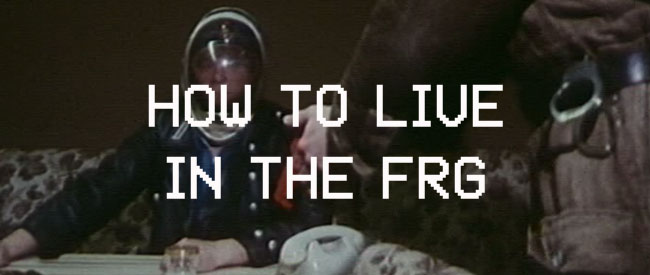
How to Live in the German Federal Republic

HOW TO LIVE IN THE GERMAN FEDERAL REPUBLIC
Dir. Harun Farocki, 1990
West Germany, 83 min.
In German with English subtitles

WEDNESDAY, JANUARY 15 – 7:30 PM
THURSDAY, JANUARY 16 – 10:00 PM

In How to Live, Farocki filmed various ‘vital-living’ training and instructional lessons performed in West Germany, right before reunification with the East. Using such lessons as facilitating a birth to purchasing life insurance, Farocki orders these lessons in a loosely chronological order, beginning with birth and ending with death. At times dark, How to Live occasionally leads to a dryly-comedic reading of the detachment the instructors feel towards such real-world subjects.


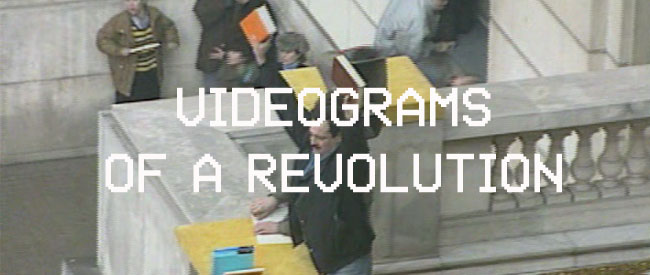
Videograms of a Revolution

VIDEOGRAMS OF A REVOLUTION
Dir. Harun Farocki & Andrei Ujica, 1992
Germany/Romania, 90 min.
In English, German & Romanian with English subtitles

SATURDAY, JANUARY 11 – 7:30 PM
SATURDAY, JANUARY 25 – 7:30 PM

Compiled of over 125 hours of found footage, amateur videos, and “official” television coverage–not to mention footage from the occupied Bucharest-TV station–Videograms of a Revolution carefully reconstructs and pieces together the events leading up to the uprising that overthrew Nicolae Ceausescu, the dictator of Romania in 1989. By combining official and marginal accounts of the revolution, Videograms shows how the camera is not only a tool for recording history, but an integral part in creating it.


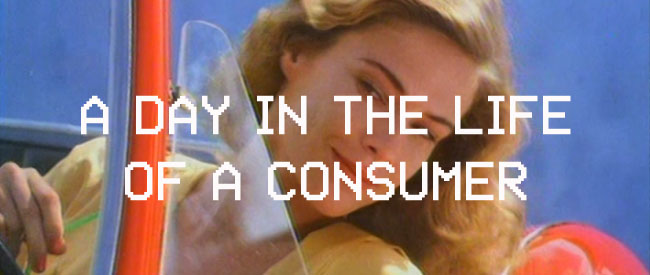
A Day in the Life of a Consumer

A DAY IN THE LIFE OF A CONSUMER
Dir. Harun Farocki, 1993
Germany, 44 min.
In German with English subtitles

THURSDAY, JANUARY 16 – 7:30 PM
WEDNESDAY, JANUARY 29 – 7:30 PM

In this highly conceptual piece predating the existence of the “supercut” by a number of years, Farocki pieces together every moment of a typical day, from dawn to nightfall, using only television advertisements. While ’80s and ’90s German commercials are hilarious—and definitely not intentionally—taken out of context and streamed seamlessly together, they reveal the unsettling oppressiveness and mania of a consumer-driven society.

TALES OF TURBULENCE FROM EMILIA-ROMAGNA

The region of Emilia-Romagna in Northern Italy prides itself on its contributions to cinema. From a website promoting tourism in the region: “Emilia-Romagna has always had a strong cinematographic tradition, with a place of honour in the history of cinema for having spawned major filmmakers like Michelangelo Antonioni, Federico Fellini, Tonino Guerra, Cesare Zavattini, Bernardo Bertolucci, Pier Paolo Pisolini [sic], Valerio Zurlini, Pupi Avati, Florestano Vancini and Liliana Cavani.”

Naturally, for the Emilia-Romagna tourism board these names are nothing but ornaments. The irreverent temperaments and iconoclastic impulses of Fellini, Pasolini, and Bertolucci are well known, and there are other transgressive figures among those listed who would scoff at being held up as exemplars of their region’s cultural heritage. Liliana Cavani was branded an enemy of the church when her early Galileo biopic was banned by the Italian authorities, and reviled even more for the Nazi eroticism in The Night Porter a few years later. Why is old-guard communist Valerio Zurlini included? Probably not because of his forgotten anticolonial prison film Seduto alla sua destra (released in the US as Black Jesus and retitled Super Brother for a VHS release) about Patrice Lumumba’s capture and torture by the Belgian authorities. The tourism bureau omitted Marco Bellocchio from its list, maybe because they forgot about him, or maybe because the intense anticlericalism and Maoism of his early films, such as China is Near and Long Live Red Proletarian May Day, make him an unsavory figure.

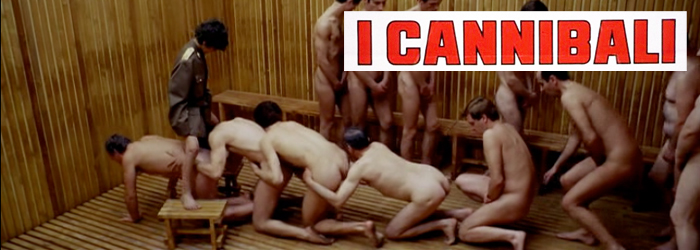
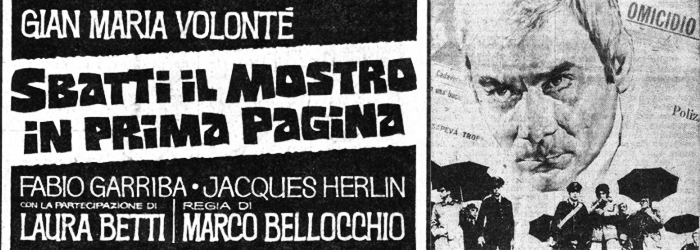
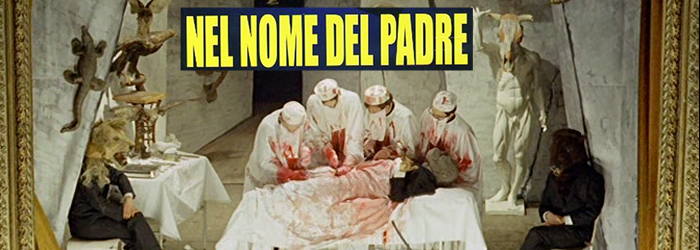
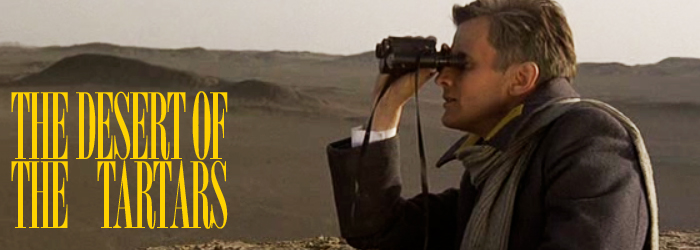
It is these three punks and pranksters, these black sheep and street-urchins, these thorns in the side of self-respecting Italian society whom the Spectacle Theater wishes to present to you, but through an entirely different set of films than those mentioned above. Liliana Cavani’s I Cannibali presents us with a near-future Milan where radicals are being killed in the street left and right, and exceptional legislation is passed to prevent their burial. Valerio Zurlini’s Desert of the Tartars in turn buries us in the absurdity of an imperial military outpost paralyzed by an eternal expectation of barbarian invasion, an obscure threat that is never realized. Marco Bellocchio’s In the Name of the Father is an Italian If… in which a Catholic boarding school and its administration are thoroughly disrespected and ridiculed by an utterly ungovernable student body led by a coldly calculating vanguard, and paternal authority in all its guises is literally slapped around from the first minute onward. Finally, Bellocchio’s Slap the Monster on Page One brings us back to Milan, where the streets are illuminated by erupting petrol bombs, and where student protesters, militant workers, and leftists of all stripes are being systematically criminalized by a powerful right-wing sensationalist newspaper helmed by an inscrutable but ultimately impotent Gian Maria Volonté.


Cannibali banner THE YEAR OF THE CANNIBALS
a.k.a. I cannibali
Dir. Liliana Cavani, 1969
Italy, 95 mins.
In Italian with English subtitles.

SUNDAY, JANUARY 5 – 5:00 PM
WEDNESDAY, JANUARY 22 – 10:00 PM

Liliana Cavani is probably best known for her portrayal of a complex erotic relationship between a former SS officer and a concentration camp survivor in her 1974 film The Night Porter. Largely overlooked however is her 1969 feature, The Year of the Cannibals, which investigates a different kind of obscene authority and the “natural rebellion” it provokes.

In this loose adaptation of Antigone set in a near-future Milan, the State has forbidden the removal of the bodies of rebels that litter the streets. As a result, the corpses are stepped over and ignored by the citizens, reminding us how a comfortable private existence in the metropolis everywhere means turning a blind eye to misery. Britt Ekland (The Man with the Golden Gun) and Pierre Clémenti (Pigsty, The Conformist) band together as vigilante body-snatchers in defiance of the decree, and ultimately face repression and execution. A radical chic romp that recalls A Hard Day’s Night and Clémenti’s work with Groupe Zanzibar, The Year of the Cannibals also offers a sober early analysis of the notorious “years of lead” in Italy, characterized by witch-hunts and wholesale incarceration of suspected militants.

“I intended to use the language of myth and universal symbols to avoid the revolutionary speeches that had become a cliché by 1969-1970. … [The Year of the Cannibals] is not the chronicle of a revolution, … but the spectral analysis of reality beyond the various episodes that characterized the demonstrations. I believe it is a comprehensive analysis, and primarily a discourse of generations.”
-Interview in Écran #26, June 1974


Sbatti il mostro banner SLAP THE MONSTER ON PAGE ONE
a.k.a. Sbatti il mostro in prima pagina
Dir. Marco Bellocchio, 1972
Italy, 90 mins.
In Italian with English subtitles.

WEDNESDAY, JANUARY 8 – 7:30 PM
SUNDAY, JANUARY 19 – 5:00 PM
MONDAY, JANUARY 20 – 10:00 PM

At Il Giornale, Milan’s equivalent of The New York Post, editor-in-chief Gian Maria Volonté is in charge of engineering the headlines for maximum effect: A story about a self-immolation is sensitive material (“You can’t say ‘desperate’ and ‘unemployed’ … It’s a provocation!”) and has to be dealt with tactfully (“Dramatic Suicide of an Immigrant”), while criminal fanatics should be treated with the utmost severity (“The Circle is Closed: Fascists and Left Extremists United by TNT“).

When a high school student is found strangled in the woods, Volonté’s misinformation machine kicks into high gear to mythologize her as the very image of saintly innocence and chastity and to cast her classmates as a diabolical anarcho-Maoist conspiracy bent on chaos and corruption. With the elections closing in, a mysterious Christian Democrat candidate controls the newspaper’s editorial direction remotely from his kitsch-baroque office, engineering a defensive mass-hysteria over red guerrillas and provocateurs lurking in the shadows and threatening to dismantle civilization by force of Molotov cocktails and rock-n-roll.

Made in the early years of the massive proletarian and youth movements that erupted in Italy in the late 60s, Slap the Monster on Page One is both a partisan self-critique and a response to the climate of fear and repression generated by the reaction.


Name of the Father banner IN THE NAME OF THE FATHER
a.k.a. Nel nome del padre
Dir. Marco Bellocchio, 1971
Italy, 115 mins.
In Italian with English subtitles.

WEDNESDAY, JANUARY 8 – 10:00 PM
WEDNESDAY, JANUARY 22 – 7:30 PM

“To ridicule, with farcical overtones, the hypocrisy of our religious institutions and their representatives: the confessors, the exorcists, the spiritual terrorists, those specialists in the fear of God, always trying to traumatize us. We hope that the audience will erupt in a liberating laugh, managing to be ironical about their own fears, their existential traumas! I wish I had the power to erase all priests and all churches!”

This could be a description of Bellocchio’s purpose in making In The Name of the Father, but it is spoken by Franco, a student at an unnamed Catholic boarding school where he—as part of a small intellectual vanguard—hopes to incite the rest of the already insubordinate student body to open rebellion. Another member, the rigorous and aristocratic Transeunti, is desperate to overcome the paralyzing mediocrity he sees permeating the school, and dreams of restoring a decaying institution whose former authority and social significance have almost completely eroded with the expansion of capitalist social relations and their norm-liquidating power.

The conflict between the administration and the students is supplemented by that between the students and the kitchen staff, a group of marginals, invalids, and former drunks whom the school has given the chance to redeem themselves through labor. Lou Castel, the star of Bellocchio’s debut feature Fists in the Pocket, is foremost among them in antagonizing the bourgeois students, spitting in their soup and sabotaging Franco and Transeunti’s didactic play.

Never before has paternal authority been so thoroughly discredited and revealed in its impotence. Dads, priests, wardens, and even God himself get their share of contempt heaped on them. In a scene reminiscent of the most beautiful shot in Jean Vigo’s Zero for Conduct, the boys in single file march up to a bust of the school’s founder and hawk loogies at him, drenching his face in mucus in slow motion.


Tartars banner

THE DESERT OF THE TARTARS
a.k.a. Il deserto dei tartari
Dir. Valerio Zurlini, 1976
Italy, 140 mins.
In Italian with English subtitles.

SUNDAY, JANUARY 5 – 7:30 PM
SUNDAY, JANUARY 19 – 7:30 PM

“The older a nation’s history is, the more legends spring up. In the end, we don’t know what’s true and what isn’t.”

Largely overlooked director Valerio Zurlini’s The Desert of the Tartars is an allegory of the disintegration of Empire.

It is 1901. Lieutenant Drogo (played by frequent Costa-Gavras collaborator Jacques Perrin) graduates from the military academy and is immediately dispatched to the most remote fortress on the northern border of an unnamed empire to guard against a mythical impending barbarian invasion. The only sign of human presence in the desert beyond the border has been a group of mysterious horsemen glimpsed fifteen years prior by Captain Hortiz (Bergman favorite and exorcist Max von Sydow), and the only officer who has seen any action is the ancient and distinguished Colonel Nathanson (Fernando Rey of The Discreet Charm of the Bourgeoisie and The French Connection).

Years pass in performing pointless drills, maintaining the most painstaking decorum, and undertaking futile land-surveying missions in the surrounding desolation. Doctor Rovin (Jean-Louis Trintignant of The Conformist, My Night at Maude’s, and Z) has discovered rare bacteria living in the fortress’s walls, which ultimately lead to Lieutenant Drogo’s ill health and pathetic withdrawal from the fortress.

Described as “the grandest and most lavish existentialist parable ever made” (Michael Atkinson, The Village Voice), The Desert of the Tartars is about the historic necessity of empires to define themselves in opposition to an external threat, and the inevitable autoimmunitary destruction that threatens them from within.

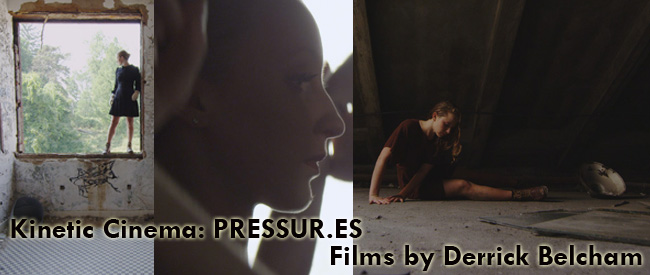
KINETIC CINEMA: PRESSUR.ES

Kinetic Cinema: PRESSUR.ES

PRESSUR.ES
Dir. Derrick Belcham
USA, 90 min.

THURSDAY, JANUARY 9 – 8:00pm

On January 9th, Derrick Belcham will present a night of excerpts from PRESSUR.ES, a 10 film dance series exploring the interaction of choreography, score and the edit and also select music videos. The night features music by Sarah Neufeld (Arcade Fire), Skye Skjelset (Fleet Foxes), Casey Dienel (White Hinterland), Marissa Nadler and Diane Cluck and choreography by Emery LeCrone, Miguel Gutierrez, Melanie Maar, Mariel Lugosch-Ecker, Lily Ockwell and Emily Terndrup.

Derrick Belcham is a Canadian filmmaker based out of Brooklyn, NY whose internationally-recognized work in vérité music documentary has lead him to work with such artists as Philip Glass, Steve Reich, Thurston Moore and Wilco. He has created works in concert with MoMA PS1, MoCA, The Solomon R. Guggenheim Museum, The Whitney Museum Of American Art, Musee D’Art Contemporain, Brooklyn Academy of Music and The Contemporary Arts Centre of Cincinnati. His work has appeared in outlets such as The New York Times, Vogue, Pitchfork, MTV, NPR and Rolling Stone.

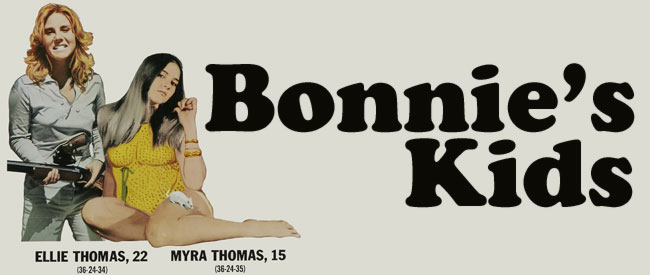
BONNIE’S KIDS

bonnies-kids-bannerBONNIE’S KIDS
Dir. Arthur Marks, 1973
USA, 105 min.

MONDAY, JANUARY 6 – 7:30 PM
MONDAY, JANUARY 13 – 10:00 PM
SUNDAY, JANUARY 26 – 7:30 PM

[TRIGGER WARNING: Forewarned is forearmed–Bonnie’s Kids and their friends don’t play nice: scenes of violence, attempted sexual assault, incest, deviant behavior and general mean-spiritedness abound.]

Bonnie’s Kids like the kind of kicks that could kill you!
Hang out with “Bonnie’s Kids” — you’ll have a blast!
Bonnie’s Kids—they’ll blow you…away.

Forgotten and largely unseen since its initial release in 1973, Bonnie’s Kids is a lost neo-noir sleaze classic that deserves rediscovering. It’s so much more than drive-in/grindhouse filler: It’s a great twist on the “femme fatale on the run” theme, one that really toys with the audience, like an especially malicious cat with a hapless mouse.

Rather than a film, Bonnie’s Kids honestly feels more like a sleazy paperback book you’d pick up in a junkshop while on vacation—and you only picked it up in the first place because of its lurid cover—but you cannot stop reading it once you’ve started. When you’re done, you want to tell all your friends about it.

What starts off as a dopey white-trash teen-sex-romp rapidly mutates into something else far more sinister, finally metastasizing into the savage B-movie love child of Elmore Leonard and Charles Willeford.

With both barrels of a shotgun, Ellie (Tiffany Bolling) and her jailbait sister, 15-year-old Myra (the oh-so-naughty Robin Mattson), have escaped the clutches of their molesting stepdad, and split to the big city of San Jose (!?!) to enjoy the good life with their Uncle Ben (veteran character actor Scott Brady; this flick is overflowing with recognizable faces), a gent whose publishing empire is a cross between Playboy and Hustler.

While Ben’s lesbian wife takes a shining to young Myra, Ellie oozes her charms at the publisher until he uses her to “run an errand,” which turns out to mean picking up a half a million dollars of stolen loot!

After hooking up with a lunkheaded but handsome private eye (Steve Sandor, later the evil biker from The Ninth Configuration), Ellie double-crosses Ben—and of course he sends henchmen after her. And this is where things really pick up: the goons are a salt & pepper team, Digger (Timothy Brown) and Eddie (Alex Rocco, veteran of a zillion hard-boiled flicks, but best remembered for getting shot in the eye in The Godfather). Eddie is the leader, and he’s like a cousin of Richard Stark’s paperback novel anti-hero “Parker,” a no-bullshit professional, but both he and Digger are intelligent, hard-working and tenacious—as well as ruthlessly vicious.

Although usually set in the bright, almost blinding sunshine, Bonnie’s Kids continues the film noir tradition of creating a world that is dark, brutal and hopeless—an existential nightmare. For the most part, everyone is mean or on the make, and the nicest character is considered by others to be a “pervert” and a “creep.”

Like a good pulp thriller, Bonnie’s Kids is willing to throw you curveballs. As the film advances, it gets more and more mean-spirited: innocent bystanders are slaughtered, good Samaritans have their heads kicked in, and a blood and mayhem are left in the awesomely tawdry Ellie’s wake. Meanwhile, she and her Private Dick get worse and worse: they are not nice people.

Through the help of crisp cinematography, great use of unique locations in the Southwest (all of which are now probably gone due to expanding urban development), and a grim, fatalistic and genuinely ironic ending, Bonnie’s Kids is a wonderfully nasty neo-noir. Subtlety isn’t its strong suit, but soon what had been a TV-movie-style of artlessness, becomes a cold, dispassionate vision—akin to villain Alex Rocco’s point of view, almost as if he was infusing the film with his personality.

This is a B-movie that keeps getting better and better as it moves along—tracking its protagonists on their one-way express trip straight to hell. But it’s the superbly crafted rise and fall of Ellie, the doomed trailer trash valkyrie who risked it all for the sweet life, that really makes the flick.

Played with loads of killer attitude by the superfine Tiffany Bolling (also the star of The Candy Snatchers, as well as Kingdom of the Spiders), protagonist Ellie is the missing link between Gene Tierney in Leave Her to Heaven, the psycho go-go girls of Faster Pussycat Kill! Kill! and ice-cold evil super-genius Wendy Kroy of The Last Seduction. A white trash demoness using razor-sharp guile and a body built for sin to get what she wants, Ellie’s only semi-civilized, though, and still a danger to herself—not to mention everybody else around her…

And as for sweet, sexy Myra? Heh-heh-heh, just watch the movie and you’ll find out… (But it’s really a perfect ending—honestly!)

BEST OF SPECTACLE 2013

bestofs-banner

To mark the conclusion of Spectacle’s third full calendar year of operation, our programming collective has selected their favorites from among the regular series features each other showed throughout the past twelve months. The result, BEST OF SPECTACLE (aka BoS2K13), provides an opportunity to revisit some of 2013’s greatest discoveries, thrills and audience-pleasers.

As the year draws to a close, Spectacle would like to acknowledge the audiences, artists and distributors who have pitched in their support, vision and feedback. Thank you for another brilliant year! We’ll save you a seat in 2014.
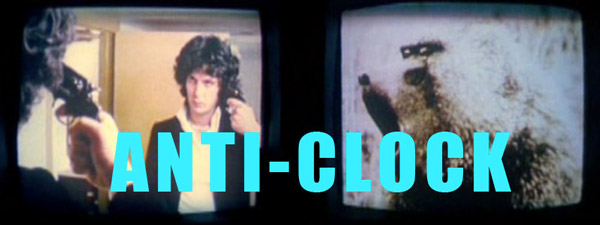

anticlock-banner

ANTI-CLOCK
Dir. Jane Arden & Jack Bond, 1979
92 min. UK.

SUNDAY, DECEMBER 15 – 5:00 PM
SATURDAY, DECEMBER 21 – 7:30 PM

Part of the series Arden & Bond

A mixed-media riddle, fractured psychodrama and slow-burning sci-fi thriller all fused into one, Anti-Clock- the final feature born out of Arden and Bond’s collaboration and only one in which they are credited as co-directors- is the CCTV output of your most paranoid, hypnagogic distress.

Ostensibly a loose narrative about an experimental psychiatric procedure that deconstructs the past, present and future of a suicidal young man, Arden and Bond employ a variety of film and video processing techniques to conjure a world in which mind and screen are enigmatically intertwined. As described in the opening credits (appropriately buried in a sea of television static), Anti-Clock is a ‘time stop’ of obsessive self-revelation.

The film premiered at the London Film Festival in 1979 and experienced a short run in NYC in 1980 before being shelved in 1982 after Jane Arden’s suicide.

assa-banner-3

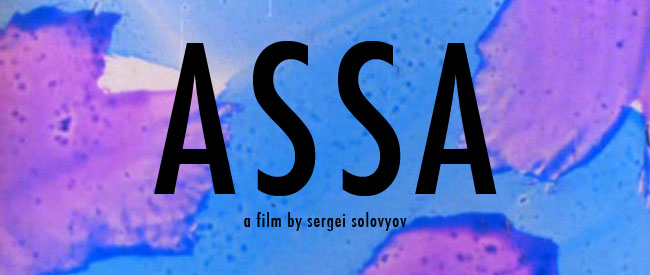
ASSA
Dir. Sergei Solovyov, 1987
Soviet Union, 153 min.
Russian with English subtitles.

SUNDAY, DECEMBER 1 – 7:30 PM
SUNDAY, DECEMBER 15 – 7:30 PM

Part of the series MOLODOST: Films on Soviet Youth

Assa came to recognition and cult status as one of the first films to bring underground rock culture into the Soviet mainstream, featuring songs by bands such as Aquarium, Soyuz Kompozitorov, Bravo, and Kino (whose lead singer Viktor Tsoi, also featured in Igla, plays himself in the film). Assa reflected a time of change in the USSR, as emphasized in Tsoi’s song “We Wait for Change,” consequently adopted by the real-life Russian opposition movement Solidarnost as its anthem. Set in Crimea during the late 1980s, Assa follows the story of Alika, a young nurse who is romantically involved with Krymov, her much older patient and the leader of an organized crime group. Despite her relationship with Krymov, Alika starts falling for a young rock musician named Bananan (played by the avant-garde artist Afrika). Bananan introduces Alika to his countercultural world of music and art. When the jealous Krymov begins to notice a change in Alika’s emotions toward him, he stages a plan to eliminate Bananan from Alika’s life forever. Assa has a playful, absurdist touch, combining sober moments with dreamlike sequences. Experimental scenes of hand-painted abstract patterns and inter-titles explaining youth slang are interspersed throughout the film. One amusing subplot that develops follows Krymov reading a book of the assassination attempt on Russia’s Tsar Paul I—the “Mad Tsar”. As he reads, a fantasy reenactment plays parallel to the main story. Perhaps this text foreshadows the inevitable fate of the Union: according to the assassins, they were only abolishing a power from Russia that had gone mad.

boxer-banner

BOXER
Dir. Shûji Terayama, 1977
94 min. Japan.
In Japanese with English subtitles.

THURSDAY, DECEMBER 12 – 10:00 PM
WEDNESDAY, DECEMBER 18 – 7:30 PM

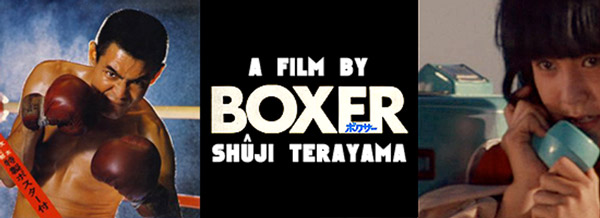
Dense with glorious tints and nail-biting moments, Shûji Terayama’s Boxer pits avant-garde and crowd-pleaser sensibilities against each other with downright jugular results.

The story is old as sin: a withered ex-champion, fueled by bitterness and drink, takes a young drifter under his wing. In a society that rewards cowardice and conformity, the student’s values are shaken by his mentor’s discipline and focus, but it’s hard to tell if the retired boxer is steady, or just plain berserk.

Spectacle favorite Terayama (Pastoral, Emperor Tomato Ketchup), who wrote boxing commentary as a hobby between plays and movies, gives the story a dazzling palette and lightning swiftness, but also a necessary sense of respect for the body – and the weight of its punishment.

embryo-bannere

THE EMBRYO HUNTS IN SECRET
Dir. Kôji Wakamatsu, 1966
72 min. Japan.
In Japanese with English subtitles.

THURSDAY, DECEMBER 12 – 7:30 PM
MONDAY, DECEMBER 16 – 10:00 PM

Part of the series Kôji Wakamatsu

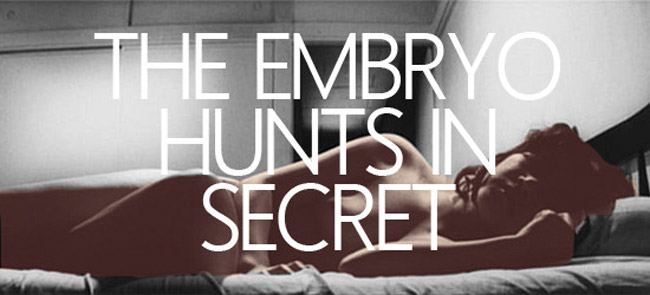
One part art house, one part Grindhouse, The Embryo Hunts In Secret was made right after Wakamatsu left Nikkatsu. This classic film presents a brutal exploration of the Japanese psyche seen through a child-like megalomaniac’s perspective.

This is a man who keeps his girlfriend imprisoned in their small apartment, controlling her every move and torturing her in between bouts of denial and self-induced humiliation. In the end, she gets revenge.

derfan-banner

DER FAN
aka Trance
Dir. Eckhart Schmidt, 1982
89 min. Germany.
In German with English subtitles.

MONDAY, DECEMBER 2 – 10:00 PM
SATURDAY, DECEMBER 14 – 7:30 PM


Part of the series Anti-Valentines 2013

In the wake of films like Christiane F., studies of displaced, dysfunctional German youth were plentiful. However, the frontrunner in the sweepstakes for the most memorable and disturbing entry would have to be Der Fan.

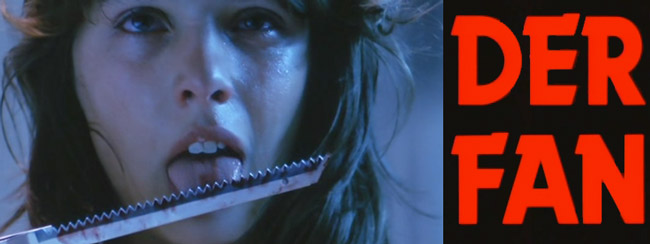
Like every other teenager in school, Simone has a crush on a rock star. And because this is Germany in the 80s, that rock star fronts a Kraftwerk-style new wave/minimal wave solo project. When the lead singer ‘R’ (lead singer of the real-life German pop group Rheingold) comes to town to make a television appearance, she’s suddenly gripped by a trance-like state… leaving school, friends and parents behind her. However, when Simone comes to realize the shallow nature of the ‘glamorous’ music industry and of ‘R’ himself, she plans a calculated revenge on her obsession that builds to one of the most shocking and brutal endings ever committed to celluloid.

An unsettling blend of new wave pop culture, adolescent angst, and full-blooded horror, this nasty little art-house shocker caught more than a few unsuspecting viewers off guard and earned a bit of a cult following in the process. Imagine a John Hughes vehicle with Michael Haneke in the driver’s seat and you’re getting close…
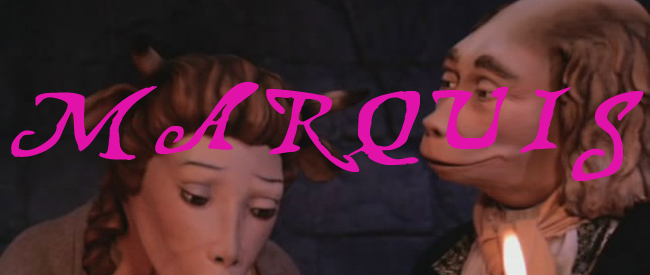

MARQUISbanner

MARQUIS
Dir. Henri Xhonneux. 1989
78 min. France.
In French with English subtitles.

TUESDAY, DECEMBER 3 – 10:00 PM
FRIDAY, DECEMBER 20 – 10:00 PM

Clumped in your history book between the chapters on French Revolution and pioneering 18th century erotic fiction grows a horny, pornographic mold called MARQUIS.

Immersed in a world in which uncanny animal masks mirror the spirit of the character within, a canine Marquis de Sade serves a prison sentence for allegedly raping the bovine Justine… but the situation may be more complicated than it seems. In between bouts of banter with his anthropomorphic, meter-long penis Colin, the Marquis gets down to writing a few of his more infamous scenes—many depicted in surreal claymation. Before too long the Revolution has begun, but where will it leave the Marquis?

Co-written by Henri Xhonneux and Roland Topor—animator of 1973′s inimitable surrealist classic “Fantastic Planet”—MARQUIS’s bizarre tone swings at will between irreverent perversion and clear-headed satire, never failing to entertain and utterly confound.

“This is one of the strangest movies I have ever seen. I found it to be discomforting and just weird. It makes you squirm in your seat and wonder what the people making this are like in real life. It’s definitely entertaining and it sort of sucks you in, especially if you don’t know French and have to read subtitles. It is certainly not American and it is certainly very peculiar. I have never seen a movie where everyone is wearing life-like animal costumes and acting like humans in very abnormal ways. This movie gives me the chills. However, I would watch it again just because it is so fascinatingly WEIRD.” -IMDB user ‘ethylester’

“NOT FOR THE PRUDISH.” -Variety

mary_jane_banner

MARY JANE’S NOT A VIRGIN ANYMORE
Dir. Sarah Jacobson, 1998.
98 min. USA.

FRIDAY, DECEMBER 6 – 7:30 PM
WEDNESDAY, DECEMBER 11 – 10:00 PM
THURSDAY, DECEMBER 19 – 10:00 PM

Part of the series You Can’t Keep Me Quiet!: Films by Sarah Jacobson

Sarah Jacobson (1971-2004) was an independent filmmaker who led a DIY filmmaking movement in the 90s. She wrote and directed several short films, documentaries, music videos and a feature film. She formed Station Wagon Productions with her mother and producer Ruth Jacobson and with her help, Sarah self-promoted and distributed her films all over the country. Originally from New Jersey and Minneapolis, Jacobson studied briefly at Bard College and then at the San Francisco Art Institute with George Kuchar.

She directed I Was a Teenage Serial Killer in 1993, which she described as the story of “a 19-year-old girl who has a series of run-ins with various condescending men.” Jacobson’s slap-in-the-face feminist interpretation of “sexy”/violent B movies found a cult following. Jacobson went on to make her feature Mary Jane’s Not a Virgin Anymore a few years later.

Too in your face to be an after-school special, Mary Jane’s Not a Virgin Anymore is a movie about sex from a girl’s point of view. After a gross and unceremonious “first time,” Jane learns about the joys of pleasing herself and asking for what she wants from her punky co-workers at a Midwestern movie theater (with Jello Biafra and Davey Havok cameos). the film debuted at the Chicago Underground Film Festival in 1997 and sold out at Sundance and SXSW; Jacobson promoted the film the year previous at the Independent Film Market with homemade “Not a Virgin” stickers that her and her mom made at Kinko’s.

After cancer ended Sarah Jacobson’s life in 2004, her mother Ruth and Sam Green established the Sarah Jacobson Film Grant to support young women “whose work embodies some of the things Sarah stood for: a fierce DIY approach to filmmaking, a radical social critique, and thoroughly underground sensibility.” Find out more about the Sarah Jacobson Film Grant here.
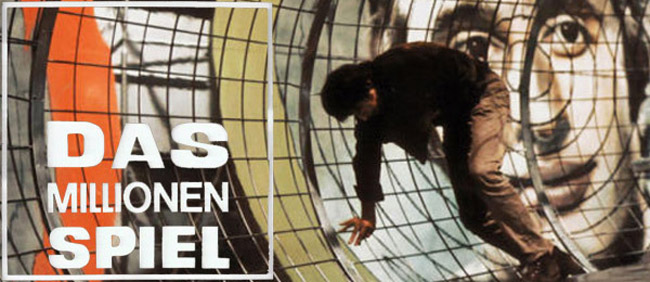

Millionenspiel-Banner

DAS MILLIONENSPIEL
Dir. Tom Toelle & Wolfgang Menge, 1970
96 min. West Germany.
In German with New English subtitles.

MONDAY, DECEMBER 2 – 7:30 PM
SATURDAY, DECEMBER 21 – 10:00 PM

Long before The Hunger Games, Battle Royale, Series 7: The Contenders and even The Running Man, 1970’s Das Millionenspeil portrays a deadly reality television contest in which a participant is given seven days to elude a trio of professional assassins and win a $1 million prize.

Based on a 1958 story by Robert Sheckley often cited as the first predicting the advent of reality television, Das Millionenspeil was itself made for German television and interspersed with convincing false advertisements, psychedelic studio interludes and man-on-the-street documentary bit. And moreso than all its followers, its a richly unsettling satire of government, broadcast and entertainment sectors colluding and engendering various alliances and sympathies among the public they entangle.

It also represents some of the first-ever recordings by the legendary CAN, then known as The Inner Space. Their propulsive title track and ambient interludes provide the backbone of an unusually polished, thrilling and subsequently little-seen production.
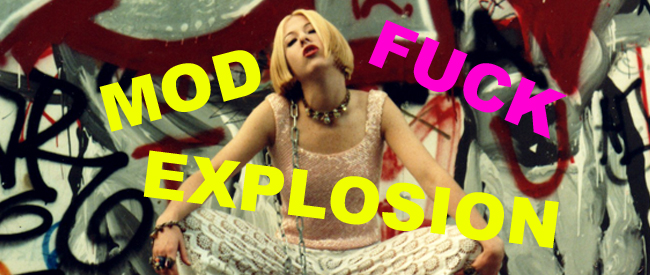

MOD FUCK BANNER

MOD FUCK EXPLOSION
Dir. Jon Moritsugu, 1994
76 min. USA.

FRIDAY, DECEMBER 6 – 10:00 PM
WEDNESDAY, DECEMBER 18 – 10:00 PM

Part of the series Postmodernism: Who Cares? The Complete Jon Moritsugu

Combining the tropes of 60s art-house cinema with the primitive punk aesthetics of the Cinema of Transgression, Jon Moritsugu has been making movies far outside the mainstream for over twenty-five years. While his work has screened at venues as high profile as the Sundance, Berlin and Toronto Film Festivals and even public television, he continually shirks convention and classification. After making his name with a series of hand-made 16mm features, he’s recently embraced video with a fervor and a freeness to which every young filmmaker should be paying attention. Moritsugu’s world is overflowing with eye-popping production design, eardrum-destroying rock ‘n’ roll, gross-outs aplenty and deadpan one-liners you’ll be quoting for weeks.

In this teen angst epic, London (Amy Davis) longs for love and leather jackets. Meanwhile, vicious Mods wage a turf war against a gang of lip-synched Asian bikers.

“A dynamic punk odyssey of a pair of innocent teens adrift in a violent urban world; Moritsugu unleashes a barrage of powerful images and hard-driving music.” – Los Angeles Times

lesbanner

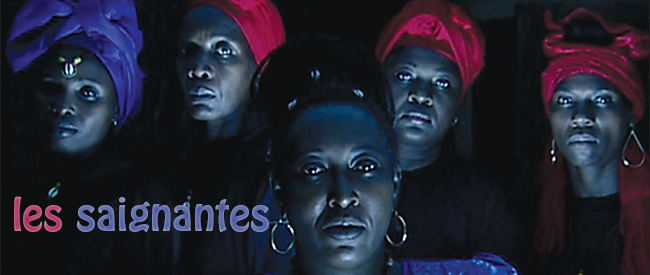
LES SAIGNANTES
aka The Blood-lettes
Dir. Jean Pierre Bekolo, 2005
Cameroon. 97 min.
In French with English subtitles.

FRIDAY, DECEMBER 13 – 10:00 PM
THURSDAY, DECEMBER 19 – 7:30 PM

Part of the series Welcome to Applied Fiction: The Films of Jean Pierre Bekolo

Les Saignantes is the best African sci-fi vampire political satire with homoerotic overtones you’ve ever seen. Best friends Majolie and Chouchou are two beautiful young women trying to get ahead in a near-future Cameroon. After accidentally killing a powerful politician during sex, the two come up with a plot to dispose of the body, and get into the glamorous wakes that have taken over the local nightlife.

As the girls tear their way through the corrupt ruling class, using their their feminine wiles and magical powers, Bekolo drops inter-titles into the film, commenting on the difficulties of filmmaking in an oppressive political climate. With a feminist subtext and cinematography like a blacklight rave, Les Saignantes is a beautiful, disorienting, and truly original work.

SchooloftheHolyBeast-Banner

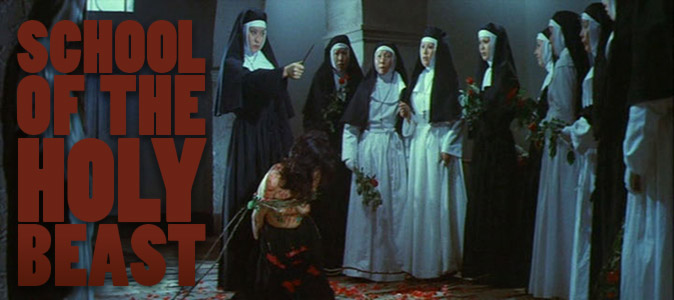
SCHOOL OF THE HOLY BEAST
Dir. Norifumi Suzuki, 1974
91 min. Japan.
In Japanese with English subtitles.

FRIDAY, DECEMBER 13 – 7:30 PM
SUNDAY, DECEMBER 22 – 5:00 PM

Part of the series S†NDAYS

Something foul is afoot at the Sacred Heart Convent, as Yumi Takigawa discovers after cloistering herself to search for traces of her mother, who had disappeared into the monastery years before. Once there, she becomes privy to dark secrets and sadistic games. In the hands of brilliant director Norifumi Suzuki, Sacred Heart is a wonderful and terrifying world of sensuality and violence rendered with masterful visual panache. Equally notorious for its exploitational extremes as its stunning artistry, School of the Holy Beast is a twisted rabbit hole of sin and vice that absolutely lives up to its legendary cult reputation.

SweetBunch-Banner.jpg.scaled1000

SWEET BUNCH
Dir. Nikos Nikolaidis, 1983
154 min. Greece.
In Greek with English subtitles.
New restoration presented in HD.

SUNDAY, DECEMBER 8 – 8:00 PM
SUNDAY, DECEMBER 22 – 7:30 PM

Part of the series Dead Wax: A Nikolaidis Double A-Side

Nikos Nikolaidis (1939-2007) is one of Greece’s most masterful and subversive filmmakers, yet his work remains inexplicably neglected abroad. Best known in the States for his transgressive, kinky horror-noir pastiche SINGAPORE SLING, his distinctive oeuvre encompasses many works embraced by radicals, outcasts and misfits, while earning an unexpected place within the pantheon of critically acclaimed national cinema of his native country.

Nikolaidis’s most acclaimed film charts a string of increasingly bizarre circumstances in the lives of four misanthropic housemates. An episodic, surreal, and offbeat paranoid epic in the spirit of Celine and Julie Go Boating, SWEET BUNCH weaves various plot strands as the characters cheat, steal, sleep, swindle and dance their way to oblivion, represented here by an extreme climax that clarifies the title’s allusion to Sam Peckinpah.

Veering between magical effervescence and hard-bitten cynicism, SWEET BUNCH is a neon-bathed yowl from a generation born into immediate obsolescence; what Vrasidas Karalis calls “an elegy and farewell to the innocence of a forgotten generation through poetic realism and colorful expression.” It’s further distinguished by nimble performances; a rich pop soundtrack; deftly choreographic sequences that would make Scorsese blush; and vintage-vortex production design encompassing offbeat knicknacks, Victorian junk, and jukejoint neons.

In it’s most recent list the Greek Film Critics Association (PEKK) ranked SWEET BUNCH among the country’s ten greatest films, and its idiosyncratic influence lingers in the work of Athina Rachel Tsangari and Giorgos Lanthimos. Nevertheless, SWEET BUNCH remains unavailable on DVD outside of Greece and previously had not been shown in New York in nearly 13 years. Here’s your chance to catch up on a national classic all-too overlooked outside its borders.

Telhphonebook-banner -new

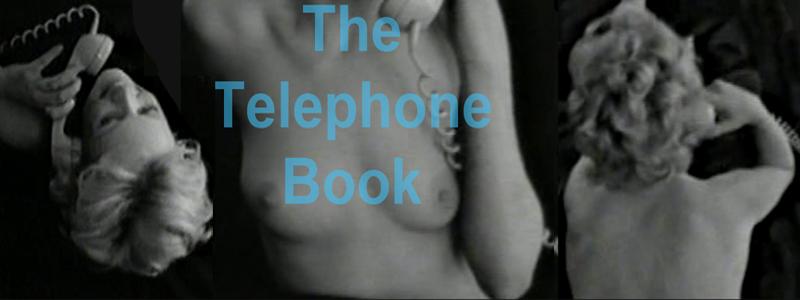
THE TELEPHONE BOOK
Dir. Nelson Lyon. 1971
80 min. USA.

TUESDAY, DECEMBER 3 – 7:30 PM
FRIDAY, DECEMBER 20 – 7:30 PM

Sexually frustrated gamine Alice (Sarah Kennedy) is freed from her apartment-bound malaise when she receives the world’s greatest obscene phone call from one “John Smith.” Setting out on picaresque journey through the Manhattan white pages in search of its maker, Alice encounters ego-crazed porn directors, perverted psychologists and priapic shut-ins. Her trip grows more and more deranged (interrupted by first-person interviews with phone freaks), climaxing in one of the nuttiest half-hours of 1970s cinema.

Directed by Saturday Night Live writer Nelson Lyon and produced by Merv Bloch, creator of some of the movie industry’s best ad campaigns, The Telephone Book is hilarious and disturbing in equal measure, featuring Warhol Factory regulars, a man with a never-ending erection, and a lurid animation sequence (that is mostly to blame for its X rating). This is the Everything You’ve Always Wanted to Know About Sex But Were Afraid To Ask…for the porn-house crowd, with one caveat: it’s not porn and it never pretends to be.

WorkingClass.png

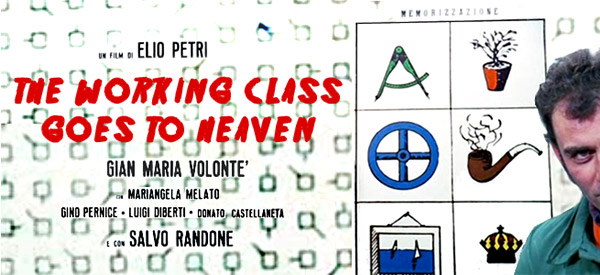
THE WORKING CLASS GOES TO HEAVEN
aka La Classe Operaia Va in Paradiso
Dir. Elio Petri, 1971
112 min. Italy.
In Italian with English subtitles.

SUNDAY, DECEMBER 1 – 5:00 PM
MONDAY, DECEMBER 16 – 7:30 PM

Part of the series Elio Petri

“Such films should be burned.”
–Jean-Marie Straub

Shot in a factory occupied by striking workers, The Working Class Goes to Heaven is Petri’s investigation of the restructuring of capitalist social relations and the waning primacy of the mass worker as the holder of revolutionary agency (Gian Maria Volonté stars as “Lulu Massa”). Student militants and union bureaucrats battle over piecework at the factory gates, while the workers themselves remain in a state of fatal ambivalence.

The mutilation of the body and the consciousness of the worker here receives one of its clearest cinematic expressions. The worker’s total incorporation into the machine of large-scale industry also occasions the most Deleuzian moment in Petri’s oeuvre: “The machine starts to move. Arms, legs, mouth tongue … The food goes down, and here is the machine that crushes it. A shit-making factory!”

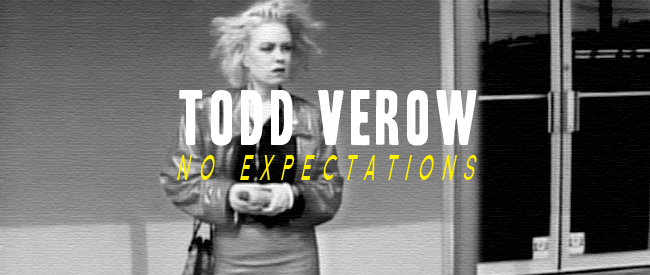
NO EXPECTATIONS: TODD VEROW

SERIESbanner

TODD VEROW IN ATTENDANCE FRIDAY, NOVEMBER 22nd!

Todd Verow did and does what a lot of people talk about doing – he makes movies. AND he does it often, with no excuses. Spectacle is proud to present four early works by the “once and future king of DV”.

A veteran of punk and queer cinema, Verow is the eye behind the detached yet dynamic compositions which comprise the playfully nihilistic work of Jon Moritsugu. But where Moritsugu’s films spend most of their time in vacuous tableaus, and revel in a kind of expectation quashing, antagonistic stillness, Verow’s early punk works are hyperactive all nighters of DV ADD. Verow has a glitter-soaked map of Nowhere, and his films manically careen from one soul crushingly small apartment to another in search of pills, booze, sex, but most of all – a place to crash.

Verow’s camera is wild, unpredictable, too close (everyone needs a close-up), too dark (who needs lights?), and too bright (that morning sun can hit like a ton of bricks). In short, it’s exciting and beautiful and like his characters, it never stops moving. These wild, restless films about addiction and the perils and pleasures of living nakedly in the moment manage to stay quite surprisingly upbeat; even in the lowest lows there is a tender and charming optimism, all furnished by Verow’s own stable of superstars and chameleons, some low key (Bill Dwyer) and some outrageous (Eric Sapp, Philly).

Club kids, undiscovered punk legends, wannabe stars, junkies, real losers, users, drag queens – they’re still here down on the exhausted LES (out in the wastelands of suburbia too), still searching, still laughing, still smiling and partying with no expectations. Verow is the only filmmaker who can keep up with them.


HAPPINESSbanner

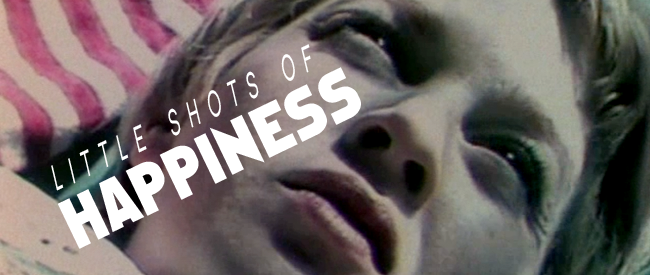
LITTLE SHOTS OF HAPPINESS
Dir. Todd Verow, 1997
USA, 83 min.

SATURDAY, NOVEMBER 9 – 7:30 PM
FRIDAY, NOVEMBER 22 – 7:30 PM (with Verow in attendance!)

Bonnie Dickenson plays Frances, a cubicle clock watcher with a secret – instead of going home at night to her Jack Torrance-esque husband and their stultifying suburban home, she does a quick costume change in the office bathroom and hits the town in search of sex, booze, and, most importantly, a place to spend the night. Little Shots Of Happiness is a gleeful, sexy, sometimes goofy, sometimes scary and unpredictable journey of one woman who has decided it’s worth some weirdness to see what’s out there.

Spring boarding from the idea of making a movie with just a camera, no lights and direct sound, this perfectly absurd yet oddly realistic premise (a woman living out a suitcase in her office) allows Verow and his crew to sketch another characteristically wild, aesthetically restless, raw, funny little movie. Bonnie Dickenson provides the charming, understated heart of Little Shots – taking sex, drugs, and violence all in stride, even with smiling good humor. Shot in Boston and featuring the early Verow regulars, this one is so stripped-down that while it evokes the episodic narrative adventures of the nouvelle vague, its minimalist humanism might be more akin to their spiritual father, Roberto Rossellini, with more techno, sex and drugs.


CURVEbanner
SHUCKING THE CURVE
Dir. Todd Verow, 1998
USA, 89 min.

SUNDAY, NOVEMBER 17 – 5:00 PM
FRIDAY, NOVEMBER 22 – 10:00 PM (with Verow in attendance!)

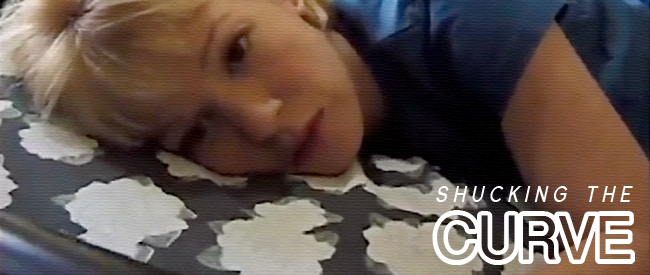
In Shucking The Curve, Verow finds the perfect premise for his most wildly gleeful exploration of negative capability – a New York City apartment hunt.

Suzanne Fountain (Bonnie Dickenson) has just arrived in New York City with a sort of perfunctory dream of being an actress and accumulating some experiences. But soon after arriving at an old friend’s apartment, who promptly hits her up for cash and then disappears, she finds herself in one bizarre and desperate situation after another in
her search for a new place to stay, and discovers that the city is more dangerous, tempting and duplicitous than she might have expected.

Like La Dolce Vita on DV, Curve traces a Dantesque course through the LES ranging from grotesquely beautiful (and hilarious) scenes of debauchery to delicate moments of human connection to the stark and grim realities of being broke and addicted. In quick, unadorned fashion, with his outlandish cast of regulars, Verow creates a fast and exhilarating tribute to those days and nights that go on and on, before the your body catches up to your spirit.


QUEENbanner
ONCE AND FUTURE QUEEN
Dir. Todd Verow, 2000
USA, 76 min.

SATURDAY, NOVEMBER 16 – 10:00 PM
WEDNESDAY, NOVEMBER 27 – 7:30 PM

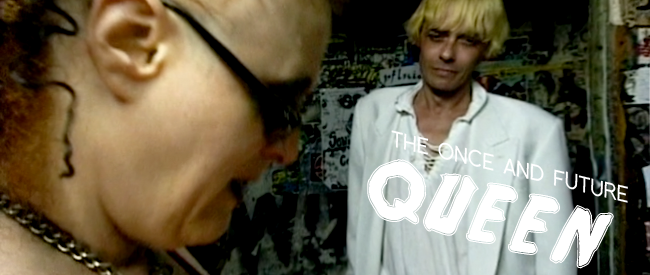
It’s not easy being a legendary genius no one knows about, but it’s sure fun to watch one try and make everyone understand that – especially when it’s Aunty Matter (Verow regular Philly), a walking talking punk rock id, whose stage antics fall somewhere between Edith Massey and G.G. Allin.

In typical Verow fashion Aunty Matter crawls across lower Manhattan looking for pills, booze, sex and a place to crash. She’s struggling to keep her band together and to stay high and alive – it’s not easy though -because after all, a lovable pariah is still a pariah. Follow the Once And Future Queen as she bounces from bedroom to bedroom, bathroom to bathroom, gobbling pills, guzzling booze, pissing everyone off, all in search of what else? More.

Queen is a fast and ugly, rough and hilarious downward spiral which showcases Philly, Verow’s compulsively watchable Divine -a philosophy spewing punk rock queen who you can’t help but love and root for. It’s also filled with lot’s of nasty, raw punk and some lofi visual passages that explore the possibilities of grainy, free form video poetry.


GRAVITYbanner

A SUDDEN LOSS OF GRAVITY
Dir. Todd Verow, 2000
USA, 90 min.

TUESDAY, NOVEMBER 5 – 10:00 PM
SUNDAY, NOVEMBER 24 – 5:00 PM

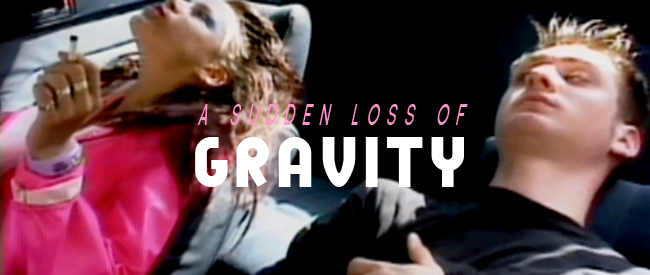
A Sudden Loss Of Gravity is Verow’s sprawling love letter (hate mail?) to small town life, where self destruction and boredom go hand in hand, and being weird and wasted is the only way to survive.

Set in Bangor, Maine (Verow’s hometown and the inspiration for his own Bangor Films), Gravity is the most ambitious and complex -narratively and temporally – of Verow’s early works. This makeshift period piece weaves multiple characters, narratives, past and present events, digressions and strange dead ends into a meditation on suburban angst and the terror and the beauty of burning hot and bright. Along the way though, there are quiet odes to human connnection and what at first comes on like a ragged, trash odyssey through the heart of teenage nihilsm turns out a measured, multi-faceted picture of longing, regret, rage and second chances.

Made with the detailed care and knowledge that comes from hometown filmmaking, this one is for anyone who ever loved and hated their own small town, and felt the desire to share the particular flavor of their own experience with someone else – a task Verow transforms into his own brand of poetry.

NEW IRISH UNDERGROUND FILM

IRISHseriesblank

THURSDAY, NOVEMBER 7th – 7:30PM & 10PM
THURSDAY, NOVEMBER 21st – 7:30PM & 10PM
THURSDAY, DECEMBER 5th – 7:30PM & 10PM

(Detailed synopses below) 

Irish cinema has never been renowned for harboring a vibrant underground or experimental film scene. There have been significant exceptions (most importantly, aspects of the Irish “First Wave” of the 1970s), but it’s only in recent years that a body of films has emerged that offer a powerful rebuttal to that perception. While to announce a fully-fledged “movement” would be premature, it is safe to say that the work of the four filmmakers featured in this series – Rouzbeh Rashidi, Maximilian Le Cain, Dean Kavanagh and Michael Higgins – represent an important new direction in Irish cinema.

Working with minimal and usually non-existent budgets, primarily on video, with zero crew and casts typically drawn from friends and family, all four filmmakers have been developing at a prolific rate over the past few years. Between them, they have produced 32 features since 2008 – though it must be admitted Rashidi, who in 2012 alone directed 9 features and 76 short films, has been the most insanely fertile contributor. All the filmmakers are members of the Experimental Film Society, an international organization founded by Rashidi aiming “to produce and promote films by its members” who are “distinguished by an uncompromising, no-budget devotion to personal, experimental cinema.” As this series will make clear, they have also been known to appear in each other’s films, and even collaborate on film projects together from time to time. (Strangely enough, Rashidi, Le Cain and Kavanagh have even released three albums of sound art together, under the collective moniker “Cinema Cyanide”.)

Irish4

For the most part, the films operate in an uncanny space between experimental and narrative film. On the one hand, generally eschewing plot and any conventional notion of “eventfulness” in favor of the immediate sensuousness of images and sounds and their juxtaposition – on the other hand, using performers, locations, lighting and sound design to evoke affects and atmospheres more readily associated with genre cinema, especially the horror film. Le Cain, also an accomplished critic, once wrote about David Lynch that he “frees the paranoia of noir from the straightjacket of narrative … [drowning] the plot in a great tidal wave of emotion”, and one can identify a similar impulse at work across many of these films. Le Cain adds that “the most unsettling aspect of [Lynch’s work] is that the fear seems to come from a source that is deeper than the plot indicates.”

It’s this deeper level that these filmmakers mostly concern themselves with. As the title of the opening film, There is No Escape from the Terrors of the Mind (2013), makes explicit, the unease evoked is existential rather than circumstantial: it’s much more about the nature of perception, memory and consciousness than anything that can be resolved, or even expressed, through action or dialogue. Usually forsaking plot entirely to tackle these depths head-on, the films mostly seem to reside in a strange, subterranean world free of the typical “narrative” trappings of our daily life. Jobs, money, the State, even social interaction, are rarely visible. Instead, there are bodies and there are spaces, there are sensations and there are memories, and there is the coming-into-being and intermingling of each of these through processes of perception (and cinema).

When language is foregrounded in these worlds – for example, in Higgins’ Birds on a Wire (2011) or Rashidi’s Bipedality (2010) – it is usually fragile and woefully insufficient. Le Cain has described Bipedality as one of Rashidi’s last films to feature extensive dialogues, as a study of “how inadequate language is to communicate feeling, or to grapple with the mysteries of existing in any given moment in relation to another person or simply to the world that surrounds one”, a world that is, in contrast, “almost overwhelmingly vivid and sensuous.” It’s our primal and problematic relationship to the world in this sense, that each of these filmmakers focus on in different ways: not the world before the Word (in the sense of Brakhage’s “untutored eye”) so much as a world beneath the Word, a subterranean field of sensations that is always available to us but which we can rarely share or articulate in social or verbal terms.


Irish5

Although it’s worth thinking through the question of whether this aesthetic direction is ultimately limited by its rejection of social or political contingencies and distrust of verbal expression, Le Cain’s thoughts on Rashidi make an opposing case that could apply to all four filmmakers: “He is not interested in cinema as arecord or replication of communication, but in what cinema can itself best communicate through sound and image. … He is concerned with the intensely private experiences of perception that perhaps cinema alone has the tools to communicate adequately.”

Or put another way, we could pick up the idea of filmmakers Graeme Thomson and Silvia Maglioni from their recent film In Search of Uiq (2013) that, “In our universe, we are tuned to the frequency that corresponds to the reality of capitalism … An infinite number of parallel realities coexist with us in the same room, although we cannot tune into them.” At their best, Rashidi, LeCain, Kavanagh and Higgins have found ways to tune into some of those other frequencies, and now invite us to join them.

Programmed by Donal Foreman, with special thanks to the Experimental Film Society.

For more information please visit: www.experimentalfilmsociety.com, www.rouzbehrashidi.com, www.maximilianlecain.com, www.deankavanagh.com, and www.mgmh.me.


THURSDAY NOVEMBER 7th – 7:30PM
HSP: THERE IS NO ESCAPE FROM THE TERRORS OF THE MIND
(Rouzbeh Rashidi, 120mins, 2013)

HSP: There Is No Escape From The Terrors Of The Mind consists of three medium length instalments of an ongoing film project by Rashidi, Homo Sapiens Project. These instalments, when watched back-to-back, will function as a single film structured in episodes. A mysterious loner, perhaps a poet, journeys through a series of uncanny surrealistic landscapes with an unclear purpose. His adventure is divided into three sections. The main theme of this experiment is to compare the eerier qualities of different landscapes and interpose the characters within them, elaborating the project’s ongoing preoccupation with extracting sinister moods from ordinary settings. In a way, these can be seen as experimental horror films in which an atmosphere of dread is evoked and sustained without the expected narrative trappings.” – Rashidi

THURSDAY NOVEMBER 7th – 10PM
BIPEDALITY (Rouzbeh Rashidi, 68mins, 2010)

“It is rare and thrilling to encounter a film that seems to pre-exist the viewer’s presence, one which pitches the audience into a disturbingly private universe and trusts it to find its bearings within an alien environment that belongs more to the characters than the spectator. There is no better example of this than Rouzbeh Rashidi’s magnificent and profoundly mysterious new underground feature Bipedality (2010). A two-hander focusing exclusively on a young couple played by Dean Kavanagh and Julia Gelezova, it troublingly articulates the way in which two people, even while sharing an intimate relationship, can remain mysterious to each other- and perhaps also to themselves.” – Le Cain

THURSDAY, NOVEMBER 21st – 7:30PM
A HARBOUR TOWN (Dean Kavanagh, 92mins, 2013)

“A young girl lives with her brother in a small cottage in the countryside. In the city a Health Inspector explores an abandoned building. It is unclear what has happened but it is evident that there have been environmental changes. A terrible sense of dread ensues and separates the brother and sister. The brother continues with his mundane chores in isolation, while the young girl drifts further away into the depths of a large rotting forest where she eventually disappears.” – Kavanagh

“Based in a small town in Co. Wicklow, working alone, without budgets and with casts more often than not drawn from his family, Kavanagh is a melancholy visionary of brooding isolation. His obscure narratives tend to focus either on the private rituals of home life or mysterious journeys to or from ‘home’, to or from memory…. His is unquestionably a cinema of contemplation: places, objects, faces, atmospheres and their immediate emotional charge are his stock in trade. Rather than telling stories in any traditional sense, his best films generate a slow, throbbing ache that invades and haunts his viewers. His world is rainswept, claustrophobic, fixated on details, with even his urban images steeped in rural gloom.” – Le Cain

THURSDAY, NOVEMBER 21st – 10pm
SHORT FILMS: MAXIMILIAN LE CAIN & VICKY LANGAN (60mins)

Since 2010, sound/performance artist Vicky Langan (aka Wölflinge) and experimental filmmaker Maximilian Le Cain have been working together in a unique creative audio-visual partnership. This is built on the strikingly fitting match between Langan’s magnetic, often troublingly intense presence as a performer and Le Cain’s distinctively jarring, disruptive visual rhythms. So far, they have completed eight moving image works together, six of which are presented in this program:

CONTACT (2011, 3 mins) uses Super-8 elements in constructing a dialectical relationship between film image and material.

WOLFLINGE 17/11/’10 (2011, 8 mins) is a haunting visual interpretation of a performance by Langan that breaks down the boundaries between spectator and performer.

LIGHT/SOUND (2010, 9 mins), their first video, acclaimed by critic Fergus Daly as one of the top ten films of 2010 in the Senses of Cinema magazine end of year poll, was chosen for distribution by Paris-based experimental film cooperative Collectif Jeune Cinéma.

HEREUNDER (2011, 12 mins) is an intense, fragmented (auto)biographical portrait of Vicky, which sets her adrift amidst lockers of garden shed bric-a-brac from which she summons an ocean of sound.

DESK 13 (2011, 8 mins) brings a darker, more erotic aspect of their vision to the fore.

DIRT (2012, 12 mins) is a phantasmagoric mélange of live performances and elements of gothic horror, resulting in a haunting, intense and sometimes humorous portrait of Wölflinge.

THURSDAY, DECEMBER 5th – 7.30pm
HISTORY OF WATER (Dean Kavanagh, 62mins, 2012)
BIRDS ON A WIRE (Michael Higgins, 63mins, 2011)

This double bill of hour-long pieces by Dean Kavanagh and Michael Higgins are perhaps the most identifiably Irish films in the season, focused as they are on the texture of rural landscapes and atmospheres.

Kavanagh’s first long-form work, History of Water, draws tremendous visual power out of a limited series of characters and spaces around his family home and native town of Greystones, Co. Wicklow.

The minimal and even hermetic scope of the film is countered by consistently rich and sensuous imagery in which local weather plays an evocative part. The underlying unease which is developed and at times becomes overwhelming, is hinted at in Kavanagh’s own synopsis of the film, which seems to function both as a description of the film’s narrative and its production: “A young man films his family to better understand them. As a result he becomes destroyed by them.”

On the other hand, Michael Higgins’ Birds on a Wire, the third film in his “road movie trilogy”, takes a paradoxically austere and static approach to a touristic journey along Ireland’s west coast. Two Polish women “experience both Ireland’s mythical history and contemporary weather patterns”, through a series of mostly distanced black and white tableaus, emphasizing the interplay of bodies, earth, weather and the flow of time much more than any contextual specifics of geography or personality.

THURSDAY, DECEMBER 5th – 10pm
WEIRD WEIRD MOVIE KIDS DO NOT WATCH THE MOVIE
(Maximilian Le Cain / Rouzbeh Rashidi, 80mins, 2013)

Weird Weird Movie Kids Do Not Watch The Movie is the second collaborative feature film between Rouzbeh Rashidi and Maximilian Le Cain. This hypnotic, visually and sonically immersive exploration of a haunted space unfolds in two parts. In the first, a woman (Eadaoin O’Donoghue) dissolves her identity into the ghostly resonances she finds in the rooms and corridors of a sprawling, atmospheric seaside basement property. In the second, a man (Rashidi), existing in a parallel dimension of the same space, pursues a bizarre and perverse amorous obsession.

EDITH CARLMAR: The Tragedies

tragediesbanner

Special thanks to the Norwegian Film Institute (NFI).

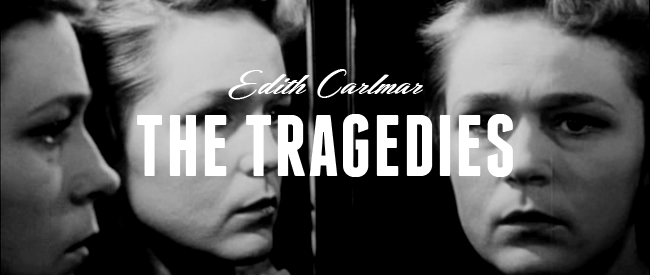
A singularly witty and dexterous auteur, Norway’s pioneering female filmmaker Edith Carlmar is ripe for a reappraisal in world cinema. Carlmar and her husband Otto co-managed their own production company, Carlmar Film A/S, with which they collaborated with a diverse community of technicians, artists and performers – including the then-teenage Liv Ullman, whose debut lead at 21 was Edith’s final film as director, The Wayward Girl. Making ten movies in as many years, the Carlmars built an astonishing resume in the 1950s before abandoning filmmaking forever when they were at the top of their game.

Today Edith’s legacy suggests a nearly clear split between flinty, ice-cold film noirs – often evincing a rare female perspective – and romantic comedies that’ll make your jaw drop even today with their sexual candor. She was in particular a master of eroticized close-ups and devastating quiet moments, never flinching from emotions (pleasurable or painful) most American directors wouldn’t touch with a fork.

That said, Carlmar Film A/S was an unabashedly commercial enterprise, at a time of deeply felt prudishness in Norway. The Carlmars made hits for a popular audience, and proudly paid all their grants back to the government. Never betraying her blue-collar roots, Edith left the distribution rights to her entire catalog to FILMVETERANENE, a union of Norwegian industry veterans. Alongside them, Spectacle is thrilled to team up with the Norwegian Film Institute to blow the dust off these classics of Scandinavian cinema this autumn.


CaressBannerDEATH IS A CARESS
(Døden er et kjærtegn)
dir. Edith Carlmar, 1949
88 mins. Norway.
In Norwegian with English subtitles.

MONDAY, NOVEMBER 4th – 7:30PM
FRIDAY, NOVEMBER 15th – 10PM

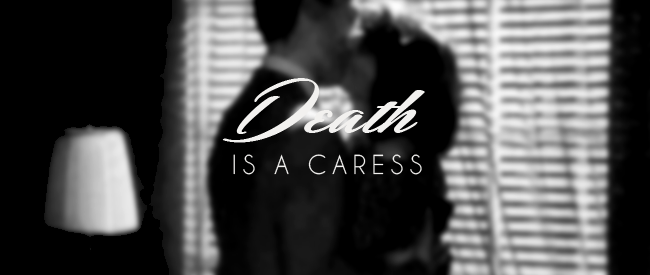
Carlmar’s fierce and mesmerizing debut film follows a Erik (Claus Wiese), a young auto mechanic, and his torrid love affair with Sonja (Bjørg Riiser-Larsen) – an older, married woman. Death Is A Caress luxuriates in beautifully staged meetings and whisperings, private moments refiltered into Erik’s voice-over account of how the affair swallowed up his life. Carlmar’s ensemble always has a wisecrack ready in response for him, but this conventional linear device also allows the filmmakers to throw their weight into wordless, lush sequences of huge import: benders, moments of heated passion, curious interior observations.

Pressed against the stoically clueless Erik, Sonja’s catty, desperately lonely femme fatale turns the film into a grand game of emotional chess as they plunge deeper into their doomed romance. Carlmar would perhaps take future subject matters more seriously in her aesthetic, but it hardly matters: Caress is haunting in how it executes one luminous, golden-era pirouette after another. Ingeniously wry, Carlmar’s filmmaking never fully tips its hat to the audience; if the film has a noir’s backbone, its filling is closer to the knotted domestic drama of Tennessee Williams. Through Erik’s virginal eye, Caress is breathtakingly sensual, making his first loss of innocence its own champagne-drunk landscape.


MaimedBanner

MAIMED
(Skadeskutt)
dir. Edith Carlmar, 1951
87 mins. Norway.
In Norwegian with English subtitles.

WEDNESDAY, NOVEMBER 6th – 10PM
WEDNESDAY, NOVEMBER 27th – 10PM

Neither a thriller nor a weepie, Maimed introduces itself as a case study, bookended with comments from a jovial old psychiatrist. If Carlmar’s first film is baroque, Maimed is decidedly a chamber piece, an attempt to conjure thrashing waves of emotion from confined spaces and situations. Carsten Winger stars as Einar Wang, an architect who keeps himself distant and cold from life; after he attempts suicide, he’s paralyzed and placed in an asylum. His wife Else (Eva Bergh) uncovers her husband’s soul-crushing depression, spurred by a deep neurosis about his inability to have children – and the hidden fact of a girlfriend’s abortion earlier in his life.

Growing impatient with the couple’s inability to conceive as Einar improves, Else soon solicits the help of her husband’s best friend. Einar takes incremental steps towards re-entering society as a formerly insane person, but the new baby – indeed, the cloud of hereditary insanity floating over their household – drives him mad all over again. Meanwhile Else, persuades herself her choice was ultimately better for them both – her feelings between Rolf, Einar and her infant son a little too well compartmentalized.

Building to an explosive conclusion, Maimed avails itself a dark underside of life-wearinesss. The asylum scenario sees the Carlmars cracking a bevy of Norwegian society’s veneers, giving some of the most memorable lines to addicts and sociopaths (and lumping the doctors in with them.) The exploration of madness as a contaminant that thrives on self-awareness sets the film worlds apart from its contemporaries, and Otto Carlmar’s script doesn’t shy in its plummet into reality.


YoungWomanBannerYOUNG WOMAN MISSING
(Ung frue forsvunnet)
dir. Edith Carlmar, 1953
90 mins. Norway.
In Norwegian with English subtitles.

SATURDAY, NOVEMBER 9th – 10PM
FRIDAY, NOVEMBER 15th – 7:30PM

Perhaps the saddest film in this series, Young Woman Missing is also Carlmar’s most political, transferring the audience’s sympathies from husband to wife after reevaluating the life of its titular young woman. When well-to-do academic Arne (Adolf Bjerke) returns home from a “men’s weekend” to find his wife Eva (Astri Jacobson) missing, he calls the police. They eventually begin to uncover facts about Eva’s earlier life – including that she was pregnant – and grapple with the question of how much to involve her prudish, unsympathetic husband.

Carlmar’s depiction of Eva’s marriage to Arne is little less than a straitjacket of classist and sexist overexpectation, causing him to crush the very thing in her that attracted him in the first place: her innocence. That said, Young Woman Missing also allows the audience to be surprised by Eva herself, and her jejune traipse into drug addiction during an earlier romance.

Carlmar’s focus on the wellbeing of her characters and their decision-making processes makes the film a quixotic – as opposed to punitive – tragedy. Ultimately a story of good intentions and overpowering weakness, the sum result is less Hollywood style finger-wagging than a ragged inscription of a human life, wrapped in the haunting beauty of Oslo’s frigid weather.

Dennis Hopper’s BACKTRACK

BacktrackBanner

BACKTRACK (Director’s Cut)
Dir. Dennis Hopper, 1990-92
102 mins. US.

MONDAY, NOVEMBER 4th – 10:00 PM
TUESDAY, NOVEMBER 12th – 7:30 PM
SATURDAY, NOVEMBER 30th – 9:30 PM

1990 AD: FOLLOWING the colossal success of his supporting roles in Hoosiers (1986, Anspaugh) and Blue Velvet (1987, Lynch)  and a well-regarded directing turn (Colors, 1988), Dennis Hopper was finally back on top of the world again. A fallen countercultural icon who had ridden with Terry Southern, tripped with Jack Nicholson, and kicked it with Hitler in a classic Twilight Zone episode, he had fallen from grace in a long list of D-roles, the epochal anti-Western (and Spectacle favorite) The Last Movie in 1971 and the tortured production of Out Of The Blue nearly a decade later.

Finally back in the saddle with some sexual cachet and critical acclaim, Hopper cast a potpourri of old friends and deep-fried favorites including (but by no means limited to) Dean Stockwell, Joe Pesci, Fred Ward  and John Turturro in his latest project, Backtrack. Hopper locked himself in the lead role of Milo—a sax-obsessed mob hitman with a loosely calibrated sensitive side. After up-and-coming conceptual artist Anne Benton (Jodie Foster) witnesses one of Milo’s whack-jobs in Seattle, the powers that be (including Vincent Price as the Don of Milo’s “family”) send him to find her in Arizona to snuff her out. However as the VHS box says, once they’ve met it’s hard to un-meet, and Milo admits he doesn’t know whether to trust Anne, to love her, or… to kill her.

What ensues is equal parts renagade-on-the-lam drama, 90s acid western action and meet-cute RomCom. Along with two filmmaking buddy Alex Cox, Hopper squeezed and tugged his feelings about postmodern art, industrialization, colonialism, jazz, soft rock, middle age, and the American road trip into a lurid balm for the soul—a kind of mashup of Lynch, Wenders, Antonioni and Scorsese with baffling, impenetrable results. Modeled closely on Jenny Holzer, Foster’s character is shown making and premiering work that was created by Holzer specifically for Backtrack – for example, installations of scrolling neon text doling out prophecies such as “EVEN YOUR FAMILY CAN BETRAY YOU.”

The resultant 3-hour film was too hot for Vestron, so it was ripped from Hopper’s hands, butchered and released as Catchfire; in protest, Hopper changed his directorial credit to the old DGA standby for disgraced edits, Alan Smithee. Only in ’92 did he get the chance to release his dialectical final cut—blasted out onto late-nite cable in a brief flare, but overall neglected like the honky-tonk swamp pop of yesteryear.

Until nw. Spectacle’s long-running, always well-advised love affair with Hopper’s work reaches further backwards than ever with this rare screening of the lost and forgotten director’s cut, available (and thus, screening) exclusively on VHS.

VETERANGEANCE

veterangeance-banner

They say old soldiers never die… in observance of Veteran’s Day, Spectacle teams up with Blue Underground to present three tales of martial vengeance from beyond the grave. On Veteran’s Day itself, we run the gory classics THE PROWLER and DEATHDREAM back-to-back. They return for an encore presentation on Saturday, November 23, along with UNCLE SAM, presented by filmmaker, Blue Underground CEO, and legendary raconteur Bill Lustig.


deathdream-banner

DEATHDREAM
Dir. Bob Clark, 1972.
USA. 88 min.

MONDAY, NOVEMBER 11 – 10:00 PM
SATURDAY, NOVEMBER 23 – 7:00 PM

He promised he’d come back! Brilliantly directed by Bob Clark (BLACK CHRISTMAS, A CHRISTMAS STORY), DEATHDREAM weaves allegory for Vietnam soldiers returning as PTSD-afflicted heroin junkies with unsettling oedipal conflict by telling the story of a soldier, declared dead, who surprises his grieving family by suddenly returning home. Andy looks and sounds the same, but he isn’t quite right: an emotionless husk, unable to reconnect with his family and friends, and suffering from some unknown physical ailment. Yet it’s not TLC that Andy needs to regain his sense of self, but blood — preferably fresh, human blood, mainlined via syringe — and when Andy’s parents have no choice but to face facts, they are horribly divided as to how to treat their darling boy’s affliction.

Often cited as an overlooked genre classic, DEATHDREAM benefits from a smart script, assured direction, and pitch-perfect performances. As Andy, Richard Backus brings an understated menace to his role that strikes a resoundingly creepy note. It’s effectively contrasted by the outstanding performances of John Marley and Lynn Carlin, recent co-stars of Cassavetes’s FACES, who treat the material with dignity, elevating it to the status of a rare horror film that manages to blend graphic gore with almost overwhelming emotional impact. And as in A CHRISTMAS STORY, Clark directs with a familiar sensitivity to domestic situations and the nuances of suburbia. The result, as genre aficionados have long known, is one of the most well-rounded and affecting masterpieces of horror cinema.


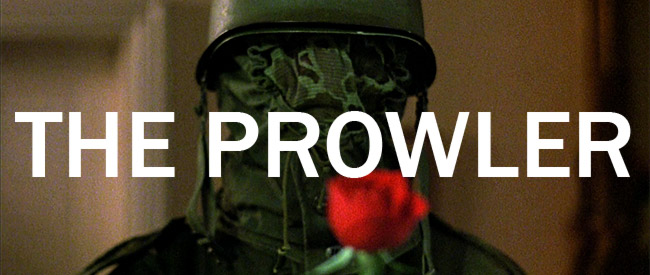
prowler-banner

THE PROWLER
Dir. Joseph Zito, 1981.
USA. 89 min.

MONDAY, NOVEMBER 11 – 7:30 PM
SATURDAY, NOVEMBER 23 – MIDNIGHT

June 28, 1945: having sent a Dear John letter to her soldier boyfriend, Rosemary attends the Avalon Bay annual graduation with her new squeeze — but before they can hit the punch bowl, a ghastly soldier plunges a pitchfork through the pair. Thirty-fire years later, the town prepares for its first dance since the tragedy: is the trauma due to repeat itself? This standout slasher is noteworthy for being described by legendary make-up artist Tom Savini — whose combat experience is an avowed influence on his work — as his proudest moment. Made at a time when more mainstream slashers were reeling back, THE PROWLER is a shocking bloodbath.


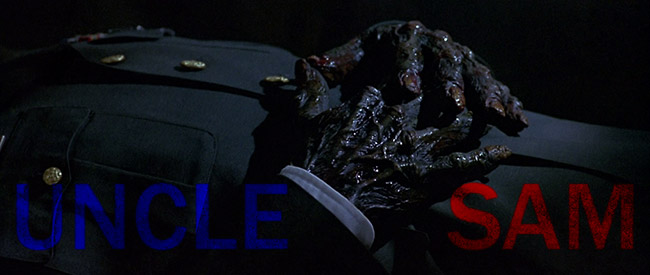
unclesam-banner

UNCLE SAM
Dir. Bill Lustig, 1996.
USA. 89 min.

SATURDAY, NOVEMBER 23 – 9:30 PM – BILL LUSTIG IN ATTENDANCE!

Re-teaming MANIAC COP director Lustig and screenwriter Larry Cohen, UNCLE SAM is a cult favorite 1997 slasher about a soldier killed by friendly fire during Desert Storm who busts out of his casket to kill flag burners and other unpatriotic types. Bearing Lustig and Cohen’s idiosyncratic blend of social commentary and no shortage of gore, UNCLE SAM is further distinguished by appearances by William Smith, Isaac Hayes, P.J. Soles, and the electrifying Robert Forster.