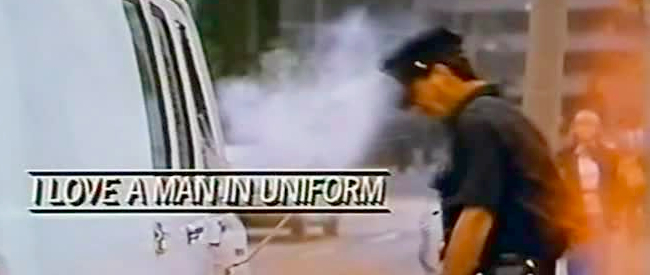
I LOVE A MAN IN UNIFORM

i love a man in uniform banner 2

I LOVE A MAN IN UNIFORM
aka A Man in Uniform
Dir. David Wellington, 1993
Canada, 97 min.

FRIDAY, MARCH 6 – 10 PM
TUESDAY, MARCH 17 – 7:30 PM
THURSDAY, MARCH 26 – 7:30 PM

Some ideas deserve more than one film, and more than one author​. T​hey​ deserve some time to ​​knock around the cinema​tic zeitgeist​ awhile in work that is not so much derivative as conversational.​ In this Canadian film from 1993, Tom McCamus plays Henry Addler, a bank clerk trying to make it as a full time actor​ while caring for his ailing father​. Henry has just landed a reoccurring role on a TV police drama. To get into the part he takes his police uniform home and begins to walk the streets of Toronto looking for real life at its worst – and the goodness that only authority can sustain. Eventually, he also acquires a gun. I LOVE A MAN IN UNIFORM makes no secret of its debt to TAXI DRIVER​. The similarities to the latter film marks one of many self-referentially cinematic elements. The emotional core of the film remains hidden just beneath the surface of a series of film tropes, common imagery, and stock characters. It’s a deeply personal and unique film, but every step of the way it struggles with cliche like an actor might struggle to give something real to a bit part. This is exactly the point, this is a film about pain that’s so hard to explain because it’s been explained so many times before, and about the roles common tragedies force us to play.

STRANGE BEDFELLOWS: ALBERTO CAVALLONE

BJbig

BLOW JOB
aka Soffio Erotico
Dir. Alberto Cavallone, 1980
Italy, 78 min.
In Italian with English subtitles

SATURDAY, MARCH 7 – 10 PM
TUESDAY, MARCH 10 – 7:30 PM
SUNDAY, MARCH 15 – 5 PM
WEDNESDAY, 18 – 7:30 PM
THURSDAY, MARCH 26 – 10 PM

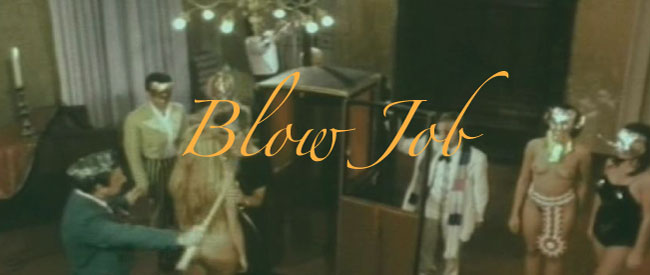
Reportedly inspired by Aldous Huxley’s Doors of Perception, BLOW JOB is a full blown out of body experience. What begins as a romantic retreat quickly heads south when a young couple, Diana and Stéfano, are evicted from their hotel room. Capitalizing on the conveniently timed suicide of their upstairs neighbor, the two sneak off to the races, intent on gambling away the last of their funds. There, Stéfano meets a mysterious, one-eyed woman who enlists his aid in exchange for the name of the winning pony. Fulfilling his end of the bargain, Stéfano and Diana drive the woman to her compound, where voodoo, mind-swapping and naked dance parties unwittingly await them. Building to its explosive, surrealist third act, BLOW JOB displays unexpectedly layered yet winking nuance — nevermind the title.


BlueMoviebig

BLUE MOVIE
Dir. Alberto Cavallone, 1978
Italy, 84 min.
In Italian with English subtitles

MONDAY, MARCH 2 – 7:30 PM
FRIDAY, MARCH 6 – 7:30 PM
TUESDAY, MARCH 10 – 10 PM
TUESDAY, MARCH 24 – 10 PM
TUESDAY, MARCH 31 – 7:30 PM

“Cavallone made his masterpiece with this 1978 film, a sort of BLOW-UP as written by George Bataille and directed by Guy Debord…Much more than just a curiosity for compulsive Italian B-movie fans, BLUE MOVIE is a singular mixture of Situationist polemic, genre deconstruction, and zero budget auteurism.” – Film Comment

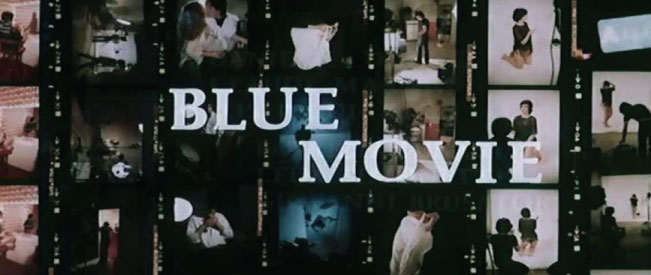
Not to be confused with the claustrophobic Warhol film of the same name, BLUE MOVIE is an almost unplaceable genre exercise in trauma and perverse affection. Perhaps the most visually distinctive of the three films in this series, BLUE MOVIE pairs Silvia, grief stricken after an attempted rape, with her rescuer, a mysterious photographer by the name of Claudio, who has some skeletons of his own. What emerges is a bizarre love affair along two parallel tracks of madness.

[Trigger Warning: Repeated scenes of attempted rape.]

Special thanks to Raro Video.


ManWomanandBeastbig

MAN, WOMAN AND BEAST
aka Spell – Dolce mattatoio
Dir. Alberto Cavallone, 1977
Italy, 100 min.
In Italian with English subtitles

MONDAY, MARCH 2 – 10 PM
SATURDAY, MARCH 7 – 7:30 PM
THURSDAY, MARCH 12 – 10 PM
TUESDAY, MARCH 17 – 10 PM
SUNDAY, MARCH 29 – 5 PM

A man too concerned with collages to confront his mute wife’s psychosexual mania; a daughter impregnated by her father at her grandfather’s funeral; a butcher a little too devoted to his products — that’s just the tip of the very bizarre iceberg in Alberto Cavallone’s anti-pastoral pastiche, MAN, WOMAN AND BEAST. Elemental though the title may be, this hallucinatory jaunt through an Italian village on the eve of an annual Catholic festival rewards repeat viewings thanks to its rhythmic cuts and roving narrative. By the ecstatic, percussive, feces-covered close, you can no longer be certain if the beast is man, meat, or what the film’s women must become in order to survive.

JUCHE YOUR ILLUSION I: CINEMA OF NORTH KOREA

JUCHE.SERIES.BANNER

North Korea’s late Kim Jong-Il was, by all accounts, a legendary cinephile who aimed to surpass the technical and artistic standards of Moscow. He weeded out potential counter-revolutionaries, organized workshops for the studies of Kim Il Sung’s theories of culture and did in fact author the volumes of film criticism published under his byline. The films produced under his leadership engage directly with the concept of juche, a particularly North Korean form of Marxism-Leninism generally revolving around the idea of total, homegrown self-reliance; in the senior Kim Il Sung’s words: “having the attitude of master toward revolution and construction in one’s own country…using your own brains, believing your own strength and displaying the revolutionary spirit of self-reliance, and thus solving your own problems for yourself on your own responsibility under all circumstances.”

Initially working as department director of propaganda and agitation, the young Kim Jong Il instituted wide-sweeping reforms in the North Korean film industry, mandating that artists avoid both art-for-art’s sake on one extreme and stiff, dogmatic films that neglect form and artistry on the other. He then actively encouraged people to emulate the heroes from films: “Day after day, leading characters in the works of art become real in each factory and each workshop,” he wrote.

Being at once proudly insular and aspiring to the artistic achievements of great Russian filmmakers and the magic of Hollywood, North Korean film is singularly baffling, enrapturing, inspiring and unsettling. This month, Spectacle presents the series JUCHE YOUR ILLUSION I, featuring feature films and propaganda made in North Korea, including CENTRE FORWARD, PULGASARI, FLOWER GIRL and URBAN GIRL COMES TO GET MARRIED. In April, JUCHE YOUR ILLUSION II will feature films made outside of North Korea that take the country as a subject.


CentreForward.BANNER

CENTRE FORWARD
Dir. Pak Chong Song, 1978
North Korea, 77 min.
In Korean with English subtitles

MONDAY, MARCH 9 – 7:30 PM
SATURDAY, MARCH 21 – 10 PM
MONDAY, MARCH 23 – 7:30 PM
TUESDAY, MARCH 31 – 10 PM

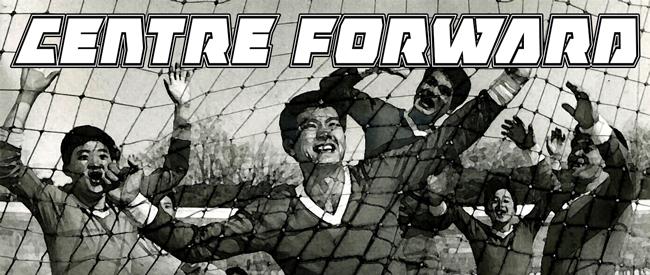
“Oh, we are sportspersons of the Leader!” In CENTRE FORWARD, the DPRK’s first soccer movie, overzealous benchwarmer In Son botches his first match for the previously-undefeated Taesongan team. Their shameful loss is followed by a harrowing post-game self-recrimination session in which various team members take turns chastising themselves for In Son’s incompetence. Ultimately, the coach blames his team’s complacency and, remembering that “the Father Leader taught us to make this country a great Kingdom of Sports,” decides to “break from the old training program” in favor of a more merciless regimen. The players become resentful and lazy, drinking beer instead of training, while the party functionary Vice-Chairman implores the coach to go easier on them. Only In Son, inspired by his sister’s relentless dedication to the practice of dancing for “the collective spirit”, pushes himself to master the new program and his own self-doubt, recognizing that “when we beat the foreign teams, the entire Nation will share the joy.” But as the final game winds down with the unpromising score of 0-2, will this humble underdog get the chance to redeem himself – and the entire nation?


Flower-Girl-Banner

THE FLOWER GIRL
Ik Kyu Choe & Hak Pak, 1972
North Korea, 121 min.
In Korean with English subtitles

SUNDAY, MARCH 1 – 5 PM
THURSDAY, MARCH 5 – 10 PM
SUNDAY, MARCH 15 – 7:30 PM
SATURDAY, MARCH 28 – 7:30 PM

On the petals dewdrops glisten.
Is it there that my tears flow?
The moon is bright but in this dim,
Dark world I know not where to go.

The opening titles proudly proclaim that The Flower Girl is the film version of a revolutionary play first staged in 1930 — or the “13th anniversary of the October Revolution,” as Kim Il-sung describes it in his eight-volume memoir, having personally authoring the libretto after forming an art troupe in a utopian village in Jilin. Curiously, however, the play went unseen for over four decades, until it reappeared, rewritten and “improved” by Organizing Secretary Kim Jong Il as an opera, novel, and film in the 1970s.

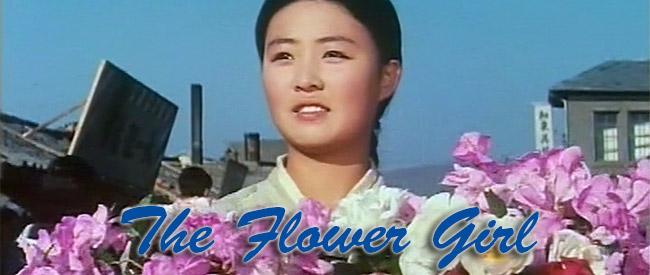
Day after day, Ggot-bun faces indifference as she travels to town to sell flowers to earn money for her ailing mother. She, her mother, and her blind sister live in poverty after a shady landlord has impressed them into what is effectively a life of indentured servitude. Ggot-bun keeps her chin up; nevertheless, her fortunes go from bad to worse as she’s abused by Japanese colonialists and sold to work in a horrendous textile mill while her family suffers worse. Is it possible that guerrillas may arrive to slaughter her oppressors and lift the poor flower girl’s spirits?

You’re going to have to sit through some completely awe-inspiring and tearjerking musical numbers staged in front of twilit hillside vistas to find out.

As author Bradley K. Martin has noted, The Flower Girl is North Korea’s Les miserables, supplanting the French Revolution with Kim Il-sung’s regime, with the the sweeping melodrama and embitter class hatred intact. As DKRP cinema goes, this is a AAA production: as representative of the juche concept as The Godfather is of capitalism. How can 25 million people’s sympathies be so drawn to a despotic regime? Because they made The Flower Girl.

“When I saw The Flower Girl, if there was a dry eye in the house, it did not belong to me.” -Bradley K. Martin, author, In the Loving Care of the Fatherly Leader


pulgasaribanner

PULGASARI
aka Bulgasari
Dir. Sang-ok Shin, 1985
North Korea, 95 min.
In Korean with English subtitles

SUNDAY, MARCH 1 – 7:30 PM
WEDNESDAY, MARCH 11 – 10 PM
SATURDAY, MARCH 21 – 7:30 PM
TUESDAY, MARCH 24 – 7:30 PM

Over the span of 20 years, Sang-ok Shin – sometimes called “the Orson Wells of South Korea” – made upwards of 60 films but all that changed in 1978 when the studio closed. Things would go from bad to worse when in what should be an unbelievable turn of events, Shin and his wife (actress Choi Eun-Hee) were kidnapped by Kim Jong-il. Kim’s intent was to have Shin create films showcasing the power and might of the Korea Workers Party for all the world to see, with Choi Eun-Hee as their star. Before their escape to Vienna in 1986, and after years in prison camps, they would make 7 films – PULGASARI being a crown jewel among them.

While seemingly an obvious Godzilla rip-off, the film is about an evil king in feudal Korea who learns of a coming peasant rebellion. The king gathers all the metal he can find – farming tools, cooking pots, etc – to make into weapons to squash the small army. A dying blacksmith uses the last of his strength to create a monster made of rice – Pulgasari. When his daughters blood hits it, the monster comes to life and traverses the countryside, eating iron – as monsters are wont to do.

Not seen outside of Korea for over a decade after its release, the film has gained a cult following for its special effects – with Kenpachiro Satsuma who was Godzilla for over a decade in the Pulgasari costume!


TriumphIl_BANNER

TRIUMPH OF THE IL: A SURVEY OF NORTH KOREAN PROPAGANDA
Dir. Various, compiled 2015
North Korea, 70 min.
In English and Korean with English subtitles

SUNDAY, MARCH 8 – 5 PM
THURSDAY, MARCH 19 – 7:30 PM
MONDAY, MARCH 30 – 10 PM

North Korea’s secrecy and isolation make it especially mysterious to outsiders, and some of our most sustained glimpses into the country are via its tenacious and dedicated propaganda department. Obscuring rather than enlightening, the films feature relentless assurances, bizarre Pollyanna qualities and extreme levels of repetition. The Juche philosophy of self-reliance, both for individuals and the North Korean state, takes on a sinister, disturbing quality despite the passionate optimism in the films, lending them a particular sense of despair.

Spectacle rounds out its Juche Your Illusion I: Cinema of North Korea series with TRIUMPH OF THE IL, selections from various North Korean propaganda films, including several which extol the virtues and philosophy of Kim Il-Sung and show the former North Korean leader in less isolated times, shaking hands with dozens of world leaders in the 1970s; a film designed to smooth the transition from Il-Sung to Kim Jong-il; karaoke-style military music videos meant to incite and inspire; and the “Arirang Mass Games”, a pageant of synchronized humanity so massive that it puts Busby Berkeley to shame.


Urban.Girl_Banner

URBAN GIRL COMES TO GET MARRIED
Dir. by Kim Il-Sung University students, 1993
North Korea, 73 min.
In Korean with English subtitles

WEDNESDAY, MARCH 11 – 7:30 PM
MONDAY, MARCH 23 – 10 PM
SATURDAY, MARCH 28 – 10 PM
MONDAY, MARCH 30 – 7:30 PM

In URBAN GIRL COMES TO GET MARRIED, Ri Hyang, the best fabric cutter at an urban clothing factory, joins her all-female coworkers on a trip to the countryside as part of a “Peasant-Worker Alliance” program, where they “must work as demanded by Juche farming method”. Amid montages of joyous rice planting and flowing grain, Ri Hyang encounters the visionary young man behind the collective farm’s duck breeding project, Song Sik. She turns up her nose at first, but his commitment to the fatherly leader’s agricultural innovation protocol and rock ‘n roll drumming skills begin to win her over. When he tells her, “It’s time to feed duck dung to the gas furnace,” she says, “I can help you.” Together, they realize that this duck dung is just the beginning, for it will “contribute to agricultural development,” including “mechanization and chemicalization”.

Featuring a musical interlude where the principal characters perform the film’s titular theme song for assembled workers and peasants, URBAN GIRL COMES TO GET MARRIED claims that “a modern farm village is good to live in,” encouraging the best and brightest young urban women to marry men in the countryside so they can apply their worldly intelligence to the execution of “socialist rural theses”.

ANTI-VALENTINES 2015

AVD_banner

This February, Spectacle presents four tales of rejection, sin, necrophilia, and infidelity…

Join us in celebrating ANTI-VALENTINES: a salute to all the things that make love so awful.


LB_banner

LE BOUCHER
Dir. Claude Chabrol, 1970
France, 89 min.
In French with English subtitles.

Special Thanks to Pathfinder Pictures

THURSDAY, FEBRUARY 5 – 7:30 PM
SATURDAY, FEBRUARY 14 – 7:30 PM
SUNDAY, FEBRUARY 15 – 7:30 PM
TUESDAY, FEBRUARY 24 – 10 PM

Set in a small French village, Helen is a sophisticated school headmistress who meets the local butcher Popaul at the wedding of a mutual friend. Desperate for some type of connection, the two begin forming a close but platonic relationship, despite advances from Popaul. Lurking in the background, a series of unsolved murders begin popping up around town, leading Helen to suspect that her new friend might be involved…

Touching on several of Claude Chabrol’s favorite themes, LE BOUCHER is the crown jewel of the French New Wave icon’s golden period. Often proclaimed as the French Hitchcock, Chabrol infuses LE BOUCHER with an expert mix of taut formalism and foreboding atmosphere. Featuring exquisite camerawork, a tense score, and career-high performances from Stéphane Audran and Jean Yanne, this is Chabrol in full command.

“Unnerving, creepy and strangely romantic in equal measure… arguably Chabrol’s masterpiece…” -The Playlist


COP_banner

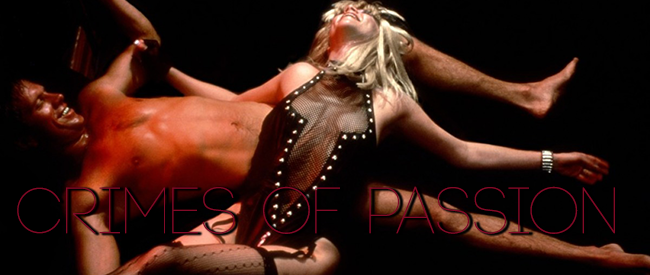
CRIMES OF PASSION
Dir. Ken Russell, 1984
USA, 112 min.

Featuring the original X-rated version of the film!
Along with a brand new video intro from screenwriter Barry Sandler!

WEDNESDAY, FEBRUARY 4 – 10 PM
SATURDAY, FEBRUARY 14 – 10 PM
SUNDAY, FEBRUARY 15 – 5 PM
SATURDAY, FEBRUARY 28 – 7:30 PM

“If you think you’re gonna’ get back in my panties, forget it. There’s one asshole in there already.”

A bored husband’s sexual awakening at the hands of fashion designer-turned-prostitute China Blue (Kathleen Turner) becomes complicated as he must decide between his suburban family and his newfound lust, all while a crazy preacher (Anthony Perkins) lurks in the fringes, hellbent on turning China Blue away from her life of debauchery.

Working from an original script by Barry Sandler (writer of the queer cinema classic MAKING LOVE), Ken Russell spins the 80s erotic thriller into an eruption of flamboyance and excess, featuring manic performances from Turner and especially Perkins… who went the extra mile of becoming ordained AND sniffing nitrate between takes for his role!

Russell’s satire on marriage and sin is a sleazy, stylish, extravagant sexual opus begging to be rediscovered. Recommended if you like blue eyeshadow and big vibrators.

“Kathleen Turner gives the performance of her life… the film remains almost compulsively watchable. Grade: A.” -Entertainment Weekly

“An extremely uninhibited satire on American sexual dreams and nightmares… a comedy so black that it recaptures some of the cinema’s long-lost power to shock.” -Time Out London

Special Thanks to Barry Sandler and Lakeshore Entertainment


Love_Me_Deadly_Lrg

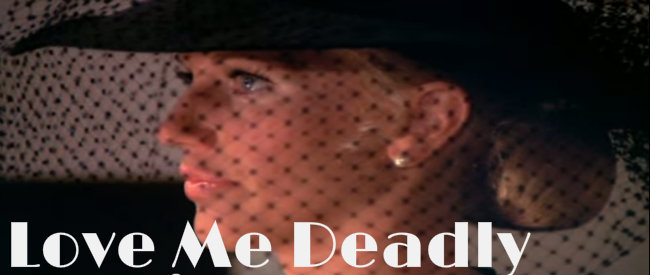
LOVE ME DEADLY
Dir. Jacque Lacerte, 1972
USA, 95 min.

FRIDAY, FEBRUARY 6 – MIDNIGHT
SATURDAY, FEBRUARY 14 – MIDNIGHT

“A beautiful child woman doomed to love only the dead!”

Before Karen Greenlee’s mortuary escapades there was “Love Me Deadly,” the story of Lindsay Finch and her lust for the dead! Ms. Finch is a beautiful California blonde who cruises funerals looking for her next lover. Alas, there are only so many funeral homes in LA, a beautiful woman in provocative mourning attire is sure to be noticed. Lucky for Lindsay she catches the eye of a funeral director who just happens to be the leader of a necrophiliac sex cult! Will Lindsay give into lust or will a chance reading of an obituary lead her to true love?

LOVE ME DEADLY is a sweet and gruesome film made delightfully perverse by its usage of romantic ballads and upbeat songs as a soundtrack. Its juxaposition of soap opera style flash-backs and embalming tables is absolutely sickening in the best possible way. Watch out for the extras in the first funeral scene, they were all members of the original Church of Satan.


psycho_lover_banner

THE PSYCHO LOVER
Dir. Robert Vincent O’Neill, 1970
USA, 80 min.

SATURDAY, FEBRUARY 7 – MIDNIGHT
FRIDAY, FEBRUARY 13 – MIDNIGHT

“What did the voice say?” “Kill. Kill. Kill. Kill. Kill.”

Robert Vincent O’Neill, the director who brought you Spectacle midnight classics WONDER WOMAN and BLOOD MANIA, offers his first and arguably weirdest film, THE PSYCHO LOVER (aka The Loving Touch). Psychiatrist Ken Alden, wants a divorce from his wife Valerie so he can spend his time with his topless girlfriend Stacy at the lake house, but Valerie refuses to give him one. Quite reasonably he decides to manipulate a patient Manchurian Candidate-style (they even mention this in the film!) into performing the murder for him. Marco, our hapless strangling necrophiliac, just may be a little too good as his job, however…

As a plot it may seem a little threadbare, but this basically opens up for some absolutely jaw-dropping visuals (our killer has a perfect O’Neill dream sequence freakout with an overdose of fuzz guitar!), the performance are all well above average, some great bitter repartee between Ken and his wife Valerie, some unexpected turns, and most notably, the actual murder scenes, both psychedelic and brutal. It’d probably be misleading to call THE PSYCHO LOVER an “American Giallo”, but it definitely has both the stylish look and visceral impact of Brian de Palma’s contemporary MURDER A LA MOD. Brainwashing, go-go dancers, home invasion: everything your Valentine’s Day requires.

ROCKUARY 2015

ROCKUARY_banner

This February, Spectacle brings you a supergroup of axe-shredding rock films, and it’s our most jam-packed ROCKUARY yet: Parisian punks girls, a Japanese dystopian sci-fi punk odyssey, a demented German children’s opera, French ye-ye pop bliss, Argentinian amateur dancers, Iron Butterfly at a backwoods amusement park, metal heads battling demons, a live document of a seminal punk group, a new wave musical, a tour diary of a legendary drone music collective, a portrait of a hair metal icon, and a portrait of an underground music icon.

For those about to (watch movies about) rock: we salute you!


LA BRUNE ET MOI BANNER

LA BRUNE ET MOI
Dir. Philippe Picouyoul, 1981
France, 50 min.
In French with English subtitles

FRIDAY, FEBRUARY 6 – 10 PM
WEDNESDAY, FEBRUARY 11 – 7:30 PM
MONDAY, FEBRUARY 16 – 7:30 PM
THURSDAY, FEBRUARY 26 – 7:30 PM

Modeled as a punk version of Frank Tashlin’s THE GIRL CAN’T HELP IT (whose French title, LA BLONDE ET MOI, was an inspiration for the film), Philippe Picoyoul’s LA BRUNE ET MOI is the story of a young Parisian girl who wants to become a famous punk rock star. Pierre Clementi stars as an older businessman who falls for the girl (Anouschka), and is determined to make her the star she dreams of becoming.

If the plot seems a little thin, it’s because it’s mostly a framework to show some blistering performances from now-obscure French punk/new wave bands, including Edith Nylon, Taxi Girl, Artefact, and Ici Paris. As Clementi and Anouschka bounce from scene to scene, bands perform around them as a part of their world. Even though Clementi often seems like an alien from another planet in most of his movies, he’s most out of place here; a pathetic, balding businessman in love with a scenester who is using him for his ability to make her famous. He does in fact become a creepy, surprisingly effective Svengali to his young protege. More than anything, LA BRUNE ET MOI is a love letter to, and an insider portrait of, a very specific scene that otherwise may have been lost to history.


BC_banner

BURST CITY
Dir. Sogo Ishii, 1982
Japan, 116 min.
In Japanese with English subtitles

MONDAY, FEBRUARY 2 – 10 PM
WEDNESDAY, FEBRUARY 4 – 7:30 PM
MONDAY, FEBRUARY 9 – 10 PM
FRIDAY, FEBRUARY 20 – 10 PM

Following the breakthrough success of his biker epic CRAZY THUNDER ROAD, Japanese maverick Sogo Ishii was granted an larger budget for his follow-up and chose to spend it on a half dozen punk bands, post-apocalyptic set design, and nearly 6,000 extras. The unprecedented BURST CITY is the result.

The ripping-at-the-seams plot concerns a clash between a group of punk musicians and contractors attempting to build a nuclear power plant, which soon attracts rival biker gangs, yakuza thugs, and riot police, all escalating into an all-out war.

Groundbreaking at the time for its rapid cutting, kinetic camera work, and renegade characters, BURST CITY provided an immeasurable influence on contemporary Japanese directors like Shinya Tsukamoto and Takashi Miike, simultaneously becoming the first time Japanese punk culture was represented on screen.

A brazen blend of MAD MAX, DECLINE OF WESTERN CIVILIZATION and ROCK ‘N’ ROLL HIGH SCHOOL, BURST CITY is punk rock in its most beautiful, chaotic form.

“A seminal and visionary work… irreverent, manic, anarchic and energetic…” -Midnight Eye


HHTG_banner_1

HELP! HELP! THE GLOBOLINKS!
Dir. Gian Carlo Menotti, 1969
West Germany, 72 min.
In German with English subtitles

MONDAY, FEBRUARY 2 – 7:30 PM
SUNDAY, FEBRUARY 8 – 5 PM
TUESDAY, FEBRUARY 24 – 7:30 PM
SATURDAY, FEBRUARY 28 – 10 PM

A filmed version of a children’s opera about a group of alien invaders (decked out in avant-garde dayglo body suits and amorphous chess pieces) who land on earth with plans to replace our trees with steel and replace our voices with electronic bleeps. A van full of schoolchildren (decked out in avant-garde German yodeling bodysuits) happen upon the aliens and become trapped. Only a teacher can save the kids and Planet Earth… with the power of MUSIC!

Conceived by the Pulitzer Prize-wining composer Gian Carlo Menotti and commissioned by the Hamburg State Opera, HELP! HELP! THE GLOBOLINKS! was a spectacular critical and commercial failure that is scarcely mentioned in Menotti’s biography and rarely performed today. Luckily for us, Menotti was also a pioneer in adapting opera for television, and filmed the Hamburg production of GLOBOLINKS for German television before it was shuttered away.

Imagine an INVASION OF THE BODY SNATCHERS-themed episode of H.R. PUFNSTUF, but performed as a demented, psychedelic children’s opera and you’re getting close.

“… although Globolinks is a failure as a work of art, that doesn’t mean it can’t hold our attention as a weird curiosity piece… a rarity that’s off the beaten path of even the weirdest movie fan.” -366 Weird Movies

“…grade A ‘what the hell?’ weird… one for the ages.” -Badmovies.org

“…must be seen to be believed.” -The Worldwide Celluloid Massacre


LES IDOLES BANNER

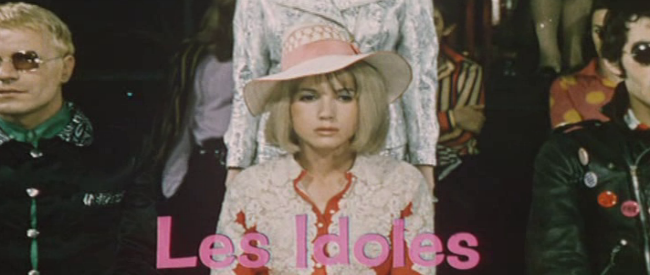
LES IDOLES
Dir. Marc’O, 1968
France, 105 min.
In French with English subtitles

FRIDAY, FEBRUARY 6 – 7:30 PM
THURSDAY, FEBRUARY 12 – 7:30 PM
TUESDAY, FEBRUARY 17 – 10 PM
SUNDAY, FEBRUARY 22 – 7:30 PM

LES IDOLES is a psychedelic, disorienting trip into the French pop world of the 1960s. “Pop” music was just coming into its own then, and writer/director Marc’O, a known stage director and multidisciplinary artist, portrays the new world of pop superstardom as a strange, frenetic world full of debauchery and greed. The plot is barebones, hiding behind the atmosphere and (annoyingly) catchy songs, but consists of an unorthodox warehouse press conference with three pop singers: Charly Switchblade, Crazy Gigi, and Simon the Magician. As the audience is able to ask any questions they want, the facade of the manufactured pop stars slowly starts to fade.

LES IDOLES started as a stage play; director Marc’O assembled some of his regular troupe of stage actors, including Bulle Ogier (in her first major film role!) and Pierre Clementi, to bring this 1960s French pop farce to the big screen. Marc’O assembled quite an impressive roster to help him out: Andre Techine acted as an assistant director, while the film was edited by Jean Eustache (there’s even an unfounded rumor that early versions of THE MOTHER AND THE WHORE included a scene on the LES IDOLES set). The costumes and settings alone are enough to make this worth seeing; but it’s the zany, weird, but relatable performances by Bulle Ogier (as a France Gall stand-in), Pierre Clementi (Johnny Halliday), and Jean-Pierre Kalfon as a palm-reader turned singer that bring the film to life.


living_stars_banner

LIVING STARS
Dir. Mariano Cohn & Gastón Duprat, 2014
Argentina, 63 min.

SUNDAY, FEBRUARY 1 – 5 PM
SUNDAY, FEBRUARY 8 – 7:30 PM
FRIDAY, FEBRUARY 13 – 7:30 PM
MONDAY, FEBRUARY 23 – 7:30 PM

This remarkable, moving documentary presents dozens of real people in Buenos Aires, in long static tripod takes, simply dancing to pop music. In their kitchens, offices, and garages, identified in the film by their name and occupation, they include all ages, diverse lifestyles and all levels of talent, each with a common and infectious enthusiasm. In the background, their pets, families and friends go about their lives – playing video games, welding, reading magazines, watching with amusement or joining in. Everything in the frame, both incidental and carefully arranged, contributes to a loving portrait of each person, and of the universal qualities of all people. The seemingly simple premise has an overwhelming cumulative effect of shared humanity and pure joy, consistently surprising and endlessly fascinating.

“There’s a world of backstory in the details: the mom willing to steer a fan so her son’s cape will flap in the breeze, the brother who rolls his eyes as his older sister gets sexy, the daughter who can’t stop laughing as her dad shakes it to the Spice Girls. I’ve never seen anything that gave me more hope for equality and tolerance than a young man in his kitchen in full drag grinding it to “Toxic” in front of his entire family. When his wig flies off, grandma leaps to hand it back, and as he slipped it back on with a diva flourish, the crowd around me burst into applause.” – LA Weekly


musical_mutiny_banner

MUSICAL MUTINY
Dir. Barry Mahon, 1970
USA, 74 min.

FRIDAY, FEBRUARY 20 – MIDNIGHT
SATURDAY, FEBRUARY 28 – MIDNIGHT

OCCUPY PIRATE’S WORLD!

Hey, kid: do you like Iron Butterfly? Do you like pirates? Do you like incitements that the youth culture should, in fact, stage a mutiny? A MUSICAL MUTINY? Spokesman of the hippie generation Barry Mahon (director of dozens of nudie-cuties/roughies) had a sort of second act at the very end of his career, directing a series of deeply strange fairytale films (THUMBELINA, SANTA CLAUS AND THE ICE CREAM BUNNY) at/for a Florida amusement park called Pirate’s World. As it happens, Pirate’s World was a somewhat hot ticket at the time for touring bands (seriously: by the time this film was released Led Zeppelin, Black Sabbath, The Grateful Dead and Traffic all played there), so it was decided to release a concert film, starring Iron Butterfly and a bunch of local bands.

Add to this a storyline about a pirate who emerges from the sea and gets the young people together for a mutiny (ie a free show), a teen chemist who may or may not have invented a new hallucinogen, a subplot about how Iron Butterfly aren’t going to play this cockydoody free show unless they get paid in full and all the footage of smiling groovy Florida pre-teens bopping along to In-A-Gadda-Da-Vida and it definitely a strange no-man’s-land that covers both midnights and Rockuary! Without giving the plot away, fear not: the kids and the establishment find a way to work together and all was well at Pirate’s World…for another year or so, until Walt Disney World opened and forced the park out of business. THE END.


rnr_nightmare_banner

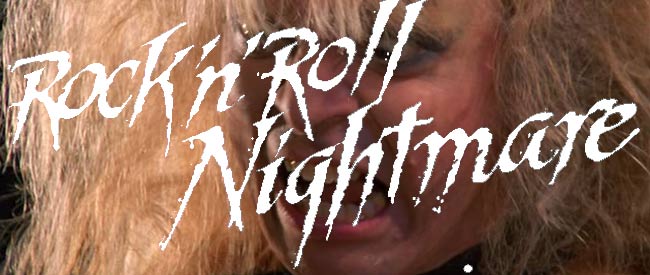
ROCK ‘N’ ROLL NIGHTMARE
Dir. John Fasano, 1987
Canada, 83 min.

SATURDAY, FEBRUARY 21 – MIDNIGHT
FRIDAY, FEBRUARY 27 – MIDNIGHT

“Toronto is where it’s happening, man.”

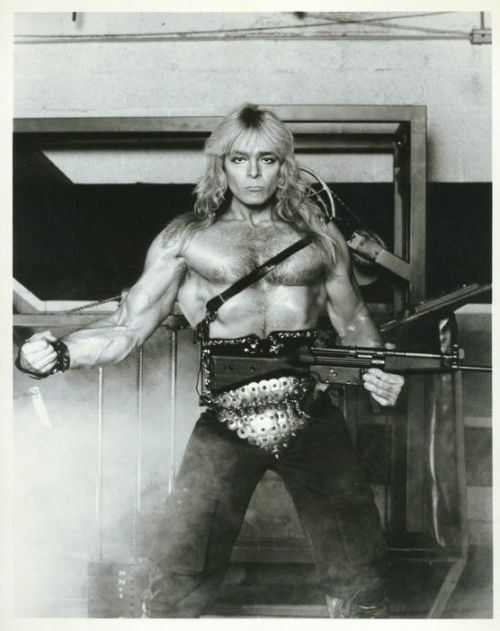
Fresh off his tour-de-force acting performance in ZOMBIE NIGHTMARE, Jon-Mikl Thor immediately set to work writing a screenplay titled The Edge Of Hell about a rock band who, while recording a new album at a remote farmhouse, discover it has been infested with demons. Together with the members of his band, a young director named John Fasano (1961-2014) and a lot of rubber puppets, Thor spent ten days shooting the film, a mix of hair metal, questionable effects, convoluted plotting and shirtless frenzy not seen since 1982’s Boardinghouse. Retitled ROCK ‘N’ ROLL NIGHTMARE (you know, like the Spinal Tap song) and released on video, the film lurked in video stores, slowly gaining a fanbase of teenage stoners and delinquents.

It’s easy to see how such a combination has since become the manna of “clever” “funny” “horror” “movie” “blogs”, but it’s the film’s bizarre logic, culminating in a truly astonishing final fifteen minutes (of which we will say no more). We haven’t even mentioned JMT’s shower makeout scene, the adorable smoking cyclops demon, the sweet conversion van, the chest-bursting and all the great Thor tracks! Spectacle is proud to present, for the second time, ROCK ‘N’ ROLL NIGHTMARE!


screamers_banner

SCREAMERS LIVE IN SAN FRANCISCO SEPT 2ND 1978
Dir. Joseph Rees, 1978
USA, 40 min.

THURSDAY, FEBRUARY 5 – 10 PM
MONDAY, FEBRUARY 16 – 10 PM
FRIDAY, FEBRUARY 27 – 10 PM

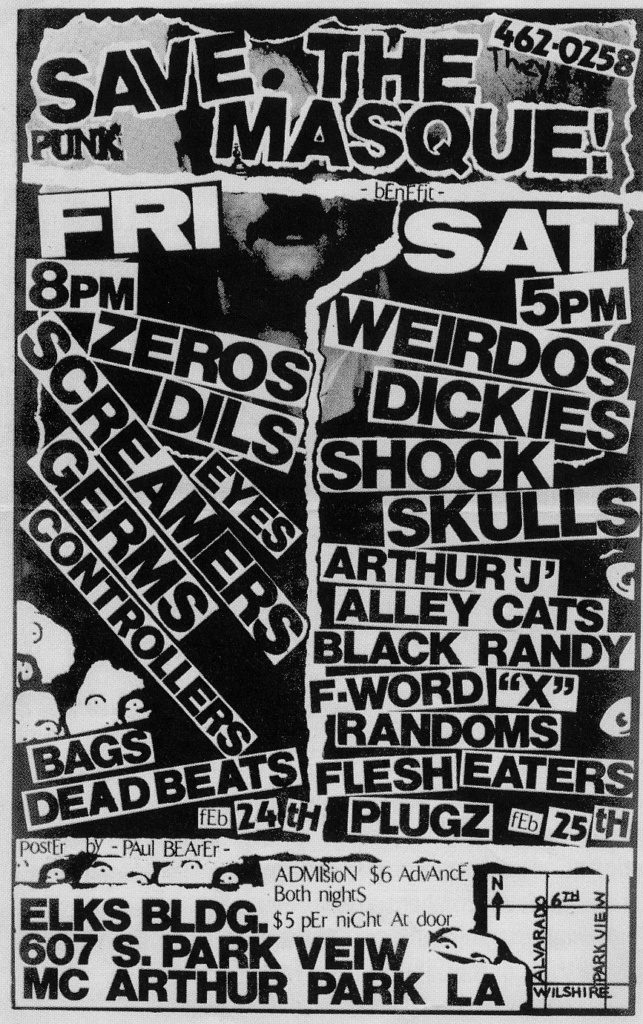
Legendary art punk icons, The Screamers, abandoned the conventional electric guitar sound of rock ‘n roll for synthesizers, drums & base, and a surplus of distortion. Headed by frontman Tomata Du Plenty, who was famous for his convulsive & theatrical stage performances, and keyboard player Tommy Gear. The group was lauded as the pioneer of New Wave music, and yet they never released a single record or album (only live recordings and bootlegs are available). To combat the band’s lack of recorded material, Joe Rees of Target Video, released this concert footage shot in a tiny club before an appreciative crowd in 1978 San Francisco. The set list includes “Vertigo,” “Beat Goes On,” “122 Hours of Fear,” “Another World,” plus five rare videos that have never been released before.

“The Screamers have become caged icons of their former selves. Tomata’s tight-bodied, shorthand contortions, the whack attack of his voice. Tommy Gear throwing his body around like a mallet in a rubber room. Their set was a model of surgical efficiency, ice on the bare wires of tension. In the pit beneath Tomata’s teeth, the audience, like iguanas, slithered faster to the cold beat.” -P.M./Gamma/Alucard, Slash Magazine #12

screamers flyer_weirdos-masque


unnamed

STARSTRUCK
Dir. Gillian Armstrong, 1982
Australia, 94 min.

SATURDAY, FEBRUARY 7 – 10 PM
FRIDAY, FEBRUARY 13 – 10 PM
TUESDAY, FEBRUARY 17 – 7:30 PM
SUNDAY, FEBRUARY 22 – 5 PM

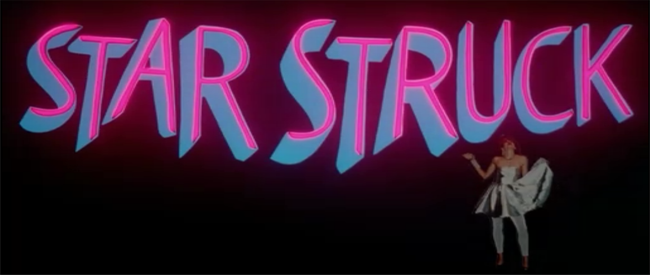
Gillian Armstrong’s STARSTRUCK is an energetic rock musical comedy, with a kitsch aesthetic that feels like LADIES AND GENTLEMEN, THE FABULOUS STAINS, but if the protagonist were Cyndi Lauper.

starstruck_1

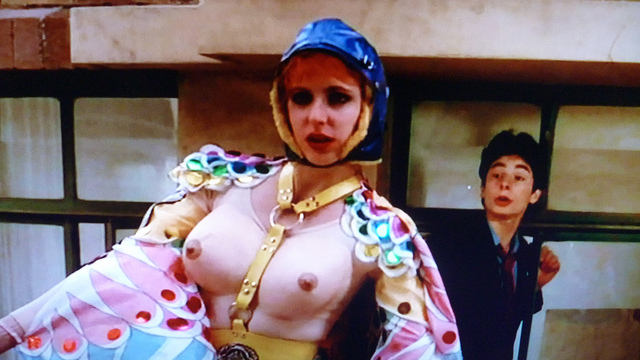
Jo Kennedy stars as Jackie, a young woman from a working class family who owns a diner, but she dreams of being a big rock and roll star. With the help of her cousin, Angus (Ross O’Donovan), who has sights on being her manager, she gets a gig in a local open mic, but it doesn’t turn out to be her big break. Instead Angus resorts to convincing Jack to perform an outlandish publicity stunt, walking “topless” on a tightrope between two buildings. This attention lands her in the papers, and she soon becomes a media darling garnering attention from a famous rock promoter, Terry Lambert (John O’May). When she ditches her band (and her beau) for a television spot, she’s shocked to find out (in a Busby Berkeley style swimming number) that Terry is a homosexual. Of course, nothing in this movie could be a downer for very long, and soon Jackie is shooting for the big time, falling in love, and saving the family diner from foreclosure.

The film’s songs, written in part by Tim Finn of Split Enz, might just be the real main attraction:


tmtot_banner

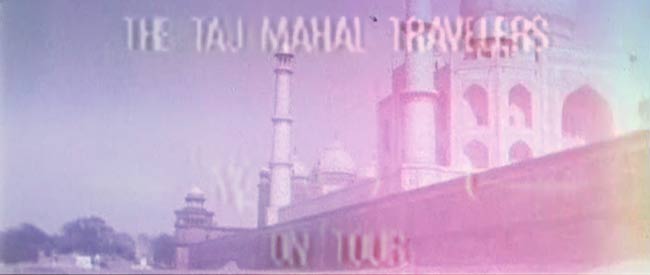
THE TAJ MAHAL TRAVELLERS ON TOUR
Dir. Matsuo Ohno, 1972
Japan, 102 min.
In English and Japanese with no subtitles (minimal dialog).

SUNDAY, FEBRUARY 1 – 7:30 PM
WEDNESDAY, FEBRUARY 11 – 10 PM
FRIDAY, FEBRUARY 20 – 7:30 PM
THURSDAY, FEBRUARY 26 – 10 PM

Fluxus artist and composer Takehisa Kosugi assembled a crew of young musicians and hit the road in a VW bus from Rotterdam to the Taj Mahal, playing a series of shows along the way in which the band used traditional instruments run through a series of electronic effects to create long sheets of drone both pulsing and timeless. Filmed by Takehisa Kosugi’s mentor Matsu Ohno (perhaps best known in the States for his sound effects/score work on the television series Astro-Boy), the film moves at the same pace as the music itself, a pastoral road movie following a band far more likely to play temples than clubs.

Kosugi’s rambling, spontaneous and worldly compositional method is perfectly matched by his open-ended touring approach, with a heavy emphasis placed on pure immersion in local culture and music. The resultant cinema-verite of the sticklike ebullient longhairs taking in the sights, trying the local fare, jamming on seaside cliffs and hanging with historic heavies like Don Cherry makes for a meditative and mimetic biopic of the entire touring experience, replete with an evershifting language-barrier. Ohno, a longtime mentor and collaborator of Kosugi famous for his own pioneering electronic music, proves to be the optimal observant eye for a performance-centric film about, ultimately, the joyous negation of sonic, cultural and music-business protocol.


thor-BANNER

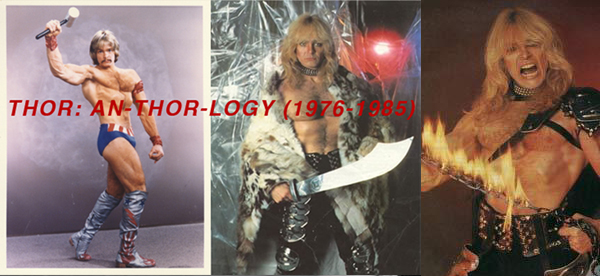
THOR: AN-THOR-LOGY 1976-1985
Dir. Frank Meyer & Paul Harb, 2005
USA, 93 min.

SATURDAY, FEBRUARY 7 – 7:30 PM
MONDAY, FEBRUARY 9 – 7:30 PM
WEDNESDAY, FEBRUARY 18 – 7:30 PM
MONDAY, FEBRUARY 23 – 10 PM

“Prior to his leap into the rock world, Jon Mikl Thor introduced himself on the world as a bodybuilder, having won Mr Canada and Mr USA titles. Taking advantage of his beefcake physique, Jon created Thor the Rock Warrior, incorporating theatrics into his rock shows. He also appeared in a number of B movies, one of which – Rock ‘n’ Roll Nightmare – he wrote, produced, starred in and scored. Released in conjunction with the new Thor studio album, Thor Against the World, is An-Thor-Logy, a new DVD retrospective covering the first decade of Thor’s career (1976-1985), featuring live footage, music videos, interviews and television appearances.

The DVD begins by running through a collage of 70’s clips and Thor describing his beginnings and how he wanted to create a comic book hero on stage. The live show antics are circus-like in the theatrics department, with Thor bending steel bars between his teeth, having bricks broken on his chest with a sledge hammer and more. The DVD really paints the whole picture, even including a 1976 appearance on the Merv Griffin show with Thor performing The Sweet’s “Action” in totally over-the-top glitzy garb. We then go through the years with a series of music videos from Thor’s glam rock phase, having recorded the videos on his own in the pre-MTV days. The glam stuff is pretty wild, coming across as a hip shaking Norse god version of Bowie or Ian Hunter. But as we get into the early 80’s we see Thor evolving into the heavy metal style that has characterized his music to this day, which is also when the music really started to get good and more aptly fit the image Thor had created.”

From Aural Innovations

thor7


wesley_willis_joyrides-banner

WESLEY WILLIS’S JOY RIDES
Dir. Chris Bagley and Kim Shively, 2008
USA, 80 min.

THURSDAY, FEBRUARY 12 – 10 PM
WEDNESDAY, FEBRUARY 18 – 10 PM
FRIDAY, FEBRUARY 27 – 7:30 PM

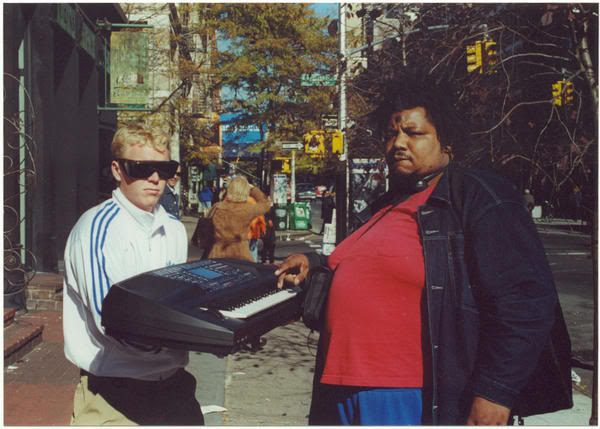
A portrait of the self proclaimed rock ‘n’ roll star and “Chicago City Artist,” Wesley Willis. An underground rock icon and revered artist, the late, great Wesley Willis attracted and offended people the world over. WESLEY WILLIS’S JOY RIDES follows the life of the prolific and controversial artist on his journey from obscurity to fame.

A Chicago native, Wesley Willis became an underground rock icon, revered artist and hero to many before his untimely death in 2003. Termed by some as an “outsider artist” due to his schizophrenia, the film examines Wesley’s ability to draw people in despite his intimidating facade. Through his force of personality and his artistic talents, Wesley’s music and art attracted people from all walks of life. Greeting people with a headbutt and a request to say “rah” and “roh,” Wesley quickly stood out in a crowd. Through interviews with friends and footage from the last four years of Wesley’s life, a portrait emerges of a man whose day-to-day existence was wrought with pain and joy. Although his life was troubled, Wesley never stopped creating. He continued to draw pictures and write songs up until his death.

WesleyWillis (1)

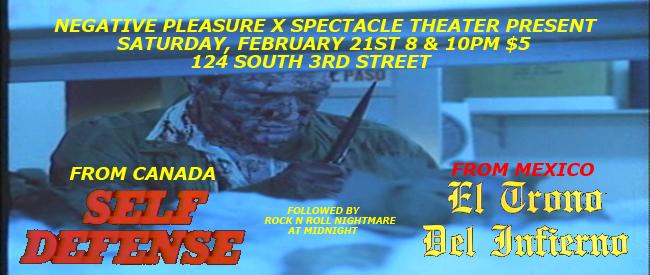
NEGATIVE PLEASURE presents SELF DEFENSE and THE THRONE OF HELL

vlcsnap-2015-01-08-22h58m21s115

Negative Pleasure, publisher of Felony Comics, Jeans and Night Burgers, returns to Spectacle Theater with another phantasmagorical cavalcade of dread-drenched cinematic bedlam.

SELF DEFENSE
Dir. Paul Donovan, 1983
Canada, 84 min.

SATURDAY, FEBRUARY 21 – 8:00 PM

In the Canadian vigilante epic SELF DEFENSE, gang members take advantage of a Halifax police strike to go on a gay bashing rampage, but when they besiege an apartment complex, the residents fight back with booby traps and, yes, self-defense. It’s a Nova Scotian bloodbath in the tradition of DEATH WISH 3 and HOME ALONE. From Paul Donovan, director of video store staple DEF-CON 4 and the unpopular sci-fi series LEXX.

THE THRONE OF HELL
Dir. Sergio Goyri, 1994
Mexico, 94 min.

SATURDAY, FEBRUARY 21 – 10:00 PM

In THE THRONE OF HELL (EL TRONO DEL INFIERNO), from Mexico, an archeological dig unleashes Beezelbub, forcing the Vatican to call in master exorcist El Hombre. In a battle of stop Armageddon, the forces of good call upon the power of the Seven Seals and the sword Excalibur to take on the devil himself. Bloodshed ensues. A lot of it. Guts, too. And some brains. Starring and directed by Sergio Goyri, star of the Mexican stage version of MEN ARE FROM MARS, WOMEN ARE FROM VENUS and creator of the Black Stallion and Still Loving U fragrances.

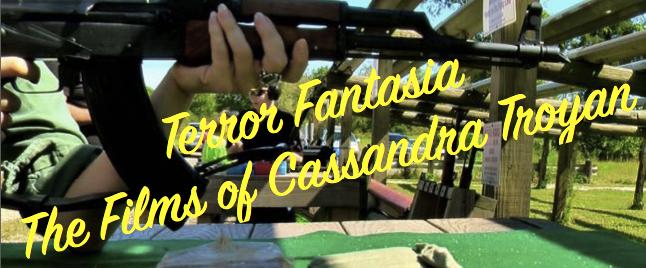
TERROR FANTASIA: THE FILMS OF CASSANDRA TROYAN

unnamed

Cassandra Troyan is a poet, filmmaker, and artist from Chicago. Spectacle is proud to present a selection of Cassandra’s work from since 2011; a selection of short films, as well as a feature-length experimental pieces. Cassandra’s work, in the artist’s own words, “develops out of a deep curiosity for uncovering situations of trauma in the every day.”

TUESDAY, FEBRUARY 10 – 7:30 PM & 10 PM**Cassandra Troyan in person!**
WEDNESDAY, FEBRUARY 25 – 7:30 PM & 10 PM

PROGRAM 1:
YOU SEEK FOLLOWERS? SEEK ZEROS.
Dir. Cassandra Troyan, 2013-2015
USA, 88 min.

TUESDAY, FEBRUARY 10 – 7:30 PM – DIRECTOR IN PERSON

WEDNESDAY, FEBRUARY 25 – 7:30 PM

WHERE THE SUN NEVER SHINES 
(HD Video, 37:42, 2013)

A hysterico-environmental dreamworld set at the edges of capitalism, WHERE THE SUN NEVER SHINES, cycles through endless rabbit holes of Midwest despair and absurdity only to find further economic collapse, failure of masculinity, the ever-present bee plight, psychological trauma. This post-utopian rust-belt drama exists in a landscape where destruction is a form of creative release.

WHERE THE SUN NEVER SHINES is part of the A CURE FIT FOR A KING series. Featuring performances by Fred Schmidt-Arenales, Katherine Harvath, Eero Somers, Paul Gerard Somers, Cassandra Troyan and Danny Volk.

MY DAUGHTER, NEVER MORE
(HD Video, TBA, 2015)

A hummingbird never returns. Anticipation, rage, and melodramatic ecstasy take the stage through longing’s articulation in the spheres of opera, historical monuments, and animals at rest as ciphers for intuited knowledge. A capacitative zoology, never questioning the tongue. I love you daughter, until you betray me.

THE WHOLE FORMS A SYNDROME
(HD Video, 12:19, 2013)

THE WHOLE FORMS A SYNDROME, is a meditation on the mediated subject gone raw, as this work explores residual matter in the politics of resistance, and what it means to be out of sync, in opposition. Historical vamping of prominent figures of authority (a gay Nietzsche, Slavoj Zizek, the Godfather, Karl Marx) this work questions the nature of collectivity and radical gestures as a correspondence between Theodor Adorno and Herbert Marcuse interrogates the practice of theory put into violence. The performance of the political experienced as a trace, as the AK-47 that gets brandished, is the same weapon shooting a barely visible target, the punctures marked only by puffs of dust and hot shells flying out of the weapon in a soundscape of explosions.

DUSK AT THE GALLOWS
(HD Video, 24:18, 2013)

A Tuscan horror film pared down to its affective tropes, both in the Italian landscape and filmic genre. Cinematic feelings are constructed out of the remnants of a quotidian world, making it all the more terrifying by what is hidden, and what is revealed. Torture, allure, mystery, and the sacred create an unconventional narrative where the characters’ motives might unfold, yet the viewer can only experience them as a series of traces. The women are left as ruptures surfacing in the residue of an environment, attempting to voice some desired intensity, violence, or hysteria until they are stifled and pushed into another unknown world.

What is to be feared within this terrain? Must the element causing terror always surface, or reveal itself like the monster or psychopath lurking around the shadowy corner? Or might it exist in some other semblance of meaning, remaining visually unrepresentable? In DUSK AT THE GALLOWS, what cannot be seen holds the greatest threat, and means for discovering a deeper notion of trauma and historical violence in the dark heart of Italy’s mysterious influence.

Performances by (in order of appearance): Kirsten Bockrath, Cody Troyan, Sarah Mendelsohn, Danielle Rosen, Nausicaa Renner, Katherine Harvath, Sophia Rhee, and Chelsea America Torres.

I WAS HAPPY THEN
(HD Video, 14:48, 2013)

The Italian filmmaker Michelangelo Antonioni made “L’eclisse” in 1962. The film begins at dawn on a summer morning inside a modernist apartment located on the suburban fringes of Rome. In the opening scene a beautiful young literary translator named Vittoria ends a relationship with her writer lover, Riccardo. Riccardo’s final plea: he only wanted to make her happy. Vittoria listlessly responds, “When we first met, I was 20 years old. I was happy then.” She subsequently emerges alone from his home into a barren, interstitial landscape. For the remainder of the film Vittoria is a tourist figure traversing the urban, architectural and economic landscapes of Rome.

“I was happy then” is both a book and film by Bureau for Open Culture that unites the filmic spaces of Antonioni’s “L’eclisse” and the present-day reality of Siena, Italy. Through the framework of a tourist guide that focuses on the topics of alienation, architecture, economy, love and urbanization, this work drawn from research and lived experience is a means to explore postwar and contemporary life in Siena.

Produced by Bureau for Open Culture with support by the Siena Art Institute in Siena, Italy.


PROGRAM 2:
WITH THE TRUE WORLD WE ABOLISHED THE WORLD WE HAD HERE

Dir. Cassandra Troyan, 2011-2015
USA, 95 min.

TUESDAY, FEBRUARY 10 – 10 PM – DIRECTOR IN PERSON

WEDNESDAY, FEBRUARY 25 – 10 PM

THE SACRIFICIAL TEMPTATION OF THE VOID (AS NIGHT SLOWLY FALLS, WE MAKE LOVE)
(HD Video, 01:14:08, 2012)

THE SACRIFICIAL TEMPTATION OF THE VOID (AS NIGHT SLOWLY FALLS, WE MAKE LOVE) explores the terror of becoming female amidst the accelerated haze of contemporary popular culture. Through evoking potentially abject worlds of ecstasy and pain within rap culture, Gothic fetishism, and 90s music videos, the film looks for ways to derive pleasure from the horror in surrender, and the romance in submission.

Sound production and mastering by Andrew Rahman
Featuring performances by Rachel Ellison, Nabiha Khan, David Giordano, and Cody Troyan

GROAN
(HD Video, 6:13, 2011)

Repetition makes its own meaning as a reflection is a kind of soundtrack. Soaring voices of The Red Army Soviet Choir inflect a visual landscape that is at once stroboscopic as it is clear. Selection from the full album and video of its unfolding.

RENDER ME THIS BLOODY HAND 
(HD Video, TBA, 2015)

A soldier removed from the domain of war, a hunter searching for authenticity on an atavistic terrain. He is wandering, wanting to know what it would mean to return.

RENDER ME THIS BLOODY HAND is part of the A CURE FIT FOR A KING series. Featuring performances by Fred Schmidt-Arenales, and Paul Gerard Somers.

THE PUSH TO PULL THE FLOW FROM LIFE’S DISTURBANCE (TERROR FANTASIA)
(HD Video, 05:18, 2012)

The nausea.

A scene constructed out of a negatively saturated world. There is a frontal collide of two figures at a table which explodes into another set of figures performing a strange play-acting on the beach. Gestures of abandon shown by gleefully running and rolling in the sand builds a desirous landscape reminiscent of 90s music video tropes only to morph into the stickiness of rap. What is more absurd than wanting to be that which you cannot be? Of having to find one’s self in a language that is not just indecipherable, but the code is the language itself. It is only in using the language that initially seems foreign, can one begin to translate.

Featuring performances by Rachel Ellison, Nabiha Khan, and Cassandra Troyan.

WHEN WE DOZE OFF IN THE BLAZE (PLEASURE THROES)
(HD Video, 10:32, 2011)

Where does desire exist within the absurd, as a suburban backyard becomes an emotional landscape of both accumulation and disappearance? Screams turn to black, darkness dims fire, as the viewer is implicated in a potential world of familiar yet pleasured terror.

Featuring performances by Cody Troyan and Lawrence Troyan.

TWO FILMS BY GIUSEPPE ANDREWS

giuseppe-andrews-banner

TOUCH ME IN THE MORNING
Dir. Giuseppe Andrews, 1999
US, 80 min.

FRIDAY, JANUARY 16 – 7:30 PM
MONDAY, JANUARY 19 – 10 PM
THURSDAY, JANUARY 22 – 7:30 PM

In this truly independent Coming-of-Age story from Troma, Giuseppe Andrews stars as Coney Island, a young man who is dealing with a lot of the issues facing today’s youth: divorce, unemployment, sexual inadequacy and a gigolo father who has just been released from prison!

Ever the optimist, Coney Island spends his days singing songs of hope to senior citizens and riding miniature broncos at his favorite playground. Pushed by his unfulfilled girlfriend to grow up, Coney Island turns to Daddy Bill (Bill Nowlin) for advice in the ways of love and embarks on a grotesque and wildly hilarious journey of self-discovery.


TRAILER TOWN
Dir. Giuseppe Andrews, 2003
US. 80 min.

FRIDAY, JANUARY 16 – 10 PM
MONDAY, JANUARY 19 – 7:30 PM
THURSDAY, JANUARY 22 – 10 PM

TRAILER TOWN is a unique motion picture experience, truly unlike anything you’ve seen before. A sexual interpretation of inner violence, about out-of-work comedians living in a trailer park run by a soap opera star. The old comedians cannot work anymore due to their addictions, and come up with the filthiest, most offensive routines they can devise, to strike out at mainstream society, their only audience being themselves. When Bill receives an eviction notice for having too many wild parties, he takes to the roof of his trailer with a rifle, and declares he is a victim of an “aluminum holocaust.”

BEST OF SPECTACLE 2014 – PART 2

bestofs-banner

To mark the conclusion of Spectacle’s fourth full calendar year of operation, our programming collective has selected their favorites from among the regular series features each other showed throughout the past twelve months. The result, BEST OF SPECTACLE (aka BoS2K14), provides an opportunity to revisit some of 2014’s greatest discoveries, thrills and audience-pleasers.

This is the second half of our selections, the first half can be viewed here.


ANNA_banner

ANNA
Dir. Pierre Koralnik, 1967
France, 85 min.
In French with English subtitles

With custom English subtitles created by Spectacle!

THURSDAY, JANUARY 8 – 7:30 PM
THURSDAY, JANUARY 15 – 10 PM
SATURDAY, JANUARY 24 – 10 PM
TUESDAY, JANUARY 27 – 7:30 PM
**closed due to inclement weather**
THURSDAY, JANUARY 29 – 7:30 PM

Part of the How Anna Got Her Groove Back: Karina After Godard series.

A kaleidoscopic, energetic burst of bright colors, infectious musical numbers, and absurdly charming performances, ANNA is a pop-art musical masterpiece that has been locked away for far too long.

Originally made as the first color film for French TV, Anna Karina stars as a shy artist who is unknowngly photographed one day and soon becomes the obsession of an advertising executive (played by French New Wave stalwart Jean-Claude Brialy). He plasters her image up all over town in an attempt to discover the mystery girl, whom he doesn’t seem to notice is the same girl that he keeps bumping into whose wearing those nerdy-chic glasses…

But really, this is all just an excuse for zany, irrestistable fun. The Yé-Yé music, scored and soundtracked by French pop icon Serge Gainsbourg (who also makes several on-screen appearances), is some of the most infectious and catchy work of his career, with Karina’s vocals shining throughout, including the famous ‘Roller Girl’ number that has since been referenced in countless fashion spreads. Every sequence features candy-coated visuals and sumptuous costuming soaked in the era’s impeccable style, all supported by ace contributions from key Godard personnel, including editor Françoise Collin (BAND OF OUTSIDERS, PIERROT LE FOU, 2 OR 3 THINGS I KNOW ABOUT HER) and DP Wally Kurant (MASCULINE FEMININE). Impossible to resist, the film feels like a pitch-perfect melding of Godard’s A WOMAN IS A WOMAN and Demy’s THE UMBRELLAS OF CHERBOURG, with Karina’s adorable beauty and effervescent charm as the center of attention. And be on the lookout for a Marianne Faithfull cameo!

The film was a hit on French television in the late 60s and received a brief Japanese theatrical run in the 90s, but has since vanished and, to the best of our knowledge, has never screened before in the US. Working with Universal Music, Spectacle is enthralled to present this lost gem of 60s French cinema.

rainha_banner A RAINHA DIABA
aka The Devil Queen
Dir. Antonio Carlos da Fontoura, 1974
Brazil, 99 min.
In Portuguese with English subtitles


SUNDAY, JANUARY 4 – 7:30 PM
SATURDAY, JANUARY 10 – 7:30 PM
WEDNESDAY, JANUARY 21 – 7:30 PM
WEDNESDAY, JANUARY 28 – 10 PM

Part of the Out in the Streets series.

[TRIGGER WARNING: Drug use, violence, sexual slurs, and a disturbing scene of torture.]

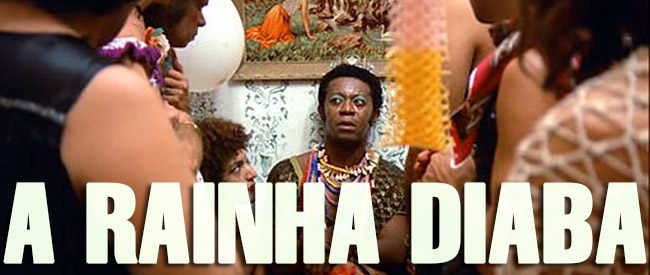
It was six years between Antonio Carlos da Fontoura’s stunning debut, COPACABANA ME ENGANA, and it’s follow-up, A RAINHA DIABA. If the former film bears the stylistic tropes of François Truffaut, then it might be said that the later was clearly influenced by weed. In a stunning change-up, the gritty, black-and-white, often loosely-choreographed cinematography is abandoned in favor of a shocking explosion of bright color to tell the story of The Devil Queen, a ruthless, pansexual, drug-pushing queen who runs Rio de Janeiro’s favelas with a velvet-gloved fist.

A RAINHA DIABA is loosely based on the persona of Madame Satã (“Madam Satan,” a name adapted from the Cecil B. DeMille film), ex-slave, drag performer, self-described homosexual, biological father of seven, convicted murderer, and legendary cabaret performer who was an outlaw hero in Rio’s 1930’s underground. Fontoura’s contemporary seventies riff is also shaped by the director’s admission that every time he smoked a joint, he wondered about the bloodshed that came with it. And the movie has no shortage of it, in garish, Hershchell Gordon Lewis red, chronicling the war that erupts in the streets after The Queen and his henchmen attempt to frame a small-time street hustler to take the fall for his boyfriend. Milton Gonçalves dominates the title role with a ruthless, wry performance that garnered him Brazil’s preeminent Best Actor award. And Odete Lara (star of COPACABANA ME ENGANGA and Glauber Rocha’s ANTONIO DAS MORTES) is also spectacular as the hustler’s nightclub singer girlfriend.

Just as COPACABANA predates Scorsese’s soundtracks and self-styled tough guys (motifs further developed here), A RAINHA DIABA is startlingly prescient of Pedro Almodóvar’s subject matter and kitschy aesthetic approach, populated with a cast of hustlers, street walkers, addicts, and outcasts that would make fine Warhol superstars. (Come to think of it, this film also predates the Scorsesean montage where people run around with guns and slaughter each other over a thin wire of searing, acid-rock guitar.) A RAINHA DIABA was one of the first films to chronicle the culture of drugs and criminality that existed in Rio’s favelas, but it forgoes the neorealist approach in favor of a nicely toasted version of Late Cinema Novo expressionism; there are oblique feats of subtly fried cinematography that appear as if they were processed not through the camera lens, but somehow willed into existence by tetrahydrocannabinol itself.

Basically, if you like weed, drag, and violence, then good news from Earth: you have a higher purpose this month.

DontDeliverUs-Banner

DON’T DELIVER US FROM EVIL
Dir. Joël Séria, 1971
France, 110 min.
In French with English subtitles

FRIDAY, JANUARY 9 – 7:30 PM
TUESDAY, JANUARY 13 – 7:30 PM
SATURDAY, JANUARY 17 – 7:30 PM
SATURDAY, JANUARY 31 – 7:30 PM

Part of the Spectober IV series.

[TRIGGER WARNING: Attempted sexual assault of a minor]

“Really about the obsessive nature of female friendship, of girls suffering a tedious, square world filled with hypocrisy and becoming hopped up by literature and the forbidden and hellfire and all the stuff that’s so intense when you’re 15, [DON’T DELIVER US FROM EVIL] is a fiendish paean to the freaky bad girl—girls who, when staring into that bland void would rather, quite literally, burn out than fade away.” – Kim Morgan, Sunset Gun

Special thanks to Pete Tombs and Mondo Macabro

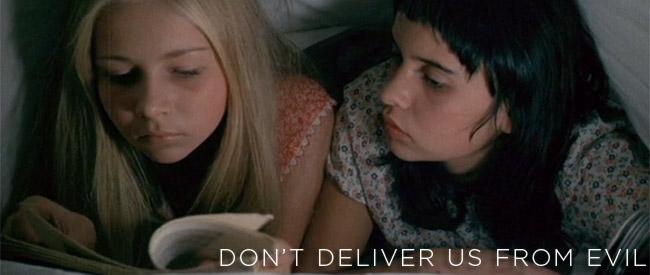
One of the great unhearalded works of early ‘70s youth rebellion, DON’T DELIVER US FROM EVIL is about a pair of upper-class parochial school BFFs who swear themselves to Satan and set out, in their own seemingly innocent way, to inflict pain and cruelty on do-gooding “idiots.” Over the course of a summer, the two have neighboring country vacation homes, and when Anne, the instigator of the two, is left on her own, her place becomes a haven for all kinds of wickedness. The girls amuse themselves with sexual intimidation of their neighbor, restaging Christ’s Carrying of the Cross with a lame groundskeeper, holding a Satanic ceremony, and seducing a married man. When they return to school, they make the ultimate statement of contempt for middle-class values.

The film is as much about hiding under the covers with flashlights and dirty books and sneaking cigs and communion wine as it is figuring out where to hide a body. It’s not difficult to imagine why the film never received US distribution: it’s not a lurid exploitation that could appeal to a grindhouse crowd, but its arthouse style and whimsy is rooted in too much anti-bourgeois perversion to appeal to sophisticated New Yorkers. (Though Amos Vogel does single it out in FILM AS A SUBVERSIVE ART.) Consider it a cross between Jean Eustache and Michael Haneke with a bit of Buñuel and Larry Clark thrown in—but one that seems uniquely attuned to its young, rebellious female protagonists. It’s a true diamond-in-the-rough.

Rally your best friend and check it out: this is essential bad girl viewing.

nakedarmy_banner THE EMPEROR’S NAKED ARMY MARCHES ON
Dir. Kazuo Hara, 1988
Japan, 122 min.
In Japanese with English subtitles

FRIDAY, JANUARY 2 – 7:30 PM
WEDNESDAY, JANUARY 7 – 7:30 PM
SUNDAY, JANUARY 25 – 5 PM
MONDAY, JANUARY 26 – 7:30 PM
**closed due to inclement weather**

Part of The Bitter Truths of Kazuo Hara series. Special thanks to Tidepoint Films.

[TRIGGER WARNING: Wartime violence and atrocities]

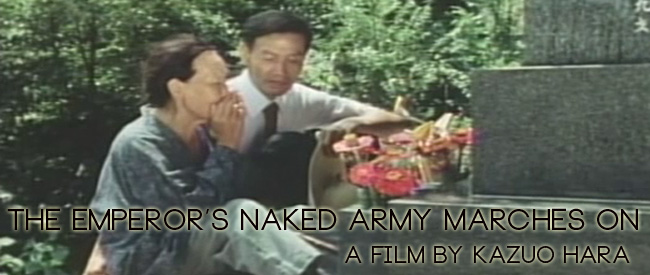
THE EMPEROR’S NAKED ARMY MARCHES ON is a more plainly political, but no less revealing, portrait of Japan since World War II. Kenzo Ozukaki was tireless in his campaign against the commonly held idea in Japan that Emperor Hirohito was not responsible for war atrocities during World War II, even getting arrested in the process. Ozukaki ambushes former soldiers into giving him the answers that he is obsessed with finding. His obsession is unsettling; even people who agree with him politically seem unwilling after a certain point to stand in solidarity with Ozukaki, as his methods get more outrageous, and eventually violent.

The film became surprisingly popular in Japan, earning Hara the New Director Prize from the Directors Guild of Japan (and only 16 years after his first film GOODBYE CP!) and drawing relatively large crowds for such controversial and alienating subject matter. Errol Morris has put THE EMPEROR’S NAKED ARMY MARCHES ON in his top 5 films of all time, high praise from a master of the documentary film (Michael Moore likes it too, if that’s more your speed). Through the entire movie, Hara remains a silent witness to Ozukaki’s increasing fanaticism and devotion to the only version of the truth he can possibly accept; but when is silence irresponsible? When are those in charge responsible for things they let happen? When is inaction morally indefensible?


FF.Banner

FINAL FLESH
Dir. Vernon Chatman
USA, 71 min.

FRIDAY, JANUARY 9 – 10 PM
SATURDAY, JANUARY 17 – 10 PM
FRIDAY, JANUARY 23 – 10 PM
SATURDAY, JANUARY 31 – 10 PM

Writer/director Vernon Chatman of PFFR (WONDER SHOWZEN, XAVIER: RENEGADE ANGEL) discovered the existence of “websites whereupon one can hire professional porn production companies to do the sick and custom bidding of your panting loins’ darkest yearn.” He chose four different custom-porn-making sites, and submitted segments of a highly detailed script, or as he called it, his “purest truths”, to each of them. The results form the “8-part prepocolyptic triptych in D minor” (or perhaps the 4-part “cinematic exquisite corpse”) that is FINAL FLESH.

This epic and disturbing saga cannot be adequately explained or summarized, but by way of an attempt, it concerns the Pollard family (who shape-shift in their representation by the four different smutmakers).

The family is calmly discussing their impending death by atom bomb when Mrs. Pollard recounts a dream in which she sensually bathes herself in the “Tears of Neglected Children”. Daughter Pam goes to the Psycho Sexual Burn-Ward (the bathroom) and reads the Koran on the toilet: “Yahweh ordered a double-latte. When the barista handed it to him, it was too hot, so Yahweh threw it in the janitor’s face. The end.” Pam then gives birth to an egg (“this is so hot”) and a piece of raw steak which she names Mr. Peterson and breastfeeds. Mrs. Pollard and Pam then hatch a plan to convince their patriarch to return to the womb (“get up in there”), before Mrs. Peterson recounts her life’s regret: “I didn’t want to have a family, I wanted to murder the president. I wanted to use his blood to oil the machinery of capitalism.” The atom bomb drops but the adventure continues as they re-emerge in God’s womb, reincarnated as a different set of amateur porn actors…

If FINAL FLESH is not the greatest film of the 21st century, then I just creamed in my demon. “It’s the same thing every Thanksgiving. Remember?”


Gaea Girls

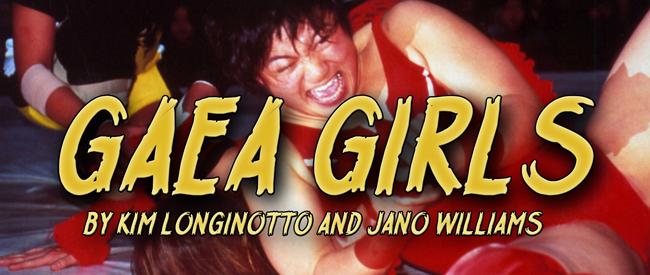
GAEA GIRLS
Dir. Kim Longinotto and Jano Williams, 2000
England/Japan, 106 min.
In Japanese with English subtitles

SUNDAY, JANUARY 11 – 5 PM
MONDAY, JANUARY 12 – 10 PM
TUESDAY, JANUARY 20 – 10 PM
FRIDAY, JANUARY 30 – 10 PM

Part of the Three Films by Kim Longinotto series. Special thanks to Women Make Movies!

This fascinating film follows the physically grueling and mentally exhausting training regimen of several young wanna-be GAEA GIRLS, a group of Japanese women wrestlers who are just as violent as any member of the World Wrestling Federation. One recruit, Takeuchi, endures ritual humiliation not seen on screen since the boot camp sequences of FULL METAL JACKET.

“Longinotto and Williams’s ability to penetrate facades is remarkable. The filmmakers build their story in a way that’s more compelling and suspenseful than many narrative films.” – Chicago Film Festival

Film synopsis courtesy of Women Make Movies!


KoA_banner

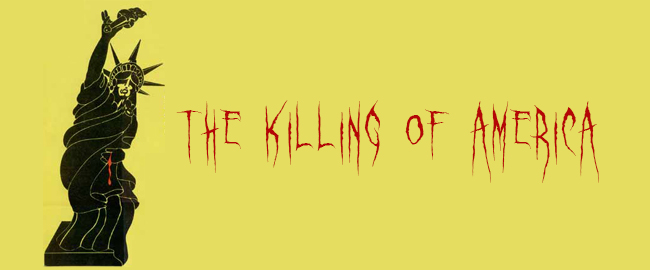
THE KILLING OF AMERICA
Dir. Sheldon Renan & Leonard Schrader, 1982
USA, 90 min.

SATURDAY, JANUARY 3 – 7:30 PM
SATURDAY, JANUARY 10 – 10 PM
TUESDAY, JANUARY 13 – 10 PM
THURSDAY, JANUARY 29 – 10 PM

Part of the Mondo America series.

ALL OF THE FILM YOU ARE ABOUT TO SEE IS REAL. NOTHING HAS BEEN STAGED.

So begins the 1982 shockumentary THE KILLING OF AMERICA, a film that, even among its mondo movie contemporaries, stands out as one of the grimmest and most infamous films ever produced. So much so, in fact, that to this day it remains effectively unreleased in The United States.

If violence is the disease, then THE KILLING OF AMERICA is the microscope. Compiled almost entirely from news broadcasts, security camera footage, etc, THE KILLING OF AMERICA chronicles nearly every major violent incident of the era, from the JFK assassination onward. The America presented here is land characterized by widespread burnout and disillusionment. Add to that the increasing pervasiveness of the mass media, as well as an obscene overabundance of firearms, and you are left with a sobering portrait of a sick society, in which insanity and paranoia breed easily. Meanwhile, three decades later…

Directed by Sheldon Renan & Leonard Schrader (brother of Paul Schrader), and featuring a noteworthy narration by voiceover master Chuck Riley.


marathon-banner THE MARATHON FAMILY
Dir. Slobodan Šijan, 1982.
SFR Yugoslavia, 92 min.
In Serbian with original English subtitles by Spectacle!

FRIDAY, JANUARY 2 – 10 PM
THURSDAY, JANUARY 8 – 10 PM
MONDAY, JANUARY 12 – 7:30 PM
SUNDAY, JANUARY 18 – 5 PM

Part of the Three Yugoslavian Comedies by Dušan Kovačević series.

Adapted by Kovačević from his play Maratonci trče počasni krug (1973)

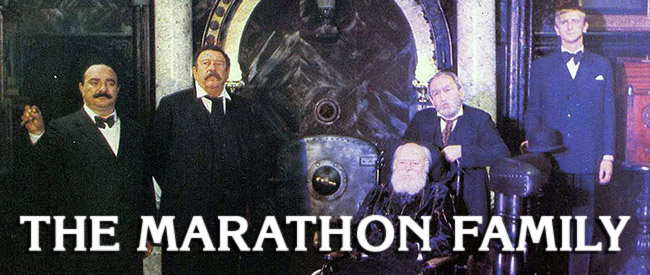
Šijan and Kovačević followed up the smashing success of WHO’S SINGIN’ OVER THERE? with the arguably even greater THE MARATHON FAMILY (the Serbian title translates to, “The Marathoners Run the Victory Lap”), based on one of Kovačević’s earliest plays. Set in a small village in 1935, it explores the offbeat personal and political tensions amid a family of six generations of contemporaneously-(mostly-)-living undertakers.

THE MARATHON FAMILY is as grim and anarchic — not to mention hilarious — as anything Šijan and Kovačević have ever done, and no less rooted in recent history of social relations. It represents various points of transitions: the assassination of King Alexander I of Yugoslavia, portrayed through the actual newsreel on which it was captured; the transition to sound film in Yugoslavia’s cinemas; and, among the family, tensions over the ailing business affairs of their cemetery and the economic motivation to pursue new crematorium technology. Due to the latter, the family also becomes mixed-up with a local gangster, whose team of grave robbers refurbish old coffins — and naturally, the undertakers are also behind on their payments. Meanwhile, the youngest, most dim-witted member of the Marathon family becomes romantically ensnared with the gangster’s disturbed daughter, whose behavior grows increasingly erratic when she’s fired as the cinema’s pianist.

Barreling through comedy, tragedy, death, pornography, murder, incineration, and historical sea change, THE MARATHON FAMILY is at once as tar-black and uproarious as movies get.


Snowwoman.BANNER

THE SNOW WOMAN
aka Kaidan Yukijorô
Dir. Tokuzô Tanaka, 1968
Japan, 79 min.
In Japanese with English subtitles

SATURDAY, JANUARY 3 – 10 PM
TUESDAY, JANUARY 6 – 10 PM
WEDNESDAY, JANUARY 14 – 7:30 PM
SUNDAY, JANUARY 18 – 7:30 PM
TUESDAY, JANUARY 27 – 10 PM
**closed due to inclement weather**

Part of the Spectober IV series.

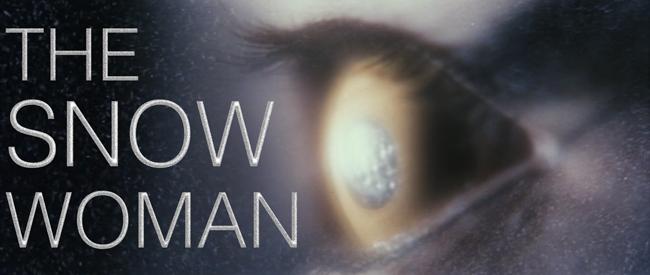
The story of Yuki-Onna, the Snow Woman, who kills any man who sets his eyes upon her, is best-known to western audiences as one of the segments in Masaki Kobayashi’s 1965 portmanteau horror classic KWAIDAN. Made just three years later, Tokuzô Tanaka’s poetic and haunting feature-length interpretation adheres to the basic outline of the folk tale (which is also referenced in Kurosawa’s DREAMS), infusing it with added emotional depth and political subtext and one-upping Kobayashi’s version with some truly inspired and terrifying set-pieces.

Shigetomo, a master sculptor, and his apprentice Yosaku set out for the Mino Mountains to find the suitable wood from which to carve the Buddhist statue for the state temple. Caught in a blizzard, they take refuge in a hut, where the Snow Woman finds them asleep. She murders the sculptor but, struck by Yosaku’s “youth and beauty”, impulsively decides to spare him if he promises to never tell anybody what he witnessed. He returns safely to his village but soon falls in love with a new arrival named Yuki, who is really the Snow Woman disguised as a human.
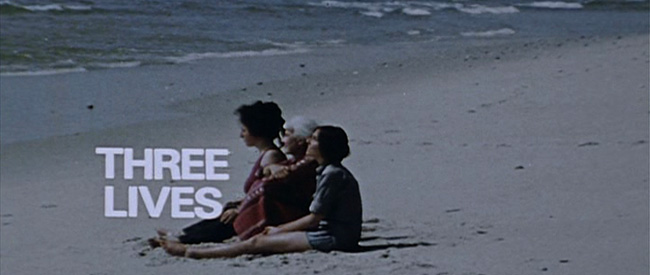


THREE-LIVES

THREE LIVES
Dir. Kate Millett, 1971
USA, 70 min.

SUNDAY, JANUARY 11 – 7:30 PM **Kate Millett and Robin Mide in attendance!**
THURSDAY, JANUARY 15 – 7:30 PM
WEDNESDAY, JANUARY 21 – 10 PM
SUNDAY, JANUARY 25 – 7:30 PM

Part of the In Our Own Words: Feminist Non-Fiction Films of the 70s series.

“Kate Millett’s Three Lives is a moving, proud, calm, aggressively self-contained documentary feature…” – Vincent Canby, The New York Times

Feminist author Kate Millett was a second-wave powerhouse; in 1970, she published Sexual Politics, called by Norma Wilson “one of the first feminist books of this decade to raise nationwide male ire,” and which, obviously, made her an enemy of Norman Mailer. In 1971, Millett brought together an all-female crew, under the name Women’s Liberation Cinema, to film three women’s remembrances of their lives.

THREE LIVES portrays three women: Robin Mide, an artist; Lillian Shreve, a chemist; and Mallory Millet-Jones, Millett’s own sister. The camera is a quiet observer, letting the women, from three different paths and generations, tell their own stories without outside interference. Through these women’s personal revelations, a narrative of living under the patriarchy is revealed. The personal is political, indeed.

Courtesy of Kate Millett.
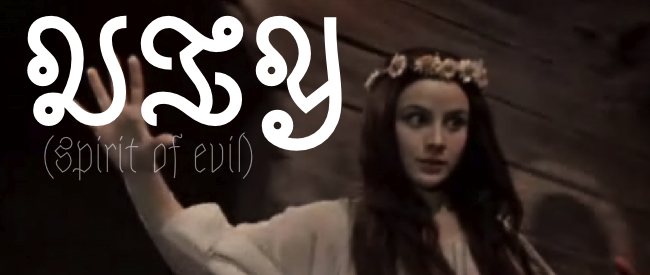


VIY_banner

VIY
Dir. Konstantin Yershov & Georgi Kropachyov
1967, 78 min.
In Russian with English subtitles

SUNDAY, JANUARY 4 – 5 PM
MONDAY, JANUARY 5 – 10 PM
WEDNESDAY, JANUARY 7 – 10 PM
FRIDAY, JANUARY 23 – 7:30 PM

Part of the Spectober IV series.

A young student must pray for 3 days over the body of a recently deceased woman – believed to be a witch – while her restless spirit and a gang of ghouls temp, prod, and terrorize him to no end. Based on the story (also called Viy) by Nikolai Gogol, the film boasts some excellent effects work and a beautiful score.
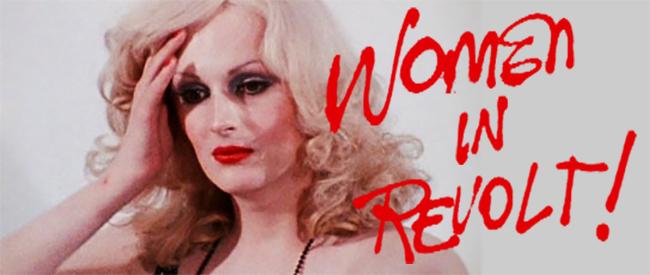


WomeninRevolt.BANNER

WOMEN IN REVOLT
Dir. Paul Morrissey, 1971
USA, 97 min.

TUESDAY, JANUARY 6 – 7:30 PM
SATURDAY, JANUARY 24 – 7:30 PM
MONDAY, JANUARY 26 – 10 PM
**closed due to inclement weather**
FRIDAY, JANUARY 30 – 7:30 PM

Part of the Four Films by Paul Morrissey series.

[TRIGGER WARNING: This film contains depictions of sexual assault.]

Featuring Candy Darling, Jackie Curtis, Holly Woodlawn and Jane Forth. With music by John Cale.

What do you mean “Come down off the trapeze and into the sawdust”? That’s circus talk.

Three of the most indelible transgender icons of all time play militant feminists in this incredible film which is so much more than parody. Jackie Curtis and Holly Woodlawn have had it with men and their foul ways, so they join a militant feminist organization called PIG (Politically Involved Girls). Candy Darling is a wealthy socialite from Park Avenue (or Long Island – they can’t keep it straight) who they draw into the group to give it legitimacy, but it turns out that she’s having an incestuous relationship with her brother. Regardless, the three quickly become enemies: “I could just plunge a knife right into her back.” “Oh no, it’s too bloody!” “Well, I could do it and just not look.” Holly Woodlawn becomes a Bowery bum and Jackie Curtis can’t stop hiring male prostitutes, while Candy becomes a famous actress: “I’m sick of incest and lesbianism. I’m ready for Hollywood.”

After WOMEN IN REVOLT previewed on 59th Street, it was protested by a feminist organization, who mistook the film for a caricature of feminism rather than a caricature of the popular discourse around feminism, not to mention a caricature of traditional gender roles. Candy Darling reportedly declared, “Who do these dykes think they are anyway? Well, I just hope they all read Vincent Canby’s review in today’s Times. He said I look like a cross between Kim Novak and Pat Nixon. It’s true – I do have Pat Nixon’s nose.”
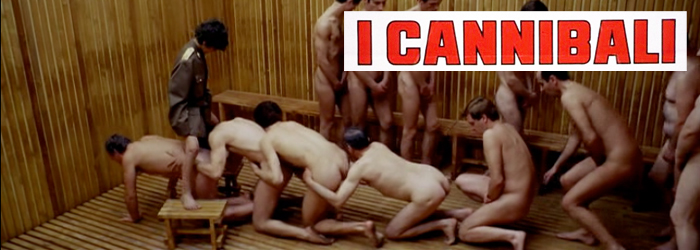


Cannibali banner

THE YEAR OF THE CANNIBALS
aka I cannibali
Dir. Liliana Cavani, 1969
Italy, 95 min.
In Italian with English subtitles

MONDAY, JANUARY 5 – 7:30 PM
WEDNESDAY, JANUARY 14 – 10 PM
TUESDAY, JANUARY 20 – 7:30 PM
WEDNESDAY, JANUARY 28 – 7:30 PM

Part of the Tales of Turbulence from Emilia-Romagna series.

Liliana Cavani is probably best known for her portrayal of a complex erotic relationship between a former SS officer and a concentration camp survivor in her 1974 film THE NIGHT PORTER. Largely overlooked however is her 1969 feature, THE YEAR OF THE CANNIBALS, which investigates a different kind of obscene authority and the “natural rebellion” it provokes.

In this loose adaptation of Antigone set in a near-future Milan, the State has forbidden the removal of the bodies of rebels that litter the streets. As a result, the corpses are stepped over and ignored by the citizens, reminding us how a comfortable private existence in the metropolis everywhere means turning a blind eye to misery. Britt Ekland (THE MAN WITH THE GOLDEN GUN) and Pierre Clémenti (PIGSTY, THE CONFORMIST) band together as vigilante body-snatchers in defiance of the decree, and ultimately face repression and execution. A radical chic romp that recalls A HARD DAY’S NIGHT and Clémenti’s work with Groupe Zanzibar, THE YEAR OF THE CANNIBALS also offers a sober early analysis of the notorious “years of lead” in Italy, characterized by witch-hunts and wholesale incarceration of suspected militants.

“I intended to use the language of myth and universal symbols to avoid the revolutionary speeches that had become a cliché by 1969-1970. … [The Year of the Cannibals] is not the chronicle of a revolution, … but the spectral analysis of reality beyond the various episodes that characterized the demonstrations. I believe it is a comprehensive analysis, and primarily a discourse of generations.” -Interview in Écran #26, June 1974

BEST OF SPECTACLE 2014 – PART 1

bestofs-banner

To mark the conclusion of Spectacle’s fourth full calendar year of operation, our programming collective has selected their favorites from among the regular series features each other showed throughout the past twelve months. The result, BEST OF SPECTACLE (aka BoS2K14), provides an opportunity to revisit some of 2014’s greatest discoveries, thrills and audience-pleasers. This is the first half of our selections, stay tuned for the second half coming in January!

As the year draws to a close, Spectacle would like to acknowledge the audiences, artists and distributors who have pitched in their support, vision and feedback. Thank you for another brilliant year! We’ll save you a seat in 2015.


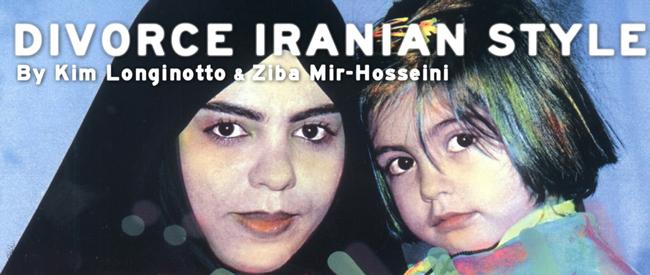
Divorce, Iranian Style

DIVORCE IRANIAN STYLE
Dir. Kim Longinotto and Ziba Mir-Hosseini, 1998
Iran/England, 80 min.
In Farsi with English subtitles.

MONDAY, DECEMBER 1 – 7:30 PM
TUESDAY, DECEMBER 9 – 10 PM
SUNDAY, DECEMBER 14 – 5 PM
SATURDAY, DECEMBER 20 – 7:30 PM

Part of the Three Films by Kim Longinotto series. Special thanks to Women Make Movies!

Hilarious, tragic, stirring – this fly-on-the-wall look at several weeks in an Iranian divorce court provides a unique window into the intimate circumstances of Iranian women’s lives. Following Jamileh, whose husband beats her, Ziba, a 16-year-old trying to divorce her 38-year-old husband, and Maryam, who is desperately fighting to gain custody of her daughters, this deadpan chronicle showcases the strength, ingenuity, and guile with which they confront biased laws, a Kafaka-esque administrative system, and their husbands’ and families’ rage to gain divorces.

With the barest of commentary, acclaimed director Kim Longinotto turns her cameras on the court for a subtle, fascinating look at women’s lives in a country which is little known to most Americans. Directed by Kim Longinotto and Ziba Mir-Hosseini, author of Marriage on Trial: A Study of Islamic Family Law.

“A fascinating verite-style documentary that counters with compassion, humor, and a keen nose for spotting empathetic characters, strong-willed women, and dramatic moments, the traditional stereotypes of women in the Muslim world as passive victims.” – Hamid Naficy, Author, ‘The Making of Exile Cultures: Iranian Television in Los Angeles’


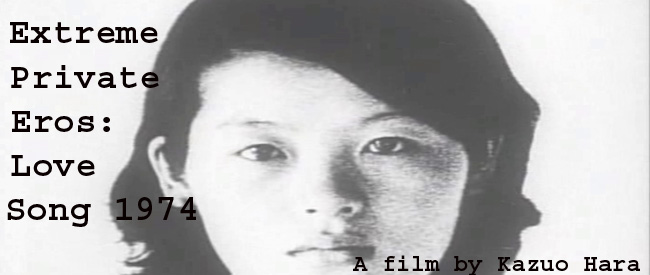
extremeprivateeros_banner

EXTREME PRIVATE EROS: LOVE SONG 1974
Dir. Kazuo Hara, 1974

Japan, 98 min.
In Japanese with English subtitles.

TUESDAY, DECEMBER 2 – 10 PM
MONDAY, DECEMBER 8 – 7:30 PM
SATURDAY, DECEMBER 20 – 10 PM
TUESDAY, DECEMBER 23 – 7:30 PM

Part of The Bitter Truths of Kazuo Hara series. Special thanks to Tidepoint Films.

Shot over several years, EXTREME PRIVATE EROS: LOVE SONG 1974, a documentary about Hara’s ex-lover was a clarion call against a historically reserved Japanese culture. The film follows Miyuki Takeda, Hara’s ex and father of his son, as she navigates new relationships (first with a woman, and then with an American GI in Okinawa), raises her son, and explores life in 1970s Japan as an outspoken feminist. But the film isn’t just a portrait of the vulnerabilities of a radical feminist single mother, in a time when that wasn’t heard of; Miyuki often takes the opportunity of being filmed by her ex to let loose with what she really thinks about him as a partner, as a lover, and as a filmmaker.

As well as a portrait of two complicated, damaged people, the film is a portrait of Okinawa as a dysfunctional city, damaged by two decades of American military presence. Hara films the GI bars and the underage prostitutes that frequent the bars for business. Hara takes a detour into the life of a 14-year-old “Okinawa girl” Chichi, whose life converges and diverges from Miyuki’s story in intriguing ways.

Released around the same time as the groundbreaking PBS series An American Family (and predating the similarly-themed SHERMAN’S MARCH by a decade), EXTREME PRIVATE EROS takes a long, hard look at gender roles, romantic relationships, and what it means to be a family in 1970s Japan. Hara’s out-of-sync sound and hand-held photography are disorienting and intimate at the same time, giving the feel of an experimental film to a film with very real content. The results are bitter and sometimes hard to watch, but always compelling.


THE FALLS

THE FALLS
Dir. Peter Greenaway, 1980
UK, 195 min.

THURSDAY, DECEMBER 18 – 7 PM
SUNDAY, DECEMBER 21 – 5 PM

A sprawling science fiction microbudget epic, Peter Greenaway’s THE FALLS is one of the more successful experimental features in accessibility and one that lasts 3 plus hours to boot. Known as Peter Greenaway’s favorite film of his own work, THE FALLS goes through a catalog of 92 individuals whose last name starts with the word “Fall” that were victimized by an event known as the VUE or the Violent Unknown Event. It’s told in a deadpan mock documentary style with numerous narrators, has a strange narrative current that somehow ties these characters together, can be seen as a mutated sequel to Alfred Hitchcock’s THE BIRDS, and boasts a playful score from Michael Nyman to wrap it all together.

Manic and mechanical, THE FALLS keeps you in focus with its absurdities and allows you to to solve the encyclopedic mystery with comic redundancies and run-ons. Indulgent in the best way possible, it’s truly mad in execution and in thought.


Go Down Death

GO DOWN DEATH
Dir. Aaron Schimberg, 2013
USA, 87 min.

THURSDAY, DECEMBER 4 – 7:30 PM
WEDNESDAY, DECEMBER 10 – 10 PM
SUNDAY, DECEMBER 14 – 7:30 PM
FRIDAY, DECEMBER 19 – 10 PM

Spectacle is pleased to present Aaron Schimberg’s staggering debut feature GO DOWN DEATH. Acclaimed as one of the most distinctive and visually stunning films of the past year, it sits uneasily among rote indie festival programming. Naturally, we feel we make a great pair.

GO DOWN DEATH is a wry, sinister realization of a strange new universe, a cross-episodic melange of macabre folktales supposedly penned by the fictitious writer Jonathan Mallory Sinus. An abandoned warehouse in Greenpoint, Brooklyn, stands in for a decrepit village haunted by ghosts, superstition, and disease, while threatening to buckle under rumblings of the apocalypse. Soldiers are lost and found in endless woods, a child gravedigger is menaced by a shape-shifting physician, a syphilitic john bares all to a young prostitute, and a disfigured outcast yearns for the affections of a tone-deaf cabaret singer. Highlighted by offbeat narrative construction, stunning black-and-white 16mm cinematography, and immaculately detailed production design, GO DOWN DEATH is a distinctively original film informed by American Gothic, folk culture, and outsider art.

Distributed by Factory 25


goodbyeuncletom-banner

GOODBYE UNCLE TOM
Dir. Gualtiero Jacopetti & Franco Prosperi, 1971
USA, 135 min. Director’s Cut.
In Italian with English subtitles.

THURSDAY, DECEMBER 4 – 10 PM
SATURDAY, DECEMBER 13 – 7:30 PM
WEDNESDAY, DECEMBER 17 – 10 PM
MONDAY, DECEMBER 22 – 10 PM

Rarely seen Director’s Cut featuring contemporary documentary footage and original narration. Part of the Mondo America series. Special thanks to Bill Lustig and Blue Underground. 

Few films have the mixed legacy accorded to MONDO CANE, the first film by Gualtiero Jacopetti and Franco Prosperi. The box office smash was nominated for the Palme d’Or and nearly won an Oscar for Riz Ortolani’s song “More,” which became a staple at weddings. It invented it’s own dubious genre, shock anthropology, and transformed the common Italian word for “world,” mondo, into a neologism conjuring all that’s bizarre, outrageous, and stranger than the fiction it questionably purports not to be. It’s the international signifier for extreme international weird.

When critics caught up with the put-on, they were relentless in their assault on the duo. By the time they released AFRICA ADDIO, a lurid chronicle of violence in the wake of decolonization in Tanzania and Kenya, they were accused of every kind of ethical violation from flagrant racism to paying soldiers to murder people before their cameras. The duo was hurt, and felt they had to do something to dispel accusations of intolerance.

So they made GOODBYE UNCLE TOM — one of the most challenging, notorious, anti-American, and maligned films of all time.

At a glance, it has very little to do with mondo. Allegedly, the idea took root when Jacopetti suggested the duo make MANDINGO into a documentary — this being many years before Richard Fleischer’s own scintilating Hollywood adaptation. The result is like if Peter Watkins and Ken Russell adapted Kyle Onstott’s taboo-shattering pulp novel about slave breeding and deciding to drive the historically rooted horrors of slavery home further by cranking them up a notch.

Making the tongue-in-cheek claim of being an actual documentary about American slavery, the film charts the entire institution of slavery from arrival (it is widely acknowledged as being the first movie ever set significantly on a slave ship) through supposed emancipation. Pulling many of the least pleasant historical realities of American slavery out from under the rug and rendering them in unhinged expressionistic extremes, it presents the institution as a grotesque atrocity exhibition including rape, infanticide, bizarre medical experimentation, and even a Bathory-esque blood bathing. And it’s all framed with contemporary newsreel footage of present-day civil rights violations and quotes—many of them presented with wry-self critique—from leaders or controversial figures including Martin Luther King, Malcolm X, Eldridge Cleaver, and Amiri Baraka, resulting in what Pauline Kael called “the most specific and rabid incitement of the race war” (while acknowledging that people of color seem to appreciate it much more than herself).

Or as Roger Ebert wrote, “They have finally done it: Made the most disgusting, contemptuous insult to decency ever to masquerade as a documentary.” Yet to be fair, one might point out that the “mockumentary” genre the film pioneers—Watkins is the only filmmaker who comes to mind who previously described such a patently fabricated scenario, i.e., one taking place before motion picture cameras were invented, as a “documentary”—was still an almost totally unfamiliar lexicon.

And with that barefaced claim, few movies are as gleefully, sadistically fixed upon a program of not-giving-a-fuck — which one might recognize as a front for a genuine core of outrage. It predates Pasolini’s canonical SALO, a like-minded piece of shock as an instrument of anti-bourgeois (an aim for which its privileged critical positioning might indicate it has failed), but is explicitly linked to the contemporary reality of American racism. Richard Corliss shouts out GOODBYE UNCLE TOM in his positive review of 12 YEARS A SLAVE — and yet one could not leverage the criticism that many, including Kareem Abdul Jabbar, made of 12 YEARS: that it stirs a rage that is compartmentalized into the past and portrayed as history without an acknowledgement of the human motivations that allow slavery to continue to exist around the world. Conversely, GOODBYE UNCLE TOM concludes with documentary footage of peaceful black protesters being brutalized by the national guard, followed by happy-go-lucky Southern Civil War re-enactors who restage history with an outrageously apparent disregard for the complexity and human debasement it represents. As the Italian narrator happily intones on the final line of the film, “It’s wonderful to return home on this splendid day in May and take a nice shower to wash away the past.”

Of course, part of the trouble of GOODBYE UNCLE TOM is that we can’t simply settle upon a simple, revisionist attitude. It’s undeniably an unpleasant, problematic, and troubling film—but one worth revisiting for those willing to confront tangled knots of history and their representation on screen.


HeadBanner

HEAD AGAINST THE WALL
aka La Tete Contre Les Murs
Dir. Georges Franju, 1959
France, 95 min.
In French with English subtitles.

SUNDAY, SEPTEMBER 4 – 7:30 PM
WEDNESDAY, SEPTEMBER 14 – 7:30PM
TUESDAY, SEPTEMBER 29 – 10PM

Part of the Views from the Inside series from 2014 and reappearing alone in September 2016 as Best of Best of Spectacle.

Anouk Aimee. Charles Aznavour. A shimmering black motorcycle jacket. Georges Franju’s HEAD AGAINST THE WALL taps into cinema’s inherent attractions but renders its own utterly untenable, less a cautionary tale than a smoldering portrait of loss. Behind the gates of a countryside sanitorium lives young Francois (future filmmaker Jean-Pierre Mocky), the hotheaded son of a stuffy lawyer – a wild one in the Brando tradition on the outside, bored to sedation within. Francois knows he’s sane, but while waiting for this latest convulsion of The System to pass, all he can do is look at the people around him – and now, without the comfort of his on-and-off girlfriend Stéphanie (Aimee), his visage isn’t pretty.

Blessed with the same magisterial stillness and dark beauty that gave EYES WITHOUT A FACE its inimitable power, Franju’s feature debut is both straightforward and serpentine. The screenplay (adapted from a Herve Bazin novel) posits man’s place in society as anything but certain; as Francois seeks validation from parties neutral to his domineering father, his individuality seems to vanish. What develops is not a critique of doctors or hospitals, but instead of French paternalism at large. Under the heel of a society founded on class expectations, Francois doesn’t lose his freedom so much as he realizes it never existed in the first place.

“He seeks the madness behind reality because it is for him the only way to rediscover the true face of reality behind this madness… Let us say that Franju demonstrates the necessity of Surrealism if one considers it as a pilgrimage to the sources. And Head Against The Wall proves that he is right.” – Jean-Luc Godard, Cahiers du Cinema

“Whether it’s the weird, eerily erotic gaze of a female inmate or a strange gathering of doves or a cityscape by night that seems as dank and claustrophobic as the asylum walls themselves, Franju’s mastery and palpable adoration of effect is ever evident.” – Glenn Kenny, The Auteurs


Hope banner

HOPE
aka Umut
Dir. Yılmaz Güney, 1970
Turkey, 100 min.
In Turkish with new English subtitles by Spectacle.

TUESDAY, DECEMBER 2 – 7:30 PM
SUNDAY, DECEMBER 7 – 5 PM
SATURDAY, DECEMBER 13 – 10 PM
WEDNESDAY, DECEMBER 17 – 7:30 PM

Part of the Yılmaz Güney: The Indomitable South series.

HOPE is considered a landmark in the history of Turkish cinema. Güney called it an “epic of verité” due to its break with the conventions of Turkish commercial cinema, the gleaming sets and powdered starlets typical of Yeşilçam (the Turkish Hollywood). Although it is often compared to De Sica’s BICYCLE THIEVES, HOPE also has much in common with Glauber Rocha’s BLACK GOD, WHITE DEVIL—with its rural merchant protagonist who gets fleeced one too many times and turns to a messianic preacher for guidance—and with Ousmane Sembene’s BOROM SARRET, the tale of a poor horse-cart driver in Dakar getting kicked around by the law.

Güney’s character, Cabbar, drives a horse-driven cart in Istanbul. Business is bad, and the rapidly modernizing city leaves little room for a man who uses such quaintly obsolete means to earn his living. His wife, mother, and five children depend on him, and their domestic life is characterized by constant threats and abuse. Indebted to everyone he knows, Cabbar’s fate is sealed when a bourgeois asshole in a sports car mows down one of his parked horses. Unable to borrow more money to replace it or even pay back his existing debts, Cabbar tries his luck at the lottery, then turns to armed robbery. Unfortunately, the American tourist he and his friend try to hold up fails to understand their threats and chases them away in anger. Furious at his creditors and indifferent to other cart drivers’ efforts to organize in a union, Cabbar falls under the influence of a hodja, a kind of wise-man witch-doctor, who promises him buried riches. Cabbar and his friend sever their bonds to the city and join the hodja in a clearly insane quest for treasure hidden in the surrounding desert.

Although it is often interpreted as a critique of the backwards superstitions rampant among the uneducated Turkish proletariat, HOPE should be read instead as a revolutionary call to break with old forms of organizing (whether in the family or in labor unions) and to embrace a non-instrumental form-of-life. It is a manifesto for the abolition of homo economicus and for the reenchantment of the world.


SPEC-InAGlassCage-banner

IN A GLASS CAGE
aka Tras el cristal
Dir. Agustí Villaronga, 1986
Spain, 111 min.
In Spanish with English subtitles.

WEDNESDAY, DECEMBER 3 – 10 PM
SUNDAY, DECEMBER 7 – 7:30 PM
MONDAY, DECEMBER 15 – 10 PM
FRIDAY, DECEMBER 19 – 7:30 PM

A huge thanks to Nico B. from Cult Epics.

[Trigger Warning: Sustained, recurring scenes of torture and sexual abuse—frequently involving children—presented in harsh, unsparing tones with a palpable, fascist historical context.]

A deeply unnerving film situated in the middle of a variety of genre film lineages, Agustí Villaronga‘s IN A GLASS CAGE blends morose, art-house chamber drama with psychologically-challenging giallo horror and unflinching exploitation film brutality into a force of will that will likely plant itself in your mind forever.

The narrative is historically-weighted yet mostly hedged in back-story. Death-camp Nazi doctor Klaus (Günter Meisner) flees to Spain after the Holocaust, where the emotional toll of his systemic, compulsive physical and sexual abuse of children during and after the war leaves him suicidal. A botched attempt lands him immobilized in an iron lung, cared for by his tormented wife Griselda (Marisa Paredes) and innocent young daughter Rena (Gisela Echevarria). Soon, a strange and aggressive man (David Sust) arrives and takes control of Klaus’ care… at the elder man’s insistence.

Inspired by the notorious, prolific 15th century child-killer Gilles de Rais, Villaronga immediately tapped Günter Meisner (multiple-time Adolf Hitler, Willy Wonka & The Chocolate Factory) for the role of Klaus, but the actor refused, disgusted with the content of the film. Eventually, he relented, claiming—apocryphally—that he could not get the script out of his mind. Meisner himself had been in a Nazi death camp as a youth.
This marked the first film for Catalan writer/director Agustí Villaronga, who would go on direct Black Bread (2010), winner of numerous Gaudí and Goya awards and the first Catalan-language film to be shortlisted for the Oscars.

Glasscage_v11

Original poster designed by Preston Spurlock.


liquid-sky-banner

LIQUID SKY
Dir. Slava Tsukerman, 1982
USA, 112 min.

FRIDAY, DECEMBER 5 – 10 PM
TUESDAY, DECEMBER 9 – 7:30 PM
TUESDAY, DECEMBER 23 – 10 PM

[Trigger Warning: Graphic sexual violence and drug use.]

Spectacle is honored to present the unforgettable cult classic LIQUID SKY—the story of a weekend in New York’s hyperrealist, queer, neon, drug fueled, dangerous, and dystopian 1980s featuring cast of underground models, electroclash singers, shrimp-obsessed housewives, scumbag clubbers, addicts, necrophiliacs, and a German Ufologist. Deadpan humor and eroticism, satire and horror, camp and realism make LIQUID SKY several bolts of lightning striking the same bottle.


NK_banner

NAKED KILLER
Dir. Clarence Fok Yiu-leung, 1992
Hong Kong, 93 min.
In Cantonese with English subtitles.

WEDNESDAY, DECEMBER 3 – 7:30 PM
SATURDAY, DECEMBER 6 – 10 PM
THURSDAY, DECEMBER 11 – 10 PM
TUESDAY, DECEMBER 16 – 10 PM

Part of the Far East Femmes with Firearms series.

A gleefully sleazy, over-the-top CAT III camp romp about dueling lesbian contract killers and the impotent policeman caught in the middle, NAKED KILLER is a joyous ode to all things (s)excessive.

Following a traumatic crime bust gone awry, Hong Kong cop Taninan can’t seem to perform in the line of duty or in the bedroom… until he meets the enchanting seductress/killer Kitty. Their tango is soon cut short by Sister Candy, a veteran assassin who snatches Kitty away and teaches her the ways of professional execution and how to tap into her sensual side. Almost just as quick, two of Sister Candy’s previous students show up to murder their former teacher, prompting an all-out lesbian assassin war.

With tongue planted firmly in-cheek, director Fok Yiu Leung crosses titillating eroticism with a strong sociological undercurrent denouncing male piggishness. But he also knows how to entertain, and wildly so: copious amounts of milk drinking, dick slicing, office shoot-’em-ups, underwater knife fights, and Skinemax soft-core lesbian playfulness all wrapped up in a engrossing amount of 90s neon bliss… it’s all here and then some.

This is the 1992 summer action blockbuster you deserve.

“Imagine the erotic world of Basic Instinct exaggerated into a kung-fu cartoon of sexy lesbian avengers executing quadruple leaping somersaults in a deadly assault against the opposite sex.” -The New York Times

“John Woo on acid… Naked Killer breaks Mach 5 within the first 10 minutes and never lets up. Bursting with colorful lighting, angles, and set pieces, it’s a panoply of Nineties sex and violence, decadence for decadence’s sake, with little moralizing thrown in. A genuine crowd-pleaser…” -The Austin Chronicle

“It’s like nothing you’ve ever seen before… a stylized girlie graphic novelization of psycho hot babe killers as channeled through and re-imagined by Quentin Tarantino… Naked Killer is girl power gone gonzo, a geek’s wet dream doused with libido lightening messages about Chinese society’s misogyny.” -Pop Matters


singin-banner WHO’S SINGIN’ OVER THERE?
Dir. Slobodan Šijan, 1980.
SFR Yugoslavia, 86 min.
In Serbian with original English subtitles by Spectacle.

FRIDAY, DECEMBER 5 – 7:30 PM
MONDAY, DECEMBER 8 – 10 PM
TUESDAY, DECEMBER 16 – 7:30 PM
MONDAY, DECEMBER 22 – 7:30 PM

Based on an original screenplay by Kovačević. Part of the Three Yugoslavian Comedies by Dušan Kovačević series.

This highly quotable classic, which screened Un Certain Regard at the 1981 Cannes Film Festival, charts the journey of a ramshackle bus across the Yugoslavian countryside toward Belgrade on April 5, 1941. Lorded over by an impetuous conductor and his numbskull son, the passengers constitute a vertiable ship of fools, misfists, and outcasts: among them a disgruntled WWI vet, a goofy hunter, a fatalistic consumptive, libidinous newlyweds, a suave pop singer, and a pair of young gypsy musicians — the source of pointed social tensions — whose folk numbers provide the film’s Greek chorus.

A prime example of the Aristotelian Unities in screenwriting, it follows the little scrapheap-that-could through encounters with highwaymen, funerals, soldiers, and other odd situations, rolling inexorably toward an unexpectedly resonant conclusion.

Fondly remembered to this day, WHO’S SINGIN’ OVER THERE? was declared by the Yugoslavian Board of the Academy of Film Art and Science (AFUN) to be the best Yugoslavian film made between 1947 and 1995.