POLICE MORTALITY

policemortality-banner
POLICE MORTALITY
Anti-Banality Union, 2013
U.SS.A., 66 min.

TUESDAY, DECEMBER 17 – 8:00 PM & 10:00 PM

TWO SHOWS – ONE NIGHT ONLY!
Admission by donation!

Do you ever try to imagine the last crime?
Suspect that Robocop is the 99%?
Or wish that the pigs would off themselves, so you don’t have to?

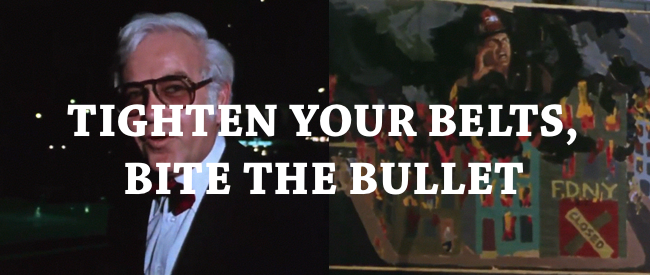
Leave it to Hollywood and the Anti-Banality Union, in the world premiere of POLICE MORTALITY, the vengeful follow-up to last year’s 9/11 bonanza UNCLEAR HOLOCAUST.

The immaculate suicide of one police officer begins to reveal the contradictions of police existence to a force which, finding itself utterly irreconcilable with itself, resorts to communism, terrorism, and ultimately terminal civil war, eradicating the prevailing organization of life in the process.

BEST OF SPECTACLE 2013

bestofs-banner

To mark the conclusion of Spectacle’s third full calendar year of operation, our programming collective has selected their favorites from among the regular series features each other showed throughout the past twelve months. The result, BEST OF SPECTACLE (aka BoS2K13), provides an opportunity to revisit some of 2013’s greatest discoveries, thrills and audience-pleasers.

As the year draws to a close, Spectacle would like to acknowledge the audiences, artists and distributors who have pitched in their support, vision and feedback. Thank you for another brilliant year! We’ll save you a seat in 2014.


anticlock-banner

ANTI-CLOCK
Dir. Jane Arden & Jack Bond, 1979
92 min. UK.

SUNDAY, DECEMBER 15 – 5:00 PM
SATURDAY, DECEMBER 21 – 7:30 PM

Part of the series Arden & Bond

A mixed-media riddle, fractured psychodrama and slow-burning sci-fi thriller all fused into one, Anti-Clock- the final feature born out of Arden and Bond’s collaboration and only one in which they are credited as co-directors- is the CCTV output of your most paranoid, hypnagogic distress.

Ostensibly a loose narrative about an experimental psychiatric procedure that deconstructs the past, present and future of a suicidal young man, Arden and Bond employ a variety of film and video processing techniques to conjure a world in which mind and screen are enigmatically intertwined. As described in the opening credits (appropriately buried in a sea of television static), Anti-Clock is a ‘time stop’ of obsessive self-revelation.

The film premiered at the London Film Festival in 1979 and experienced a short run in NYC in 1980 before being shelved in 1982 after Jane Arden’s suicide.


assa-banner-3

ASSA
Dir. Sergei Solovyov, 1987
Soviet Union, 153 min.
Russian with English subtitles.

SUNDAY, DECEMBER 1 – 7:30 PM
SUNDAY, DECEMBER 15 – 7:30 PM

Part of the series MOLODOST: Films on Soviet Youth

Assa came to recognition and cult status as one of the first films to bring underground rock culture into the Soviet mainstream, featuring songs by bands such as Aquarium, Soyuz Kompozitorov, Bravo, and Kino (whose lead singer Viktor Tsoi, also featured in Igla, plays himself in the film). Assa reflected a time of change in the USSR, as emphasized in Tsoi’s song “We Wait for Change,” consequently adopted by the real-life Russian opposition movement Solidarnost as its anthem. Set in Crimea during the late 1980s, Assa follows the story of Alika, a young nurse who is romantically involved with Krymov, her much older patient and the leader of an organized crime group. Despite her relationship with Krymov, Alika starts falling for a young rock musician named Bananan (played by the avant-garde artist Afrika). Bananan introduces Alika to his countercultural world of music and art. When the jealous Krymov begins to notice a change in Alika’s emotions toward him, he stages a plan to eliminate Bananan from Alika’s life forever. Assa has a playful, absurdist touch, combining sober moments with dreamlike sequences. Experimental scenes of hand-painted abstract patterns and inter-titles explaining youth slang are interspersed throughout the film. One amusing subplot that develops follows Krymov reading a book of the assassination attempt on Russia’s Tsar Paul I—the “Mad Tsar”. As he reads, a fantasy reenactment plays parallel to the main story. Perhaps this text foreshadows the inevitable fate of the Union: according to the assassins, they were only abolishing a power from Russia that had gone mad.


boxer-banner

BOXER
Dir. Shûji Terayama, 1977
94 min. Japan.
In Japanese with English subtitles.

THURSDAY, DECEMBER 12 – 10:00 PM
WEDNESDAY, DECEMBER 18 – 7:30 PM

Dense with glorious tints and nail-biting moments, Shûji Terayama’s Boxer pits avant-garde and crowd-pleaser sensibilities against each other with downright jugular results.

The story is old as sin: a withered ex-champion, fueled by bitterness and drink, takes a young drifter under his wing. In a society that rewards cowardice and conformity, the student’s values are shaken by his mentor’s discipline and focus, but it’s hard to tell if the retired boxer is steady, or just plain berserk.

Spectacle favorite Terayama (Pastoral, Emperor Tomato Ketchup), who wrote boxing commentary as a hobby between plays and movies, gives the story a dazzling palette and lightning swiftness, but also a necessary sense of respect for the body – and the weight of its punishment.


embryo-bannere

THE EMBRYO HUNTS IN SECRET
Dir. Kôji Wakamatsu, 1966
72 min. Japan.
In Japanese with English subtitles.

THURSDAY, DECEMBER 12 – 7:30 PM
MONDAY, DECEMBER 16 – 10:00 PM

Part of the series Kôji Wakamatsu

One part art house, one part Grindhouse, The Embryo Hunts In Secret was made right after Wakamatsu left Nikkatsu. This classic film presents a brutal exploration of the Japanese psyche seen through a child-like megalomaniac’s perspective.

This is a man who keeps his girlfriend imprisoned in their small apartment, controlling her every move and torturing her in between bouts of denial and self-induced humiliation. In the end, she gets revenge.


derfan-banner

DER FAN
aka Trance
Dir. Eckhart Schmidt, 1982
89 min. Germany.
In German with English subtitles.

MONDAY, DECEMBER 2 – 10:00 PM
SATURDAY, DECEMBER 14 – 7:30 PM


Part of the series Anti-Valentines 2013

In the wake of films like Christiane F., studies of displaced, dysfunctional German youth were plentiful. However, the frontrunner in the sweepstakes for the most memorable and disturbing entry would have to be Der Fan.

Like every other teenager in school, Simone has a crush on a rock star. And because this is Germany in the 80s, that rock star fronts a Kraftwerk-style new wave/minimal wave solo project. When the lead singer ‘R’ (lead singer of the real-life German pop group Rheingold) comes to town to make a television appearance, she’s suddenly gripped by a trance-like state… leaving school, friends and parents behind her. However, when Simone comes to realize the shallow nature of the ‘glamorous’ music industry and of ‘R’ himself, she plans a calculated revenge on her obsession that builds to one of the most shocking and brutal endings ever committed to celluloid.

An unsettling blend of new wave pop culture, adolescent angst, and full-blooded horror, this nasty little art-house shocker caught more than a few unsuspecting viewers off guard and earned a bit of a cult following in the process. Imagine a John Hughes vehicle with Michael Haneke in the driver’s seat and you’re getting close…


MARQUISbanner

MARQUIS
Dir. Henri Xhonneux. 1989
78 min. France.
In French with English subtitles.

TUESDAY, DECEMBER 3 – 10:00 PM
FRIDAY, DECEMBER 20 – 10:00 PM

Clumped in your history book between the chapters on French Revolution and pioneering 18th century erotic fiction grows a horny, pornographic mold called MARQUIS.

Immersed in a world in which uncanny animal masks mirror the spirit of the character within, a canine Marquis de Sade serves a prison sentence for allegedly raping the bovine Justine… but the situation may be more complicated than it seems. In between bouts of banter with his anthropomorphic, meter-long penis Colin, the Marquis gets down to writing a few of his more infamous scenes—many depicted in surreal claymation. Before too long the Revolution has begun, but where will it leave the Marquis?

Co-written by Henri Xhonneux and Roland Topor—animator of 1973′s inimitable surrealist classic “Fantastic Planet”—MARQUIS’s bizarre tone swings at will between irreverent perversion and clear-headed satire, never failing to entertain and utterly confound.

“This is one of the strangest movies I have ever seen. I found it to be discomforting and just weird. It makes you squirm in your seat and wonder what the people making this are like in real life. It’s definitely entertaining and it sort of sucks you in, especially if you don’t know French and have to read subtitles. It is certainly not American and it is certainly very peculiar. I have never seen a movie where everyone is wearing life-like animal costumes and acting like humans in very abnormal ways. This movie gives me the chills. However, I would watch it again just because it is so fascinatingly WEIRD.” -IMDB user ‘ethylester’

“NOT FOR THE PRUDISH.” -Variety


mary_jane_banner

MARY JANE’S NOT A VIRGIN ANYMORE
Dir. Sarah Jacobson, 1998.
98 min. USA.

FRIDAY, DECEMBER 6 – 7:30 PM
WEDNESDAY, DECEMBER 11 – 10:00 PM
THURSDAY, DECEMBER 19 – 10:00 PM

Part of the series You Can’t Keep Me Quiet!: Films by Sarah Jacobson

Sarah Jacobson (1971-2004) was an independent filmmaker who led a DIY filmmaking movement in the 90s. She wrote and directed several short films, documentaries, music videos and a feature film. She formed Station Wagon Productions with her mother and producer Ruth Jacobson and with her help, Sarah self-promoted and distributed her films all over the country. Originally from New Jersey and Minneapolis, Jacobson studied briefly at Bard College and then at the San Francisco Art Institute with George Kuchar.

She directed I Was a Teenage Serial Killer in 1993, which she described as the story of “a 19-year-old girl who has a series of run-ins with various condescending men.” Jacobson’s slap-in-the-face feminist interpretation of “sexy”/violent B movies found a cult following. Jacobson went on to make her feature Mary Jane’s Not a Virgin Anymore a few years later.

Too in your face to be an after-school special, Mary Jane’s Not a Virgin Anymore is a movie about sex from a girl’s point of view. After a gross and unceremonious “first time,” Jane learns about the joys of pleasing herself and asking for what she wants from her punky co-workers at a Midwestern movie theater (with Jello Biafra and Davey Havok cameos). the film debuted at the Chicago Underground Film Festival in 1997 and sold out at Sundance and SXSW; Jacobson promoted the film the year previous at the Independent Film Market with homemade “Not a Virgin” stickers that her and her mom made at Kinko’s.

After cancer ended Sarah Jacobson’s life in 2004, her mother Ruth and Sam Green established the Sarah Jacobson Film Grant to support young women “whose work embodies some of the things Sarah stood for: a fierce DIY approach to filmmaking, a radical social critique, and thoroughly underground sensibility.” Find out more about the Sarah Jacobson Film Grant here.


Millionenspiel-Banner

DAS MILLIONENSPIEL
Dir. Tom Toelle & Wolfgang Menge, 1970
96 min. West Germany.
In German with New English subtitles.

MONDAY, DECEMBER 2 – 7:30 PM
SATURDAY, DECEMBER 21 – 10:00 PM

Long before The Hunger Games, Battle Royale, Series 7: The Contenders and even The Running Man, 1970’s Das Millionenspeil portrays a deadly reality television contest in which a participant is given seven days to elude a trio of professional assassins and win a $1 million prize.

Based on a 1958 story by Robert Sheckley often cited as the first predicting the advent of reality television, Das Millionenspeil was itself made for German television and interspersed with convincing false advertisements, psychedelic studio interludes and man-on-the-street documentary bit. And moreso than all its followers, its a richly unsettling satire of government, broadcast and entertainment sectors colluding and engendering various alliances and sympathies among the public they entangle.

It also represents some of the first-ever recordings by the legendary CAN, then known as The Inner Space. Their propulsive title track and ambient interludes provide the backbone of an unusually polished, thrilling and subsequently little-seen production.


MOD FUCK BANNER

MOD FUCK EXPLOSION
Dir. Jon Moritsugu, 1994
76 min. USA.

FRIDAY, DECEMBER 6 – 10:00 PM
WEDNESDAY, DECEMBER 18 – 10:00 PM

Part of the series Postmodernism: Who Cares? The Complete Jon Moritsugu

Combining the tropes of 60s art-house cinema with the primitive punk aesthetics of the Cinema of Transgression, Jon Moritsugu has been making movies far outside the mainstream for over twenty-five years. While his work has screened at venues as high profile as the Sundance, Berlin and Toronto Film Festivals and even public television, he continually shirks convention and classification. After making his name with a series of hand-made 16mm features, he’s recently embraced video with a fervor and a freeness to which every young filmmaker should be paying attention. Moritsugu’s world is overflowing with eye-popping production design, eardrum-destroying rock ‘n’ roll, gross-outs aplenty and deadpan one-liners you’ll be quoting for weeks.

In this teen angst epic, London (Amy Davis) longs for love and leather jackets. Meanwhile, vicious Mods wage a turf war against a gang of lip-synched Asian bikers.

“A dynamic punk odyssey of a pair of innocent teens adrift in a violent urban world; Moritsugu unleashes a barrage of powerful images and hard-driving music.” – Los Angeles Times


lesbanner

LES SAIGNANTES
aka The Blood-lettes
Dir. Jean Pierre Bekolo, 2005
Cameroon. 97 min.
In French with English subtitles.

FRIDAY, DECEMBER 13 – 10:00 PM
THURSDAY, DECEMBER 19 – 7:30 PM

Part of the series Welcome to Applied Fiction: The Films of Jean Pierre Bekolo

Les Saignantes is the best African sci-fi vampire political satire with homoerotic overtones you’ve ever seen. Best friends Majolie and Chouchou are two beautiful young women trying to get ahead in a near-future Cameroon. After accidentally killing a powerful politician during sex, the two come up with a plot to dispose of the body, and get into the glamorous wakes that have taken over the local nightlife.

As the girls tear their way through the corrupt ruling class, using their their feminine wiles and magical powers, Bekolo drops inter-titles into the film, commenting on the difficulties of filmmaking in an oppressive political climate. With a feminist subtext and cinematography like a blacklight rave, Les Saignantes is a beautiful, disorienting, and truly original work.


SchooloftheHolyBeast-Banner

SCHOOL OF THE HOLY BEAST
Dir. Norifumi Suzuki, 1974
91 min. Japan.
In Japanese with English subtitles.

FRIDAY, DECEMBER 13 – 7:30 PM
SUNDAY, DECEMBER 22 – 5:00 PM

Part of the series S†NDAYS

Something foul is afoot at the Sacred Heart Convent, as Yumi Takigawa discovers after cloistering herself to search for traces of her mother, who had disappeared into the monastery years before. Once there, she becomes privy to dark secrets and sadistic games. In the hands of brilliant director Norifumi Suzuki, Sacred Heart is a wonderful and terrifying world of sensuality and violence rendered with masterful visual panache. Equally notorious for its exploitational extremes as its stunning artistry, School of the Holy Beast is a twisted rabbit hole of sin and vice that absolutely lives up to its legendary cult reputation.


SweetBunch-Banner.jpg.scaled1000

SWEET BUNCH
Dir. Nikos Nikolaidis, 1983
154 min. Greece.
In Greek with English subtitles.
New restoration presented in HD.

SUNDAY, DECEMBER 8 – 8:00 PM
SUNDAY, DECEMBER 22 – 7:30 PM

Part of the series Dead Wax: A Nikolaidis Double A-Side

Nikos Nikolaidis (1939-2007) is one of Greece’s most masterful and subversive filmmakers, yet his work remains inexplicably neglected abroad. Best known in the States for his transgressive, kinky horror-noir pastiche SINGAPORE SLING, his distinctive oeuvre encompasses many works embraced by radicals, outcasts and misfits, while earning an unexpected place within the pantheon of critically acclaimed national cinema of his native country.

Nikolaidis’s most acclaimed film charts a string of increasingly bizarre circumstances in the lives of four misanthropic housemates. An episodic, surreal, and offbeat paranoid epic in the spirit of Celine and Julie Go Boating, SWEET BUNCH weaves various plot strands as the characters cheat, steal, sleep, swindle and dance their way to oblivion, represented here by an extreme climax that clarifies the title’s allusion to Sam Peckinpah.

Veering between magical effervescence and hard-bitten cynicism, SWEET BUNCH is a neon-bathed yowl from a generation born into immediate obsolescence; what Vrasidas Karalis calls “an elegy and farewell to the innocence of a forgotten generation through poetic realism and colorful expression.” It’s further distinguished by nimble performances; a rich pop soundtrack; deftly choreographic sequences that would make Scorsese blush; and vintage-vortex production design encompassing offbeat knicknacks, Victorian junk, and jukejoint neons.

In it’s most recent list the Greek Film Critics Association (PEKK) ranked SWEET BUNCH among the country’s ten greatest films, and its idiosyncratic influence lingers in the work of Athina Rachel Tsangari and Giorgos Lanthimos. Nevertheless, SWEET BUNCH remains unavailable on DVD outside of Greece and previously had not been shown in New York in nearly 13 years. Here’s your chance to catch up on a national classic all-too overlooked outside its borders.


Telhphonebook-banner -new

THE TELEPHONE BOOK
Dir. Nelson Lyon. 1971
80 min. USA.

TUESDAY, DECEMBER 3 – 7:30 PM
FRIDAY, DECEMBER 20 – 7:30 PM

Sexually frustrated gamine Alice (Sarah Kennedy) is freed from her apartment-bound malaise when she receives the world’s greatest obscene phone call from one “John Smith.” Setting out on picaresque journey through the Manhattan white pages in search of its maker, Alice encounters ego-crazed porn directors, perverted psychologists and priapic shut-ins. Her trip grows more and more deranged (interrupted by first-person interviews with phone freaks), climaxing in one of the nuttiest half-hours of 1970s cinema.

Directed by Saturday Night Live writer Nelson Lyon and produced by Merv Bloch, creator of some of the movie industry’s best ad campaigns, The Telephone Book is hilarious and disturbing in equal measure, featuring Warhol Factory regulars, a man with a never-ending erection, and a lurid animation sequence (that is mostly to blame for its X rating). This is the Everything You’ve Always Wanted to Know About Sex But Were Afraid To Ask…for the porn-house crowd, with one caveat: it’s not porn and it never pretends to be.


WorkingClass.png

THE WORKING CLASS GOES TO HEAVEN
aka La Classe Operaia Va in Paradiso
Dir. Elio Petri, 1971
112 min. Italy.
In Italian with English subtitles.

SUNDAY, DECEMBER 1 – 5:00 PM
MONDAY, DECEMBER 16 – 7:30 PM

Part of the series Elio Petri

“Such films should be burned.”
–Jean-Marie Straub

Shot in a factory occupied by striking workers, The Working Class Goes to Heaven is Petri’s investigation of the restructuring of capitalist social relations and the waning primacy of the mass worker as the holder of revolutionary agency (Gian Maria Volonté stars as “Lulu Massa”). Student militants and union bureaucrats battle over piecework at the factory gates, while the workers themselves remain in a state of fatal ambivalence.

The mutilation of the body and the consciousness of the worker here receives one of its clearest cinematic expressions. The worker’s total incorporation into the machine of large-scale industry also occasions the most Deleuzian moment in Petri’s oeuvre: “The machine starts to move. Arms, legs, mouth tongue … The food goes down, and here is the machine that crushes it. A shit-making factory!”

SANTA KLAUS

santaklaus-banner

TWO MOVIES! ONE NIGHT ONLY!

This December, Santa Klaus is Coming to Town — but instead of presents, he comes bearing DEATH.

For one night only, we revisit two stellar Kinski jams that previously played as midnights. In the gothic western AND GOD SAID TO CAIN, Kinski plays the angel of death personified: a man wrongfully sentenced to prison labor camp who returns to reign vengeance upon the wealthy land baron who framed him. And in the Edgar Wallace adaptation CREATURE WITH THE BLUE HAND, Kinski plays dual roles (!) as a pair of demented twins (!!) in a haunted castle stalked by a serial killer with a steel blue claw (!!!).

If Jesus gave us nothing else, at least we might appreciate that his birth would, 2013 years later, provide fodder for this delicious pun that inspired a night of can’t-miss screenings.


godsaidtocain-banner

AND GOD SAID TO CAIN
aka Satan of Revenge
Antonio Margheriti, 1970.
96 min. Italy/West Germany.
In German with English subtitles.

MONDAY, DECEMBER 9 – 7:30 PM

In this macabre spaghetti western, the Duke of Delirium, Goth Kinski, gives a rare, heroic leading role as a man released after ten years of wrongful incarceration in a prison labor camp. Once sprung, he meanders his way back to town to get revenge on the men who framed him — one of whom has since become a wealthy and politically powerful land baron with dozens of hired guns on the payroll. And then Klaus Kinski kills all of them.

The plot may be traditional, but the movie is anything but: AND GOD SAID TO CAIN is notorious as of the darkest spaghettis ever made, and closer in tone to Italian horror films of the period than traditional westerns. It’s the most accomplished picture of underrated director Antonio Margheriti, best known for gothic horror films like CASTLE OF BLOOD and THE LONG HAIR OF DEATH. CAIN is an effortless synthesis of the two genres: in a largely wordless performance, Kinski assumes an almost phantasmagorical aura, and eerie shootouts take place under moonlight and in churches and candlelit quarters. The film’s baroque, blazing climax — think the of funhouse shootout of THE LADY FROM SHANGHAI restaged in Hell — validates the film’s German title, SATAN DER RACHE — “Satan of Revenge.”

Though AND GOD SAID TO CAIN frequently languishes in washed out transfers in YouTube andpublic domain purgatory, tonight we’ll show a pristine digital transfer with the German-language soundtrack that preserves Kinski’s original spoken dialog.


CreaturewiththeBlueHand-Banner

CREATURE WITH THE BLUE HAND
(aka The Bloody Dead)
Dir: Alfred Vohrer, 1967.
84 min. West Germany.
In German with English subtitles.

MONDAY, DECEMBER 9 – 10:00 PM

The proto-giallo classic in its original, uncut German-language version!

Klaus Kinski stars twice-over as a pair of possibly evil twins, one of whom— but which?— has recently escaped from an institution for the criminally insane. Coincidentally, a mysterious caped killer begins stalking his estate, clutching victims one-by-one in the grip of its BLUE STEEL CLAW!

Director Alfred Vohrer is perhaps the greatest, and certainly one of the most prolific, practitioners of the krimi film, which became the primary influence on the giallo explosion. Creature with the Blue Hand is adapted from the work of Edgar Wallace and full of byzantine twists and insane red herrings while being just as lurid and Gothic as its Italian progeny.

In the U.S., it became a cult favorite though late-night television broadcast in the 1970s, dubbed into English and alternately chopped for violence or padded out with additional gore from unrelated movies. This evening we present the full, untouched German-language version, which totally slays.

THE FUTURE WEIRD: SUPRA-PLANETARY SOVEREIGNS

TFWbanner

THURSDAY, NOVEMBER 14 – 8PM
TUESDAY, NOVEMBER 26 – 8PM

This November, the Future Weird returns loaded with the retro tropes of science fiction to pay tribute to space-age prophets, musicians and messiahs. We start with John Akomfrah’s The Last Angel of History, which packages historic Black sci-fi as a futuristic Pan-African venture. Eventually, it swaps techno-centric experiments for messianic characters who fight dominating narratives of science and progress for cosmic philosophies.

This time around we depart from our previous format (feature film + shorts) in order to include interviews, testimonies, and archival footage of magnetic, creative leaders who promise transcendence for their followers, and achieve intergalactic travel through prayer as well as funk.

SPSbanner

We’ll mix photos, tape-recorded testimonies, and home videos from South African church services in with Akomfrah’s all-start cast of American musicians, charismatic space captains and Star Trek heroines in order to collectively consider belief, art, truth telling, and forms of authority.

The Future Weird is a bimonthly series exploring contemporary film from the global south – with an African bias. Our title, “the future weird”, is inspired by The State’s ongoing documentation of non-western futurisms: http://www.thestate.ae/

The Last Angel Of History is presented with special thanks to Icarus Films.

NEW MOVIES (Vol. I)

banner

TUESDAY NOVEMBER 5th – 7:30PM 
ONE NIGHT ONLY
Tired of old movies?? These movies are so new you haven’t even seen them yet! “New Movies” is a screening of new cartoons and movies by NY area animators and filmmakers, and a few by some fellows from out of state. This first installment will feature the world premiere of director and cartoonist Owen Kline’s new short film “Fowl Play”, the story of three insane men and a uruguayan who try to buy a chicken.

In addition, there will be a “Dink! the Cat” movie cartoon drawn by Charlie Judkins, with films and cartoons by Lyla Ribot, Alex Wood, Pete Bresinger, and several others. At the end of the screening there will be a certain “surprise”, guaranteed to warm the cockles of your heart! Fun for boys and men alike!

new movies poster NEW

& OTHER WORKS: KEREN CYTTER

&OW_CYTTER_BANNER

WEDNESDAY NOVEMBER 20

SCREENINGS AT 8 AND 10 PM

“& Other Works” is a series of screenings focusing on film and video from contemporary artists organized by C. Spencer Yeh. “& Other Works” is an informal communal viewing experience, away from the white walls and passwords.

For November, we welcome Keren Cytter, with a program surveying her short-form works from the last few years. We may be biased towards the silver screen, but we think these cinematic fever dreams are the paramount expressions of Cytter’s artistic practices – a restless trajectory traversing fiction, choreography, poetry, theater, etc.

cytter_der_spiegel_640x360

VIDEO ART MANUAL
Dir. Keren Cytter, 2011.
DE. 15 min.
English, German w English subtitles.

OPEN HOUSE (3D)
Dir. Keren Cytter, 2011.
DE. 8 min.
English.

CORRECTIONS
Dir. Keren Cytter, 2013.
DE. 8 min.
English.

FOUR SEASONS
Dir. Keren Cytter, 2009.
DE. 12 min.
English.

LES RUISSELLEMENTS DU DIABLE (WHISPERS OF THE DEVIL)
Dir. Keren Cytter, 2008.
DE. 10 min.
French w English Subtitles.

DER SPIEGEL
Dir. Keren Cytter, 2008.
DE. 5 min.
German w English Subtitles, English.

SOMETHING HAPPENED
Dir. Keren Cytter, 2007.
DE. 8 min.
German w English Subtitles.

What’s that saying? Something about sticks and stones?

How often do you entertain that yearn “nothing is real” and that “nothing is happening”? Cytter employs the lurid signifiers of “action” as we’d call it in cinema. I wouldn’t necessarily say that she “makes it her own” – who wants to really claim ownership of the crappy gestures crafted by some other jerk-off dudes? What’s that thing about dramatic tension? Something about someone pulling a gun to get the conflict pumping? A drop of blood to get everyone’s attention? It’s ok – we are not being asked to question positions in the cultural hegemony – after all, one video contains the taboo-boo of a dude jerking off. It’s a cock, it’s hard, it’s being pulled. Adult content. The elephant in the room is being electrocuted. The spectacle is maintained. We’ll be providing the 3D glasses for Cytter’s “Open House.”

cytter_open_house_(3d)_1280x720

Let’s try this again – here’s some borrowed (not appropriated) excerpts from a 2011 press release:

“In her films, Cytter explores stories of love, violence, sex, jealousy, betrayal and murder told in non-linear narrative in which time overlaps and characters mutate. The actors repeat lines, switch roles and recite directions aloud creating a shared lexicon through repetition and rhyme. Cytter’s fractured stories, suggestive of dream and memory, are often inspired by direct experience and observation but are filled with literary references, cinematic quotes and clichés drawn from popular culture that result in works that are existential dramas composed from seemingly incompatible genres.

In the film (Video Art Manual), Cytter offers a historical analysis of video art and its development the last forty years, focusing on the conditions of how contemporary video art is produced, installed and consumed.

In addition to films and works on paper, Cytter is the author of several novels and an opera libretto and the founder of D.I.E. NOW (Dance International Europe Now), a dance and theater company.” – Zach Feuer Gallery

Keren Cytter was born in Tel Aviv in 1977. She studied at The Avni Institute in Tel Aviv and received her degree from de Ateliers in Amsterdam. Cytter’s work has been featured in solo exhibitions at the Stedelijk Museum, Amsterdam; Hammer Museum, Los Angeles; Moderna Museet, Stockholm;Tate Modern, London; Witte de With Center for Contemporary Art, Rotterdam; Museum Moderner Kunst Stiftung Ludwig, Vienna; KW Institute for Contemporary Art, Berlin and Kunsthalle Zürich. Her work was included in the 53rd Venice Biennial; Found in Translation, Solomon R. Guggenheim Museum; 8th Gwangju Biennale; Manifesta 7, Trentino; and Talking Pictures and K21 Kunstammlung Nordhein-Westfalen, Düsseldorf.

& OTHER WORKS: TOM THAYER

&OW_THAYER_BANNER

WEDNESDAY, OCTOBER 23RD

TWO SCREENINGS – 8 AND 10 PM – ARTIST IN ATTENDANCE

MORE DETAILS TBA!

“& Other Works” is a series of screenings focusing on film and video from contemporary artists organized by C. Spencer Yeh. “& Other Works” is an informal communal viewing experience, away from the white walls and passwords.

Maybe you don’t know the particular shadow that the October moon casts for us here at the Spectacle, but in its quaint darkness we like to call it Spec3ber – the numerical affectation being that it’s the third in our fledgling history. Nothing is ever easily defined or agreed upon with us, except that Halloween is a month-long event. And since & Other Works is even younger, we like to learn by watching and following along with our guardian – stealing make-up, smoking pretzel sticks, and pretending our shoe is an iPhone. So, it’s with great pleasure that this Spec3ber we have the fantastical works of the inimitable Tom Thayer.

Thayer_screencap_8

Let’s start off by saying that really in order to get the whole picture, you may need to attend one of Thayer’s fully three-dimensional performances or installations. However, in keeping with the &OW ethos, we’ll be focusing on JTV – Just The Video. Nothing will be lacking however, as all the unsettled lanky angles and smeared colors of his paintings, sculptures, music and his etcetera and ephemera are fully in effect and incorporated. In fact, as &OW hopes, being served by the flat faceful will put you even further in the zone.

Thayer_screencap_2The program will survey Thayer’s video works from his earliest animation “Phantasmagoria” on through music videos for both his own music as well others (e.g. NYC’s finest No Neck Blues Band), and on to later works regularly incorporated into aboveplugged performances and installations. We’re pretty excited to give them the proper &OW “microcinematic” attention and reception.

Thayer has gone on record more-or-less saying his methods and materials are decidedly kept to a period of time in which he feels comfortable and connected working within. So, that’s masking tape and cardboard, crude cuts and jagged circuits; Thayer coaxes every bit and blurp of curdle and mist out of his tools. Though a particular unplaceable nostalgia may be provoked in sampling his work, Thayer is no more a retro-fetishist than you would be using your great-grandparents’ armoire, because that shit is built to last.

Thayer_screencap_1

It’s hard to really describe the vibe without getting into some words like “haunting,” “playful” and “surreal” but those words are loaded with blanks these days. Likewise, we can get into talking about collage, stop-motion, marionettes, analog video, oscillators, and drum machines. Then there’s the thin gaunt birds, rainbow omelette mountains, and children with crushed faces only mothers with crushed faces could love. Or we can just say there’s something about how every element just lands beautifully and properly in Thayer’s hand and vision that we had no choice but to use “inimitable” earlier.

Thayer_screencap_3

THE FUTURE WEIRD: VISIONS OF EXCESS

futureweirdbanner

THE FUTURE WEIRD: VISIONS OF EXCESS
WEDNESDAY, JULY 31st – 8:00 PM
ONE NIGHT ONLY!

Jean-Pierre Bekolo’s 2005 genre-bending sci-fi thriller Les Saignantes – which will be screening at Spectacle throughout the month of August – opens with a woman who whispers: “We are in 2025 and nothing has changed.” Then she fucks a man to death.

Visions of Excess is an evening of screenings which documents bodies produced by force. We study body movement which confounds the dichotomy between human and machine. But forget what you know about the sexy cyborg – we’re talking about discipline, ritual, secret societies run by women, the appetites of deep sea creatures, eroticized amputees, and militant bread bakers. Welcome to the black fantastic.

Join us on Wednesday 31st July, at 8pm for Les Saignantes, alongside short films/clips by Wangechi Mutu and Kibwe Tavares + archival material.

“Visions of Excess” is the first installment of a monthly series exploring contemporary film from the global south – with an African bias. Our title, “the future weird”, is inspired by The State’s ongoing documentation of non-western futurisms: http://www.thestate.ae/

AUGUST MIDNIGHTS!

FRIDAY, AUGUST 2: BLOODSUCKING DOLL
SATURDAY, AUGUST 3: SPECTACLE ROULETTE

FRIDAY, AUGUST 9: CHARLIE’S BACK WEEKEND! and TROMA ENTERTAINMENT presents THE LOVE THRILL MURDERS
SATURDAY, AUGUST 10: CHARLIE’S BACK WEEKEND! presents THE NIGHT GOD SCREAMED

FRIDAY, AUGUST 16: MANDATORY MIDNIGHTS presents HOLOGRAM MAN
SATURDAY, AUGUST 17: HOLLYWOOD BURN

FRIDAY, AUGUST 23: FIGHTING MADAM
SATURDAY, AUGUST 24: THE MEAT EATER

FRIDAY, AUGUST 30: BLACK SHAMPOO
SATURDAY, AUGUST 31: AND GOD SAID TO CAIN


doll-banner

BLOODSUCKING DOLL
aka LEGACY OF DRACULA
Michio Yamamoto, 1970.
71 min. Japan.
In Japanese with English subtitles.

FRIDAY, AUGUST 2 – MIDNIGHT

In the early 1970s, a little-known director named Michio Yamamoto made a series of three vampire films for Toho studio. A surprisingly effective mashup of Hammer Goth, psychedelia, and classic Japanese kaidan, his trilogy of contemporary vampire tales remains curiously overlooked and virtually unseen in the U.S.

The first and most nocturne entry of Yamamoto’s series takes place in a spooky house where a young man goes to visit his girlfriend after several months apart. When he meets her mother, he’s shocked to learn she was apparently killed in a car crash. And yet while staying the night, he begins to experience strange visions of her. When he suddenly disappears, his own sister (Kayo Matsuo of Gate of Flesh, Shogun Assassin, and Lone Wolf and Cub: Baby Cart at the River Styx) visits the house to pursue her own investigation. From there, things become exceedingly creepy. Of the trilogy, BLOODSUCKING DOLL has the most in common with traditional Japanese ghost stories. The searing yellow eyes of its vampire are truly unforgettable, as is her method of dispatching victims by slashing their throats with a dagger (if Quentin Tarantino makes another vampire movie…). Though bigger on moonlight, candles, and fog than violence, BLOODSUCKING DOLL builds to a wicked climax featuring geysers of gore.


spectacle-roulette.jpg.scaled1000

Spectacle presents:
SPECTACLE ROULETTE
Dir. ???, 19??/20??.
????. ??? min.
In any number of languages.

SATURDAY, AUGUST 3 – MIDNIGHT

Once again it’s time to spin the chamber! And this time you CAN be any geek off the street!

But wait…

What are we going to show?

Cooking shows hosted by puppets from Iceland? Italian dancefighting epics? Hologramsploitation? Hostage situation bloopers? Dog Wedding Massacre? Open heart surgery? Prison slime fights? Hip-Hop Pronunciation? Mustard eating contests? Secret footage of doctors giving terrible news to patients? Hot Dog factory tours? Space Vampires? Musicals with songs in made up languages? Motorcycle accidents? Unicycle accidents? Regional DOOM II championship temper-tantrums? Pizza noir?

Well, that’s up to you.

The first 6 people to show up with a movie will be given the chance to lobby by showing 5 minutes of that film. After all 6 are shown, everyone votes and that’s what we watch!

If you want to participate, please do the following:

1. Show up at least 15 minutes BEFORE midnight with your proposed film. (Either a DVD or digital copy!) 2. Be prepared to introduce your 5 minute clip and lobby hard for your candidate. 3. COME CORRECT. Bring the craziest thing you can find, no half-steps! 4. Tell your friends!


charlie's back

CHARLIE’S BACK WEEKEND!

“From the world of darkness I did loose demons and devils in the power of scorpions to torment.”—Charles Milles Manson

The Summer of Love O.D.’ed and its body was tossed on the trash heap—and the basilisk that emerged from the dung was named Charlie…

While the brutal slaughters performed by the Manson Family, Charlie’s gaggle of drug-addled followers, didn’t bring down “Helter Skelter,” the murders and subsequent headlining-hogging trail captured the gruesome fascination of the U.S.—and Hollywood noticed.

Exploitation flicks based on the conman/musician/guru’s blood-drenched crimes were churned out, and added to the Hippie Fear the “Silent Majority” craved.

Watch some political piggies get creepy-crawled at the Spectacle, maaaaaaan!

THE LOVE THRILL MURDERS BANNER 2

THE LOVE THRILL MURDERS
Robert L. Roberts, 1971.
92 min. USA.
English

FRIDAY, AUGUST 9 – MIDNIGHT

Troy Donahue as an acid slinging, anti establishment, messianic Charlie Manson surrogate who turns a bourgeois orgy into a freak scene slaughterhouse?! Yep, and the Spectacle’s got it for you. Made a little over a year after the Manson Family murders, THE LOVE THRILL MURDERS (formerly SWEET SAVIOR) comes on free and easy, propelled by mellow folk rock(provided by the legendary composer Jeff Barry) and montages of communal hippie bliss, BUT sex and drugs quickly turns into blood and guts when Donahue decides it’s time kick out the jams mamma jama.

Moon (Troy Donahue) is the bearded, motorcycle riding, charismatic, free love Jesus who leads a group of hippie freaks down on New York’s lower east side in the late sixties. Moon and his followers fund their free and simple way of life by providing “straight pigs” with freaky sex and drug parties for cash, but Moon’s got something a little different planned for their next orgy on demand—and it ain’t musical chairs.

THE LOVE THRILL MURDERS is a disarmingly pleasant, unhurried and well acted little gem which confounds the line between tasteless exploitation and earnest independent filmmaking. This straight forward slice of MANSPLOITATION features some precognitive editing borrowed from Easy Rider and a break neck psychedelic dance number with a golden cobra! Mr. Troma himself, LLoyd Kaufman, served as production manager for this New York lensed affair, and watch out for a young Lloyd as one of Moon’s long haired, freaky followers.

ADVISORY: This films contains scenes of sex, violence and torture which may act as triggers for some viewers.


_night-god-screamed_banner

THE NIGHT GOD SCREAMED
Dir. Lee Madden, 1971
USA, 85 min.

SATURDAY AUGUST, 10 – MIDNIGHT

If you hate religion, goodness gracious, do we have a flick for you! Deliciously nasty old-school 42nd Street madness returns to South 3rd when this lost exploitation trash is given a midnight resurrection at the Spectacle!

1971’s The Night God Screamed is an almost forgotten, “ripped from the headlines” grindhouse flick about the dangers of uncanny Bible-quoting hippies and the generation gap that has only gotten better with age as its subtextual philosophical questions have gotten more prescient over the years.

Neither the Manson-esque followers of psycho-prophet Billy Joe Harlan (a perfectMichael Sugich) nor the “Squares” who spend their last dime on religious trinkets instead of necessities, are spared in The Night God Screamed: foolish Reverend Pierce has used this month’s mortgage payment on a giant wooden cross; and drug-pushing Billy Joe exults to his faithful, “They was all just a bunch of sinners…but I saved them, Lord! I showed them that using dope was the way to turn on to You!

Meanwhile, Billy Joe’s hooded henchman, the Atoner (“the AAAy-toner!” shrieks themessianic nutjob in a way that will become a secret code between everyone who sees this film), lurks and slaughters for his master, like a medieval Jason Voorhies transplanted to suburban SoCal, prefiguring those killers with superhuman powers who stalked 1980s slasher pix.

After testifying against these “Kill for Jesus” freaks because they crucified (!) her preacher husband, Fanny Pierce (former Hollywood starlet Jeanne Crain, also in 1967’sHot Rods to Hell) finds herself in Straw Dogs territory as the incensed cultists seek holy revenge—by stalking her to a house where she’s babysitting college students.

Enlivened by some beyond over-the-top performances and extraordinary documentary-style footage of the soup kitchens of Los Angeles’ Skid Row, this is the exploitation market in overdrive, plugging into then-topical/now-dated qualms: Fear the Hippies! TheMansons are everywhere! Beware of longhairs! Christians are murderous, brainwashed loonies! Hey, wait a minute…

Yet with all its sleazy and grim turns, 1971’s The Night God Screamed is a valid primer on the nature of guilt, earned or not—with a great twist ending (that you should just forget I ever mentioned).

Helped by a breakneck—hint, hint—pace, the script that feels like something John Waters wrote, but taken absolutely seriously.

Born and raised in Brooklyn, director Lee Madden also helmed these better-than-average biker movies: Hells Angels ’69 (1969) and Angel Unchained (1970).

Can your soul stand the theological implications of The Night God Screamed?

Find out at the Spectacle, Midnight, August 10th!


HMAN

MANDATORY MIDNIGHT

Feeling left out? Can’t find common ground with your kids during those long, awkward dinners of meatloaf and self-loathing? Criminally unversed in the works of David A. Prior? Missing all those CANDY SNATCHERS references around the water cooler? Be honest, would you even be able to recognize an INTREPIDOS PUNK if you saw one?

Feeling woozy, it’s getting dark, this is the end…

NOT QUITE.

The Spectacle Presents MANDATORY MIDNIGHTS (aka Turkish Netflix)! Fall in love for the first time or all over again with the best of Spectacle Midnights! Every month The Spectacle is showcasing one of our beloved midnight classics like ROCK N ROLL HOTEL, KILLER WORKOUT, HOLOGRAM MAN and so many MORE!!! Don’t yawn your way through another screening of Rocky Horror, half heartedly throwing rice and lip syncing through tears of boredom. Come get kicked in the chest by the AMERICAN HUNTER and lose a quart of blood to a BLOODSUCKER FROM OUTER SPACE!

You haven’t seen a Spectacle Midnight until you’ve seen it twice! Come Get Weird and Stay Weird at MANDATORY MIDNIGHTS!

THIS MONTH…

FRIDAY, AUGUST 16 – MIDNIGHT

HOLOGRAM MAN
Dir: Richard Pepin, 1995.
USA. 101 min.

LOS ANGELES, THE 21st CENTURY: Slash Gallagher (Evan Lurie), a revolutionary bomber locked in holographic stasis, finally gets a parole hearing. “Relax”, the technician transporting Gallagher says: “I’m a genius.”

But when Gallagher’s corporate handlers get hacked, the vicious terrorist is on the loose again – from prison to prism. As his vengeance is wreaked across the city, innocent blood spilt in multiple dimensions, the only man to stop him is the rookie who put him in the slammer way back when: Kurt Decoda (Joe Lara). Richard Pepin’s direct-to-video film is a brain-flattening kaleidoscope of superhighway chases, dusty warehouse explosions, shocking shootouts and gorgeously realized dystopian nightmares. This January, justice isn’t blind – it’s holographic.


meateater-banner

THE MEATEATER
(aka: BLOOD THEATER)
Dir. Derek Savage, 1979
USA

SATURDAY, AUGUST 24 – MIDNIGHT

You know, a lot of you have probably had this dream. The dream of leaving the hustle and bustle of your day job behind – let’s say your job is being a traveling shoe salesman for instance, let’s also say that’s it’s put such a strain on you and your family and your home life that it’s given you a “bleeding ulcer.” Selling shoes. Anyway, the next logical step in your dream would be to…open a movie theater, right? OF COURSE! It’s way easier than selling shoes. Well, friends, that happens to be the exact dream of a Mr. Mitford Webster. He’s had it! Through with the shoe game! So when “they” finally accept his bid on the old local theater – The Crest – (which, by the way, was shut down for showing PORNOGRAPHY!) he’s in there like swimwear.

Mitford gets the whole family together to clean up “pigeon BM”, hang decorations, stock the snack bar over and over and – naturally – talk about how much they love hot dogs at every chance they get. They hire a nerdly projectionist with the hots for Mitfords daughter and soon the bright lights of the marquee are setting the night ablaze as opening night is upon them! Keeping good on his promise to the townsfolk to show “nothing harder than a G” (coincidentally, the name of my new rap album) Mitford & Company come out swinging with GRIZZLY SAFARI WHOLESOME MOVIE. With nearly the whole town in attendance – what could go wrong? Well, after the electrocution of the aforementioned nerdly projectionist – a terrible skeleton is discovered hanging behind the screen. So much for wholesome. Enter Lt. Wombat (for real) to solve the mystery. Will the family heed the warnings of the crusty hobo telling them of their impending doom? Who is the even crustier rat-biting, Jean Harlow obsessive? Who really likes hot dogs this much? What happens at the end of GRIZZLY SAFARI WHOLESOME MOVIE?

While Derek Savage shows a clear love for old timey movies, THE PHANTOM OF THE OPERA, the family unit, rats, and more – the true star of this PG rated head-scratcher is, you guessed it, MEAT. Though not explicitly stated, not long into it’s 85 minute runtime it becomes clear that the Meat Council has sunk it’s claws deep into the banking of this film. On more than one occasion, all action stops to extol the virtues of hot dogs and their various nutrients. One has to wonder how good it can be for a shoe-selling-induced-bleeding-ulcer to have hot dog after hot dog piled on it, but, hey, we’re not doctors.

All told THE MEATEATER (aka BLOOD THEATER) is not a perfect film, though it is one you are not likely to forget anytime soon and certainly has that particular je ne sais hot dog that we find so endearing. In fact, once you’ve MUSTARD the strength to get your BUNS in the seat and watch it, you might find you actually RELISH it. I’ll show myself out.


black_shampoo_banner

BLACK SHAMPOO
Dir. Greydon Clark, 1976
USA, 83 min.

FRIDAY, AUGUST 30 – MIDNIGHT

Old-school 42nd Street madness returns to South 3rd when this lost exploitation masterpiece about the dangers of being a stud hairdresser springs into action at the Spectacle! Enlivened by beyond over-the-top performances and excessive (but thematically integral) nudity, 1976’s Black Shampoo is blasexploitation at its height: Mr. Jonathon knows how to satisfy his customers!

Essentially a Russ Meyer flick that takes itself seriously, Black Shampoo is a cross between one of RM’s 1960s B&W morality tales, and one of his candy-colored 1970s romps. So you get the dangers of drug trafficking mixed with nude BBQs; violence is given a musical score better suited for the carnival; a goofy detour with the nympho swimming-pool sisters and disconcerting overdubbings; and any and all opportunities to show all-natural 1970s-era female flesh. So retro, it’s refreshing!

There’s total camp value in this flick, as well, with hair styles and clothing that’s now almost like something out of a sci-fi movie. Lead John Daniels (who did all his own stunts) struts his stuff well, and the flick is enlivened by location shooting around Los Angeles (without permits, of course) by young Dean Cundey, a couple of years before he began his long collaboration with John Carpenter.

Meanwhile, Brenda, the new receptionist at Mr. Jonathan’s hair salon, seems to be the only woman who has melted his Casanova’s stone heart. Their happiness is threatened by Brenda’s past as a Mafia mistress, though, as her old boyfriend wants her back.

Then, what started as a raunchy blaxploitation rip-off of Warren Beatty’s “Death of the Sixties” opus, takes a nasty turn, and ends with pack of mean-spirited goons and amotherfuckin’ chainsaw fight!

During the flick’s meaner segments, anything gets used as a weapon: cars, pool cues—and in a scene both ludicrously over-the-top and quite horrifying, a sympathetic gay hairdresser is sexually abused with a curling iron.

If you can enjoy this flick on a deeper, more philosophical level, good for you—otherwise Mr. Jonathon’s follicle follies will keep you happy with its parade of disrobing women—various Me Generation hotties of unique shapes and sizes—some low-budget thrills; and a super-soul soundtrack that’ll flip your wig.

A few years earlier, director Greydon Clark explored race relations in the U.S. with 1973’s highly recommended The Bad Bunch, a bleak and grim flick whose bitter message and utter social realism made it box-office poison.

With the much less socially conscious Black Shampoo, Clark eschews all politics: Playing up the legend of the Black Stud to the hilt while being weirdly post-racial in its depictions of social interactions, the movie spends half of its time being spicy and silly. Then the other half is menacing and serious—creating an overall schizoid vibe that keeps things jumping, even during moments of relative calm.

Black Shampoo—more bang for your B-movie buck!


godsaidtocain-banner

AND GOD SAID TO CAIN
Antonio Margheriti, 1970.
96 min. Italy/West Germany.
In German with English subtitles.

SATURDAY, AUGUST 31 – MIDNIGHT

In this macabre spaghetti western, the Duke of Delirium, Goth Kinski, gives a rare, heroic andunquestionably leading role as a man released after ten years of wrongful incarceration in a prison labor camp. Once sprung, he meanders his way back to town to get revenge on the men who framed him — one of whom has since become a wealthy and politically powerful land baron with dozens of hired guns on the payroll.

The plot may be traditional, but the movie is anything but: AND GOD SAID TO CAIN is notorious as of the darkest spaghettis ever made, and closer in tone to Italian horror films of the period than traditional westerns. It’s the most accomplished picture of underrated director Antonio Margheriti, best known for gothic horror films like CASTLE OF BLOOD and THE LONG HAIR OF DEATH. CAIN is an effortless synthesis of the two genres: in a largely wordless performance, Kinski assumes an almost phantasmagorical aura, and eerie shootouts take place under moonlight and in churches and candlelit quarters. The film’s baroque, blazing climax — think the of funhouse shootout of THE LADY FROM SHANGHAI restaged in Hell — validates the film’s German title, SATAN DER RACHE — “Satan of Revenge.”

Though AND GOD SAID TO CAIN frequently languishes in washed out transfers in YouTube andpublic domain purgatory, tonight we’ll show a pristine digital transfer with the German-language soundtrack that preserves Kinski’s original spoken dialog.

WHITE STAR

whitestar-banner-resized

WHITE STAR
1983. 92 min. West Germany.
In English.

FRIDAY, JULY 26 – 10:00 PM

BACK DUE TO POPULAR DEMAND! ONE SHOW ONLY!

“The emotionally most demanding film I’ve ever made, and therefore the most dangerous one — for me.” – Dennis Hopper

Blue Velvet? In the words of Frank Booth: Fuck That Shit. Dennis Hopper gives his most terrifying, unhinged performance as a seedy concert promoter in this dystopian synthpunk urban odyssey.

Hopper plays Kenneth Barlow, the sociopathic Colonel Tom Parker to fledgling New Wave artist Moody Mudinksy aka White Star’s Elvis. Ferociously asserting his credibility while getting beat up, pissed on, and sold out, Barlow orchestrates a series of increasingly dangerous schemes without Moody’s knowledge, culminating in a wretched stunt straight out of a mid-’70s Bowie concept album.

Made while Hopper was at the rock-bottom throes of addiction, White Star leads one to truly fear for the actor’s fellow performers, as if he’ll break role, snap their necks, and charge out of the screen at any moment. The experience of working with Hopper allegedly sent his director into early retirement and rural seclusion, where he has remained ever since. Miraculously, Klick has maintained the star’s performance wasn’t ad-lib’ed — you be the judge. Spectacle shows an uncut version previously mangled beyond recognition by Roger Corman for stateside non-release. This is a must-see.