MERCANO EL MARCIANO

mercanobanner

MERCANO EL MARCIANO
(aka Mercano the Martian)
Dir: Juan Antin, 2002.
73 min. Argentina.
In Spanish with English subtitles.

FRIDAY, JUNE 7TH – 7:30PM
SUNDAY, JUNE 9TH – 7:30PM
THURSDAY, JUNE 20TH – 10:00PM

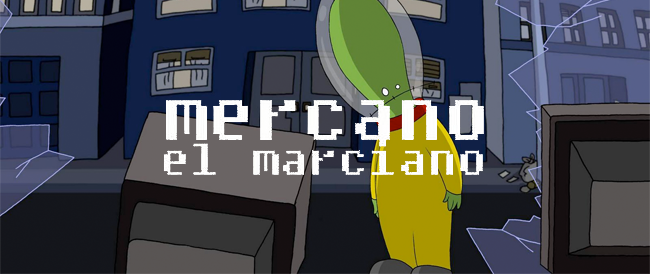
In this often rude, adult-oriented, breathlessly-paced animated film, after a space-probe from Earth squashes his “dog,” angry alien Mercano flies his saucer to Earth—only to find a place so dysfunctional and illogical that it would give Mr. Spock a nervous breakdown!

The film is a twist on the “fish out of water” and “Martian Invasion” tropes, and uses the spaceman’s naiveté of our greedy and malevolent ways to drive the humor. Stranded in Buenos Aires, the sad and lonely Martian (who looks like a cross between a skinny Charlie Brown and a pickle) wanders through a city that has been devastated by poverty, violence and uncertainty, all the while chased by trigger-happy cops.

In an attempt to “phone home,” the extraterrestrial steals a laptop computer, but instead winds up befriending a Star Trek-obsessed teenager he meets on-line. Meanwhile, the kid’s yuppie-executive father is plotting total global consumer enslavement—and he intends to use Mercano’s outer space technology to get it.

The first independent Argentine full-length animated film in 30 years, MERCANO EL MARCIANO was originally created as a series of shorts for Argentina’s MTV. The film is certainly in a similar vein as South Park and Beavis & Butthead—but not just because of the outrageous gross-out humor, deliberately crude animation and propensity for musical numbers, but as a barbed and absurdist take on contemporary society.

Created while Argentina’s economy was melting down, the film has even greater resonance today with a global recession and nightmarish austerity measures forced down people’s throats ruining social services. “Now after ten years, the whole world started to collapsed and I am not surprised at all,” said director Juan Antin recently.

Featured in multiple international film festivals, MERCANO EL MARCIANO was the winner of the Audience Award at Spain’s Catalonian International Film Festival in 2002, as well as the Special Jury Mention at the Festival du Film d’Animation Annecy 2002 in France.

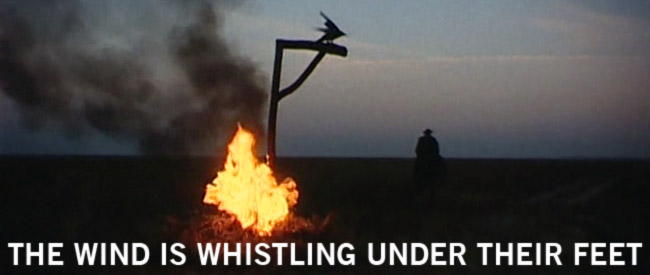
THE WIND IS WHISTLING UNDER THEIR FEET

wind-whistling

THE WIND IS WHISTLING UNDER THEIR FEET
Dir. György Szomjas, 1976.
Hungary. 95 min.
In Hungarian with English subtitles.

FRIDAY, JUNE 7 – 10:00 PM
THURSDAY, JUNE 20 – 7:30 PM
SUNDAY, JUNE 23 – 10:00 PM

György Szomjas brings exquisite style and pacing to this elegiac gallows western about a betyár — a brand of 19th century highwayman popular in contemporary Hungarian balladry — set amid the Great Hungarian Plain in 1937. It follows the path of a brooding, aging outlaw newly escaped from prison whose personal revenge quest dovetails with the interests of the landless herdsman who oppose the state’s building a canal through the fields on which they work their trade. He becomes an unlikely hero to unwashed vagabond workers while facing down a mutually-admiring adversary in the form of a forthright squire who had captured him before. Meanwhile, an opportunistic youngster attempts to work both sides to his benefit. As ditches are dug for canals and corpses alike, the state puts increasing pressure on the wistful squire, who realizes the social order is changing and his fortunes are in decline; and yet he remains dutifully attached to his mission.

Along with Szomjas’s follow-up ROSSZEMBEREK, THE WIND IS WHISTLING UNDER THEIR FEET is probably the only example of a “Goulash Western.” Though carefully paced and supposedly based on historical documents, it aims squarely for populist appeal. The autumnal palette, period imagery, and sudden outbursts of hysterical grotesquery recall Andrzej Żuławski’s THE DEVILS. Yet most of all it brings to mind the unlikely grouping of Woody Guthrie, Miklós Jancsó, and Akira Kuroswawa — or maybe Béla Tarr meets Sergio Leone. Whatever the comparisons, THE WIND IS WHISTLING UNDER THEIR FEET is a stirring, forgotten gem in classic Spectacle tradition and not to be missed.

THE STREET FIGHTER TRILOGY

STREETFIGHTER_TRILOGY_banner

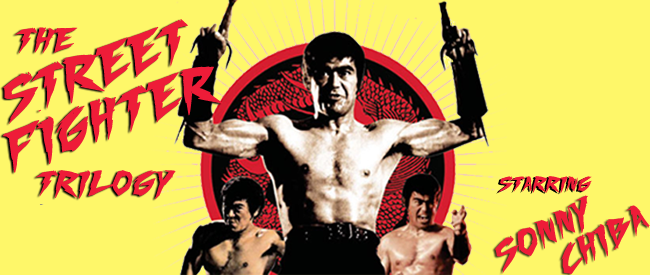
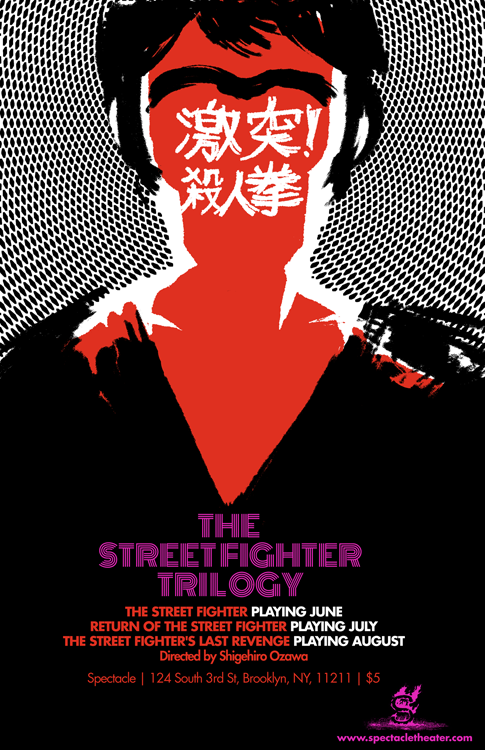
This summer, Spectacle presents three incredibly savage, incredibly savory kung fu films that launched the career of martial arts star Sonny Chiba and became landmarks of Japanese exploitation cinema – THE STREET FIGHTER TRILOGY!

Following the crossover success of Bruce Lee (who died the previous year), the mighty Japanese film company Toei decided to gamble on a considerably darker, more nasty brand of martial arts action with an unknown actor as the star. The result was The Street Fighter– a hard-boiled, gore-drenched exploitation classic that spawned an entire franchise of sequels and spinoffs.

Praised by fans as some of the best kung fu films of the era and worshipped by Tarantino for decades, don’t miss this chance to experience grindhouse exploitation at its finest!

Presented UNCUT and in their ORIGINAL JAPANESE LANGUAGE!

And as a special bonus, we’ll have three female-centered kung fu films in our summer midnights programs for an extra dosage of ass-kicking!

*NOTE: The entire STREET FIGHTER TRILOGY will screen as a marathon on SATURDAY, AUGUST 31ST!

THE STREET FIGHTER – 5PM
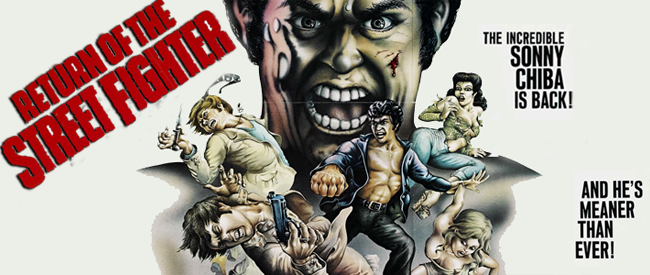
RETURN OF THE STREET FIGHTER – 7:30PM
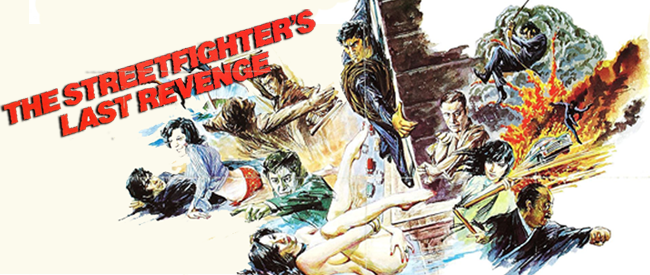
THE STREET FIGHTER’S LAST REVENGE – 10PM

SFT2_small


STREETFIGHTER_01_banner

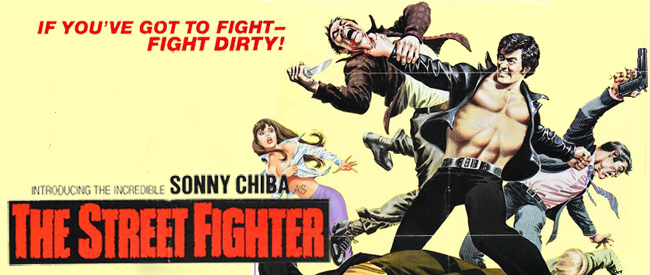
THE STREET FIGHTER
Dir: Shigehiro Ozawa, 1974.
87 min. Japan.
In Japanese with English subtitles.

SATURDAY, JUNE 8TH – 10PM
SATURDAY, JUNE 15TH – 10PM
SATURDAY, JUNE 29TH – 10PM
*SATURDAY, AUGUST 31ST – 5PM (part of THE STREET FIGHTER TRILOGY marathon!)

Sonny Chiba IS Tokuma Tsurugi: a high-priced, high-voltage assassin hired by the Yakuza to kidnap the heiress of a deceased billionaire. When his demands are too high, all-out chaos ensues. Shortly thereafter, the body count starts to grow…

A significant shift away from the classic, technical martial arts, THE STREET FIGHTER features numerous sequence of raw, shockingly graphic brawls and battles that garnered the film the first ever X rating solely for violence. Chiba is pure brute force, an anti-hero that acts not out of honor, but for self-satisfaction. But even for a character with zero morals, Chiba’s magnetic personality shines through, lending his mercenary killer a sparkly, devilish demeanor.

A prime cut of juicy 70s kung-fu topped with an X-ray blast to the skull, THE STREET FIGHTER is unadulterated escapism of the bloodiest order.

*WARNING: THE FILM CONTAINS GRAPHIC DEPICTIONS OF VIOLENCE*


STREETFIGHTER_02_banner

RETURN OF THE STREET FIGHTER
Dir: Shigehiro Ozawa, 1974.
79 min. Japan.
In Japanese with English subtitles.

WEDNESDAY, JULY 10TH – 7:30 PM
THURSDAY, JULY 18TH – 10:00 PM
SATURDAY, JULY 20TH – 7:30 PM
*SATURDAY, AUGUST 31ST – 7:30PM (part of THE STREET FIGHTER TRILOGY marathon!)


STREETFIGHTER_03_banner

THE STREET FIGHTER’S LAST REVENGE
Dir: Shigehiro Ozawa, 1974.
80 min. Japan.
In Japanese with English subtitles.

WEDNESDAY, AUGUST 14TH – 7:30PM
FRIDAY, AUGUST 23RD – 7:30PM
*SATURDAY, AUGUST 31ST – 10PM (part of THE STREET FIGHTER TRILOGY marathon!)

We conclude with Sonny Chiba channeling James Bond!

The Street Fighter’s Last Revenge takes a turn towards spy film and finds Tsurugi using a fistful of gadgets and masks to battle a sombrero-donned, laser-wielding Mexican bandito!

Featuring pinku legend Ike Reiko!

YOU CAN’T KEEP ME QUIET!: FILMS BY SARAH JACOBSON

sarahjacobsonbanner

YOU CAN’T KEEP ME QUIET!: FILMS BY SARAH JACOBSON

FRIDAY, JUNE 14TH – 8PM (w/ special guest Sam Green!)
SUNDAY, JUNE 30TH – 8PM (w/ special guest Mikki Halpin!)

“I consider myself a feminist filmmaker, definitely. The whole reason I got into film was because I never saw cool girls in films that I liked. I have no fear of the word ‘feminist.’ I know that that has certain negative connotations to some people, but then why should I let other people’s stupidity bully what I want to do, right? To me, feminism means that I should have an equal opportunity to do what I want to do as a woman. I don’t want to be better than men, I don’t want to shut men up. It’s like, look, you’ve got your little thing over here, you’ve got your B-movie aesthetic, and I’ve got my interpretation of it that girls can enjoy, too, so you don’t always have to watch the bimbo get raped or slashed or stalked or whatever.”Sarah Jacobson


ROAD MOVIE (OR WHAT I LEARNED IN A BUICK STATION WAGON)
Dir: Sarah Jacobson, 1991.
10 min. USA.

I WAS A TEENAGE SERIAL KILLER
Dir: Sarah Jacobson, 1993.
27 min. USA.

MARY JANE’S NOT A VIRGIN ANYMORE
Dir: Sarah Jacobson, 1998.
98 min. USA.


Sarah-Jacobson

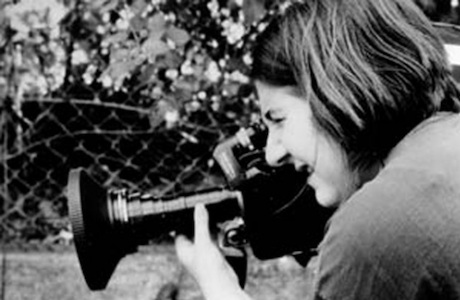
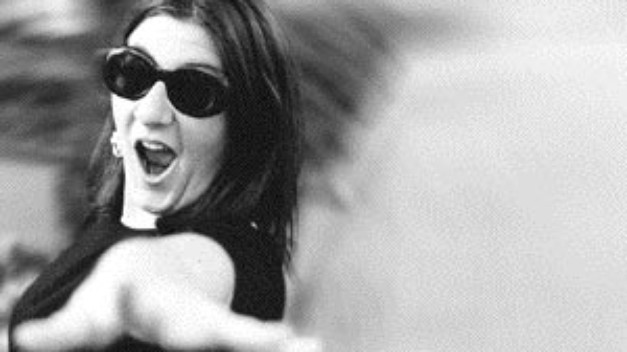
Sarah Jacobson (1971-2004) was an independent filmmaker who led a DIY filmmaking movement in the 90s. She wrote and directed several short films, documentaries, music videos and a feature film. She formed Station Wagon Productions with her mother and producer Ruth Jacobson and with her help, Sarah self-promoted and distributed her films all over the country. Originally from New Jersey and Minneapolis, Jacobson studied briefly at Bard College and then at the San Francisco Art Institute with George Kuchar.

She directed I Was a Teenage Serial Killer in 1993, which she described as the story of “a 19-year-old girl who has a series of run-ins with various condescending men.” Jacobson’s slap-in-the-face feminist interpretation of “sexy”/violent B movies found a cult following. Jacobson went on to make her feature Mary Jane’s Not a Virgin Anymore a few years later.

Too in your face to be an after-school special, Mary Jane’s Not a Virgin Anymore is a movie about sex from a girl’s point of view. After a gross and unceremonious “first time,” Jane learns about the joys of pleasing herself and asking for what she wants from her punky co-workers at a Midwestern movie theater (with Jello Biafra and Davey Havok cameos). the film debuted at the Chicago Underground Film Festival in 1997 and sold out at Sundance and SXSW; Jacobson promoted the film the year previous at the Independent Film Market with homemade “Not a Virgin” stickers that her and her mom made at Kinko’s.

627

After cancer ended Sarah Jacobson’s life in 2004, her mother Ruth and Sam Green established the Sarah Jacobson Film Grant to support young women “whose work embodies some of the things Sarah stood for: a fierce DIY approach to filmmaking, a radical social critique, and thoroughly underground sensibility.” Find out more about the Sarah Jacobson Film Grant here.

Filmmaker Sam Green will be at Spectacle on June 14th for a Q&A, and writer Mikki Halpin, who now runs the SJ Film Grant, will be at the June 30th screening. Jacobson’s DVDs will be on sale to benefit the film grant fund!

Spectacle’s program will also include an early autobiographical short called Road Movie (or What I Learned in a Buick Station Wagon) (1991) which is the story of a college filmmaker who leaves Minneapolis for NYC after her professors and classmates make fun of her film (with an Adolfas Mekas cameo).

POSTMODERNISM: WHO CARES? THE COMPLETE JON MORITSUGU

MORITSUGUBANNER A

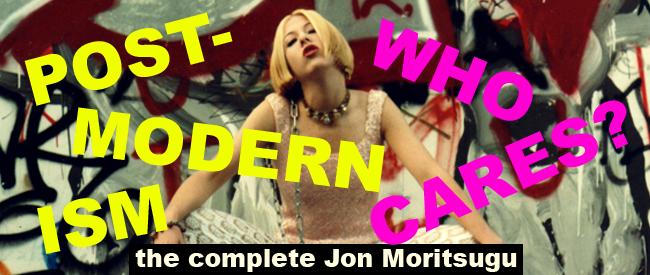
Combining the tropes of 60s art-house cinema with the primitive punk aesthetics of the Cinema of Transgression, Jon Moritsugu has been making movies far outside the mainstream for over twenty-five years. While his work has screened at venues as high profile as the Sundance, Berlin and Toronto Film Festivals and even public television, he continually shirks convention and classification. After making his name with a series of hand-made 16mm features, he’s recently embraced video with a fervor and a freeness to which every young filmmaker should be paying attention. Moritsugu’s world is overflowing with eye-popping production design, eardrum-destroying rock ‘n’ roll, gross-outs aplenty and deadpan one-liners you’ll be quoting for weeks.

We’re proud to present the first complete retrospective of Jon’s work, including every feature and short he’s produced to date, along with the New York premiere of his newest movie, PIG DEATH MACHINE. Also in the line-up are his impossible-to-find shorts like DER ELVIS, SLEAZY RIDER and LITTLE DEBBIE, SNACK WHORE OF NEW YORK CITY! Plus two uber-rare 16mm screenings of his masterpiece, MOD FUCK EXPLOSION!

Like all true artists, Jon Moritsugu thrives under the limits of his budgets- producing an oeuvre of punk classics and establishing him as DIY icon.

SATURDAY JUNE 1ST
7:30PM: PIG DEATH MACHINE
10PM: MOD FUCK EXPLOSION (on 16mm)

SUNDAY JUNE 2ND
7:30PM: MY DEGENERATION
10PM: HIPPY PORN

MONDAY JUNE 3RD
7:30PM: TERMINAL USA (release version)
10PM: FAME WHORE

TUESDAY JUNE 4TH
7:30PM: SCUMROCK
10PM: PIG DEATH MACHINE

WEDNESDAY JUNE 5TH
7:30PM: MOD FUCK EXPLOSION (on 16mm)
10PM: TERMINAL USA (rough cut version)

THURSDAY JUNE 6TH
7:30PM: PIG DEATH MACHINE
10PM: SCUMROCK


MY DEGENERATION
Dir: Jon Moritsugu, 1990.
70 min. USA.

SUNDAY, JUNE 2ND – 7:30PM
ONE NIGHT ONLY!

Preceded by the shorts DER ELVIS and LITTLE DEBBIE SNACK WHORE OF NEW YORK CITY

In the tradition of Beyond The Valley Of The Dolls and Ladies and Gentlemen, The Fabulous Stains, Moritsugu’s very first feature is the story of a female rock trio – sponsored by a sinister meat corporation. Our narrator is the bass player, who falls in love with a real pig’s head that thinks out loud. See why Roger Ebert walked out after 7 minutes!

“Spikey satire on modern pop culture and ‘star is born’ movies.” – Los Angeles Times


HIPPY PORN
Dir: Jon Moritsugu, 1993.
97 min. USA.

SUNDAY, JUNE 2ND – 10PM
ONE NIGHT ONLY!

This simultaneous homage-to and takedown-of the French New Wave, follows the perpetual ennui of a small group of art school students. While indulging his usual stylistic subversions, Moritsugu crafts a film whose closest cousin might be Jean Eustache’s iconic The Mother and The Whore.

“The French New Wave goes to hell. HIPPY PORN is about as adventuresome as feature filmmaking gets… bleakly beautiful.” – Los Angeles Times


TERMINAL USA
Dir: Jon Moritsugu, 1993
54 min. (Release Version) / 71 min. (Rough Cut Version)
USA.

MONDAY, JUNE 3RD – 7:30PM (Release Version)
WEDNESDAY, JUNE 5TH – 10PM (Rough Cut Version)

Preceded by the shorts SLEAZY RIDER and CRACK

A wholesome portrait of the perfect Japanese immigrant family – well, except for the scummy drug addict son who disappoints his parents. But who is stealing grandpa’s morphine? Who is secretly gay for skinheads? And who is being blackmailed with a sex tape?

“FATHER KNOWS BEST meets PINK FLAMINGOS… a post-punk soap opera about an Asian-American family that single-handedly shatters the clean-cut, hard-working image of the model minority.” – New York Daily News


MOD FUCK EXPLOSION
Dir: Jon Moritsugu, 1994.
76 min. USA.

SATURDAY, JUNE 1ST – 10PM (on 16mm!)
WEDNESDAY, JUNE 5TH – 7:30PM (on 16mm!)

In this teen angst epic, London (Amy Davis) longs for love and leather jackets. Meanwhile, vicious Mods wage a turf war against a gang of lip-synched Asian bikers.

“A dynamic punk odyssey of a pair of innocent teens adrift in a violent urban world; Moritsugu unleashes a barrage of powerful images and hard-driving music.” – Los Angeles Times


FAME WHORE
Dir: Jon Moritsugu, 1997.
73 min. USA.

MONDAY, JUNE 3RD – 10PM
ONE NIGHT ONLY!

Preceded by the short MOMMY, MOMMY, WHERE’S MY BRAIN?

Three misguided social climbers scrounge for stardom! A closeted tennis star, a talentless fashion designer, an animal activist with an imaginary friend – will any of them make it?

“Luridly florid… like a porno flick with the fucking parts cut out.” – Village Voice


SCUMROCK
Dir: Jon Moritsugu, 2002.
79 min. USA.

TUESDAY, JUNE 4TH – 7:30PM
THURSDAY, JUNE 6TH – 10PM

Preceded by a collection of music videos by Jon Moritsugu

Moritsugu’s first foray into video continues his devotion to fast music, cheap cameras and Amy Davis. A pretentious underground filmmaker (TV on the Radio’s Kyp Malone) struggles with his masterpiece while a skuzzy punkoid chick (Davis) tries to keep her band from fading into obscurity.

“SCUMROCK is as fast and energetic as it is funny. Moritsugu is a true visionary.” – Los Angeles Times


PIG DEATH MACHINE
Dir: Jon Moritsugu & Amy Davis, 2013.
84 min. USA.

SATURDAY, JUNE 1ST – 7:30PM
TUESDAY, JUNE 4TH – 10PM
THURSDAY, JUNE 6TH – 7:30PM

A brainless bimbo is transformed into a total genius after eating rotten meat. Meanwhile, a misanthropic punk botanist babe gains the power to talk to plants. Moritsugu’s first film in a decade is a triumphant return, complete with a hilarious film-within-a-film, and glittery bacon animation!

“Everyone who has half a brain and even a milligram of taste knows that Jon Moritsugu is a LIVING FUCKING UNDERGROUND MOVIE GOD” – 2003 New York Underground Film Festival

ARTHUR LIPSETT

LipsettSeriesBanner

“As science grows, religious belief seems to have diminished… The new machines are now invested with spiritual qualities.”
ARTHUR LIPSETT

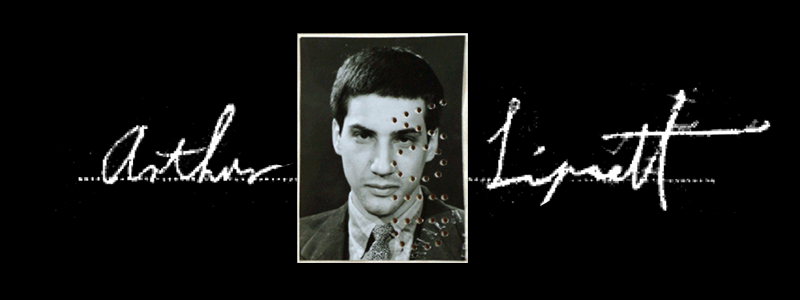
May 1st marks the anniversary of Arthur Lipsett’s death, weeks shy of what would have been his 50th birthday. Who was Arthur Lipsett? A remarkable, yet unsung experimental filmmaker, he received praise from some of the great auteurs of his time and inspired generations of Canadian artists. Despite this, his obscurity continues to shadow his influence. One might attribute this to his reserved character– which would become more reclusive and idiosyncratic as he struggled to support himself amidst a deteriorating mental health. Arthur turned down an offer to work with Stanley Kubrick and gave an inscrutable response to a Harvard invitation for artist residency, “ I cannot come to Harvard at this time in history.”

Others have drawn attention to the lack of support from the National Film Board of Canada, which was evident even in the late eighties. In a conference regarding Canadian artists, Stan Brackhage recalled how he had been given a print of Very Nice, Very Nice, one of a few that had been rescued from the NFB’s garbage. But Lipsett’s distinct visual style lives on: dense, baroque and engaging many types of meaning concurrently, constructed with a focus and precision that demands the same from the viewer.

Spectacle is proud to present a near-complete retrospective of Lipsett’s work, from high-quality remasters generously provided by the National Film Board of Canada.


PROGRAM I: SHORTS, 1961-1970
FRIDAY, MAY 10TH – 7:30PM
TUESDAY, MAY 14TH – 10PM
MONDAY, MAY 27TH – 10PM

VERY NICE, VERY NICE
1961. 7min. Canada.

While a junior artist and engaging a variety of trades on NFB produced projects, Lipsett began gleaning from his colleague’s trim bins, pulling together pieces of audio tape creating what would later become the soundtrack for Very Nice, Very Nice. With the support of producer Colin Low, he took a Leica and film to London where he showed a marked proficiency as a stills photographer. The photographs, collage and archive materials were assembled according to the audio track with very little modification to the audio itself. Produced for five hundred dollars, Very Nice, Very Nice was nominated in 1962 for an Academy Award in the category of Best Live Action – Short Subject and catapulted Arthur forward as the NFB’s new ‘boy genius’.

21-87
1964. 10min. Canada.

21-87 reasserts Arthur Lipsett’s focus on the absurd relationships between humans and their environments. Referred to as “fragments of a prophecy” by Lipsett himself, if Very Nice, Very Nice qualifies Lipsett’s perception of the external world 21-87 is its inverse, revealing his internal turmoil and foreshadowing his later break with public life.

This was a favorite at the USC film school, with many filmmakers later claiming influence; one, George Lucas, would go on to recycle this title several times in later feature films.

FREE FALL
1964. 9min. Canada.

Animated frame by frame with footage shot solely by Arthur, his first work as such, and replete with many in camera tricks including dissolving superimpositions, pixellation effects and syncopated rhythms, this is the filmmakers most striking usage of vertical montage. Free Fall is “an attempt to express in filmic terms an intensive flow of life… the transformation of a physical phenomena into psychological ones – a visual bubbling of picture and sound operating to create a new continuity of experience” reads Arthur’s proposal to the NFB.

Free Fall was originally intended to be a collaboration with John Cage who after an exchange of letters withdrew his participation over creative differences.

A TRIP DOWN MEMORY LANE
1965. 13min. Canada.

Finished in 1965 as a ‘time capsule’, this is Arthur’s first film of purely re-appropriated footage, utilizing five decades worth of excavated NFB newsreels. “There are hundreds of items, once front-page stuff, but all wrly grotesque when seen in this reshuffle of the past” reads the NFB catalogue.

FLUXES
1968. 24min. Canada.

Produced during a time of waning institutional support and deteriorating emotional health, Fluxes evokes Lipsett’s search for the “balance between the primitive, ritualized world and the universe of science and logic”. Described as oppressive and revealing a “phantasmagoria of nothing”, this was Lipsett’s longest, most erratic, and diffuse work yet.

N-ZONE
1970. 45min. Canada.

A departure from his collage films, N-Zone is a personal work, a spiritual quest, precisely structured around leftover photographs and sound bits, interspersed with live-action footage of friends and family. Poorly received by the Board, Lipsett took his severance and promptly left Montreal on sabbatical. Invoking the ethos of the Beats, “these ‘characters’ enact an unspoken confrontation between unbridled individuality and a society of conformity.” (Brett Kashmere) Despite later attempts N-Zone would be the last film Arthur completed with the NFB.

EXPERIMENTAL FILM
1963. 28min. Canada.

Directed by Arthur in the year following Very Nice, Very Nice, this early attempt to explain his films and encourage dialogue about experimental filmmaking features a panel discussion including film historian and famed film translator Herman Weinberg, national film critics Clyde Gilmour and Fernand Cadieux and NFB producer Guy Glover ,who would later produce Arthur’s Fluxes.

The participants comment on various experimental filmmakers of the time including Robert Breer, George Dunning, Jay Lenica, Walerian Borowczyk, and Arthur Lipsett, while afterwards Norman McClaren (director of the seminal Neighbors) describes some of his working methods.


PROGRAM II: ON LIPSETT
TUESDAY, MAY 7 – 10:00 PM
FRIDAY, MAY 17 – 10:00 PM
MONDAY, MAY 27 – 7:30 PM
REMEMBERING ARTHUR
dir. Martin Lavut, 2006
89 min. Canada.

Close friend and filmmaker Martin Lavut documents the personal influences and public legacy of Arthur Lipsett. The film traces Lipsett’s life and brief career up to his untimely death. The film investigates both man and filmmaker, shaped by interviews with his sister Marian, then-girlfriend Judith Sandiford and colleagues Colin Low, Robert Verrall, Ryan Larkin and Henry Zemel, who would later help produce Strange Codes, Arthur’s last completed film. Remembering Arthur is both a eulogy and a celebration, as well as an important time capsule shedding light onto Lipsett’s contributions to the heyday of avant-garde filmmaking.

THE LIPSETT DIARIES
aka Les journax de Lipsett
dir. Theodore Ushev, 2010
14min. Canada.

Surprised to learn that Arthur Lipsett originally lived on his street, Theodore Ushev visits the filmmaker’s old building. After meeting the conceirge, who knew Arthur, he’s shown an old locker where they find a small blue notebook with ‘Lipsett’ written on the cover and notes by the late filmmaker on the inside. The result of this encounter is this hand painted tribute animation written by Chris Robinson and narrated by filmmaker Xavier Dolan. The Lipsett Diaries was listed as one of the top ten Canadian films at the 2010 Toronoto International Film Festival.

HIGHWAY

HIGHWAY
Dir: Deepak Rauniyar, 2012.
Nepal. 80 min.
In Nepali with English subtitles.
FRIDAY, MAY 10 – 10:00 PM
TUESDAY, MAY 14 – 7:30 PM
FRIDAY, MAY 31 – 10:00 PM

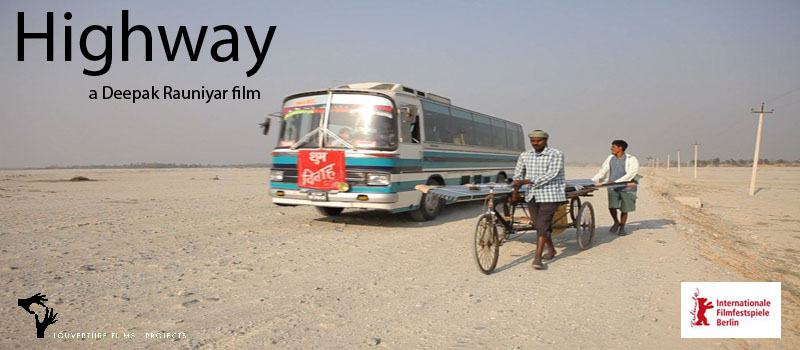
Highway tells many stories at the same time: a man and his wife have been trying unsuccessfully to have a child.  The man travels to a healer who gives him a special drink and tells him he must make love to his wife within 36 hours for it to work. This seems simple enough, and then the bandh.  A bandh, or general strike, usually consists of a group of people in a particular region or village of Nepal stopping traffic and blocking roads as a form of protest, for many apparent and not so apparent reasons.  A woman wants to visit her family but can’t pass.  Every aspect of life can be shut down or affected by the bandhs and is emblematic of Nepal’s many problems.  Highway moves between stories past and present, all different stories, unrelated. The only thing in common is that everyone needs to desperately get to Kathmandu.

An Official Selection at the Berlin Film Festival (2012), Highway is the debut film by Nepalese filmmaker Deepak Rauniyar who MOMA calls ‘a filmmaker of great ability and visual imagination’ and is the first Nepalese film to ever screen at a major international film festival.

 “MUST SEE: HIGHWAY” | Nepali Times
“Love It or Hate It, Daring Nepali Film Makes Waves” | NY Daily News
“BBC Man Stars in Nepali Feature Film” | BBC News Asia

LA VENGANZA DE LOS PUNKS

LA VENGANZA DE LOS PUNKS
Dir: Damián Acosta Esparza, 1987
88 minutes. Mexico.
In Spanish with new English subtitles.
SATURDAY, MAY 11 – 7:30 PM
SATURDAY, MAY 18 – 10:00 PM
SUNDAY, MAY 26 – 7:30 PM

Please note the Saturday, May 18 screening time has changed from 7:30 PM to 10:00 PM to accommodate an encore screening of INTREPIDOS PUNKS. Catch the entire saga back-to-back!

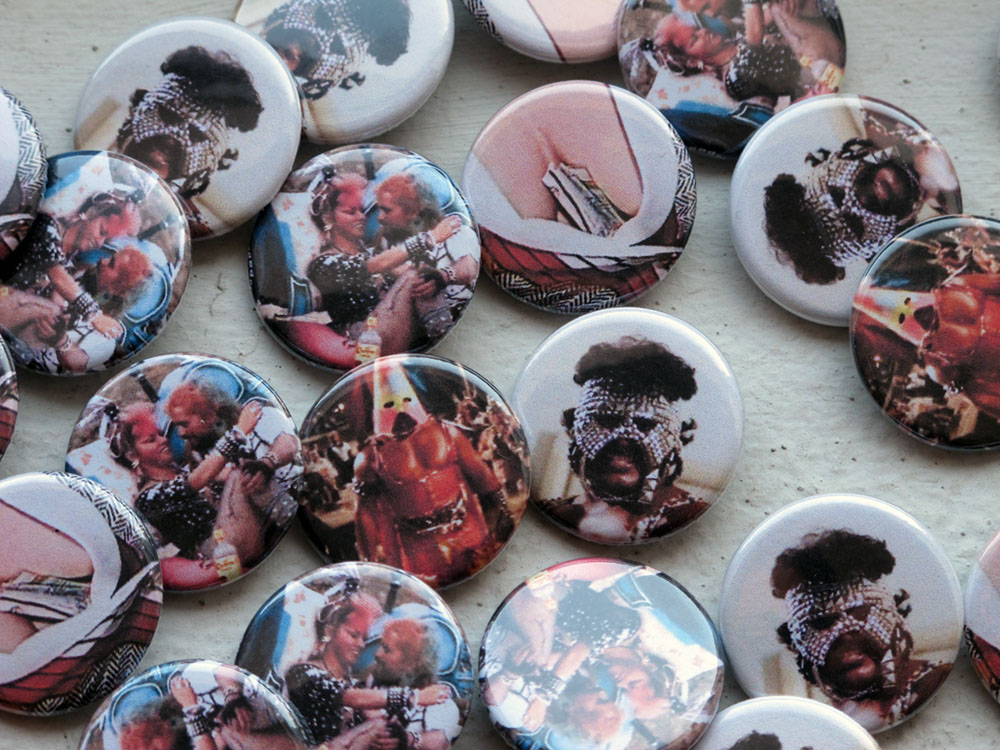
FREE Venganza De Los Punks button with Admission!

Every cinema’s audience gets the film it deserves. Ladies and gentlemen, Spectacle is proud to present to you the sequel to Intrepidos Punks.

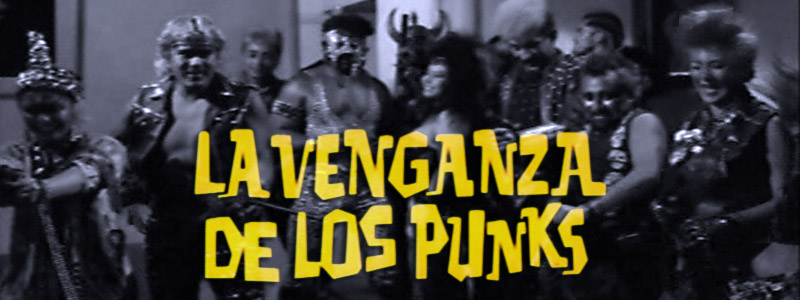
Like the mutant linebacker sibling of its literary-minded forebearer, La Venganza is bigger, louder, and naystee-er than it’s older brother—and dos veces más intrépido. As we wrote of the first, La Venganza is still about “a sexy apocalyptic biker gang led by a ruthless luchadore pushing drugs, racing choppers and killing the police who are helpless to stop them. And partying.”

Only this time, one police gets fed up, and goes sub-intrepidos to re-christen himself as the reigning angel of death and stamp out the punks with profane savagery. Snake torture, ritual satanic murder, live immolation, eye-gouging, mass-murder, acid disfiguration, and base depravity, La venganza de los punks is an almost surrealistic atrocity exhibition; it’s like an more vile cousin to Buñuel’s Land Without Bread, only it’s not a joke.

To defeat los punks, one must become los punks. #VERDAD

¿ES USTED INTREPID SUFICIENTE?
ESTE VERANO: #VDEVENGANZA

Get a FREE button of your choosing with admission, or nab all four designs for $5! Muchos gracias to Desiree Leary, la excelente fabricante de los botones!

button_edited

THE DRIVER’S SEAT

THE DRIVER’S SEAT (aka The Three Lives of Identikit, aka Psychotic)
Dir. Giuseppe Patroni-Griffi
Italy, 1974
105 mins. English.
SUNDAY, MAY 5 – 10:00 PM
SATURDAY, MAY 25 – 10:00 PM
FRIDAY, MAY 31 – 7:30 PM

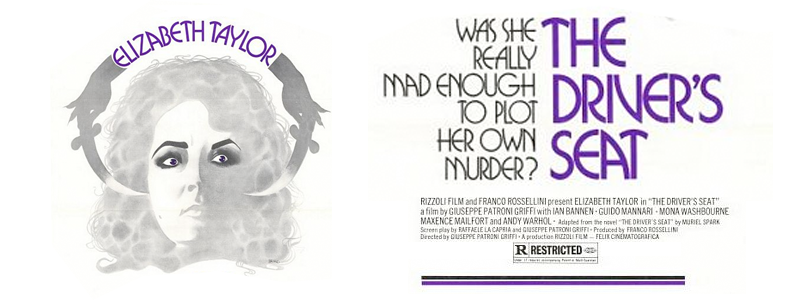
Of the many Euro arthouse B-pictures that didn’t make their way into the official story of Elizabeth Taylor’s career as she was eulogized in 2011, the variously titled Identikit – released in the U.S. under the original novella title The Driver’s Seat – is a bizarre curio from her Europhase, roughly 1968-74. During this period, Taylor — facing middle age and a mid-career slump, as well as an increasingly zaftig figure — took on roles from English and Continental directors offering riskier, more experimental work, which better accommodated her searching, passionate acting style like a muumuu. Among the menagerie of films were two in which she co-starred with her husband Richard Burton, Joseph Losey’s Boom! (1968, the film version of Tennessee Williams’ “The Milk Train Doesn’t Stop Here Anymore”) and Under Milk Wood (1972), both notoriously ill-begotten literary adaptations, if a hoot to watch. Losey’s underappreciated Secret Ceremony (also 1968), with a spooked and brunette Mia Farrow, typifies Taylor’s career during this period, in which she sinks her teeth into stark, enigmatic dialogue as she interprets characters of murky origin, motives and morality.

Identikit, adapted from Scottish novelist Muriel Spark’s (“The Prime of Miss Jean Brodie”) novella by Raffaele La Capria and Giuseppe Patroni Griffi (its director) sank like a stone at the box office when it was released in the U.S. in 1975 as an arthouse second bill. Its second life, as an Avco-Embassy video release in the 1980s, built up a new audience (when I first discovered it, dusty and rarely rented in a college town video store) as a Seventies relic that seemed to be the perfect accompaniment to box wine, marijuana and pizza. Now, in recent years, it seems to be entering a third, post-video phase of its cinematic life, as a number of gay critics have been dusting it off for a second look. Critics David Ehrenstein and Doug Bonner’s recent articles argue convincingly that its merits may add up to a film better than its historic “so-bad-it’s-good” reputation. It seems as though this orphan film is finally finding a home — and rightly so — within the queer canon.

Spark’s story, characteristically spare, is infused with Patroni Griffi’s outré sensibility as an Italian opera director and gay novelist famed for works that were known for their transgressive characters.

While Taylor certainly didn’t need any director to push her to lusty, emotionally naked performances (Suddenly, Last Summer had proved that 15 years earlier), it’s tempting to theorize that the combustible mixture of Patroni Griffi — an aristocratic, decadent figure of Italy’s literary scene whose own works pushed the envelope on sexuality and morality in post-war Italy — with Taylor, the definitive, volatile Hollywood diva — with a psychological thriller by the queen of the genre at the time, Muriel Spark — accounts to large degree the film’s abstract tone, theatrical direction and its subversive appeal to a gay audience.

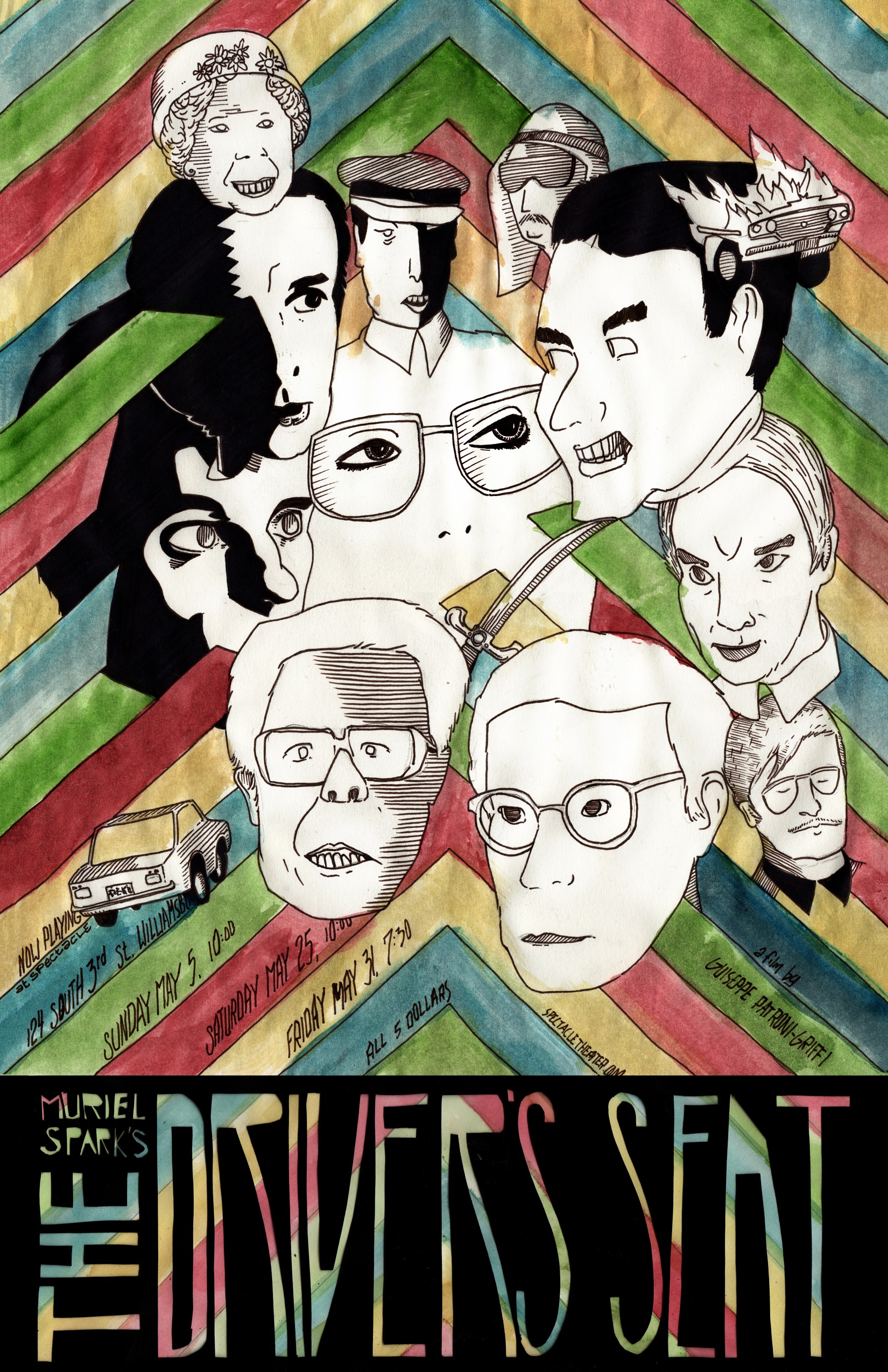
Poster by Nate Dorr!

A lonely woman, Lise (Taylor) flies from her home in a cold, northern European city (Munich) to Rome on a quest to find a man. She’s not looking for love. Who that man is, or what she wants from him is not clear to any of the people who encounter her, from an elderly tourist from Nova Scotia (Mona Washbourne), to a macrobiotic and sexually frustrated businessman from England. As she navigates the sultry streets of Rome, dodging terror attacks, shopping in empty department stores and wandering through hotel lobbies, she rebuffs offers, and threats, of sex. When it becomes clear what purpose she has in mind for this man, when she does meet him, all the loose ends of the story tie up elegantly in this scattered jigsaw puzzle of a film.

Taylor gives a performance of barely controlled madness, maybe one of the most bizarre of her career, resembling mid-70s Divine in a gaudy, multicolored dress (itself a central character in the film). You can’t take your eyes off her, not that Patroni Griffi lets you. Scene after scene features a tight shot of her head, filling the entire frame with her Medusa-like hair and staring, kohl-rimmed eyes as she delivers her odd bits of dialogue. It’s as though she’s sleepwalking,but with her eyes fixed on a point in the distance. After watching it a few times, I realized it was her choice of communicating her single-minded quest for her killer. When she has to deal with irritating obstacles in her path, ie., shopgirls and hotel maids, she becomes a screaming drag queen on a rampage. It’s both jaw-dropping and hilarious.

Even though her quest seems to be an asexual one, her spirit is charged with eroticism. She screams at an airport security guard who undresses her to check for explosives: “I hate to be touched!” Then later, once alone in her hotel room, she squeezes her own breasts passionately, hinting that she alone can bring herself pleasure.

In fact, apart from dowdy but adorable Helen (Mona Washbourne) an elderly tourist, the film’s sole exemplar of conventional middle-class sexuality is Bill (the great character actor Ian Bannen), a traveling businessman obsessed with his macrobiotic diet and related “one orgasm a day.” His clumsy attempts to seduce Lise, whose unpredictable outbursts make him lick his lips like a confused dog, only drive home the point how in over his head he is with her, her mysterious quest, and the raw sensuality of Italy.

“When I diet, I diet. And when I orgasm, I orgasm,” she tells him flatly, as he tries to convert her to his yang-focused diet. When his bags of brown rice burst in his pocket, pouring grain all over the Roman pavement, she taunts him over his premature spill. Again, the influence of Patroni Griffi is seen here. Conventional sexuality and middle-class mores burst on contact with the decadent outlaws in his plays and films (Metti, una sera a cena, One Night At Dinner, 1969).

In another revealing scene demonstrating the collision of straight society and perverse Lise, a frumpy, bespectacled woman struggles to explain to a detective her impression of the madwoman: “That multicolored dress…there was something unseemly about her, something of a prostitute…it’s as though she wanted to be noticed!” She then reveals, despite herself, that she admired her for it as a woman. A whisper of feminism (Spark) in a film that is frank in its depiction of Italian male lust (Griffi). And again, the dress. It inspires a whole range of emotions, from derisive laughter, to fury, to bewilderment. Obviously it’s a symbol for the unreadable Lise herself, her taste and her choices, but Griffi’s sensibility makes it a character that is as central to the plot as the overcoat in the Gogol short story of the same name.

Finally, after Taylor herself, the best thing in this “bad movie” is Vittorio Storaro’s luminous cinematography. Seizing on the chiaroscuro of Lise’s mental world, he paints the film like a canvas in a range of light and shadow, all of it looking supernaturally beautiful.

Now that Identikit’s questionable legacy is being reassessed by queer critics and bloggers, and as a result discovered fresh by a new generation, let’s hope for the best — assuming Rizzoli Films
won’t be shipping a pristine, vault print of it to some New York repertory theater anytime soon (if one even exists). Let’s hope that someone undertakes a quality, definitive digital transfer of the film to preserve it for future generations as a shined up statuette in Giuseppe Patroni Griffi’s filmography, and an example of how good “bad” art films of the ‘70s look today.

– David Savage

David Savage has been a New York-based film journalist since 1989, specializing in films of the 1960s and ’70s. He wrote for Vanity Fair in the mid-90s and also was a contributing editor at index magazine from 1996-2005. Since 2006 he has been a columnist at the UK film magazine Cinema Retro (www.cinemaretro.com).

TEENAGERS FROM OUTER SPACE

TEENAGERS FROM OUTER SPACE
Dir. Tom Graeff, 1959
USA. 86 min.
SUNDAY, MAY 5 – 7:30 PM
FRIDAY, MAY 17 – 7:30 PM
SUNDAY, MAY 26 -10:00 PM

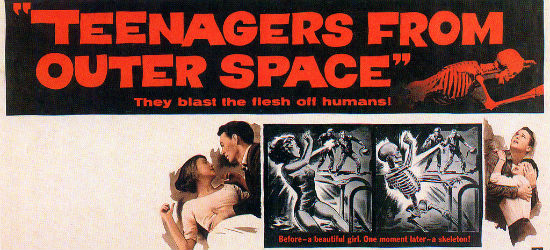
In this 1959 pulpy sci-fi low-budget classic, a spaceship manned by human-lookalike teenage aliens lands on Earth to find a grazing ground for their food source the “gargons” (lobster-lookalike air-breathing monsters). One of the aliens in the crew, Derek, is secretly part of an underground rebel faction with “humanist” ideals; he doesn’t believe the aliens have a right to colonize this new Earth-land! He flees from his crew to warn the humans, and the rest of the spacemen led by bad-guy Thor search for him to protect their mission. Derek rents a room from Betty and her Grandpa Joe to blend in. When Betty discovers Derek’s mission she joins him to fight the spacemen who are armed with x-ray gun vaporizers! Can Derek, Betty, Grandpa Joe and Betty’s clueless boyfriend Joe Rogers (played by director Tom Graeff) save this community before it’s too late?

*Rumor has it that director Tom Graeff (who wrote, directed, edited, produced and acted in TEENAGERS FROM OUTER SPACE) employed guerrilla cost-cutting tactics to save money on the film such as posing as a UCLA student. Following the film’s total failure at the box office, Graeff suffered a breakdown and proclaimed himself as the second coming of Christ. After an arrest for disrupting a church service, Graeff disappeared from Hollywood and committed suicide in 1970.