May Midnights

FRIDAY, MAY 6: Hologram Man
SATURDAY, MAY 7: Little Marines 2

FRIDAY, MAY 13: Digital Man
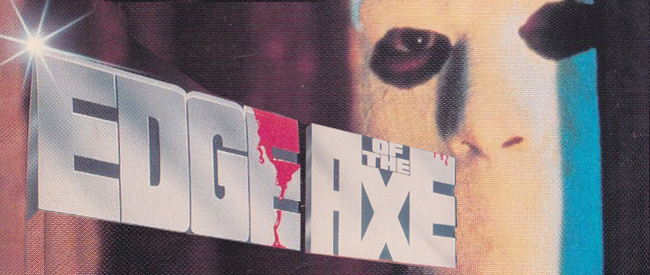
SATURDAY, MAY 14: Edge of the Axe

FRIDAY, MAY 20: Little Marines 2
SATURDAY, MAY 21: Hologram Man

FRIDAY, MAY 27: Death Promise
SATURDAY, MAY 28: Digital Man


THE EDGE OF THE AXE
AKA: Al filo del hacha 
Dir. José Ramón Larraz, 1988
Spain, 90 minutes.
In English.

SATURDAY, MAY 14 – MIDNIGHT

PURCHASE TICKETS HERE


AN EVENING WITH ANDREA CALLARD

SATURDAY, APRIL 30th – 7:30 PM

** ONE NIGHT ONLY! **

PURCHASE TICKETS HERE

A measured rationality forms the spine of the short 8mm works made in the 1970s by Andrea Callard, a cofounding member of both the XFR Collective and Collaborative Projects, Inc. (COLAB.) Callard organized the lobby then photographed the art throughout COLAB’s seminal Times Square Show in 1980. Many of Callard’s short works are unto themselves detours in crystalline clarity, dropping everything to chase seagulls or meditate on the miasma Ailanthus trees populating empty zones of Callard’s home in the 1970s of New York. Probing without piercing, her films combine lush glimmers of celluloid field capture with a wry sensibility; Callard herself features often, rendering many in singsong deadpan, playfully calling the films’ logic of authority into question.

The program on April 30th will feature a mixture of prints and digital restorations. These include (but are not limited to): the new 16mm print of Callard’s 1976 short SOME FOOD MAY BE FOUND IN THE DESERT (originally shot on 8mm), FLUORESCENT/AZALIA, 11 THRU 12, NOTES ON AILANTHUS and FLORA FUNERA (FOR BATTERY PARK CITY), as well as 2013’s digital work SAMPLE MAP #1.

Callard’s films have screened at museums, festivals and symposia around the world. These include DOXA 2013, Ambulante, The Museum of Modern Art, The Walker Art Center, The 7th Orphans Film Symposium, and  and the 56th Oberhausen Short Film Festival.  Artworks by Callard have been exhibited at PS 1/MoMA, Exit Art, Kentler International Drawing Space, White Columns and the Museum of the Chinese in America.

DETOURNEMENT: OUTER BODY FRAGMENTED FEMME WINDOWS TRANSLATE WELL CURRENTS

DETOURNEMENT: OUTER BODY FRAGMENTED FEMME WINDOWS TRANSLATE WELL CURRENTS
Dir. Various, 2016
USA, approx 90 min.

THURSDAY MAY 5
SCREENINGS AT 7:30 PM AND 10 PM

SPECIAL LIVE SCORE BY MERIDIANS + ERIC BAYLESS-HALL AT 9 PM ONLY
(10 PM TICKET HOLDERS CAN ARRIVE EARLY)

ADVANCE TICKETS AVAILABLE HERE http://www.brownpapertickets.com/event/2543789

Multidisciplinary artists from Eugene Lang College at The New School have come together to make some sweet dissonance between image, sound, and text. Having spent the semester learning and theorizing the expanses and limitations unique to artistic collaboration, six groups take up their chosen mediums. Stolen and live footage, original and sampled sound, archived microfilms, and live performance are collaged together in dynamic shorts that aim to dispute and reboot historicized modes of seeing, hearing, and analysis in the cinematic surround. Theatrically toppling storied tropes, shifting salient subjectivities, uncovering and rediscovering the assemblage of quotidian experiences in private/ public spaces, these six films and performances are imaginative and galvanizing presentations that update and augment monumental theoretical texts that have come to shape audiovisual perception.

Present at all screenings will be Dr. Julie Beth Napolin, Assistant Professor at Eugene Lang, Lisa Brenner, Seminar Fellow, and Shiva Addanki, Research Assistant, and co-teacher C. Spencer Yeh, artist and volunteer at Spectacle Theater..

This project is a collaboration with the Civic Liberal Arts Program at Eugene Lang College, The New School for Liberal Arts.

FEMME
Dir. Thomas Blakeley, Carol Brown, Daniel Friedman, 2016

Utilizing a series of elements from multiple sources, we intend to explore themes surrounding the depiction of femininity in mass media, and how it has taken the truest elements of life and transformed them into substance-less reproductions. In these multiple mediums, we also plan to contrast original content against the found elements, in order to form a peripheral commentary from our own perspective, as an anchor for the audience and illustration of our intentions. By allowing an outside, sampled source to serve as the meat of the project we can then incorporate original content – satiric re-dubbing of advertisements marketed towards women, for example – as a foundation for our reinterpretation of the source material.

FOR THOSE WHO ARE SMITTEN WITH HISTORY
Dir. Lisa Brenner, Owen Deutsch, Sienna Fekete, 2016

Who are these people? What’s wrong with this picture?

Scrolling along the micro-film, detached from the specific contexts of the images yet actively aware of their historical distance, very striking juxtaposition between macro-level happenings on the world scale, codified in human faces, expressions, and most of all a sense of everydayness so well known to us yet laid out in these discrete manifestations. Who are these people? And where do they lie on the spectrum of historical importance? Newsprint is already manufactured as a collage. Reevaluate what it means to put a face, to put a name and a sound to historical circumstance. Not a newscast, not a report, but a new contextualization of the past.

OUTER BODY
Dir. Shiva Addanki, Isabel Allen, Jake Gulliver, Reuben Hamlyn, 2016

Mixed media permutations centering in-on images, sounds, and evocations of the Outer Body. Mixed media collectivity presented as shambolic unified whole. Rotating orbit of individual understanding presented and told thru the cohesion and placement of distinct units. Snapshots of the distilled Outer Body / A reorientation of filmic representation centered on the collective to invoke the individual, an attempt to grasp a singular thru varying and shifting parts. Film and sound cut-up re-fed thru machine for new collective context. Transformation of the image and theme thru movement and sound and collective input. Mixed live and direct for the creation of linked assemblage: a breakdown of the whole into parts to reassemble back into the whole.

SONDAGE
Dir. Jimmy Dillon, Kristen Moyer, 2016

Modern cinema has attempted and reattempted to decipher the complex ways in which women relate and communicate with one another. Yet, these obtuse efforts repeatedly put women in conflict with one another or insert them into narratives of passive aggression. SONDAGE or “the probing of an open wound” is a story that you have not heard, but one you remember listening for. We attempt to get at the more real female solidarity that we know exists by means of playing the Spectacle at its own game: We are all bled dry by the serrated struggle of existence, but whether our bloodied hands wear a grin is up to us.

WINDOWS
Dir. Sahar Sepahdari, Prince Lang, 2016

A meditation on conversations that envelop us through our environment. We aim to make buildings talk.

“___________________”
Dir. Selwa Abderrazak, Juno Chung, Emma Conlon, Andrea Nappi, 2016

While impatiently waiting for the next train, have you ever been trapped in your own thoughts? Were you there alone?

Is public space private? What is privacy within a public context?

______ is a film that delves into the realm of opposing two forces through a process of entanglement. The line represents the duality within aspects of reality/ fantasy, phantasma (dreams and nightmares) and public/private space.

Inspired by Arendt’s T​he Human Condition,​______ is a sensuous exploration of the notion of ‘privacy’ in a contemporary approach in regards to individuality.

“​W​e no longer think primarily of deprivation when we use the word “privacy,” and this is­partly due to the enormous enrichment of the private sphere through modern individualism,” (Arendt 38).
This quote illustrates and exposes the “theory of uniqueness,” in terms of the “exclusivity” of an individual. What Arendt’s statement concludes, in regards to plurality, as well as shared/mediated and isolated spaces, is that the only privacy that an individual can condone to is their unconscious. In the subway, the individual is alone even though he is part of this network, not by choice but constraint. The politics of a space and society work to disclose uniqueness through speech and action. So even though the individual is “alone” within a shared “social” space, the only uniqueness that remains within is their unconscious mind.

PURE FICTIONS: THE FILMS OF LUIS OSPINA

luis

Luis Ospina was a founding member of Colombia’s Grupo de Cali, an interdisciplinary collective dedicated to capturing the vitality of Colombian life and hypocrisy in how it was presented to the world. Formed in the early 70s, the group contributed immensely to Colombia’s nearly nonexistent film industry, founding Cine Club de Cali (“The Cali Film Club”), printing the film magazine Ojo al Cine, and creating numerous documentaries and fiction films. Grupo de Cali rejected the gravity of Third Cinema tenets holding sway at the time, especially the definition of documentary as “a cinema of facts and irrefutable truth,” opting to disrupt with black humor and reveal truth as subjective.

Each of these three features finds its own way to renounce narrative authority, culminating in a work of pure socio-historical collage in Un Tigre De Papel: the story at hand is always peripheral to something bigger, and often incidental to the official version. Pura Sangre closely follows the earlier Cali Group shorts’ line of questioning the use of media in reinforcing oligarchic power structures, while SOPLO DE VIDA spins micro-narratives off a young woman’s murder – standing in, itself, for a bigger repressed trauma (the 1985 Armero tragedy, wherein the Colombian government declined to warn its citizens about an imminent volcanic eruption and 22,000 people died.)

Viewer advisory: these films include images of kidnapping, drug abuse, murder and suggested rape.


PuraBanner

PURA SANGRE
aka Pure Blood
Dir. Luis Ospina, 1982
Colombia. 98 mins.

PURCHASE TICKETS HERE

PURA SANGRE follows a trio of health aides to a dying sugar magnate named Don Roberto (Gilberto “Fly” Forero), who find themselves blackmailed into abducting and murdering children for the purposes of keeping him alive one blood transfusion at a time. As Andres Caicedo referred to Cali as “a city that doesn’t open its doors to desperate men”, Ospina’s careful eye registers the mercenaries’ dispassionate crimes with surreal casualness. Carlos Mayolo – who, with Ospina, co-directed the shorts in the GRUPO DE CALI: 1971-1978 program – stars as one of Don Roberto’s three contract killers, giving deadpan casualness to a day’s work committing one atrocity after another.

A cinephilic work par excellence, PURA SANGRE invites metatextual scrutiny across each of its cool-registered plotlines, as Don Roberto watches JOHNNY GUITAR and CITIZEN KANE from his deathbed. The conspiracy at its heart invites any number of analogies: in interviews Mayolo and Ospina both discussed the “monster of Mangones” terrorizing Cali growing up, a string of disappearances and murders of young boys that haunted a generation of neighborhood kids. Contemporaneously, Don Roberto’s empire finds itself in hock to sleazy drug dealers, widening the scope of PURA SANGRE’s tragedy. Ospina’s vision of evil can barely even be called “satiric” but nonetheless is, cutting both backwards and forwards in history.


SoploBanner

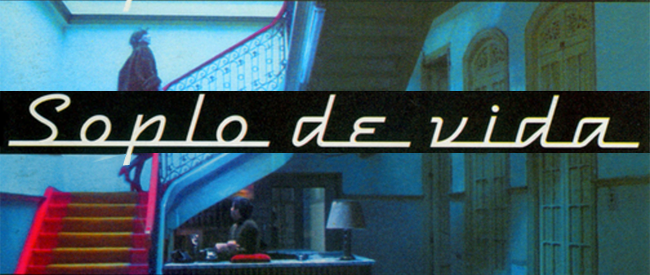
SOPLO DE VIDA
aka Breath of Life
Dir. Luis Ospina, 1999
Colombia. 108 mins.

PURCHASE TICKETS HERE

Ospina’s sole foray into Hollywood style film noir, the 80s-set SOPLO DE VIDA concerns the disappearance of Golondria (Flora Martinez), a beautiful sex worker, as investigated by grizzled ex-cop Emerson Roque Fierro (Fernando Solorzano) – nicknamed “Dick Tracy” by the sleazoid tenants of his ramshackle hotel home. While Ospina clearly enjoys teasing attendant genre tropes out of this seedy milieu, SOPLO DE VIDA also allows for another cross-examining of repressed traumas: Golondria’s history exposes a conspiracy that includes an old john with links to paramilitary death squads, while her murder becomes yet another bellwether of the hypocrisy that follows Ospina’s every last depiction of Colombian culture.

On setting a genre film in an 80s context, Ospina said: “Noir travels very well; besides that, it is a genre that has not aged very much, because it is a genre in which one can manipulate a certain moral ambiguity, where the good guys aren‘t completely good, nor are the bad guys completely bad; rather, the characters are enveloped in a corrupt environment that permeates everything and affects everything.”


tigrebanner

UN TIGRE DE PAPEL. 2008.
aka A Paper Tiger
Dir Luis Ospina.
Colombia. 112 mins.

PURCHASE TICKETS HERE

UN TIGRE DE PAPEL ollows the trajectory of Pedro Manrique Figueroa, an author and nadaisto who becomes a phantom fixture of Ospina’s 20th century, guided by his pacifist conscience across cultural sluices of the left. Not unlike Leonard Zelig, Figueroa (or “PMF” as termed by the film) manages to vanish and reappear at exactly the right time – a perfect ideological foot soldier with nothing to lose, losing and gaining identity wherever he goes. Nevertheless, PMF is as memorable a shaggy dog protagonist as they come; one interviewee claims that “anywhere, he went he was noticed because of his verbal diarrhea”.

PMF’s artistic career comes under the microscope of Ospina’s film, much of the work crude but nonetheless potent collage-work – for example, campesinos emasculating a wailing Captain America with a manic-panic red hammer and sickle. After relocating to Jackson Heights to work as a line cook (quoting Jose Marti’s dictum that “you’ve got to live inside the monster to know its entrails”), Figueroa comes under the thumb of FBI investigators, following an ill-fated campaign to stamp “fake” on all valid U.S. currency. Like Ospina’s film, PMF output works as a hypothetical salve on real-life irreconcilables like Trotskyism and Leninism, Communism and the Catholic Church, indeed democracy and U.S. influence in Latin America at large.


shortsprogrambanner

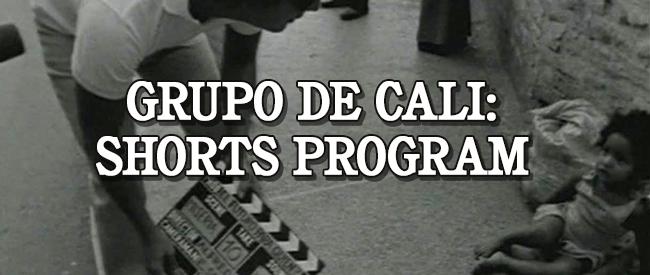
GRUPO DE CALI: 1971–1978
Total running time: 68 minutes

PURCHASE TICKETS HERE

OIGA, VEA!
aka See, Hear!
Co-directed by Carlos Mayolo.
1971. 27 min.

Made in the style of a straight-shooting As The World Turns… style mini-documentary, OIGA, VEA! serves as psychic exposé of Cali upon the arrival of the 6th annual Panamerican Games in 1971. Shooting with a handheld 16mm camera “borrowed” from Carlos Mayolo’s ad agency workplace, the film finds wobbly panoramas on spectacular assemblages, but always from the outside – an exteriority which defines itself fuller in the film’s cockeyed dissection of the Games’ pomp and circumstance. Rallies of military might serve only to demonstrate their planners’ unmistakable Cold War anxieties, and proprietary feats of infrastructural know-how – like a new railroad track, received by some shantytowns like manna from heaven – exposed for the limited-time-only publicity perks they are. Ospina and Mayolo steal glimpses at once officially decorative and incisively marginal; by the film’s end, the bitterness engendered by the project has been transferred in total from the shantytowns outside the Games’ encampment, and directly into the audience.

CALI: LA PELICULA
aka Cali: The Movie
1973. 13 min.

The frantic, colorful CALI DE PELICULA is antithesis to the sort of pedantic ‘misery porn’ Mayolo and Ospina would mock in AGARRANDO PUEBLO. Like a Mondo movie without the voiceover, Ospina and Mayolo frame bullfighting as silent slapstick, turn voyeuristic girl-watching ominous with a horror heartbeat, and capture life at street level, a pagan carnival churning by. Dancing, so vital to social life in the area, is shown in all its movement and color, but capturing faces without smiles or real joy – even enjoying themselves Cali’s citizens are cautious.

AGARRANDO PUEBLO
aka The Vampires of Poverty
Co-directed by Carlos Mayolo.
1978. 28 min.

This program concludes with AGARRANDO PUEBLO, widely recognized as the Group’s masterpiece. Mayolo and Ospina star as effigies of themselves, wielding Bolexes and Nagras on a mission to make the perfect cine de sobreprecio (“surcharge film”) for German television – skewering a then-commonplace of Colombian cinema dictated by the Committee for Quality Control, a government-supported bureau intended to help foster a national cinema but a de facto organ of censorship. Retitled THE VAMPIRES OF POVERTY in English, “Agarrando Pueblo” mistranslates a number of ways along the lines of “the clutching of poverty” and “the tricking of the people” – Ospina described it as a popular regional phrase at the time. The certainly film gives away as much (if not more) of its antiheroes’ sleazy postcolonial errand as it does the poverty they seek. Who is clutching whom? While the filmmakers are obviously the supposed vampires, the film is also explicit in the way their exposure to an impoverished zone gets their minds going about the potential windfall for their own careers (aided, inevitably, by a few lines of blow back at the hotel.)

In his The Aesthetic of Hunger (first presented at a festival in 1965, modified and republished in the early 70s) Brazilian filmmaker Glauber Rocha criticized a certain trend in Latin American cinema that played up tropes of poverty as a kind of image-dependency. Rocha posited that these countries were still living under the same colonialism as yesteryear, only the means of representation (establishing poverty as an indomitable symptom/destiny, and not the result of socioeconomic policies) had changed.

The tension of this encounter – between the type of European-inflected filmmakers Rocha referred to as “above zero” for their filmmaking resources, and Cali’s poorest – reaches a remarkable boiling point in AGARRANDO PUEBLO. It’s unclear whether the documentarians’ expedition is being turned on its head, or in fact fulfilling its original intent too perfectly; the barrier between color footage of the slums and black-and-white footage of the filmmakers gets shakier. As Mayolo himself likened the experience of shooting OIGA, VEA! to having “150 assistant directors”, PUEBLO brings it all back home when one of the documentary’s “stars” refuses to participate, becoming all the more desirable a subject for the filmmakers. The man is played by one Luis Alfonso Londo, a longtime resident of the El Guabal shantytown profiled in OIGA, VEA! According to the filmmakers, they first met Londo when he jumped out and asked them: “Ah, con que agarrando pueblo, no?”

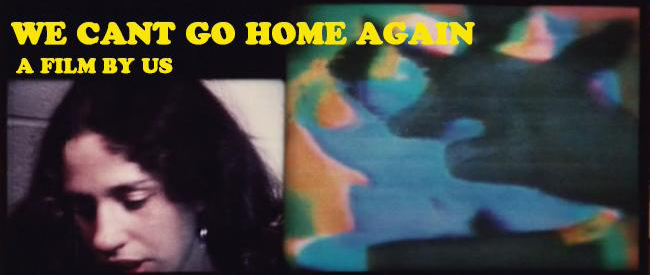
WE CAN’T GO HOME AGAIN

We Can’t Go Home Again
Dir. Nicholas Ray, 1973.
USA, 93 min.
In English.

MONDAY, APRIL 4 – 10:00 PM
TUESDAY, APRIL 12 – 10:00 PM
FRIDAY, APRIL 22 – 7:30 PM

PURCHASE TICKETS HERE


Nicholas Ray’s experimental masterpiece, made with his students at the State University of New York at Binghamton, WE CAN’T GO HOME AGAIN embodies Ray’s approach to filmmaking as a communal way of life. The film records Ray’s groundbreaking use of multiple image as a way of telling more than one story simultaneously, and of colorization as a way to heighten emotional expression. He called it a “journalistic” film, one that shares the anthropologists’ aim of recording the “history, progress, manners, morals, and mores of everyday life,” at a critical moment in American history. Ray plays himself in the film, serving as mentor, friend, and reference point around whom the students’ stories constellate.

MAGIC OF THE UNIVERSE

MAGIC OF THE UNIVERSE
Aka Salamamgkero / The Magician / Monster of the Universe
Dir. Tata Estaban, 1986/1988.
Philippines. 84 min.
Dubbed in English.

BELIEVE in MAGIC. A wizard accidentally loses his daughter to an unimaginable evil. He risks hat and wand to make things right. Cast of tens includes humans and puppets.

THEMROC

themroc-banner

THEMROC
Dir. Claude Faraldo, 1973.
France. 110 min.
In grunts.

FRIDAY, MARCH 4 – MIDNIGHT
MONDAY, MARCH 7 – 10:00 PM
THURSDAY, MARCH 17 – 10:00 PM
SATURDAY, MARCH 26 – 7:30 PM
THURSDAY, MARCH 31 – 7:30PM

PURCHASE TICKETS HERE

With only a vague U.S. release and a blind eye turned by all but the most annoyingly nerdy film buffs, this surreal French satire doubles as a pitch-black freak-out. But when writer/director Claude Faraldo starts to lose it and settle for straight absurdism, THEMROC’s bizarre view of working-class revolution is, as Shock Cinema puts it, “worth a look, if only for its audacity. The most inspired aspect of this Working Class Rant is the fact that nobody on-screen utters a single word of intelligible dialogue, with the entire story told in grunts, howls or simple gibberish. At first glance, the middle-aged Themroc (Michel Piccoli) seems like your typical, brutish, dirty-undershirted factory laborer. And his day goes straight into the crapper once he arrives at his dreary job, and is called onto the carpet after playing voyeur on a manager and his leggy secretary. With a lifestyle this demeaning and repetitious, it’s no big surprise when Themroc suddenly goes bonkers, and for the first time in his miserable life, breaks free of his 9-to-5 shackles. The second he gets home, this disgruntled wacko wrecks his apartment (unlike modern-day Americans, who’d prefer to grab a gun and shoot their boss) and begins acting like a modern-day Neanderthal.“

AGARRANDO VERDAD

series banner

Luis Ospina was a founding member of Colombia’s Grupo de Cali, an interdisciplinary collective dedicated to capturing the vitality of Colombian life and hypocrisy in how it was presented to the world. Formed in the early 70s, the group contributed immensely to Colombia’s nearly nonexistent film industry, founding Cine Club de Cali (“The Cali Film Club”), printing the film magazine Ojo al Cine, and creating numerous documentaries and fiction films. Grupo de Cali rejected the gravity of Third Cinema tenets holding sway at the time, especially the definition of documentary as “a cinema of facts and irrefutable truth,” opting to disrupt with black humor and reveal truth as subjective.

Having attended film school at UCLA, Ospina in particular warped Hollywood genres to paradoxically reveal larger truths about Colombia’s political climate. But it’s his subversion of documentary that helped Ospina achieve his ultimate goal of preserving personalities and places from oblivion. Ospina said he would “never be able to make a film that didn’t have to do with [his] city”. Each work in this series reflects Cali’s casual horrors and wary joy – Ospina’s documentaries are not necessarily true, but always truthful.
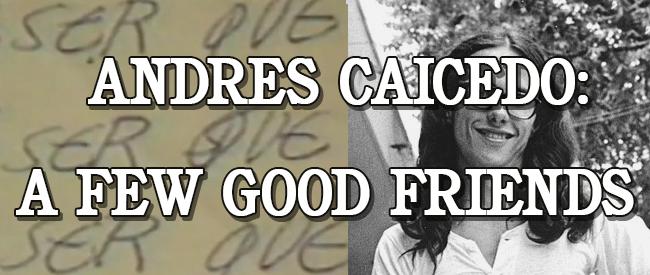

ANDRÉS CAICEDO: UNOS POCOS BUENOS AMIGOS
aka Andrés Caicedo: A Few Good Friends
Dir. Luis Ospina, 1986.
Colombia. 82 min.
In Spanish with English subtitles.

SUNDAY, MARCH 13 – 7:30 PM
MONDAY, MARCH 21 – 7:30PM
TUESDAY, MARCH 29 – 10:00 PM

PURCHASE TICKETS HERE

“May no one know your name and no one give you shelter. May you remain free of Fame’s foul schemes. If you leave a body of work behind, die easy, trusting in only a few good friends.”
– Andrés Caicedo, Long Live Music!

Cult author, playwright and poet Andrés Caicedo’s work captured the vitality and frustration of a generation of Colombians, avoiding magical realism’s twee sheen in favor of grounded social observation. Never directly acknowledging the heavy shadow narco-political violence cast over his city of Cali, Caicedo instead conveyed urban life’s inherent fatalism through stories of malcontent youth.

His influence resonates deeply through present-day Colombia, but as the opening scene of A FEW GOOD FRIENDS makes painfully clear, only nine years after his death no one in his hometown, forget country, remembers who he was. As the above quote suggests this is partly Caicedo’s own doing – at age 25, the day his first novel was published, he took his own life. Ospina’s documentary is an attempt to resurrect a self-erased man through his own words; taking that same quote to heart, A FEW GOOD FRIENDS focuses as much on Caicedo’s brief life and body of work as on his continued impact on friends left behind.
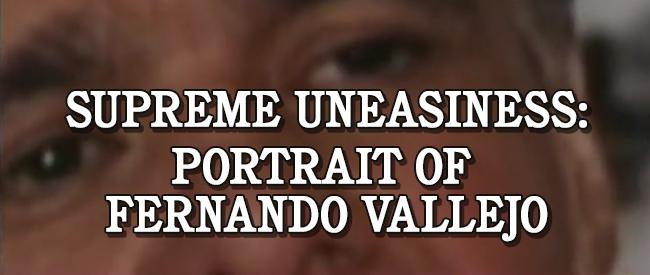

LA DESAZÓN SUPREMA: RETRATO INCESANTE DE FERNANDO VALLEJO
aka The Supreme Uneasiness: Incessant Portrait of Fernando Vallejo
Dir. Luis Ospina, 2003.
Colombia. 91 min.
In Spanish with English subtitles.

WEDNESDAY, MARCH 9 – 7:30 PM
FRIDAY, MARCH 25 – 10:00 PM
MONDAY, MARCH 28 – 10:00 PM

PURCHASE TICKETS HERE

From the opening shot capturing his own shadow filming, Ospina cheerfully defies documentary’s pretense to objectivity and impartiality in his documentary on controversial author Fernando Vallejo. Best known in the U.S. for his novel Our Lady of the Assassins (later made into a film of the same name by Barbet Schroeder), Vallejo left Colombia for Mexico in 1971 after censorship of his first film. He turned to writing, and in 2007 publicly renounced his Colombian citizenship, declaring it had always been an abusive and miserable country, but upon election of then-President Álvaro Uribe found it was stupid to boot. For someone so vehemently outspoken against Colombia, all Vallejo’s work, including three films made in Mexico, centers on the country; much like Ospina, he feels an unseverable connection to his homeland in spite of its horrors and corruption.

Vallejo’s writing, nearly always first-person, blurs the line between fiction and autobiography, and Ospina’s content to let his subject dictate the form – his presence behind the camera is continually called out by Vallejo, who delights in breaking the wall between subject and filmmaker. Both act audaciously, Vallejo with his perpetual soft-spoken blasphemies, Ospina with his unabashed use of video effects including picture-in-picture, mobile graphics, and text overlay. Ospina’s is the sin of friendly informality in a genre affecting somber elegance to convey ‘serious’ intent.

Beauty isn’t necessary to portray two intertwined characters on both sides of the screen – an author who lost hope in the language of film constantly flashing new facets of personality, presented by a director who overwhelms the screen with text – both haunted by places and people that no longer exist.
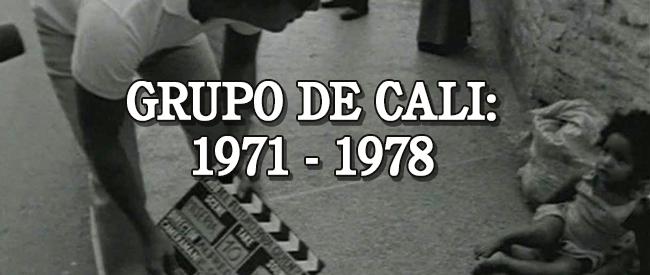

GRUPO DE CALI: 1971–1978
Total running time: 68 minutes

SUNDAY, MARCH 6 – 7:30 PM
SATURDAY, MARCH 19 – 10:00 PM
WEDNESDAY, MARCH 23 – 7:30 PM
MONDAY, MARCH 28 – 7:30 PM

PURCHASE TICKETS HERE

OIGA, VEA!
aka See, Hear!
Co-directed by Carlos Mayolo.
1971. 27 min.

Made in the style of a straight-shooting As The World Turns… style mini-documentary, OIGA, VEA! serves as psychic exposé of Cali upon the arrival of the 6th annual Panamerican Games in 1971. Shooting with a handheld 16mm camera “borrowed” from Carlos Mayolo’s ad agency workplace, the film finds wobbly panoramas on spectacular assemblages, but always from the outside – an exteriority which defines itself fuller in the film’s cockeyed dissection of the Games’ pomp and circumstance. Rallies of military might serve only to demonstrate their planners’ unmistakable Cold War anxieties, and proprietary feats of infrastructural know-how – like a new railroad track, received by some shantytowns like manna from heaven – exposed for the limited-time-only publicity perks they are. Ospina and Mayolo steal glimpses at once officially decorative and incisively marginal; by the film’s end, the bitterness engendered by the project has been transferred in total from the shantytowns outside the Games’ encampment, and directly into the audience.

CALI: LA PELICULA
aka Cali: The Movie
1973. 13 min.

The frantic, colorful CALI DE PELICULA is antithesis to the sort of pedantic ‘misery porn’ Mayolo and Ospina would mock in AGARRANDO PUEBLO. Like a Mondo movie without the voiceover, Ospina and Mayolo frame bullfighting as silent slapstick, turn voyeuristic girl-watching ominous with a horror heartbeat, and capture life at street level, a pagan carnival churning by. Dancing, so vital to social life in the area, is shown in all its movement and color, but capturing faces without smiles or real joy – even enjoying themselves Cali’s citizens are cautious.

AGARRANDO PUEBLO
aka The Vampires of Poverty 
Co-directed by Carlos Mayolo.
1978. 28 min.

This program concludes with AGARRANDO PUEBLO, widely recognized as the Group’s masterpiece. Mayolo and Ospina star as effigies of themselves, wielding Bolexes and Nagras on a mission to make the perfect cine de sobreprecio (“surcharge film”) for German television – skewering a then-commonplace of Colombian cinema dictated by the Committee for Quality Control, a government-supported bureau intended to help foster a national cinema but a de facto organ of censorship. Retitled THE VAMPIRES OF POVERTY in English, “Agarrando Pueblo” mistranslates a number of ways along the lines of “the clutching of poverty” and “the tricking of the people” – Ospina described it as a popular regional phrase at the time. The certainly film gives away as much (if not more) of its antiheroes’ sleazy postcolonial errand as it does the poverty they seek. Who is clutching whom? While the filmmakers are obviously the supposed vampires, the film is also explicit in the way their exposure to an impoverished zone gets their minds going about the potential windfall for their own careers (aided, inevitably, by a few lines of blow back at the hotel.)

In his The Aesthetic of Hunger (first presented at a festival in 1965, modified and republished in the early 70s) Brazilian filmmaker Glauber Rocha criticized a certain trend in Latin American cinema that played up tropes of poverty as a kind of image-dependency. Rocha posited that these countries were still living under the same colonialism as yesteryear, only the means of representation (establishing poverty as an indomitable symptom/destiny, and not the result of socioeconomic policies) had changed.

The tension of this encounter – between the type of European-inflected filmmakers Rocha referred to as “above zero” for their filmmaking resources, and Cali’s poorest – reaches a remarkable boiling point in AGARRANDO PUEBLO. It’s unclear whether the documentarians’ expedition is being turned on its head, or in fact fulfilling its original intent too perfectly; the barrier between color footage of the slums and black-and-white footage of the filmmakers gets shakier. As Mayolo himself likened the experience of shooting OIGA, VEA! to having “150 assistant directors”, PUEBLO brings it all back home when one of the documentary’s “stars” refuses to participate, becoming all the more desirable a subject for the filmmakers. The man is played by one Luis Alfonso Londo, a longtime resident of the El Guabal shantytown profiled in OIGA, VEA! According to the filmmakers, they first met Londo when he jumped out and asked them: “Ah, con que agarrando pueblo, no?”

EVERYTHING BAD THAT’S GOOD FOR YOU: THE FILMS OF RON MANN

Canadian documentarian Ron Mann has been chronicling the odd corners of North American pop culture for more than 30 years. This March, Spectacle Theater is proud to present four of this acclaimed filmmaker’s finest explorations of the 20th century’s subversive ephemera.


TWIST
Dir. Ron Mann, 1992
Canada, 74 minutes

TUESDAY, MARCH 1 – 10:00 PM
SATURDAY, MARCH 5 – 10:00PM
SUNDAY, MARCH 6 – 5:00 PM
FRIDAY, MARCH18 – 10:00 PM

PURCHASE TICKETS HERE

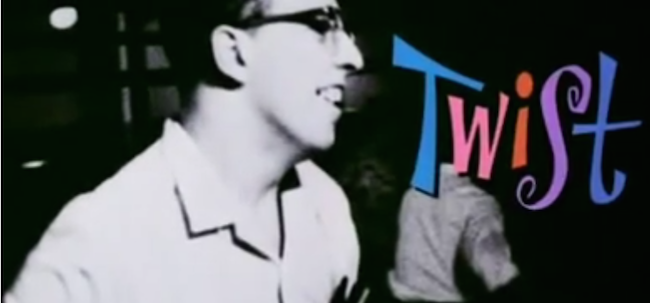
In TWIST, Mann traces the history of popular dance post-WW2 and the rise of the adolescent demographic. TWIST includes music and interviews from Little Richard, Chubby Checker, Frankie Avalon, Hank Ballard and Fats Domino, among others.


COMIC BOOK CONFIDENTIAL
Dir. Ron Mann, 1988
US/Canada, 90 minutes

WEDNESDAY, MARCH 2 – 7:30 PM
THURSDAY, MARCH 3 – 10:00 PM
THURSDAY, MARCH 10 – 7:30 PM
SATURDAY, MARCH 19 – 7:30 PM
TUESDAY, MARCH 22 – 10:00 PM

PURCHASE TICKETS HERE

In the groundbreaking COMIC BOOK CONFIDENTIAL, Mann interviews some of the comics world’s most innovative talents, from veterans like Will Eisner and Jack Kirby to underground legends like Robert Crumb and Gilbert Shelton to the 80’s vanguard of Charles Burns, Lynda Barry and the Hernandez Brothers. Also features Sue Coe, Al Feldstein, Bill Gaines, Bill Griffith, Harvey Kurtzman, Stan Lee, Frank Miller, Francoise Mouly, Art Speigelman, Harvey Pekar and other artists who helped defined the medium of comics.


GRASS
Dir. Ron Mann, 1999
Canada, 80 minutes

SATURDAY, MARCH 5 – MIDNIGHT
FRIDAY, MARCH 11 – 10:00 PM
WEDNESDAY, MARCH 16 – 7:30 PM
TUESDAY, MARCH 22 – 7:30 PM

PURCHASE TICKETS HERE

GRASS covers the U.S. government’s demonization and subsequently war on marijuana. Narrated by actor and drug activist Woody Harrelson.


TALES OF THE RAT FINK
Dir. Ron Mann, 2006
Canada, 78 Minutes

WEDNESDAY, MARCH 2 – 10:00 PM
TUESDAY, MARCH 8 – 7:30 PM
THURSDAY, MARCH 10 – 10:00 PM
SUNDAY, MARCH 20 – 7:30 PM

PURCHASE TICKETS HERE

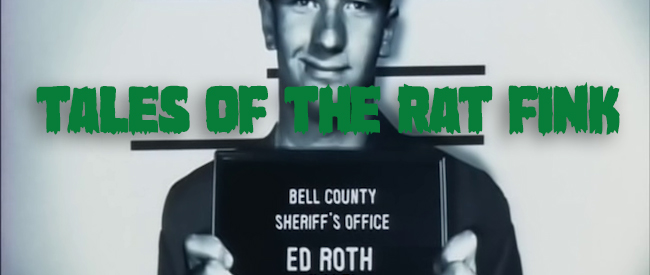
2006’s TALES OF THE RAT FINK presents a biography of cult icon hot rod artist Ed “Big Daddy” Roth, creator of Rat Fink, featuring appearances and narration by John Goodman, Ann-Margret, the Smothers Brothers, Matt Groening, Jay Leno, Stone Cold Steve Austin, ZZ Top’s Billy Gibbons and Brian Wilson (yes, Brian Wilson).