FAR EAST FEMMES WITH FIREARMS

FEF_banner

This June, Spectacle presents two classics of the ‘Girls With Guns’ genre- a style of Asian action films featuring strong female leads packing serious amounts of heat and deadly kung-fu moves.

Originated by 50s Japanese B-movie icon Seitaro Suzuki and popularized during the 80s and 90s, these films are now considered commonplace amongst the Hollywood landscape, usually festering in video game adaptations (Lara Croft: Tomb Raider) or genre pastiche (Kill Bill).

The best ones, however, not only feature visceral gunplay and hire-wire martial art acts, but also situate the female lead as the dominating hero warrior over the weaker sex, in both the fabric of the film and in Asian society.

Luckily, we’ve picked two of the best. Hold on to your butts, because they’re about to get picked up and slammed.


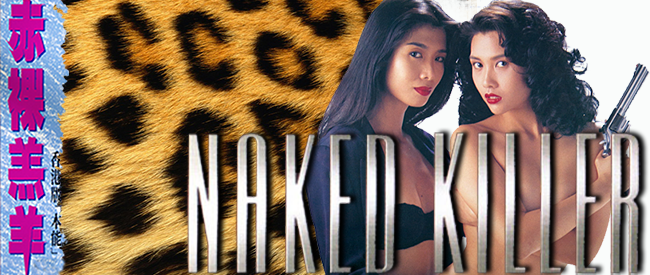
NK_banner

NAKED KILLER
Dir. Clarence Fok Yiu-leung, 1992
Hong Kong, 93 min.
In Cantonese with English subtitles.

FRIDAY, JUNE 6 – 7:30 PM
MONDAY, JUNE 9 – 7:30 PM
THURSDAY, JUNE 19 – 10 PM
FRIDAY, JUNE 27 – 10 PM

A gleefully sleazy, over-the-top CAT III camp romp about dueling lesbian contract killers and the impotent policeman caught in the middle, NAKED KILLER is a joyous ode to all things (s)excessive.

Following a traumatic crime bust gone awry, Hong Kong cop Taninan can’t seem to perform in the line of duty or in the bedroom… until he meets the enchanting seductress/killer Kitty. Their tango is soon cut short by Sister Candy, a veteran assassin who snatches Kitty away and teaches her the ways of professional execution and how to tap into her sensual side. Almost just as quick, two of Sister Candy’s previous students show up to murder their former teacher, prompting an all-out lesbian assassin war.

With tongue planted firmly in-cheek, director Fok Yiu Leung crosses titillating eroticism with a strong sociological undercurrent denouncing male piggishness. But he also knows how to entertain, and wildly so: copious amounts of milk drinking, dick slicing, office shoot-’em-ups, underwater knife fights, and Skinemax soft-core lesbian playfulness all wrapped up in a engrossing amount of 90s neon bliss… it’s all here and then some.

This is the 1992 summer action blockbuster you deserve.

“Imagine the erotic world of Basic Instinct exaggerated into a kung-fu cartoon of sexy lesbian avengers executing quadruple leaping somersaults in a deadly assault against the opposite sex.” -The New York Times

“John Woo on acid… Naked Killer breaks Mach 5 within the first 10 minutes and never lets up. Bursting with colorful lighting, angles, and set pieces, it’s a panoply of Nineties sex and violence, decadence for decadence’s sake, with little moralizing thrown in. A genuine crowd-pleaser…” -The Austin Chronicle

“It’s like nothing you’ve ever seen before… a stylized girlie graphic novelization of psycho hot babe killers as channeled through and re-imagined by Quentin Tarantino… Naked Killer is girl power gone gonzo, a geek’s wet dream doused with libido lightening messages about Chinese society’s misogyny.” -Pop Matters


YM_banner

YES, MADAM
(aka Police Assassins)
Dir. Corey Yuen, 1985
Hong Kong, 90 min.
In Cantonese with English subtitles.

WEDNESDAY, JUNE 4 – 10 PM
TUESDAY, JUNE 17 – 10 PM
FRIDAY, JUNE 27 – 7:30 PM

A female buddy-cop/martial-arts movie featuring international stars Michelle Yeoh and Cynthia Rothrock in their breakout roles, YES, MADAM follows Inspector Ng (Yeoh) teaming up with Scottish investigator Carrie Morris (Rothrock) to get on the trail of a crooked businessman hellbent on getting an incriminating piece of microfilm back from a bubbling group of low-level criminals who stole it.

The first significant roles for both leading ladies (Yeoh a former beauty queen and Rothrock a former marital arts instructor), the film became a critical and commercial success and launched the careers of both women, with subsequent sequels and spin-offs for the YES, MADAM franchise.  Most importantly, it provided the blueprint for all future ‘girls with guns’ films: an equal mixture of acrobatic spectacle and determined heart.

AND THIS IS FREE

NEWAndthisisfree.BANNER

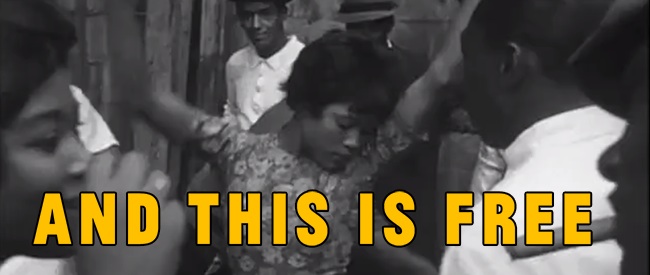
AND THIS IS FREE
Dir. Mike Shea, 1965
USA, 50 min. (+20 min. of supplements)

SATURDAY, JUNE 7 – 10 PM
MONDAY, JUNE 16 – 10 PM
THURSDAY, JUNE 26 – 7:30 PM

During its heyday, the Maxwell Street Market in Chicago was the biggest and most populated open-street market in America, and a singular cultural melting-pot – it has been called “the Ellis Island of the Midwest”. Thousands of people swarmed there every weekend to shop for bargains and second-hand junk on pushcarts and in stores (Ron Popeil got his start there). They also came for the entertainment: hucksters, hustlers, eccentrics, sidewalk preachers and, most famously, the street musicians, including many of Chicago’s blues greats.

Mike Shea’s only film is a seldom-seen pioneering cinema-vérité masterpiece, an essential historical document of Chicago and the market as a quintessential public space (the market was dismantled in 1994 to make room for student housing). Shea, who had been a photojournalist for Life and other magazines, shot the film over 16 Sundays (the market’s busiest day) in 1964, and was often accompanied on the shoot by 21-year old Mike Bloomfield, later of the Paul Butterfield Blues Band and Dylan’s Highway 61-era band, who knew the street musicians and helped facilitate filming. AND THIS IS FREE features blues and gospel performances by legendary Chicago musicians Robert Nighthawk, Johnny Young, Blind Arvella Gray, Jim & Fannie Brewer, Carrie Robinson and many more.

AND THIS IS FREE is one of the greatest documentaries of the 1960s and perhaps the liveliest portrait of American street life ever captured on film. The 50-minute feature will be supplemented by additional rare footage documenting the market and the musicians who played there.

Special thanks to Shanachie.

SCREWED

screwed_banner

SCREWED
Dir. Alexander Crawford, 1996
USA, 85 min.

WEDNESDAY, JUNE 4 – 7:30 PM
FRIDAY, JUNE 13 – 10 PM
SATURDAY, JUNE 28 – 10 PM
[Featuring Q&A with former editors of SCREW!]

On December 19th, 2013, New York City said goodbye to a cultural institution. Well, some said “goodbye;” others said “good riddance.”

Al Goldstein—pornographer, cable access host, free speech activist and unapologetic scumbag—was never afraid to offend, and treated bad taste like something of a birthright. As the publisher of SCREW Magazine and the host of the television show MIDNIGHT BLUE, Al Goldstein had two particularly prominent platforms at his disposal… and plenty of bile to spew from both of them.

The 1996 film documentary SCREWED, directed by Alexander Crawford and produced by Todd Phillips and Andrew Gurland (“Hated,” “Frat House,” “The Hangover Movies”), follows Goldstein as he eats pussy, hits on transsexuals, strolls through his unrecognizable, pre-gentrification Williamsburg birthplace and flips bird after bird at target after target. Though Goldstein spent the last years of his life in poverty, SCREWED captures the man at the height of his powers, sitting fat and satisfied atop a multimillion-dollar porn empire. (How many million, you ask? “Fuck you for wanting to know,” intones the film’s subject.) The film also features interviews with Al’s fans, as well as his enemies (including Guardian Angels founder Curtis Sliwa) as they navigate a pre-Giuliani New York City in its final years of seediness. In the New York City of 1996, Time Square is still a hotbed of depravity, peepshows and porn stores are common, and hookers can be picked up easily right off the street (and occasionally interviewed on camera).

Featuring a killer soundtrack by Amphetamine Reptile Records (including all-original tracks by Melvins, Mudhoney, Boss Hog, Cows, and more), SCREWED is a filthy, fascinating portrait of sweaty, pink-faced, 400-pound god in a universe of his own making.

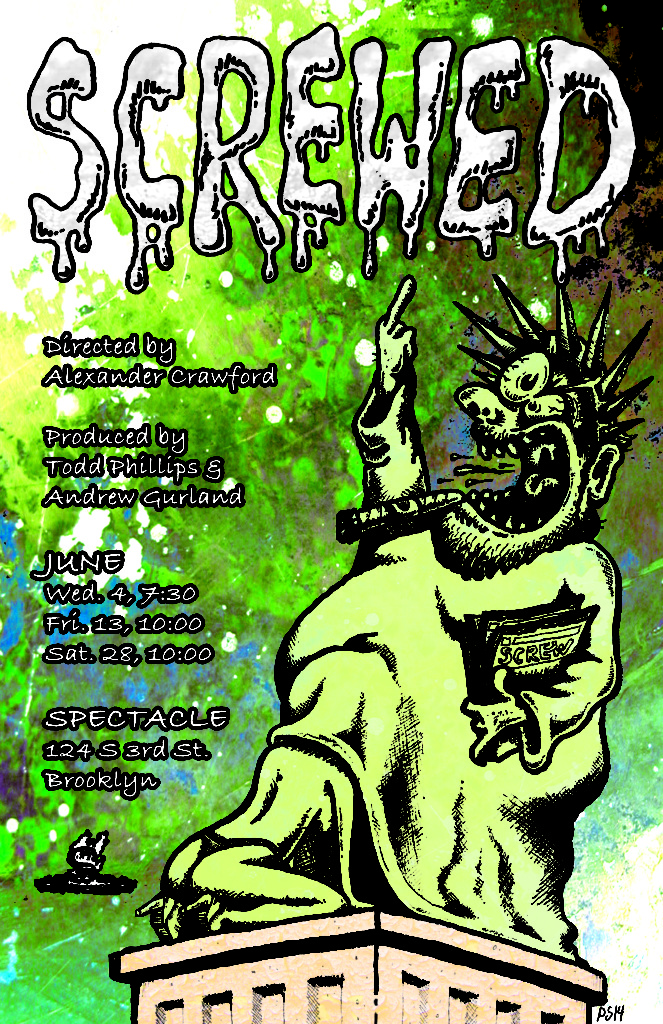
screwed_v04

Poster by Preston Spurlock.


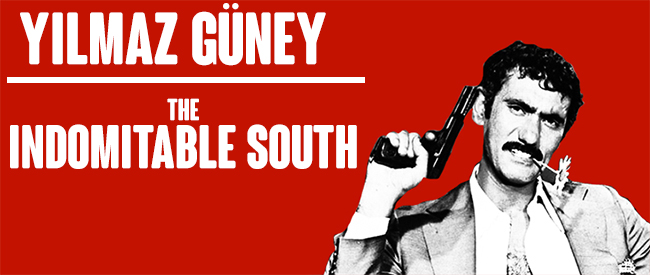
YILMAZ GÜNEY – THE INDOMITABLE SOUTH

Yılmaz Güney banner

“I am a man of struggle and my cinema is the cinema of the liberation struggle of my people.” -Yılmaz Güney

Critics are fond of separating a filmmaker’s “life” from his “work,” as if the two were related but autonomous spheres. In the case of Yılmaz Güney, the hollow-cheeked, mustachioed action movie star and director whose name has become legend in Turkey, it is clear to everyone that the two are inseparable. A communist Kurd, Güney was looked upon with an unfriendly eye by three successive military regimes in Turkey and spent twelve of his 26 years as a filmmaker behind bars. Many of his films are set in prisons, and when they’re not, his characters are imprisoned by a variety of operations, such as the industrialization of Turkey’s countryside and the proletarianization of its rural nomadic tribes. Constantly hounded by the authorities for his communist “sympathies” while also hugely popular, Güney was a real threat that refused to be neutralized.

Having become an icon by appearing in seventy to eighty films in the 1960s—mostly bloody low-budget revenge movies, shot within days and often based on popular Hollywood movies like ONE-EYED JACKS and I DIED A THOUSAND TIMES— Güney had developed a considerable following by the time he started directing his own films. As critic Atilla Dorsay has said, “His films are watched with as much attention and ‘respect’ as a religious ceremony. The audience is humiliated with him, suffers with him, and when, finally, he decides to revolt, they approve with applause and shouts of joy.” When he turned to analyzing class injustice in HOPE (Umut) in 1970, it was a major shift in affective register. Whereas Güney’s character in THE BRIDE OF THE EARTH from two years previously was a mix of the Man with No Name, Antonio das Mortes, and the T-1000, a near-indestructible vigilante who follows only the law of the gun, his character in HOPE is more like Antonio from BICYCLE THIEVES. What the physician-pedagogue in Truffaut’s THE WILD CHILD says about the boy savage applies equally to this transformation in Güney’s on-screen persona: “What he’ll lose in strength he’ll gain in sensitivity.”

Güney was imprisoned for eighteen months shortly after the military coup of 1960 for a short story he had written as a teenager that constituted “communist propaganda.” The production of THE POOR ONES was cut short when Güney was imprisoned again after another military coup in 1971, this time for sheltering anarchist students. After a general amnesty resulted in his release in 1974, he directed THE FRIEND, widely considered his most nuanced examination of class dynamics in Turkey, and started work on ANXIETY, when he was once again convicted, this time for murdering a conservative judge in a bar fight. Güney would remain behind bars until 1981, but for several years his fame guaranteed him a relatively high degree of freedom in prison. He sent scripts and storyboards to his assistants Serif Gören and Zeki Ökten, who then directed THE HERD, THE ENEMY, and YOL (The Road/The Way) using Güney’s instructions. After yet another military coup in 1980, further repression of all leftist intellectuals severely restricted Güney’s prison conditions, and he escaped to Switzerland. He finished YOL, went to Cannes to collect his Palme d’Or for it with Interpol on his trail, then retreated to Paris. He made one more film, THE WALL, before he died of stomach cancer in 1984.

Güney has described his work as “a refusal of injustice, a call to resistance, the need for organization and also the idea that individual liberation does not make sense, that it does not lead anywhere.” It ranges stylistically from Westerns to social realism, with elements of Godard, B-class gangster movies, and animist mysticism. Though his later films are his most lauded—his penultimate film YOL being the most often screened in the US—his earlier revenge films were both more appealing to the masses and more confident in the ability of the oppressed to collect the strength to kill their enemies. The first half of this eight-film retrospective highlights Güney’s early work as a director, from the Westerns THE BRIDE OF THE EARTH and THE HUNGRY WOLVES to the American-cultural-imperialism-mocking PRIVATE OSMAN and the neorealist-inflected HOPE.
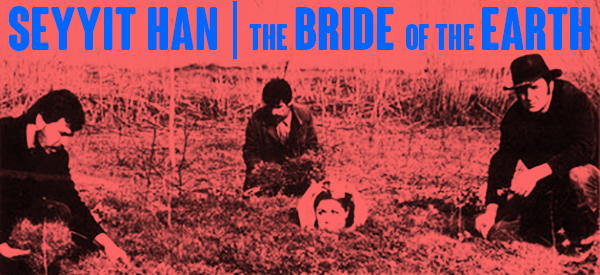

Bride of the Earth banner

THE BRIDE OF THE EARTH
a.k.a. Seyyit Han
Dir. Yılmaz Güney, 1968
Turkey, 81 min.
In Turkish with new English subtitles by Spectacle

SUNDAY, JUNE 1 – 5 PM
WEDNESDAY, JUNE 11 – 10 PM
WEDNESDAY, JUNE 18 – 7:30 PM
MONDAY, JUNE 30 – 10 PM

After making his directorial debut with HORSE, WOMAN, GUN in 1966 and establishing his own production company, Güney Filmcilik, in 1968, Güney made THE BRIDE OF THE EARTH, a tale of love and revenge that brings together the gun-slinging virtuosity of the Ugly King and the plight of the backwards Turkish peasantry.

The stone-faced Seyyit Han has a sweetheart waiting for him in his home village. Years ago, reluctant to condemn her to a life of hardship, he set out to kill all his enemies and promised to return for her. Now, after a seven-year prison sentence, Han returns to find a wedding in progress: his bride-to-be has been promised to a prominent man in the village by her impatient brother. Han’s bitterness and his bride’s suicidal despondency culminate in her tragic death and Han’s vengeance, which he exacts by becoming an inexorable killing machine fueled by his hurt pride, taking out the groom and his henchmen one by one.

THE BRIDE OF THE EARTH dramatizes the subjugation of women through the feudal marriage practices of rural Turkey by cloaking it in a pulse-pounding pseudo-Western shoot-em-up that satisfies our craving for sub-proletarian justice. It is widely considered the first film with Kurdish main characters and can be read as a metaphor for the struggle of the Kurds against oppressive tribal traditions and Turkish landlords.
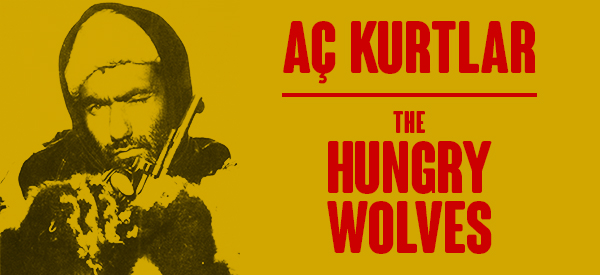

Hungry Wolves banner

THE HUNGRY WOLVES
a.k.a. Aç Kurtlar
Dir. Yılmaz Güney, 1969
Turkey, 85 min.
In Turkish with English subtitles

TUESDAY, JUNE 3 – 7:30 PM
MONDAY, JUNE 9 – 10 PM
MONDAY, JUNE 16 – 7:30 PM

A communist Western set in the snowy plains of eastern Anatolia, THE HUNGRY WOLVES follows Memet, a mysterious mercenary played by Güney, as he tracks down bandits and exchanges their heads for rewards. Memet rivals the reticent anti-heroes of Leone and Corbucci with his stone-faced screen presence and his reluctance to talk about anything but money. He patiently outwits all his opponents and takes down ever bigger and more cunning gangs, until his final destruction at the hands of the vengeful military police.

Güney shot the film in Muş, one of the 17 provinces that comprise Turkish Kurdistan, during his military service there. The Turkish title, Aç Kurtlar, almost sounds like ‘aç kürtler,’ meaning ‘hungry Kurds.’ Sure enough, many of the bandits preying on the peasants are Kurds, and the film presents an obvious critique of those tendencies among the Kurdish people that cause it to direct its violence against itself rather than against its real enemy (the Turkish state, capitalism).

Called “an epic of banditry” by a critic at the time of its release, THE HUNGRY WOLVES would be the last in Güney’s series of horse-riding tough-guy pictures, soon to be followed by his more sensitive portrayals of existentially threatened peasants and the urban poor.
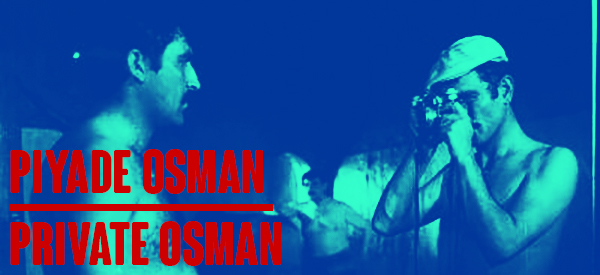

Private Osman banner

PRIVATE OSMAN
a.k.a. Piyade Osman
Dir. Yılmaz Güney, 1970
Turkey, 72 min.
In Turkish with new English subtitles by Spectacle

TUESDAY, JUNE 3 – 10 PM
WEDNESDAY, JUNE 11 – 7:30 PM
SUNDAY, JUNE 15 – 7:30 PM
MONDAY, JUNE 23 – 7:30 PM

The strangest entry in Güney’s oeuvre, PRIVATE OSMAN belongs neither with the guns-and-muscle revenge rippers of his first decade in cinema, nor with the sheep-and-tractor social portraits of his last.

The titular character, played by Güney himself, is a hapless photojournalist who has returned from military service and now makes his living in Istanbul by manufacturing spectacular crimes that he and his colleague-girlfriend will then be the first to cover. Constantly ducking from the law, shooting up bars, and starting fights, Osman is a kind of devil-may-care Peter Parker, a Belmondo with a camera. His racket eventually lands him in the thick of a crime syndicate’s real intrigues, and he ends up having to walk more of the walk than he expected. Osman takes on more and more of the traits of Güney’s traditional “Ugly King” persona, culminating in a half-hour long showdown in which many bad guys get shot from impressive distances.

Following less in the footsteps of Italian neorealism than HOPE from the same year and more in those of the French New Wave, PRIVATE OSMAN features a girl and a gun, frenetic cutting, and a mockingly American soundtrack consisting mostly of a few repeated bars of Yankee Doodle. Those interested in class struggle will also find the token band of striking workers, portrayed with a mix of back-slapping familiarity and ironic detachment. Snippets of a union leader’s exhortations are heard and glimpses of torn posters for proletarian street rallies are glimpsed. Both references to the contemporary political situation in Istanbul recall early Godard in their light-handedness.

If BAND OF OUTSIDERS is Godard’s most accessible film, PRIVATE OSMAN is certainly Güney’s.

Hope banner

HOPE
a.k.a. Umut
Dir. Yılmaz Güney, 1970
Turkey, 100 min.
In Turkish with new English subtitles by Spectacle

SUNDAY, JUNE 1 – 7:30 PM
THURSDAY, JUNE 19 – 7:30 PM
MONDAY, JUNE 30 – 7:30 PM

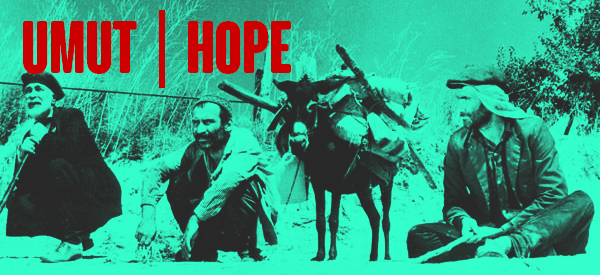
HOPE is considered a landmark in the history of Turkish cinema. Güney called it an “epic of verité” due to its break with the conventions of Turkish commercial cinema, the gleaming sets and powdered starlets typical of Yeşilçam (the Turkish Hollywood). Although it is often compared to De Sica’s BICYCLE THIEVES, HOPE also has much in common with Glauber Rocha’s BLACK GOD, WHITE DEVIL—with its rural merchant protagonist who gets fleeced one too many times and turns to a messianic preacher for guidance—and with Ousmane Sembene’s BOROM SARRET, the tale of a poor horse-cart driver in Dakar getting kicked around by the law.

Güney’s character, Cabbar, drives a horse-driven cart in Istanbul. Business is bad, and the rapidly modernizing city leaves little room for a man who uses such quaintly obsolete means to earn his living. His wife, mother, and five children depend on him, and their domestic life is characterized by constant threats and abuse. Indebted to everyone he knows, Cabbar’s fate is sealed when a bourgeois asshole in a sports car mows down one of his parked horses. Unable to borrow more money to replace it or even pay back his existing debts, Cabbar tries his luck at the lottery, then turns to armed robbery. Unfortunately, the American tourist he and his friend try to hold up fails to understand their threats and chases them away in anger. Furious at his creditors and indifferent to other cart drivers’ efforts to organize in a union, Cabbar falls under the influence of a hodja, a kind of wise-man witch-doctor, who promises him buried riches. Cabbar and his friend sever their bonds to the city and join the hodja in a clearly insane quest for treasure hidden in the surrounding desert.

Although it is often interpreted as a critique of the backwards superstitions rampant among the uneducated Turkish proletariat, HOPE should be read instead as a revolutionary call to break with old forms of organizing (whether in the family or in labor unions) and to embrace a non-instrumental form-of-life. It is a manifesto for the abolition of homo economicus and for the reenchantment of the world.

THE 4TH BASEMENT MEDIA FEST

BASEMENT_banner

THE 4TH BASEMENT MEDIA FEST
Dir. Various
Approx. 60 min.

THURSDAY, JUNE 5 – 7:30 PM
SATURDAY, JUNE 21 – 7:30 PM

THE BASEMENT MEDIA FEST IS A SURVEY OF CONTEMPORARY ARTISTS WORKING WITH LO-DEF, LO-TECH, AND LO-FI MOTION PIX TECHNIQUES. FOUNDED IN RESPONSE TO HI-RES COMMERCIAL MEDIA AND CORPORATE-SPONSORED FILM FESTS, BASEMENT IS A CELEBRATION OF THE MEDIATED EXPERIENCE AS AN AESTHETIC EXPERIENCE. EQUAL PARTS GLITCHD DIGITAL VIDZ, FUZZY VHS, AND GRIMY 16MM FILM, WE’LL BE PRESENTING A MIXD PROGRAM OF CELLULOID AND .MOVS. COME ENJOY SOME 100 YR OLD TECH IN A STATE OF THE ART CONVERTED BODEGA THEATER.

///WARNING/// SUM OF THESE MOVIES FEATURE FLICKERING LIGHT AND RAPIDLY CHANGING MOTION. MAY CAUSE SEIZURES/MOTION SICKNESS. IF YOU HAVE TO SPEW, SPEW IN THIS.

/START PROGRAM:

House (Andy Birtwistle, 3:45, Digital)

I Am All Men As I Am No Man and Therefore I Am (Gilberto Alfredo Salazar­ Caro, 5:29, Digital)

Election Coverage (Chris Paul Daniels, 1:01, Digital)

Cold Blood (Tyler Tamburo, 3:24, Digital)

Queens Quay (Stephen Broomer, 1:11, 16mm)

[phrases] (Ben Balcom, 4:24, Digital)

Doubt #2 (Josh Lewis, 5:26, 16mm)

Smashed (Emma Varker, 3:53, Digital)

The HandEye (Bone Ghosts) (Anja Dornieden & Juan David Gonzalez Monroy, 7:09, 16mm)

[RGB] (N. Heppding, 4:30, Digital)

Seriously Delinquent (Dylan Pasture, 6:49, Digital)

The Way You Recognize It (Laura Thatcher, 1:32, Digital)

How to Draw Clouds (Salise Hughes, 2:20, Digital)

RIP Geocities (Faith Holland, 2:31, Digital)

Every Feature Film on My Hard Drive 3 Pixels Tall and Sped Up 7000% (Ryan Murray, 3:29, Digital)

holiday 13 (Jordan Lopez, 1:44, Digital)

Up (Scott Fitzpatrick, 4:47, Digital)

/END PROGRAM

FOR MORE INFO, CHECK OUT: HTTP://BASEMENTMEDIAFEST.COM

THE LAND DOWN UNDERGROUND

The Land Down Underground

THE LAND DOWN UNDERGROUND
Dir. Various, 2009-2013
Australia, approx. 61 min.

TUESDAY, JUNE 17 – 7:30 PM
THURSDAY, JUNE 26 – 10 PM

While underground film has a decades-long history in the United States, it’s a much newer form in Australia, where the first underground film festival was established in 2000 in Melbourne, followed by Sydney in 2007 and Brisbane in 2010. Underground film in Australia, at this stage of its evolution, is a mixture of work from experimental filmmakers, visual artists working with the moving image, and new, inexperienced directors, many with no formal training. This program brings together some of the recent films from this movement.

THE AFRICAN WORD FOR SUMMER
Dir. Chris Allery, 2011
Australia, 7 min.

GLORY HOLE
Dir. John Barker, 2011
Australia, 8 min.

HANSEL & GRETEL
Dir. Emma Varker, 2012
Australia, 7 min.

AFTER THE RAINBOW
Dir. soda_jerk, 2009
Australia, 5.5 min.

KAPPA
Dir. D.A. Jackson, 2012
Australia, 5 min.

POLLY, JENNIFER & MELISSA
Dir. Diego Ramirez, 2012
Australia, 4.5 min.

BUFF TRAILER
Dir. soda_jerk, 2013
Australia, 2 min.

WHITE RUSSIAN
Dir. Emma Varker, 2013
Australia, 4 min.

WEATHERED
Dir. Shaun Burke, 2013
Australia, 6 min.

CINAMNESIA
Dir. Nicola Walkerden, 2013
Australia, 6 min.

HEART SHAPED BRUISES
Dir. Diego Ramirez, 2013
Australia, 2 min.

YOU ARE SPECIAL!!

You are Special

SUNDAY, JUNE 15 – 5 PM
SATURDAY, JUNE 28 – 7:30 PM

Feeling sad and lonely? Secretly worried you’re just not good enough? Is the constant terror of being exposed as a failure and a fraud holding you back from living your best life?

You Are Special! is the program you need. New short films about human vulnerability—self help cults, private tears, puppets, ugly motel furnishings, game shows, depressed motivational speakers, and dancing, dancing, dancing. Unlock the power within and make your dreams come true. Learn to stop worrying and start living (TM) with Spectacle.

HISTORIA CALAMITATUM (THE STORY OF MY MISFORTUNES) PART II: THE CRYING GAME
Dir. Roger Beebe, 2014
USA, 21 min.

It’s all right to cry. Sometimes it’s even better than all right.

HOT CHICKEN
Dir. Iain Bonner, 2014
Australia, 14 min

No man is an island. Give praise!

THE PERFECT HELLO
Dir. Zack Kasten, 2013
USA, 42 min.

Wade Perkins is a fifty-five year old motivational speaker at the end of his rope. After learning of his younger brothers demise, he embarks on an alcoholic bender through middle America accompanied by a much younger woman named Sweetheart. Their short love affair is captured in a series of poetic and piercing scenes en route to the funeral.

Screens with extra found video easter eggs from the depths of the internet, and your soul.

THE FILMS OF ANTON PERICH: SHIT ON THE FENDERS OF YOUR CONVERTIBLE BECAUSE WE’RE COMING THROUGH NO MATTER WHAT

AntonPerich.BANNER

THURSDAY, JUNE 12 – 7:30 (Program I) & 10 PM (Program II)
TUESDAY, JUNE 24 – 7:30 (Program II) & 10 PM (Program I)

In 1973, filmmaker Anton Perich, the legendary Candy Darling and Taylor Mead, and the Broadway actor Craig Vandenburgh went to a nice apartment on Central Park West to make a film. The apartment belonged to the art collector Sam Green and the walls were groaning with Warhols. Perich came up with a simple scenario: Taylor Mead would play a decadent and perverse wall street type, Candy his socialite daughter. As the film opens, Craig Vanderbilt plays the piano for Candy while she screams “Play!” and strikes the instrument with her high heeled shoe. From there, everything is improvised. Before the night is through, Candy and Craig have split, Taylor Mead sits on the stairs, singing incoherently, with his pants around his ankles, and Anton Perich had a finished film.

Many of Perich’s films were made this way, in two or three takes and improvised from simple premises. His films and interviews feature many regulars from Max’s Kansas City (he was a busboy there) and Warhol’s clan (he was also a photographer for INTERVIEW), including Andrea Feldman, Holly Woodlawn, Jackie Curtis, Edwige Belmore and Tinkerbelle, as well as orbiting artists and celebrities like John Cage and Merce Cunningham, Hugh Hefner, Grace Jones and John Waters, resulting in an incredible cross-pollination between art and personality. FRANKENSTINO (1973, starring Taylor Mead as Frankenstein, Katrina Toland, Jayne County and Robert Starr) was shot in the studio of sculptor John Chamberlain atop one of his giant works of foam (and features the line which serves as title for this series, uttered by Taylor Mead). In VICTOR HUGO ROJAS, the performance artist descends into an “Egyptian trance” (he’s wrapped in toilet water, spritzed with water and doused with baby powder) before destroying an original Warhol painting. In HUNTINGTON HARTFORD’S TIE CLOSET (1977), Jerry Hall drapes herself with ties from the Fifth Avenue closet of multimillionaire Huntington Hartford, heir to the A&P supermarket fortune and art collector (who hated abstract art and once called Picasso a “mountebank”).

Perich’s MR. FIXIT (1973) is among the earliest material to be actively censored on television. Starring Susan Blond, Sami Melange and Danny Field, it appeared on public access in Manhattan and concerns a married couple (Blond and Field) who take a special interest in a television repairman’s ass (a lightbulb and a jar of vaseline are involved). The cable operator literally cut the sound and picture for periods of time during the broadcast, interrupting and resuming the tape’s transmission as he saw fit, explaining afterwards in a disembodied voice, “Certain segments of this tape were deleted on purpose. There was no time to edit it.”

Anton Perich embraced television at a time when video and performance artists were beginning to turn to New York galleries in which to show their work. To him, the galleries were safe and bourgeois, whereas television was the “last taboo for artists”, a pristine middle class venue waiting to be anointed by a subversive underclass of artists. Perich spent many years as a painter, poet and filmmaker before embracing the Portapak and its primitive video quality, and wanted to do something new with the technology. “TV was so perfect and sanitized, the answer was to introduce bad quality, bad sound, bad taste”.

In addition to the short narrative and experimental content of the show, Perich also followed a rotating cast of hosts (Susan Blond, R. Couri Hay, Tinkerbelle) to parties, fashion shows, concerts and gallery openings. The show became such an exciting weekly event that Newsweek’s media arm attempted to co-opt its success with its own mainstream version, with Tinkerbelle as host, called “Tinkerbelle’s Parties”. Producer John Peaslee recalls, “We were going to do a slicker version of Anton Perich.” The show failed miserably. “The minute it got slick we lost it.”

Beginning in 1980, Anton Perich took a 25-year break from filmmaking but continued to paint. Then he began to make films once again. His sense of humor is thoroughly intact (in 2010’s MOTHER OF GOD, 85 year-old Taylor Mead plays an aging Sarah Jessica Parker) and he still uses improvisation to build on simple narratives – lately they often have to do with technology (he equates googling oneself to masturbating). Proust is his hero these days. Perich said that he thinks about the fact that Proust made his contribution to the world with just a pencil. Now for the first time, a pen can cost more than a video camera. “Everyone can be a filmmaker, but not everyone is.” Therefore, “it’s a good time for people to redefine cinema again”.

In this special series, Spectacle presents both old and new works by extraordinary underground filmmaker Anton Perich.

Films by Anton Perich PROGRAM I: MAX’S KANSAS CITY, CANDY & DADDY, HUNTINGTON HARTFORD’S TIE CLOSET, and LIKE CINDERELLA
(97 min.)

THURSDAY, JUNE 12 – 7:30 PM
TUESDAY, JUNE 24 – 10 PM

MAX’S KANSAS CITY (1972)
14 min. Silent.
Andrea Feldman, Candy Darling, Jackie Curtis, Jack Smith, Taylor Mead, Holly Woodlawn and others hang out inside and out front of Max’s Kansas City.

CANDY AND DADDY (1972)
35 min.
Featuring Candy Darling, Taylor Mead and Craig Vandenburgh. A perverse wall street broker (Taylor Mead) walks in on his daughter (Candy Darling – whose improvisation is genius) with her lover and then tries to seduce him.

HUNTINGTON HARTFORD’S TIE CLOSET (1977)
17 min.
Featuring Jerry Hall, R. Couri Hay, Antonio Lopez, Roger Webster and Huntington Hartford. The multi-millionaire Huntington Hartford had a collection of thousands of ties in a special closet in his Fifth Avenue penthouse, which a gorgeous, 21-year-old Jerry Hall puts to good use in this short film. She sings dirty songs, one of which begins “Going through the jungle with a dick in my hand.” Huntington Hartford appears periodically, annoyed that his ties are being disturbed.

LIKE CINDERELLA (2010)
31 min.
Paparazzi kidnap a glamorous Italian movie star, and force her to clean while they photograph her.

Films by Anton Perich PROGRAM II: THE LIMO LIFE, VICTOR HUGO ROJAS, FRANKENSTINO and MOTHER OF GOD(101 min.

THURSDAY, JUNE 12 – 10 PM
TUESDAY, JUNE 24 – 7:30 PM

THE LIMO LIFE (1976)
13 min.
Featuring Victor Hugo Rojas, Tinkerbelle, Nancy North and Ramona. “What was the name of that limousine company? Where we had the orgy last week?” Five upscale citizens cruise “Los Angeles” (Manhattan) in a white limo. They pause to sing showtunes, brush their teeth, put on frog masks and die in the gutter. Brought to you by Dom Perignon and a jar of pickles.

VICTOR HUGO ROJAS (1978)
14 min.
Venezuelan performance artist Victor Hugo Rojas was an icon of the separate but overlapping fashion, art and gay party scenes. Here he performs various “Egyptian rites” before destroying an original work by his friend Andy Warhol.

FRANKENSTINO (1973)
31 min.
After the controversy surrounding the live televised censorship of MR. FIXIT, Perich and his cohort were on a mission. FRANKENSTINO features full frontal nudity and general nonsensical discussion of cunts and Hitler. Taylor Mead plays Frankenstein, who frolics atop a giant foam sculpture by John Chamberlain (the film was made in his studio) with Katrina Toland, Jayne (formerly Wayne) County, Robert Star and others.

MOTHER OF GOD (2007)
41 min.
Featuring Taylor Mead as an actor who has made millions playing an aging Sarah Jessica Parker. Mead’s pregnant granddaughter arrives to ask for money but gets only a belly dancing lesson.

VIEWS FROM THE INSIDE

ViewsBanner

This May, in honor of the flowers blooming just outside our windows, Spectacle presents two unforgettable tales of world cinema with a common backdrop: the nuthouse.


JannieBanner

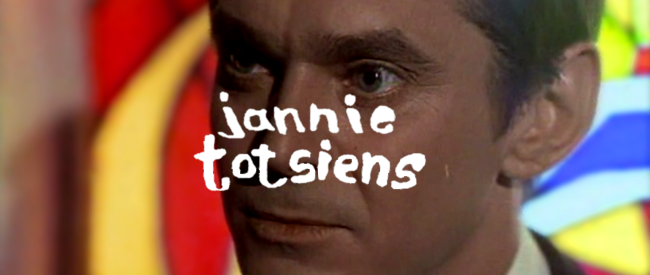
JANNIE TOTSIENS
aka JOHNNY FAREWELL
Dir. Jans Rautenbach, 1970
South Africa, 106 min.
In Afrikaans & English with English subtitles.

THURSDAY, MAY 1 – 7:30PM
MONDAY, MAY 5 – 7:30PM
FRIDAY, MAY 16 – 10PM
SUNDAY, MAY 25 – 7:30PM

Considered a cornerstone of South Africa’s little-revisited 1960s “Golden Era,” Jannie Totsiens is a heady and disturbing surrealist grapple with apartheid as an entrenched form of neurological illness. A paltry band of inmates – including a washed-up Nazi sympathizer and a baby-talking blonde nymphomaniac obsessed with rocking horses and dolls – roam the grounds of South Africa’s most opulent mountain-retreat madhouse. Filmmaker Jans Rautenbach gives each character their own hard-etched idiosyncrasies, allowing linkages to their pre-asylum lives to burble to a surface before dissipating amidst so much wheezing, rambling gibberish.

Into the fray enters a catatonic young mathematics professor named Jannie (Cobus Rossouw). Committed following a plunge into despair, Jannie’s addition tests the menagerie’s thin veneer of community, exposing the lunatics’ threadbare delusions and the bottomless hypocrisy of their sane keepers. (At one point, the sanitarium’s director sighs that he’s given up on therapy – from here on out, “just pills and injections.”) As a drama, Rautenbach’s film is avant-garde in its disavowal of emotional logic: his camera pushes, pulls or spins on the caprices of his insane characters. The result is a sometimes hilarious shadow play of predatory human weakness, richly textured in its balancing of color and death, veering wildly from satire to tragedy in the space of a few edits.


HeadBanner

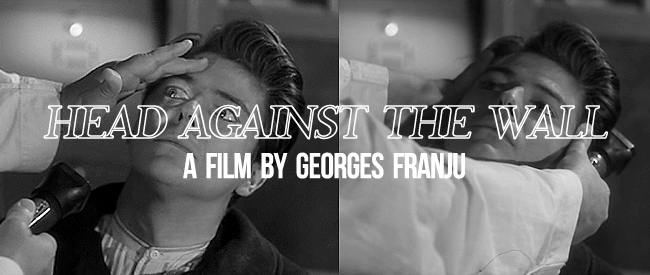
HEAD AGAINST THE WALL
aka La Tete Contre Les Murs
Dir. Georges Franju, 1959.
France. 95 min.
In French with English subtitles.

MONDAY, MAY 5 – 10:00 PM
FRIDAY, MAY 9 – 7:30 PM
SATURDAY, MAY 17 – 7:30 PM

Anouk Aimee. Charles Aznavour. A shimmering black motorcycle jacket. Georges Franju’s Head Against The Wall taps into cinema’s inherent attractions but renders its own utterly untenable, less a cautionary tale than a smoldering portrait of loss. Behind the gates of a countryside sanitorium lives young Francois (future filmmaker Jean-Pierre Mocky), the hotheaded son of a stuffy lawyer – a wild one in the Brando tradition on the outside, bored to sedation within. Francois knows he’s sane, but while waiting for this latest convulsion of The System to pass, all he can do is look at the people around him – and now, without the comfort of his on-and-off girlfriend Stéphanie (Aimee), his visage isn’t pretty.

Blessed with the same magisterial stillness and dark beauty that gave Eyes Without A Face its inimitable power, Franju’s feature debut is both straightforward and serpentine. The screenplay (adapted from a Herve Bazin novel) posits man’s place in society as anything but certain; as Francois seeks validation from parties neutral to his domineering father, his individuality seems to vanish. What develops is not a critique of doctors or hospitals, but instead of French paternalism at large. Under the heel of a society founded on class expectations, Francois doesn’t lose his freedom so much as he realizes it never existed in the first place.

“He seeks the madness behind reality because it is for him the only way to rediscover the true face of reality behind this madness… Let us say that Franju demonstrates the necessity of Surrealism if one considers it as a pilgrimage to the sources. And Head Against The Wall proves that he is right.” – Jean-Luc Godard, Cahiers du Cinema

“Whether it’s the weird, eerily erotic gaze of a female inmate or a strange gathering of doves or a cityscape by night that seems as dank and claustrophobic as the asylum walls themselves, Franju’s mastery and palpable adoration of effect is ever evident.” – Glenn Kenny, The Auteurs

WORLD CINEMA FANTASTIQUE: THE DEVIL’S SWORD

DS_Banner

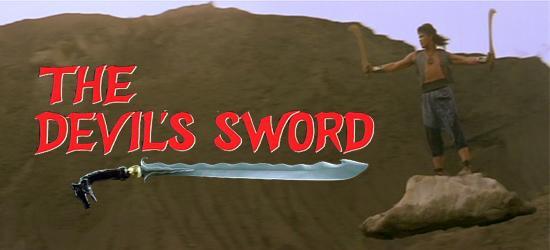
THE DEVIL’S SWORD
Dir. Ratno Timoer, 1984
Indonesia, 101 min.
In English

FRIDAY, MAY 2 – 10:00 PM
SUNDAY, MAY 18 – 5:00 PM
SATURDAY, MAY 24 – 10:00 PM

Presented by Mondo Macabro

From the heyday of Indonesian fantasy cinema, The Devil’s Sword is a classic example of the mind-bending weirdness that brews in homegrown cinemas around the world. With little money and a lot of heart, they shot for the moon but ended up somewhere deep among the stars.

Starring local legend Barry Prima (whose role as Jakka Sambung in THE WARRIOR – an Indonesian Robin Hood – created a celebrity personality whom is often mistaken for a real hero), THE DEVIL’S SWORD concerns an ancient sword whose holder is granted immeasurable power. When the evil Crocodile Queen lures a young prince-to-be to obtain the sword for her, Prima steps in to thwart the evil Queen and defeat her army of half-crocodile men and evil warlocks!

Magic, flying guillotines, and all sorts of mystical malarkey is on display here and achieved for zero budget. And it shows. Grade A absurdity for 1/5 of the price of anywhere else in the world.

World Cinema Fantastique is a monthly screening of crazy fantastic films from around the world.