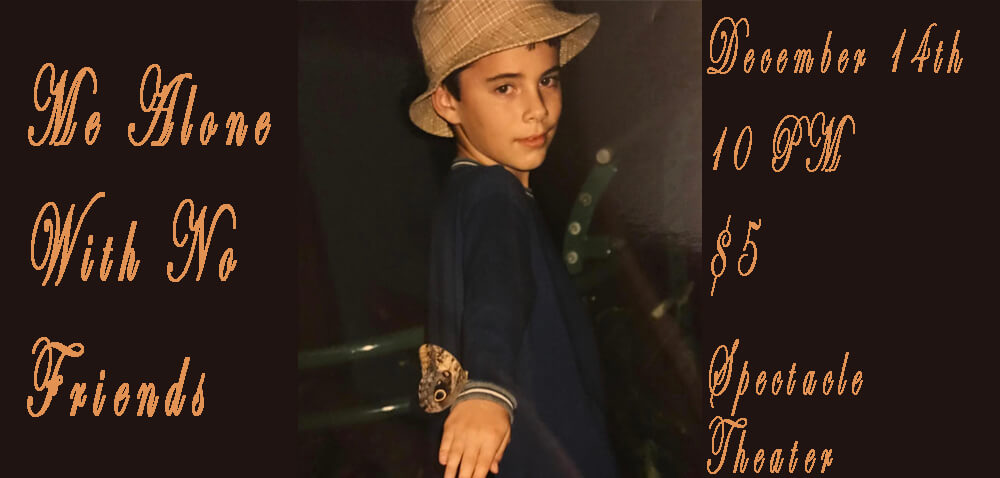
ME ALONE WITH NO FRIENDS
Joe Castle Baker, 2019
SATURDAY, DECEMBER 14 – 10 PM
ONE NIGHT ONLY!

SATURDAY, DECEMBER 14 – 10 PM
ONE NIGHT ONLY!

THURSDAY, DECEMBER 19 – 7:30 PM
ONE NIGHT ONLY!
BAPHTA is a bi-monthly multimedia comedy show that celebrates legendary cinematic artists. Hosted by Andy Ward, Manning Jordan, and Tim Kov, BAPHTA is anchored by original monologues, characters, and videos inspired by the honoree’s body of work. In addition, special guests are invited to put their spin on these visionaries of the seventh art.
Our December installment will focus on an actor about to make her directorial debut in 2020, the consummate Kirsten Dunst.
Arguably one of the most versatile performers working today, Dunst has lent her talents to a variety of projects including INTERVIEW WITH THE VAMPIRE, DICK, MONA LISA SMILE, THE VIRGIN SUICIDES, BRING IT ON and MELANCHOLIA.
Join BAPHTA as we survey Dunst’s body of work and envision what the future holds for her and her upcoming adaptation of Sylvia Plath’s The Bell Jar.
Although Hollywood has been overlooking Dunst’s artistry in recent years, all eyes will be on her at this edition of BAPHTA, as we proclaim “DUNST IS CINEMA!”
Celebrate December with your favorite blonde ingenue-turned-auteur whose mischievous snaggletoothed smile has inspired a generation!
TIM KOV is a writer and performer whose work has appeared all over New York. He hosts and produces Hail Mary: Our Queer Saints, a Kennedy Center Honors-style ceremony honoring gay icons, Power Broker, a Robert Caro themed standup show, and My Little Tonys, a theater history podcast. Last summer, he completed an artist residency at Mall of Found in New Lebanon, NY, where he developed two plays, Peg and Rubbed the Wrong Way: A Prostate Play.
ANDY WARD is a Brooklyn queer comedian and writer.Andy is a recent New York transplant from Phoenix, Arizona where he hosted a monthly storytelling show “SHOW&TELL.” He hosts a monthly comedy variety show RED FLAGS. He has performed at Union Hall, Littlefield, Bellhouse, Club Cumming and has been featured in Buzzfeed.
MANNING JORDAN is a lesbian comedian/playwright. You can see her do stand up around Brooklyn, or on MNN public access network on her variety show called, HEY NOTHING. She has a monthly show at Brooklyn Comedy Collective called Monologues with Manning. As a playwright, Manning has self produced four plays, three of which were in Fringe’s FRIGID festivals for three consecutive years (2017, 2018, 2019). On July 11th her latest play, “Les Museums” premiered at Dixon Place. Her work has been shown at Dixon Place, The Kraine Theater, Manhattan Rep, Theater Under St. Marks, Vital Joint, The Footlight and more. Her short film THOSE WHO CAN’T has been named an Official Selection of the Reel 13 Short Film Contest, and her pilot SUNNY & 70 was accepted as a Fastidious Official Selection.

CALLING ALL LEFTISTS! The past few years have been a whirlwind: exhausting, invigorating, and ripe with potential. It’s tremendously difficult, when in the thick of it, to pause, reflect, or even find a moment to catch a breath. Especially when “it” refers to the rise of fascism on a global scale, with any number of future cataclysms hovering just over the horizon. But we digress.
Join us, then, for a series that asks: if not now, when? Come for great works of radical political filmmaking, stay for the generative discussions, or even just to gossip and gripe. The hope isthat this forum for authentic representations of successes, defeats, and the messy work of political action, will be thrilling, edifying, and maybe even inspire your next organizing project. To butcher the title of a great film for the sake of a moderately applicable pun: “Throw away your dogma, rally in the cinema.”

SUNDAY, DECEMBER 1 – 7:30 PM
ONE NIGHT ONLY!
A screening of short works by NYC-based anarchist video artists Sherry Millner & Ernie Larsen. Stick around for a post-screening Q&A with the filmmakers.
Shot in Paris, Athens, Thessaloniki, Barcelona, and at an anti-fascist festival in Serbia, the video essay ROCK THE CRADLE centers on the fierce aftermath of the December ’08-January ’09 insurrection in Greece, during which an unprecedented array of the excluded and the intransigent took to the streets: the fed-up, the legions of radically disillusioned youth, the unemployed and the under-employed (the precariat), autonomous unions, angry refugees, anarchists and anti-authoritarians. The video reaches a startling climax when dozens of police attack Micropolis, an anarchist social center in Thessaloniki.
HOW DO ANIMALS AND PLANTS LIVE? is a radical inquiry into the sudden eviction and demolition of the self-organized anarchist-supported migrant squat Orfanotrofeio (an abandoned orphanage) in Thessaloniki, Greece, in July 2016—under the direct orders of the Syriza government in cahoots with the Orthodox Church, the biggest landowner in Greece.
On-site testimony of a young West African migrant, first-hand exploration of revealing remnants of the bulldozed ruins of the orphanage, and performative translations from a Greek-language children’s schoolbook that the filmmakers found amid the rubble when they broke into the padlocked site pointedly coalesce to ask and answer : how is this possible?
If indeed “no one is illegal,” then this video salvages from the ruins the structure of a new commons–on the basis of such anarchist principles as self-organization, autonomy, solidarity, assembly, and direct action, at an historical moment when the status of the refugee has become a global paradigm.
Sherry Millner and Ernie Larsen co-created the interventionist video project State of Emergency, collaborating with more than 15 artists in a silent shout-out against U.S. invasions of the Middle East and the global plague of neo-liberal ideology. Together they have also produced several situationist films, including PARTIAL CRITIQUE OF SEPARATION, two anti-documentaries redefining crime, and a series of semi-autobiographical videos focusing on the authoritarian structures indispensable to capital. Millner is also an installation artist and photomonteur; Larsen a novelist and media critic; his latest nonfiction novel is The Trial Before the Trial (Autonomedia). They have co-curated many programs of short-form radical experimental media at such venues as the Oberhausen Film Festival, the Subversive Film Festival, and the Flaherty New York series. They are co-producers of Disruptive Film: Everyday Resistance to Power, more than forty films in two volumes, available (in DVD) from Facets.

WEDNESDAY, DECEMBER 11 – 7:30 PM
With filmmaker Brian Chu in conversation with Wesley “El Bongocero” Ferrer and Council Member Antonio Reynoso.
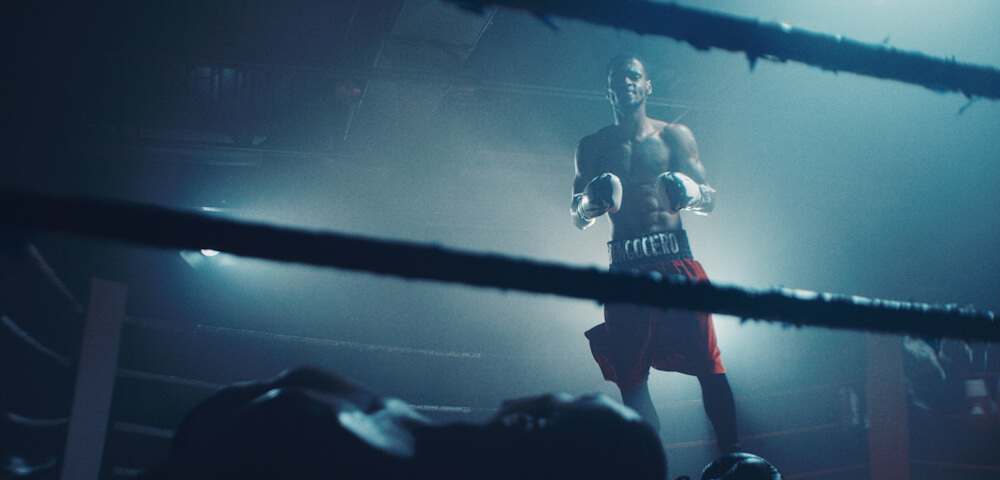
For ONE NIGHT ONLY, Spectacle is thrilled to host local filmmaker Brian Chu for a screening of his short documentary THE B-SIDE FIGHTER, alongside other works made within (and about) the neighborhood our theater calls home, the South Side of Williamsburg. Following the shorts program, Chu and his collaborator/subject Wesley “El Bongocero” Ferrer will hold a discussion with Antonio Reynoso, Council Member the 34th District.
THE B-SIDE FIGHTER
dir. Brian Chu, 2019
15 mins. United States.
In English, and Spanish with English subtitles.
The south side of Williamsburg (Brooklyn, NY) a neighborhood built on industry and hustle. From these streets emerges a young boxer named Wesley Ferrer, AKA “El Bongocero” because of his rhythmic punching style. Wesley was originally born in the Dominican Republic and moved to Brooklyn when he was a teenager. When his father Mateo took him to the boxing gym one day, he immediately saw his potential for greatness.
Wesley quickly worked his way through the amateurs and won the prestigious Golden Gloves tournament which started his professional boxing career. Alongside his father Mateo, who became his trainer, they held an undefeated record of 12-0 and continued to chase their dream of becoming a champion.
It’s been over a year since their last fight and this inactivity is tough on a boxer. Stuck in the politics of boxing, all they can do is continue to train and patiently wait for their next fight. Balancing the life of a professional athlete and being a kid living in Brooklyn pushes Wesley and Mateo to the edge of giving it all up. All they want is a chance to prove themselves in the ring.
This event is a collaboration with UnionDocs, WEREHAUS and the office of City Council Member Antonio Reynoso.

SATURDAY, DECEMBER 14 – 7:30 PM
ONE NIGHT ONLY! (This event is $10.)
Radical tape transfer collective XFR is back with another grab-bag of goodies from their summertime residency at the Leslie-Lohman Museum, Manhattan’s foremost collection of queer art and culture! These recently-digitized jewels were transferred from original materials provided by museum members, and offer a rare glimpse into the bygone world of queer home video culture.
From consciousness-raising protests to community-made PSAs and drag queen beauty contests, the films included in this program represent the equally radical and joyous past of LGBTQI filmmaking. Thanks to the technical whizzes at XFR, we can continue to exhibit these incredible films well into the future.
Members of XFR Collective and TBD guests will provide introductions, anecdotes, and contexts throughout the screening.
POETIC VISIONS / SHATTERED DREAMS REAL ART WORKS
dir. Carlos Gutierrez-Solana. 8 mins.
Gutierrez-Solana memorializes the friends and loved ones he has lost to the HIV/AIDS crisis through a performance art piece wherein he shatters large panes of glass while an audience looks on.
LESBIAN AVENGERS SKATE-IN
dir. Clarity Haynes. 14 mins.
Lesbian Avengers Skate In protest during the summer of 1993 in Fairfax, Virginia for greater visibility of lesbians in American culture.
GMHC DANCE-A-THON PSA
dir. David Mandel. 3 mins.
Produced by Gay Men’s Health Crisis Multimedia Department, this short PSA was created to help gay men become aware of how HIV/AIDS is spread and how to practice safe sex.
MISSFIRE ISLAND 1995
dir. David Mandel. 29 mins.
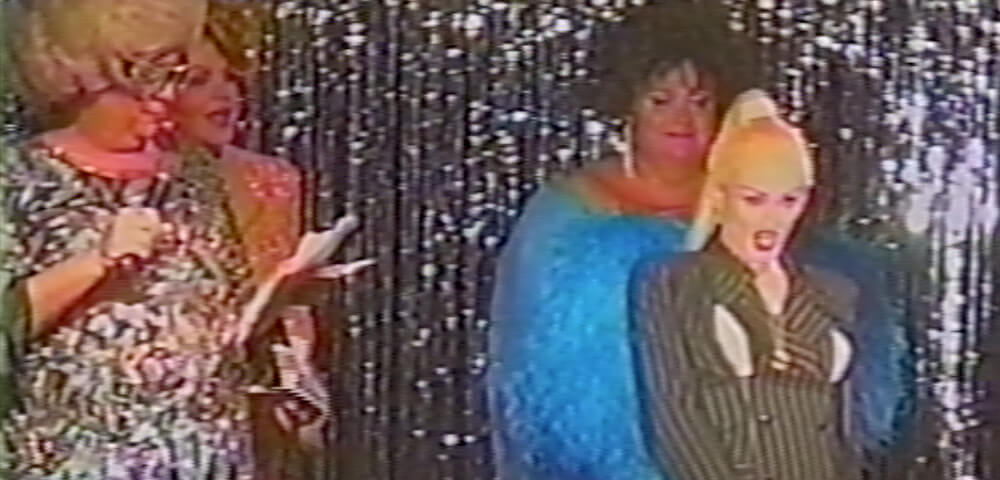
This is a drag competition that takes place yearly on Fire Island, called Miss Fire Island. Each of the many contestants are introduced on stage in front of a large audience.
ISLANDS IN THE STREAM
dir. Larry Krone. 5 mins.
Music video for the song made famous by Kenny Rogers and Dolly Parton.
INTERVIEW AND CLIPS FROM HOMO TEENS AIRED ON DYKE TV
dir. Joan Jubela. 7 mins.
Looking to capture a sense of what it is like to be an LGBTQ teen, filmmaker Joan Jubela offered cameras to New York City’s young people for them to capture their own lives. Jubela also interviews them about their experiences.
BLUE BATHROOM BLUES PRESENTATION
dir. Frederick Weston. 8 mins.
Weston presents poems and slides from his series Blue Bathroom Blues at the Neuberger Museum of Art for World AIDS Day, held in cooperation with Visual AIDS.

SUNDAY, DECEMBER 8 – 7:30 PM
ONE NIGHT ONLY!
(This event is $10.)
Spectacle is thrilled to host author and curator Raymond Foye as he presents a program of film rarities honoring the late poet and painter Bob Kaufman. Our feature is Will Combs’s recently restored HEARTBEAT (c 1978 b/w, digital transfer, 24 minutes) a film long out of circulation. About this work, the filmmaker has written:
“As a young film student immersed with the works of Godard and cinema verite’, Will Combs barged into the backyard of the remaining Beats in San Francisco’s North Beach in the mid 1970’s. Using surplus film stock and a spring-wind Bolex, he began to capture the temperament of the Era, kabuki style. HEARTBEAT features rare and personal footage of Bob Kaufman, Jack Micheline and Hube the Cube in their environment, infusing poetry with a concise inquiry into the Beat Era.”
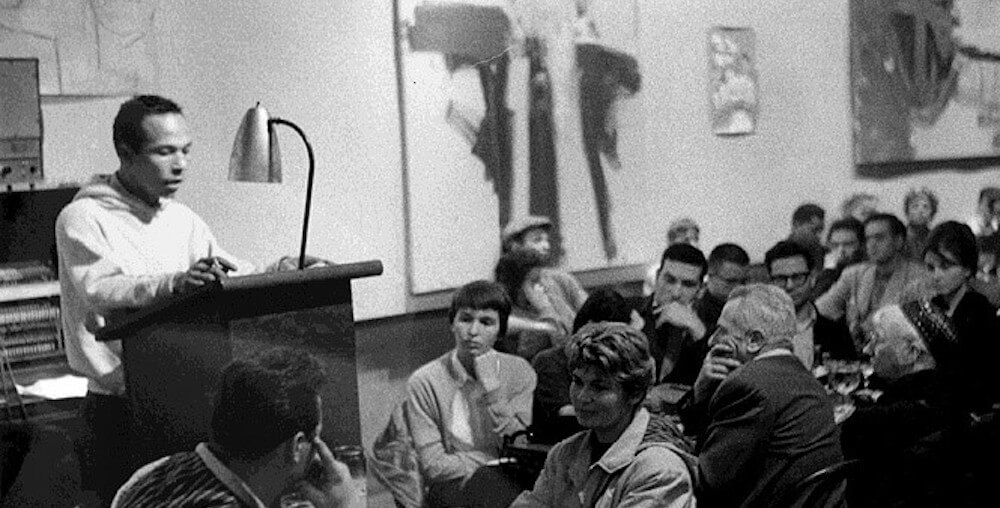
Also on the program are recently discovered and remastered film and video footage of Kaufman, including excerpts from his famed reading at Malvina’s Cafe in San Francisco on December 6, 1974, his first major reading since he broke a ten-year silence, and his 1979 reading with Philip Lamantia at the San Francisco Art Institute.
Poet and publisher Kaye McDonough will be present to discuss her friendship with Kaufman and read from her North Beach diaries from the 1970s and 80s.
This program celebrates the recent publication of the Collected Poems of Bob Kaufman by City Lights Books.
WILL COMBS, a renowned visual artist, maintains an active studio on Sonoma Mountain.
RAYMOND FOYE is a publisher, editor, writer and curator who has lived in New York’s Chelsea Hotel since 1979. He studied film with Stan Brakhage at the Art Institute of Chicago, and attended the San Francisco Art Institute. He worked as an editor at City Lights Books (The Unknown Poe, 1980) and New Directions (Bob Kaufman: The Ancient Rain, 1981). From 1990-1995 he was Director of Exhibitions and Publications at Gagosian Gallery, New York. Since 1995 he has independently organized dozens of art exhibitions worldwide, including the first gallery exhibitions of Allen Ginsberg’s photographs, and the art works of Harry Smith. He serves as literary executor for John Wieners, James Schuyler, and Rene Ricard.
KAYE MCDONOUGH was born in Pittsburgh and studied literature at Vassar College, and UC Berkeley where she earned her degree in Art History. She has an MFA from Sarah Lawrence Colelge. She is a poet and printer, who lived in the North Beach community for 20 years (1965- 85). She founded the Greenlight Press, devoted to fine letterpress editions including the classic Jack Micheline book Purple Submarine. She is the author of Pagan: Selected Poems (New Native Press, 2014) and Zelda: Frontier life in America (City Lights, 1978), she is currently working on a memoir: The Spell of Bohemia: Twenty Years in San Francisco’s North Beach 1965 – 1985.
BOB KAUFMAN was born in New Orleans, and had a career as a merchant seaman and labor organizer before turning up in San Francisco in 1957. He founded Beatitude magazine, while his books and broadsides were published by City Lights and New Directions. His defiant stance against police authority led to repeated beatings and incarcerations.

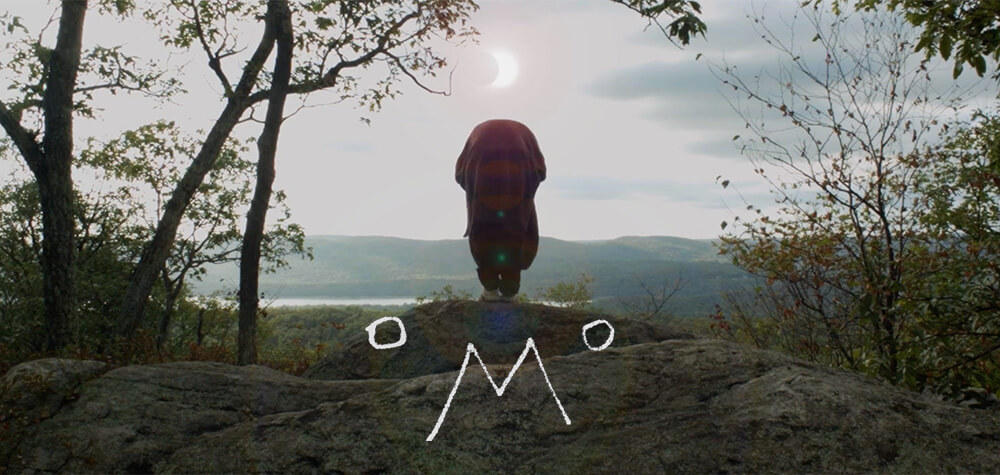
oMo
dirs. Carlos Arco & Peter Brensinger, 2019
United States. 35 mins.
In English.
SUNDAY, DECEMBER 15 – 5 PM
ONE NIGHT ONLY! WORLD PREMIERE with Carlos Arco & Peter Brensinger IN PERSON for Q&A!
(This event is $10.)
In pristine forests, families of cardboard boxes roam amidst fallen leaves. Plastic bags cavort through the air as garden hoses coil around branches to look on. A world absent of humans, or one in which our mundane things have outlived and succeeded us? But even in this sylvan idyll, something is very wrong. A corrupting influence has crept in and left a brutal mark among the stones of fallen empires. As an eclipse draws close, two beings from opposite sides of the land may hold the keys, but of redemption or destruction?
oMo shares its origins with that long lineage of highly independent fantasy micro-epics lovingly crafted and shot in woodlands and empty lots across America especially since the dawn of home video. But from the first moments of life granted inanimate objects through graceful puppeting, oMo diverges. Wisely shot without dialogue, exposition, or legible words of any kind, this is a quest by way of expansive landscapes and percussive ambient sound design, even the human cast conveying hints of an elaborate mythos only through expressive silent film pantomime. oMo is familiar yet mysterious, interspersed with moments of universal recognition among the beats of an alien progression, telling nothing while hinting at much much more.
On Tuesday December 3rd, we are pleased to welcome filmmaker Daniel Schmidt (DIAMANTINO) back to Spectacle for a special presentation of Kamal Amrohi’s MAHAL (1949) alongside James Kienitz Wilkins’ short film SPECIAL FEATURES (2014). The screening is part of a multi-venue series organized by Schmidt, with companion double features at Light Industry and Metrograph. Schmidt’s last visit to Spectacle was nearly four years ago, when he and filmmaker Alexander Carver presented João Pedro Rogrigues’ O FANTASMA alongside Pier Paolo Pasolini’s LE MURA DI SANA. Schmidt describes his latest series, ALIENATING RESURRECTIONS, as follows:
“There are few dreams I am able to recall years later. Dreams that persist, despite their inherent evanescence, outliving the very memories of waking life which scientists hypothesize they’ve been conjured to reinforce. Dreamy dreams – whose ornamentations are surely boring to anyone besides me. But I wonder if others share a similar grouping of remnants. They are united by their common inhabitants – intimate relations from my life who have departed from theirs. Here they are alive. The circumstances of their resuscitation are never clear, nor is it clear they ever died – but there is something deathly about them. While in life our relationships were often strong – my memories of them loving – in dreams it is the vitality of these relationships which are now paradoxically faded. Aunts who were like mothers, a mother who was like a best friend, a best friend who was like a lover – reappear defamiliarized, of uncertain allegiance – often aloof, sometimes possessed. They gravitate towards some second death, wounded in some obscure, unknowable way. Physically intact, yet spiritually wraithlike, their motives and sense of self are opaque to me and perhaps to them. Often, they seem like imposters who have forgotten the reason for their disguise. They are both alienated and alienating. I awaken similarly disoriented. Always mesmerized by the opportunity to be in their presence, but estranged by who they’ve become.
I do not experience lucid dreaming. I remain without awareness, and without capacity to make decisions. I only just learned you can train yourself to develop this talent – would be cool to try. For now, it is only in waking life that I can stray into such liminal realms. Namely while making and watching movies. Through these collaborative actions I find I am able to at least consciously participate and orient myself to the phenomena of dreams – and engage the elusive revenants within.
Here I’ve gathered eight films that have allowed just that. Films that explicitly and implicitly concern alienating resurrections. Most have at their centers – the emotional narratives of people who experience a sort of demise and a sort of revival. While some elaborate on their initial deaths – the central concern is of the problems and possibilities wrought by their rebirths – both for themselves and the living whom they encounter.
In contrast to predictable desires held by the undead populations of so many commodified fictions – the ghost seeking vengeance, the vampire seeking blood, the zombie seeking brains – these films are instead populated with phantoms who often lack direct motivations and are mired in existential confusion – perhaps seeking identity or freedom from it. They are lost amidst relatively earthly environments, usually in one or two simple locations, unburdened of the archetypal phantasmagoria. For some – like in my dreams – it is their personalities which are illusory. In the pop-sci lingo of oneirology their personalities are the “interobjects” – dreamed condensations of two unlike objects that could not occur in real life. The films’ shapes resonate around these characters with a generative ambiguity. Most, if not all, derive from this a vital sense of humor – ranging from mordant to whimsical, satirical to absurd.
Of course, this eight-starred constellation is merely a survey of a much larger, inexhaustible galaxy of art concerning such specters. Here, some personal favorites – four longer films by inspiring strangers, paired with four shorter films by inspiring friends. I feel each on their own and when grouped together exemplify what critic and programmer Dan Sullivan described as “cinema’s freedom to be a liquid medium—always something slightly other than what we think it is.” A freedom and flexibility that might stimulate similar openness to life and death, loosened from strict interpretations and the desire to define, while both awake and asleep.”
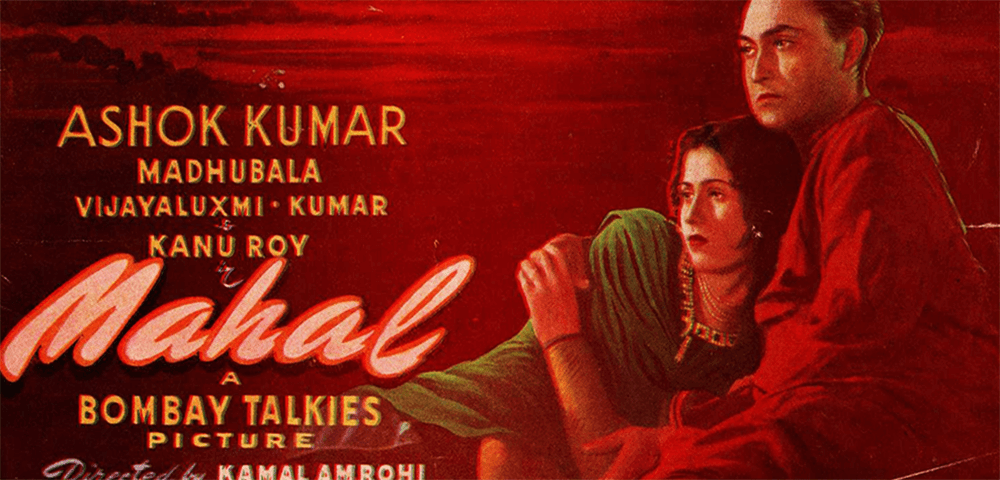
MAHAL
(THE MANSION)
dir. Kamal Amrohi, 1949
165 mins. India.
In Hindi and Urdu with English subtitles.
TUESDAY, DECEMBER 3 – 7 PM w/introduction from Daniel Schmidt
ONE NIGHT ONLY!
(This event is $10.)
A musical. An all-night metaphysical requiem. Hari Shankar, the son of a famous judge, arrives at a desolate mansion he purchased in a government auction and learns of its tragic past from a remaining servant. Thirty years prior, the estate’s original owner, an anonymous man of means, drowned in a flooded river while travelling back to home to his lover. With his final words he vowed to return to her in the next life. However, the lover, Kamini, soon after succumbed to the same fate – while searching the waters for him. Thereafter, Shankar discovers a portrait, presumably of the former proprietor, which bears a striking resemblance to his own. He readily conceives that he is the reincarnation of the drowned man – reborn to reunite with his lost love.
Profoundly disoriented – Shankar’s stunning interpretation evaporates moments later when he hears a woman’s voice wavering through his new home. Through a series of elusory encounters with the singer – he arrives a new belief: that she is the ghost of Kamini – and he, Shankar, is falling in love with her. She confides this is true, as is her undying love for him. To be united in the flesh – she proposes Shankar commit suicide and be reborn again with her. Then, fearing such a plan could fail, she suggests Shankar instead murder the servant’s daughter – so that she may inhabit the body for herself.
Who is reincarnated? Who is a ghost? And what might they carry from the past life to this one or into the next? To say more would give away the revelations best shared with these haunted protagonists. It might also overly emphasize the causality and chronology of a saga whose harmonic digressions are just as touching and touched by uncertainty and a longing to know and control.
In one such passage, the perspective shifts to that of Shankar’s unloved wife, Ranjana, via her written correspondence to her family. Within the letters she asks for counsel as she mournfully seeks to understand her husband’s despondence over the course of two unhappy years. Eventually, having learned of Kamini, Ranjana spies on her and Shankar. In a simple yet strikingly staged image – Ranjana eavesdrops by standing very close and very nearby their conversation, surely within view of their peripheral vision. Yet she remains unseen. Is this theatrical blocking or is Ranjana herself a ghost?
Vagueness permeates the world of MAHAL. There’s a lack of distinction between the infinite space of the mansion and a seeming eternity of twilight that surrounds it. The anonymous servants, who, as is customary, are reciprocally unaware of the wealthy identities of whom they serve; remain, often shrouded, to perform their roles in the mansion indefinitely. Obsession is the protagonist, ensnaring all in sinuous orbits. They spin, flickering between lonely oblivion and luminous passion, intersecting and then rushing apart again. A building and bodies, alternately possessed and forsaken.
MAHAL entranced its viewers as well – and was tremendously popular upon its initial release in India. An ouroboros film – it is also a provenance. Bollywood’s first gothic, and in a sense, first horror film. It was also strikingly the first Hindi film to feature ornate sets. As Amrohi’s directorial debut feature – he imagined someone beyond the famous performers of the day and cast Madhubala as Kamini in her first significant role, becoming an icon of sensitivity and tragedy at age 16.
Kamini, like the film, is mesmerically and ironically layered – at times authentic while veiled, at others chimeric while exposed. But amid these visions there was a second discovery – one of sound. Much as Shankar was first drawn to her ethereal singing, Mahal’s audiences, and the larger public who heard its songs on the radio – were drawn to this, unfamiliar voice – and insisted to know her identity. Bollywood relented and for the first time revealed the identity of a playback singer – it was Lata Mangeshkar. Thus began her 10,000+ career of recorded songs. Using nascent sonic techniques, Mangeshkar recorded a consonant, almost corporeal presence, within Madhubala’s Kamini. Standing in the corner of the studio, with the microphone in the center of the room – she moved towards it singing:
Time stands still,
The stars are silent,
The world is at rest.
Yet my heart is uneasy.
Suddenly, I hear footsteps nearing,
As though someone were
walking through my heart…
Most significantly, perhaps, MAHAL was the first Indian film to feature a reincarnation narrative. Fittingly, the film itself has been reincarnated many times over. One can see its dark reflection in remakes, homages and rip offs from Mumbai to the cinemas beyond. Woefully unrestored and underseen – it is at times lost, but now returns seeking old and new lovers with its melody of sound and image.
screening with
SPECIAL FEATURES
dir. James Kienitz Wilkins, 2014
12 mins. United States.

A GERMAN YOUTH
(UN JEUNESSE ALLEMANDE)
dir. Jean-Gabriel Périot, 2015
93 mins. France/Germany.
In German and French with English subtitles.
FRIDAY, DECEMBER 6 – 7:30 PM
SUNDAY, DECEMBER 8 – 5 PM
MONDAY, DECEMBER 9 – 7:30 PM
TUESDAY, DECEMBER 10 – 7:30 PM
TUESDAY, DECEMBER 10 – 10 PM
WEDNESDAY, DECEMBER 11 – 10 PM
THURSDAY, DECEMBER 12 – 10 PM
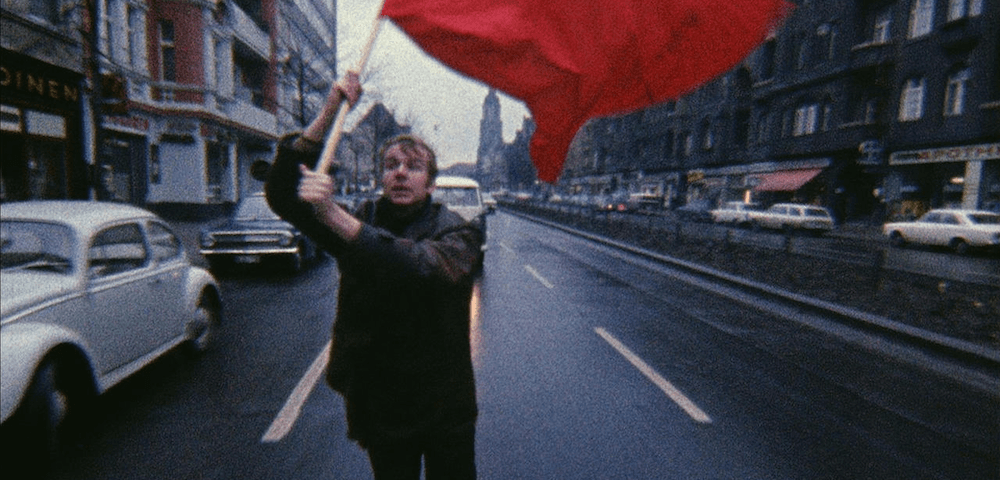
A GERMAN YOUTH chronicles the political radicalization of some German youth in the late 1960s that gave birth to the Red Army Faction (RAF), a German revolutionary terrorist group founded notably by Andreas Baader and Ulrike Meinhof. The film is entirely produced by editing preexisting visual and sound archives and aims to question viewers on the significance of this revolutionary movement during its time, as well as its resonance for today’s society.
A GERMAN YOUTH gathers its sources from three irreconcilable sides: the West German government, the RAF and the movie-makers of the time (including Godard, Fassbinder and Antonioni), as well as the images respectively produced by each. The story of the film is told in the present tense and chronologically, without retrospective excerpts, indeed exclusively through images that are contemporary with the events in the story. The connections between the characters as well as the story’s dramatic arc and flair are brought to life through the editing.
A GERMAN YOUTH is a real story of failures and fears. A story told through powerful, historical images. During the director’s research about the RAF, he watched over a thousand hours of archival footage.
“Exploring the rise and fall of the Baader-Meinhof Group (aka the Red Army Faction) through student movies, protest films, news broadcasts and other audio-visual records of the epoch, this densely layered documentary reveals how members of a disillusioned post-war generation gradually transformed into left-wing militants whose actions would have deadly consequences for all involved. Essential for anyone interested in cinema and politics…” – Jordan Mintzner, The Hollywood Reporter
“A GERMAN YOUTH presents the historical evidence and leaves the audience to form their own opinions and draw their own conclusions about how and why the Red Army Faction came to be and how and why they should be remembered. The answer differs depending on who you are and what beliefs you hold, and needless to say, it is not a simple one. And while A German Youth does not ask us to side with Andreas Baader, Ulrike Meinhof, Gudrun Ensslin, Holger Meins and the rest of the RAF, it does want us to understand them, and to learn from them.” – Lee Jutton, Film Inquiry
JEAN-GABRIEL PERIOT was born in France in 1974 and has directed several short films. Between documentary, animation and experimental films, most of his works deal with violence and history. A GERMAN YOUTH is his first feature.
Special thanks to Big World Pictures.

CALLING ALL LEFTISTS! The past few years have been a whirlwind: exhausting, invigorating, and ripe with potential. It’s tremendously difficult, when in the thick of it, to pause, reflect, or even find a moment to catch a breath. Especially when “it” refers to the rise of fascism on a global scale, with any number of future cataclysms hovering just over the horizon. But we digress.
Join us, then, for a series that asks: if not now, when? Come for great works of radical political filmmaking, stay for the generative discussions, or even just to gossip and gripe. The hope isthat this forum for authentic representations of successes, defeats, and the messy work of political action, will be thrilling, edifying, and maybe even inspire your next organizing project. To butcher the title of a great film for the sake of a moderately applicable pun: “Throw away your dogma, rally in the cinema.”

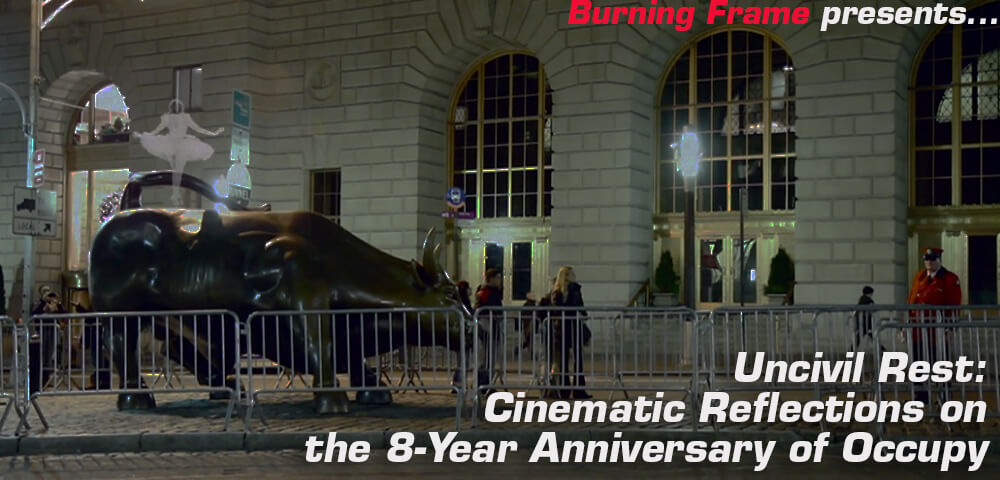
UNCIVIL REST: CINEMATIC REFLECTIONS ON THE 8-YEAR ANNIVERSARY OF OCCUPY WALL STREET
dir. Various, 2011-????
Approx. 90 mins.
THURSDAY, NOVEMBER 21 – 7:30 PM – ONE NIGHT ONLY!
ONLINE TICKETS FACEBOOK EVENT
The razing of Zuccotti Park – enacted by the state to quite literally squash Occupy Wall Street – succeeded in so far as the movement, whose nom de guerre was also its central organizing tactic, was constituted within and thus constrained by physical space. From its outset, however, Occupy had become something grander and more abstract than an assemblage of squatters in a park. It actualized as a vital experiment in new forms of organizing and orienting oneself in collective struggle. The state may have bulldozed the people’s bookstore, but the wisdom gained, and strategies tested, have informed the approach of activists throughout the decade – Occupy Sandy, Standing Rock, and Occupy ICE being but a few notable examples.
Crucial to its global impact were the people who recorded every step of the occupation: live streamers, documentarians, fine artists, and ordinary smartphone-owners. Burning Frame proudly presents a supercut of vivid imagery captured during Occupy Wall Street and its aftermath. After the screening, we will be joined by a panel of former Occupy organizers for a candid discussion on the successes, failures, and legacy of Occupy – with the expressed aim of answering the perennial question: “Where do we go from here?”