Despite his conception of the Gesamtkunstwerk (‘total work of art’), Richard Wagner died shortly before the inception of cinema, thus ensuring that any future Gesamtkunstwerks would have at least one more art form to potentially incorporate than he ever did. While many a film score’s use of leitmotifs would eventually grow out of his wake, cinematic adaptations of Wagner musikdramas (or, for that matter, any opera) are rarer on the ground. Attending the 150th anniversary of the Bayreuth Festival may be out of reach for most people reading this description, but Spectacle is pleased to offer a chance to see two rarely-screened Wagner kino adaptations. A one-time film director adapts the first mature Wagner work in Joachim Herz’s 1964 East German production of THE FLYING DUTCHMAN, and an arthouse legend adapts the last in Hans-Jürgen Syberberg’s 1982 West German production of PARSIFAL. Despite the contrasts, both utilize all the possibilities of cinema to create Gesamtkunstwerks for a post-Wagner world – right down to both needing to reckon with how his anti-Semitism had influenced the Nazis. Channel your inner Ludwig II and be a patron of Wagner’s arts this August at Spectacle.
Special thanks to Ruben Schwaben (DEFA Film Library) and Viviana Kammel (Filmgalerie 451).
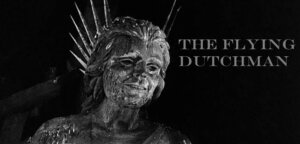
THE FLYING DUTCHMAN
(DER FLIEGENDE HOLLÄNDER)
Dir. Joachim Herz, 1964
East Germany. 101 min.
In German with English subtitles.
SATURDAY, AUGUST 8 – 5 PM
WEDNESDAY, AUGUST 12 – 7:30 PM
FRIDAY, AUGUST 21 – 7:30 PM
SATURDAY, AUGUST 29 – 10 PM
In order to escape her narrow and restrictive life, Senta, the daughter of a rich shipowner, seeks refuge in her fantasies and dreams. In this realm of imagination, a bold and restless sea captain appears to her—the Flying Dutchman—who is cursed to wander the seas forever. In her obsessive dreams, Senta frees this man through her love for him.
“The only East German film to include elements of horror and vampire genres, The Flying Dutchman was the first complete Wagner opera ever made on film. The script clearly separated the real from the imaginary; in the original 35mm format, this was reflected visually by changing the image size—from Academy ratio for reality, to wide-screen for fantasy. The film was produced with a groundbreaking 4-channel magnetic soundtrack.” – DEFA Film Library
“DEFA’s The Flying Dutchman is considered the first attempt to film a Wagner opera in its entirety, although, in point of fact, it too reworks the story to suit both the cinematic medium and the political viewpoint of the GDR. It was directed by opera director Joachim Herz, who, perhaps because it was his first (and only) film, opted to experiment with state-of-the-art sound and film techniques. Director Herz dramatically changes Wagner’s opera from one about a ghostly event to the reveries of a young woman named Senta who is infatuated with the story of the Flying Dutchman. To separate reality from Senta’s imagination, Mr. Herz uses two different film aspect ratios. Whenever we are watching Anna in the real world, the aspect ratio is [in 1.67:1]. When the film shifts to Senta’s dream world, the screen slowly opens up to the 2.35:1 dimensions of DEFA’s Totalvision (the same as Cinemascope). In other films that use multiple aspect ratios, the change in screen aspect is handled as edits, but Herz wanted these switches in perspective to flow like the film’s lush score. To do this required sophisticated in-camera techniques involving animation frames and an American Mitchell camera that accepted double reels. This process meant that everything had to be shot with the larger format while the animation frame was simultaneously running through the camera. That this worked at all is a testament to cinematographer Erich Gusko’s skill with a camera.” – Jim Morton
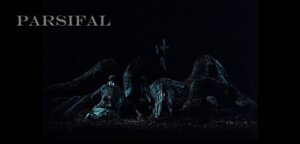
PARSIFAL
Dir. Hans-Jürgen Syberberg, 1982
West Germany, France. 245 min.
In German with English subtitles.
SATURDAY, AUGUST 29 – 5 PM
EVENT TICKETS ($5)
Please note that this film does NOT feature an intermission.
A psychological interpretation of the opera mixing in references to the history of Germany, Wagner’s life, German literature and philosophy. The action is centered on Wagner’s death mask. Syberberg’s version was made on the one hundredth anniversary of the opera’s first performance at Bayreuth in 1882. As in his earlier films, Syberberg shot his Parsifal completely in-studio.
“It’s as if Wagner’s hypnotic allure and Brecht’s intellectualized alienation have been somehow mystically united.” – John Rockwell
“Unlike the Ring or Der Meistersinger von Nürnberg, which were both gleefully embraced by the Nazi Party as expressions of good German nationalism, Parsifal already had a contended status among the upper-level Nazis: it was never “banned”-banned, but it was withheld from being produced at Bayreuth starting with the 1940 festival (that is, the first one after the outbreak of World War II), despite having been produced at the festival every year of the opera’s existence other than 1896. The obsession with Christology, the focus on spiritual and religious transcendence, and the embrace of non-violence and the rejection of earthly power all contributed to the opera being viewed with some suspicion by Nazi leadership, including, if we are to trust the word of Joseph Goebbels, Hitler himself. Which is perhaps part of why Syberberg picked it as the capstone to his ‘unwieldy epic-length cinematic dissections of Germany history’ project: the opera is in a paradoxical space, at once tainted by Nazism (as all Wagner operas pretty much have to be), and yet untainted by Nazism (because it was the one Wagner opera that made the Nazis nervous).” – Timothy Brayton