
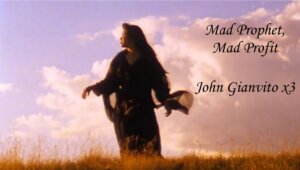
Boston-based filmmaker and former Harvard Film Archive curator John Gianvito had made a few films before the 20th century became the 21st, but he would wind up emerging as one of the definitive filmmakers of the current century during its first decade. His six years of work on Gulf War I cri de cœur The Mad Songs of Fernanda Hussein wound up serving as one of the definitive commentaries on the upcoming century when it premiered in 2001. Mad Songs served as a work of inadvertent commentary on the bloodlust spurred by the Twin Tower attacks, and the Gulf War II that was going to come about as a result. It was also a work of intensely personal cinephilia-inspired curation: Griffith- and Wyler-adjacent structuring of multiple war-at-home storylines was melded with archival footage and performance documentary, resulting in a bold and sprawling hybrid work. Despite fierce advocacy from notable champions in Chantal Akerman, Peter Watkins, Jonathan Rosenbaum, and Dennis Lim, it was not an easy film to see in 2001 and it has not gotten much easier since. He’d take another six years to make his next film, this time decidedly aimed at the domestic. Profit Motive and the Whispering Wind (2007) was a film whose more minimalist scale and running time didn’t reduce its power. Its simultaneously rousing and despairing analysis, courtesy of Howard Zinn, marked a turn towards a more domestic issue: how America eats its rabble rousers but leaves a tribute to them later. The groundwork laid by the champions of Mad Songs resulted in Profit Motive finding more of an audience, and it subsequently being named the Best Experimental Film of 2007 by the National Society of Film Critics.
Spectacle is pleased to present Gianvito’s two features of the 2000s in collaboration with Gianvito himself, who suggested a third title to accompany the present moment where America’s leaders are once again burning down the Middle East for money while punishing its own citizens for speaking up. The omnibus film Far From Afghanistan (2012), conceptualized and edited by Gianvito as a follow-up to the Chris Marker-led Far From Vietnam (1967), finds him and four other directors turning their attentions to the Afghanistan War during its peak years. The more things change, the more they stay the same.
Special thanks to John Gianvito, Mark Rance (Watchmaker Films), and Ryan Krivoshey/Kazu Watanabe (Grasshopper Film).
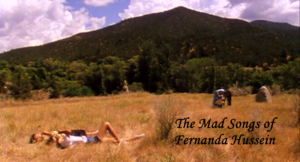
THE MAD SONGS OF FERNANDA HUSSEIN
Dir. John Gianvito, 2001
United States. 168 min.
In English.
TUESDAY, NOVEMBER 3 – 7 PM
SUNDAY, NOVEMBER 8 – 7:30 PM
SUNDAY, NOVEMBER 22 – 7:30 PM [$10 SPECIAL EVENT – John Gianvito post-film Q&A]
MONDAY, NOVEMBER 30 – 7 PM
Shot and largely set in the Santa Fe desert, three stories linked to the first Gulf War unfold: a Mexican-American mother with the married last name Hussein is persecuted for it, a young soldier who’s finished his tour of duty in the Gulf struggles to adjust back to civilian life, and a teenager begins to reckon with what’s going on abroad. Alongside these storylines are images of the Santa Fe desert, CNN and Pentagon propaganda, archival footage, images of war memorabilia, and concert footage of the Iraqi musician Naseer Shamma.
“By virtue of being nonprofessional, Gianvito is free to mix documentary with fiction, a love for silent cinema and landscape (he works as associate curator for the Harvard Film Archive, and also teaches — a fact reflected in his cameo in the film) with music (most notably, extended passages by Iraqi musician Naseer Shemma commemorating some of the war’s victims) and dialogue, a taste for blistering satire (in the remarkable sequence devoted to war toys) as well as convulsive and cathartic tragic lyricism (in the extraordinary final sequence, at once tribal and experimental in its poetic meditation on ritualistic violence). Ironically, with an almost Whitmanesque inclusiveness and restlessness, he can make me feel proud to be an American again.” – Jonathan Rosenbaum
“Six years and 13 credit cards in the making, John Gianvito’s The Mad Songs of Fernanda Hussein stands as a rebuke to the cost-benefit models that have come to dominate American independent filmmaking. After hearing first-hand accounts from students who had served in the Persian Gulf, Gianvito says he became ‘inarticulate with rage. I needed an outlet for that energy.’ In the summer of 1994, he drove to New Mexico with $17,000 in hand. He chose the location for the visual rhyme that the Southwestern deserts provided and for the state’s concentration of military bases, but also because ‘it apparently had a higher proportion of Gulf War veterans than any other state.’ He rented a room, made friends in the activist community, and wrote a script in two weeks. Principal photography stretched over two years and three trips from Cambridge. The cast was assembled from amateur theater troupe members and by approaching people in the street. The crew came together with the help of the local film commission: ‘Besides me, everyone behind the camera is from New Mexico.’”– Dennis Lim
“If I would have to write an article on THE MAD SONGS OF FERNANDA HUSSEIN, I would call it – The Silence and the Fury, or rather – the Silence and the Horror. What was for me the most striking and the most moving was the silence, the silence which leaves room to the other, to the spectator facing the muted horror, and then I wanted to say that silently we start to love this filmmaker, who doesn’t make any noise, a kind of “saint” I feel like saying. Someone who doesn’t calculate, doesn’t make any fuss, any effect and takes you by the hand to make you feel something with him. He says come, look, listen. And we do.” – Chantal Akerman
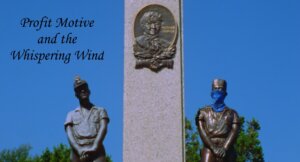
PROFIT MOTIVE AND THE WHISPERING WIND
Dir. John Gianvito, 2007
United States. 58 min.
No dialogue (English writing).
TUESDAY, NOVEMBER 3 – 10 PM
WEDNESDAY, NOVEMBER 11 – 10 PM
SUNDAY, NOVEMBER 22 – 5 PM
MONDAY, NOVEMBER 30 – 10 PM
A visual meditation on the progressive history of the United States as seen through cemeteries, historic plaques and markers. Inspired by Howard Zinn’s A People’s History of the United States.
“Let’s start with the title — a shotgun marriage between two omnipresent yet far from equally featured players in these unremarked, meditative spaces: an abstract impulse that supposedly keeps our American republic healthy and vital (while producing a lot of junk along with more helpful items) and a concrete force softly caresses everything in its path, keeping us alive and alert. More specifically, an encounter between the cause of many of the deaths that are being commemorated here — especially those relating to the genocide of Native Americans and many of the massacres occasioned by slave revolts and labor protests — and what D.W. Griffith lamented he found missing from modern cinema, the wind in the trees, found in the vicinity of most of the dozens of gravesites visited.” – Jonathan Rosenbaum
“Gianvito’s leftist vision is righteously ecumenical, encompassing Eugene V. Debs and Frank Little, Sojourner Truth and Malcolm X, Elizabeth Cady Stanton, Cesar Chavez, and many, many others whom mainstream historical accounts have buried far more comprehensively than their undertakers. In addition to forging a radical remapping of the American terrain, Gianvito’s film provides its audience with the rare opportunity to pay our respects by proxy. At a time when most attempts at political cinema result in the equivalent of hastily xeroxed leaflets, Gianvito has produced a document, one we will no doubt be examining for years to come.” – Michael Sicinski
“His camera is still, locked off in the spirit of James Benning, as he looks, testifying with the lens to the so little remembered sacrifices and struggles across the centuries. The steadiness of the gaze, and the silence of the acknowledgement, in the shadow of industrial parks, shopping centres and busy highways, only increases the sense of the lived and vocal histories being noted. When we are with the dead, we are quiet for a reason. We are with them to listen, to hear their voices raised, their feet on public asphalt, they who were not quiet, who did not sink beneath the waves without their song. And the fixity of the camera, against the fleeting business nearby, again acknowledges the endurance of their example.” – Gareth Evans
FAR FROM AFGHANISTAN
Dir. John Gianvito/Jon Jost/Soon-Mi Yoo/Minda Martin/Travis Wilkerson, 2012
United States. 129 min.
In English, and Pashto/Dari with English subtitles.
THURSDAY, NOVEMBER 5 – 7 PM
WEDNESDAY, NOVEMBER 11 – 7 PM
SUNDAY, NOVEMBER 15 – 5 PM
SATURDAY, NOVEMBER 28 – 5 PM
Five accomplished, politically progressive film-makers come together to raise the collective consciousness about the U.S. war in Afghanistan, officially the longest war in U.S. history. Inspired by the 1967 collaborative undertaking Loin du Vietnam [Far From Vietnam], Far from Afghanistan explores, through a mosaic of approaches, issues of shared responsibility, history and memory – all in a concerted effort to help accelerate political resistance to the war.
“When American filmmaker, programmer and teacher John Gianvito resolved to make a multivocal feature modelled after Loin du Vietnam last year, the war in Afghanistan was approaching its tenth anniversary, surpassing Vietnam as the longest overseas conflict in American history. Where Loin du Vietnam was a series of manifestos intended to place an array of perspectives on the war in dialogue with each other, Far from Afghanistan exposes a prevailing sense of individual alienation and helplessness in the face of a seemingly interminable war.
Gianvito’s opening segment ‘My Heart Swims in Blood’ contrasts scenes of American daily life with voiceovers reporting Afghan casualties and facts about the war. Jon Jost’s ‘Empire’s Cross’ unfolds wordlessly at first, with the familiar image of a plane crashing into a tower. Soon-Mi Yoo’s ‘Afghanistan: The Next Generation’ juxtaposes scenes of Afghans from American propaganda made during the Soviet invasion of Afghanistan with scenes of contemporary Afghan life. Minda Martin’s ‘The Long Distance Operator,’ Far from Afghanistan’s sole fictional narrative, shows two soldiers directing a bomber plane over Afghanistan from a control base in the States. Travis Wilkerson’s closing segment ‘Fragments of Dissolution,’ filmed in high-contrast black and white, listens to the stories of four American women: two relatives of soldiers who have committed suicide, and two relatives of victims of fires caused by illegal electricity hook-ups.” – Aaron Cutler & Mariana Shellard
“It’s central to Gianvito’s overall achievement to make and illustrate connections between diverse topics that are far from obvious; indeed, coping with disconnection — the Marker theme par excellence — is in many ways the driving force behind the film.” – Jonathan Rosenbaum
“…brilliant, poetic and cold as it should be. I was blown away by it, and by the relentlessness of its exploration.” – Fanny Howe