

While the brutal dictatorship and resulting censorship of the Philippines’ Ferdinand Marcos regime ought to have smothered the country’s film industry throughout the 1970s and 80s, it wound up producing what is now referred to as The Second Golden Age of Philippines Cinema. The country was lucky enough to have a libertarian-inclined censorship office head, and most of the boundary-pushing films of that era did well enough financially and critically to allow for the Marcos regime to accept a certain amount of cinematic criticism. Nevertheless, it still wouldn’t have been called a Golden Age without directors such as Lino Brocka, Kidlat Tahimik, and Mike De Leon all managing to push boundaries via their own forms of melodrama, docufiction, social realism, and more.
Despite being considered the second-most important Filipino director after Brocka in his home country, the work of Second Golden Age director Ishmael Bernal has not been screened as often abroad in recent years, in part due to print scarcity. Notorious for his sharp wit, the openly gay Bernal was a subversive ironist and a committed feminist. His films frequently used the roles of women to skewer what he saw as a sick society under the Marcos regime, best summed up by a line from his provocatively-titled essay Why The Martial Law Will Affect Your Sex Life: “Here we are, being practically ruled by a stranger who shall parade the chills and fevers of his ego and what are we going to do about it? We are going to be gripped by hysteria, that’s what.” This attitude culminated in the consensus pick for his masterpiece, Himala (1982), a study of the blind faith of the Philippines and the grip of hysteria that comes with it – it has only been vindicated with the country’s election of another Ferdinand Marcos to the Presidency. Bernal has subsequently remained a touchstone for the two key figures from the subsequent Third Golden Age: Spectacle favorites Lav Diaz and Raya Martin.
Spectacle is pleased to announce a partial retrospective of some of Bernal’s best-known work from the heart of the Second Golden Age, showing in rarely-screened 2K/4K restorations to allow for a new appreciation of why Bernal’s contributions to Filipino cinema are considered some of the country’s boldest and best.
Special thanks to Thellie Castro-Palanisamy & Cathrina Lim-Achacoso (ABS-CBN).
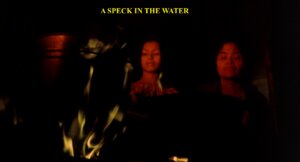
A SPECK IN THE WATER
(NUNAL SA TUBIG)
Dir. Ishmael Bernal, 1976.
Philippines. 118 min.
In Tagalog with English subtitles.
THURSDAY, SEPTEMBER 3 – 7:30 PM
SATURDAY, SEPTEMBER 19 – 10 PM [w/ intro]
FRIDAY, SEPTEMBER 25 – 5 PM
SPECIAL INTRO by filmmaker Isabel Sandoval (Lingua Franca, Moonglow) on September 19th!
This film has hardcoded Japanese subtitles due to the 2K restoration being based off the sole extant 35mm print.
In the impoverished village of Santa Fe, some investors capitalize on fish pens growing bangus (milkfish) under the care of Mang Pedro (Ruben Rustia). But for some mysterious reason, the fish are dying. To save the situation, they decide to salt the fish and dry them under the sun. Benjamin (George Estregan), who owns a boat that shuttles passengers to town, has a regular passenger Chedeng (Daria Ramirez), who is going to be a midwife soon. Chedeng has a close friend and neighbor, Maria (Elizabeth Oropesa), but unknown to each other, they are both having an affair with Benjamin. When Maria becomes pregnant, she becomes Chedeng’s first patient and a disastrous situation that ends in tragedy ensues.
“A Speck in the Water reappears as one of the most personal early works by Bernal, when he was most assured and daring in his innovative style. Today, it looks like a forgotten masterpiece, but at the time of release, the film was very unevenly received by local film critics. Some of them said it was ‘un-Filipino,’ and even [that it looked] ‘French!’ However, as one sharp critic, Hernando, wrote: ‘Nunal sa Tubig is so well crafted, complex, sharp, and to a certain degree, abstruse, that the film requires complete concentration and openness to a new film concept, and, whenever necessary, a willingness to see it again.’” – Max Tessier
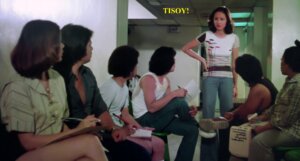
TISOY!
Dir. Ishmael Bernal, 1977.
Philippines. 120 min.
In Tagalog with English subtitles.
FRIDAY, SEPTEMBER 4 – MIDNIGHT
WEDNESDAY, SEPTEMBER 9 – 7:30 PM
SATURDAY, SEPTEMBER 19 – 7:30 PM
Based on a popular comic strip by Nonoy Marcelo, Tisoy (Christopher de Leon) is a bohemian balikbayan [Filipino term for repatriate] searching for his father. He gets help from his friends as they scour the immaculately clean Metro Manila as well as reunite him with his high-school sweetheart.
“Bernal, taking a momentary step away from the melodramas he specialized in, used [the comics] to create a story full of gags, hidden social metaphors, and meta-jokes. To say that Tisoy! is as straightforward narratively as the synopsis makes it seem would be a lie. It’s a mosaic of stories and characters which, despite being connected to one another, would be able to stand strongly on their own. Above all, Tisoy! is a satire made during the time of martial law. When cinema served as a tool against the government, Bernal used it to not only criticize the situation – fancy menu items while most of the country was impoverished due to the rapid urbanization, or streets that apparently weren’t as clean as he portrayed them – but also to mock other films made during that time.” – Magdalena Nieświec
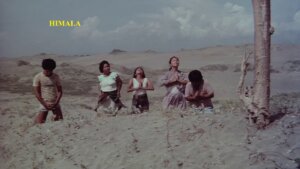
HIMALA
(MIRACLE)
Dir. Ishmael Bernal, 1982.
Philippines. 124 min.
In Tagalog with English subtitles.
SUNDAY, SEPTEMBER 6 – 5 PM
SATURDAY, SEPTEMBER 12 – 10 PM
TUESDAY, SEPTEMBER 22 – 7:30 PM
When plain orphan Elsa (Nora Aunor) begins having visions of the Virgin Mary, the rest of the residents of her isolated village find themselves questioning their own beliefs and values. Soon, Elsa is healing people with a variety of ailments. As word of this phenomenon spreads, tourists, pilgrims, patients and a documentary filmmaker all arrive on a quest to partake in the miracle.
“Bernal himself described the film as ‘…not just the story of a couple of characters. It is also the story of a society. And that is Himala. What I show in Himala is the picture of a society that is ill. A society which has no recourse but to cling to apparitions and miracles. It is not important if there really was a miracle or not. What is important is the need of a people to believe.’” – ABS-CBN
“Web site users voted to award the late Filipino director Ishmael Bernal’s film the top prize in the CNN APSA Viewers Choice Award for Best Asia-Pacific Film of All Time, edging Akira Kurosawa’s acknowledged classic Seven Samurai into second place.” – Fei Phoon