As the second installation of our occasional series DECADES OF DEBRIS (formerly known as BENJI’S WORLD), Spectacle is thrilled to collaborate with our longtime partners at Screen Slate to host a one-day marathon of fist-and-face-blending action works helmed by the still-mysterious mononymous Indonesian director known as ARIZAL.
The original “HOT BLOODED: THE ARIZAL MARATHON” took place in August 2012, in conjunction with Spectacle’s first-and-last-ever SUMMER OF SHRAPNEL – an entire month of action cinema from around the world programmed in a doomed bid at offsetting the dog days of late summer. To commemorate the tenth anniversary of the filmmaker’s untimely passing in May 2014, HOT BLOODED is back, with a few new VHS transfers.
With over 50 features and eight television series (“sinetron”) to his credit between 1974 and 2006, Arizal is is rightly described by his English Wikipedia page as “one of Indonesian most productive film director and script writer;” and yet these six films dated between 1981 and 1989 are the only ones classified as “Action” films on the IMDb (which lists one under two different titles for an incorrect total of seven movies). If Arizal is an obscure figure outside North America, it’s not difficult to imagine why—each of these features individually puts the entire western action film canon to shame. Suppression is an obvious motive.
Arizal is, if nothing else, the Monet of cars spewing fire from their trunks barrelling nose-first, upside-down into other exploding vehicles while Anglo heroes arc through the flames like star-spangled ropes of jism spewing bullets from a musclebike. The kind of artist who suicide-launches a flaming oil tanker into the helicopter of logic and reason, Arizal is on a sobering quest to unabashedly deliver every dashed promise all other action filmmakers have made. He is a steel-toothed, Rube Goldbergian idea factory of prurient bloodlust, pyromania and righteous acrobatic vengeance. If 10-year-old boys’ lewdest fantasies didn’t already exist, Arizal would have invented them.
EACH OF THESE FILMS stars a uniquely charismatic Anglo leading male, none of whom anyone would have ever heard of if AMERICAN HUNTER’s Christopher Mitchum had not run unsuccessfully for California’s 24 congressional district house seat back in 2012. And yet with the exception of THE STABILIZER, and just months ago SPECIAL SILENCERS, none of these films are available for retail in North America, and scantly available via private file sharing networks; when we last hosted this retrospective they could only be seen through carefully circulated choice bootleg distribution of decades-old Dutch, Greek and Japanese VHS releases.
Thanks to Screen Slate, Spectacle has obtained the highest quality sources available, and we take great pride in having procured all works with their original English dubbing.
TO BURN THE SUN
(MEMBAKAR MATAHARI)
dir. Arizal, 1981
90 mins. Indonesia.
In dubbed English.
SATURDAY, JUNE 15 – 1 PM
GET YOUR TICKETS!
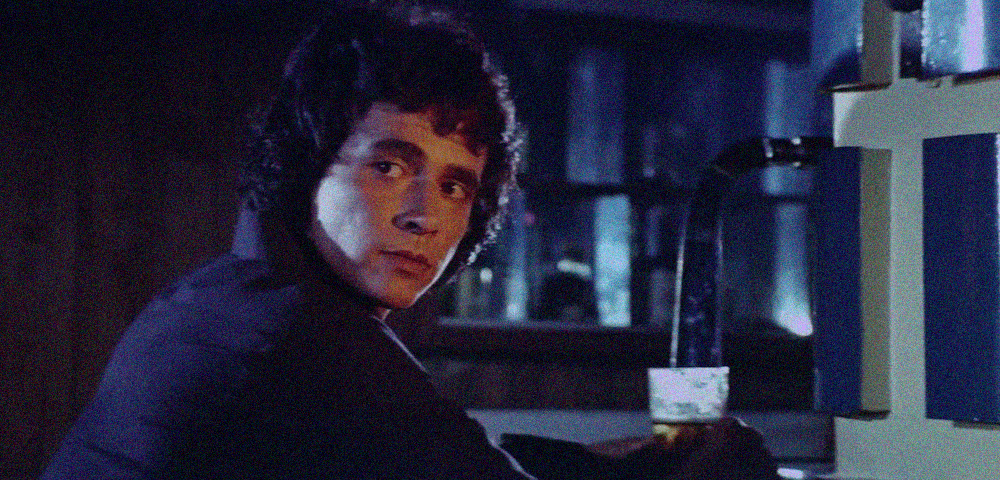
The first of over a dozen collaborations between Dutch-Indonesian martial arts star Barry Prima (THE WARRIOR) and the lovely Eva Arnaz (THE WARRIOR), TO BURN THE SUN is the most hand-to-hand-combat intensive film in the Arizal canon. Arnaz is the film’s true protagonist—a young woman whose village was raided by bandits that stole her innocence and slaughtered her family. She was forced into a life of prostitution in capital city Jarkata, which is where Prima spies her escorting a customer in a night club. The two had been lovers once, and with this chance meeting they make arrangements to elope and return home. Naturally, this unsettles her pimp, whose thugs land Prima in the hospital (but not without an epic fight). Arnaz flees to her village, where her grandfather schools her in the deadly art of karate. With a newfound confidence and deadly resolve, she sets her sights on vengeance.
TO BURN THE SUN is without a doubt the most obscure item in Arizal’s catalog, and one that plays most directly to classic exploitation tropes. Arnaz’s performance suggests Meiko Kaji (LADY SNOWBLOOD, the FEMALE CONVICT SCORPION series), and she and Prima share a unique chemistry developed even further in SPECIAL SILENCERS and budded offscreen into a full-fledged marriage. The soundtrack is aided by some decidedly rockin’ Asian-tinged electrofunk rock.
DOUBLE CROSSER
(MEMBAKAR LINGKARAN API)
(aka CROCODILE CAGE)
dir. Arizal, 1989
84 mins. Indonesia.
In dubbed English.
SATURDAY, JUNE 15 – 2:45 PM
GET YOUR TICKETS!
“The richer you get, the crazier your ideas become…”
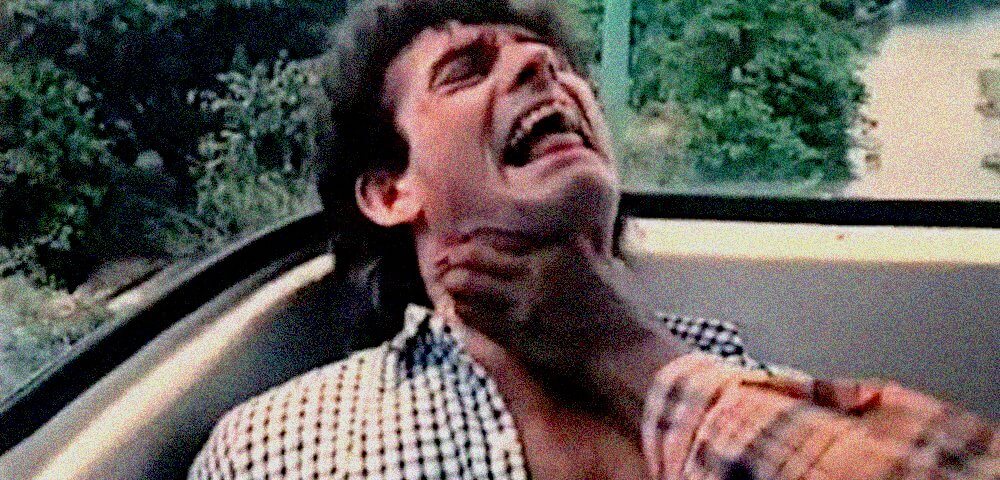
Arizal, star Peter O’Brian and scriptwriter Deddy Armand reteam several years after THE STABILIZER for their final and most intricately-plotted film. O’Brian stars as Jack, an ex-P.I. widower and amateur boxer who has hit upon hard times after being discharged from his latest job. He keeps close companionship with his brother-in-law, Leo, who helps Jack look after his blind daughter. But when a nefarious French villain—whose dubbing would pass for a fine Maurice Chevalier parody—insists they fight each other in an illegal boxing match, he’ll stop at nothing to make it happen. First he tries kidnapping Jack’s daughter, but when that doesn’t work, he hits upon a new scheme to wedge them apart… Might the stunning young woman whom Jack rescues from an apparently impromptu attempted gang rape (after an epic car chase) have something to do with it?
In any case, it’s eventually up to Jack to steal a small airplane and fly it into the side of a mountain after making a last-second dive onto a speeding pickup truck, which he then hijacks, to save his daughter from a second kidnapping before she’s released from a diabolical device which will drop her into a cage of bloodthirsty crocodiles. Other highlights include a saccharinely sweet date montage suddenly interrupted by a random attack on the ferris wheel and countless close-ups of O’Brian’s chiseled visage, delicately framed by his fluffy mullet, as it makes subtle twitches to indicate the rage bubbling beneath his cool surface.
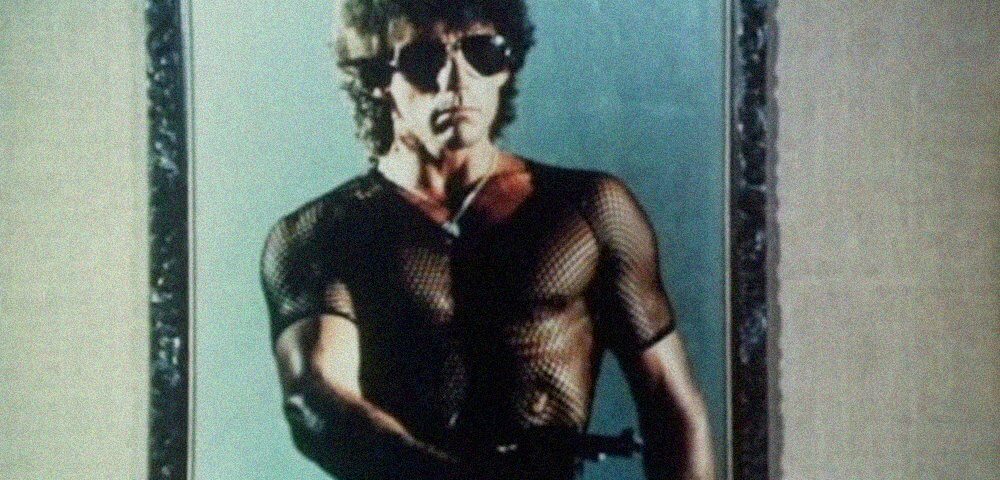
THE STABILIZER
dir. Arizal, 1984
94 mins. Indonesia.
In dubbed English.
SATURDAY, JUNE 15 – 4:30 PM
GET YOUR TICKETS!
“Listen, Debbie, we’re dealing with Big Leaguers here: the world’s best criminals, who are completely capable of upsetting the balance between Good and Evil. As impossible as it seems, what we need is a man with the guts and the ability to restore the balance…”
Justly considered Arizal’s masterpiece, THE STABILIZER is, by the filmmaker’s standards, a sprawling, prismatic exhibition of picaresque high-octane adventure and squad-driven justice. In his signature role, feather-mulleted Peter O’Brian—variously described as an FBI agent and American cop—leads a colorful task force of special agents in the crusade against diabolical drug smuggler Greg Rainmaker. He’s after a rumored device known as the “Narcotics Detector” for the purpose of planting drugs on his competition. Just how the device will further this purpose, or the lapse of logic in the plan owing to his targets likely, as drug smugglers, already having drugs on their person, is not clarified; nor does this justify it being incommensurately pitched as a decisive battle between the forces of Good and Evil.
In any case, O’Brian’s Peter Goldson has a decidedly personal stake in the mission, as Rainmaker had previously ravaged Goldson’s fiancée and stomped her to death with his spike-soled derby shoes. Ditto the beautiful and deadly Christina Provost, whose father invented the Narcotics Detector and is being held captive by Rainmaker. Their team is mirrored by an equally distinct lineup of opposing henchmen including a man who eats live baby alligators—animals were definitely harmed during the making of this film—and an Asian Mr. T. The lengthy drug barn raid sequence, which begins with Goldson bursting through the wall Kool-Aid Man style on the back of a motorcycle, doing donuts in a pile of cocaine, and throttling off a balcony plunging his front tire directly into a random bad guy’s head, is a cinematic tour de force—and it only anticipates the later, greater drug warehouse raid sequence. Featuring the would-be hit punch-dance ballad “The Stabilizer.”
SPECIAL SILENCERS
(SERBUAN HALILINTAR)
dir. Arizal, 1982
86 mins. In dubbed English.
Indonesia.
SATURDAY, JUNE 15 – 6:45 PM
GET YOUR TICKETS!
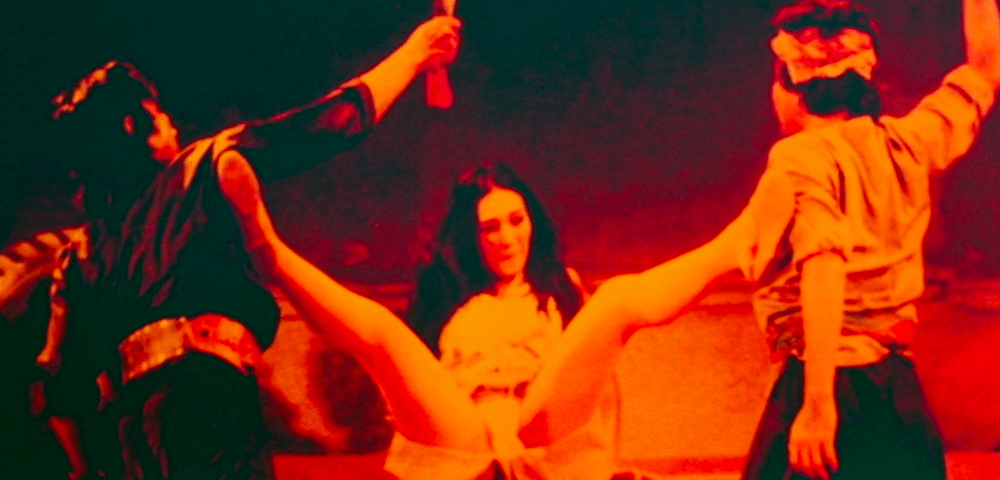
When a greedy, power-hungry magician decides to assassinate the beloved village mayor to seize his political seat and glean his riches, he’s not content to simply dispatch a knife-wielding killer; rather, he slips the mayor one of his “Special Silencers,” a small tablet which causes an orgiastic gaggle of tree branches to burst forth from its victim’s stomach with a torrent of blood and entrails streaming from their surcles. The same treatment goes to the mayor’s brother, an out-of-town police officer en route to ensure his family’s safety, but his daughter Eva Arnaz escapes—and just happens to cross paths with Dutch-Indonesian exploitation stalwart and champion martial artist Barry Prima. He may be a simple, kind-hearted drifter—or perhaps a police spy. The pair fight off legions of assassins and silencers are dispersed like razor-bladed candy while the heroes work to uncover the identity of their puckish antagonist.
Remember the never-ending torrent of blood in the possessed hand scene of EVIL DEAD 2? In SPECIAL SILENCERS, a simple papercut is occasion enough for Arizal to turn on the waterworks, and it’s not merely the insane, Cronenbergian special effects—which seemingly anticipate The Thing and happen to have appeared within weeks of Alien—that occasion geysers of gore, but even more so the rough-and-tumble physical fights and alarmingly dangerous-looking stunts. Which is to say, this isn’t so much an “action-horror” hybrid as a brute-force action extravaganza in which gnarled tree branches periodically explode out of people’s stomachs in spectacularly violent ways.
FINAL SCORE
(aka STRIKE COMMANDO)
(aka ELEGY OF A MASSACRE)
(aka AN ARMY OF ONE)
Dir. Arizal, 1986
88 mins. Indonesia.
In dubbed English.
SATURDAY, JUNE 15 – 8:30 PM
GET YOUR TICKETS!
“We can do this the easy way, or I can carve what I want out of you piece-by-piece…”
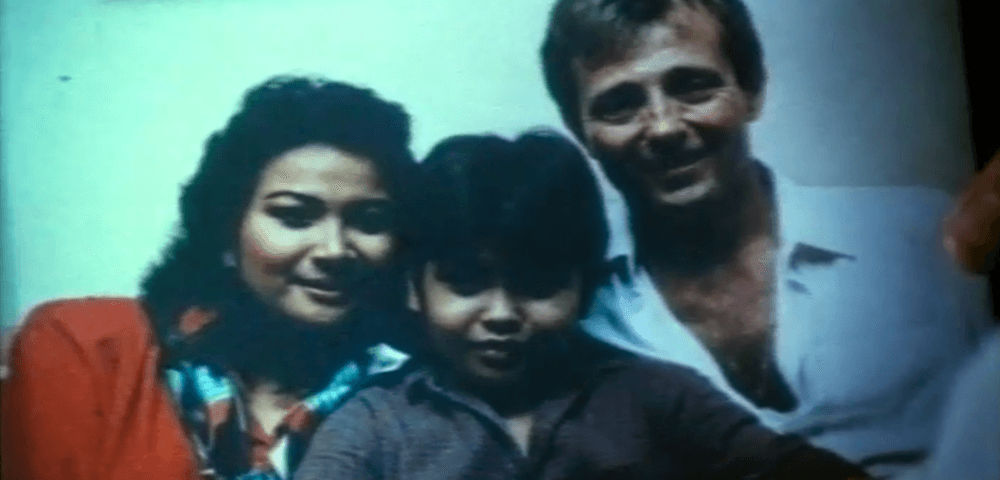
Christopher Mitchum is Richard Brown, a decorated Vietnam Vet who’s settled into an idyllic family life in Southeast Asia while forging his trade in the computer business. Unfortunately, ultra baddie Donovan Hawk—played by meaty Godfrey Ho regular Mike Abbott—has his own ideas about turning Indonesia into “Silicon Valley 2” and making a lucrative grab in the tech market while using it as a front for his illegal operations. When Brown rebuffs his buyout offer, Hawk dispatches his thugs to slaughter Brown’s wife and child on the boy’s 8th birthday. Now fraught with ‘Nam flashbacks, Brown straps up to settle the FINAL SCORE. He makes an unlikely ally in the form of a beautiful ninja who has insinuated herself as Hawk’s secretary in order to wreak her own revenge over a sister who was forced into prostitution, hooked on drugs and left to die on Hawk’s watch.
This setup is what qualifies as a “pot-boiling slow-burn” in the world of Arizal, and for the majority it’s one of his grimmest films—a stealthy guerilla DEATH WISH in the jungle. But once it kicks into high gear, it’s a never-ending string of some of Arizal’s most insane set pieces, including an epic, logic-and-continuity-defying car chase and a 20-minute climactic moto-massacre with Mitchum throttling a missile-launching dirt bike while blowing up multiple entire houses, not to mention jeeps and people. The final gun-mounted motorcycle vs. gun-mounted helicopter shootout is rad as shit.
AMERICAN HUNTER
(aka LETHAL HUNTER)
dir. Arizal, 1988
92 mins. In dubbed English. Indonesia.
SATURDAY, JUNE 15 – 10 PM
GET YOUR TICKETS!
“With the information in this study, the wrong people could start a panic on Wall Street that would bring the Western World to its knees…”
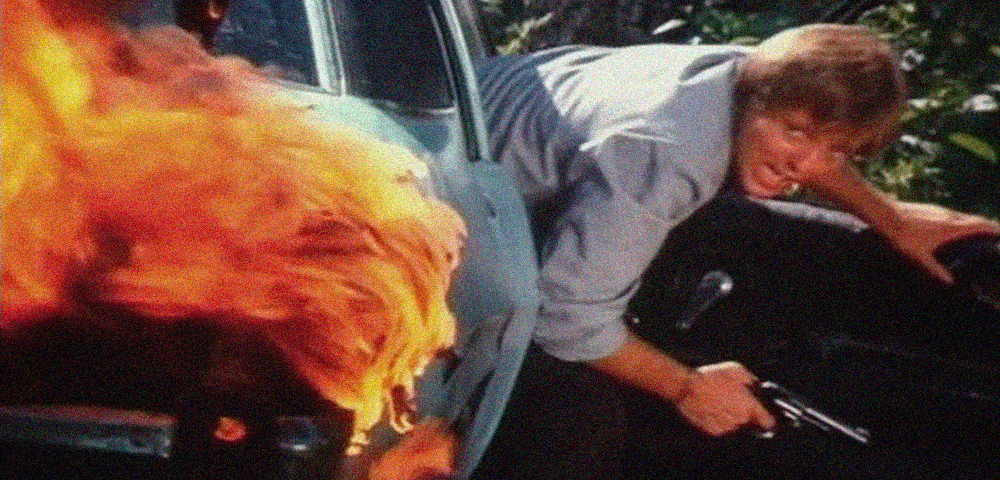
Christopher Mitchum returns for what might be the purest expression of Arizal’s shoot-’em-up aesthetic as Jake Carver, an “agent” whose self-described occupation is to “fight bad guys.” In AMERICAN HUNTER, Carver battles a multifariously evil organization over a piece of microfilm to unspecified ends. Highlights include a jeep driving off the side of one skyscraper into the window of another, a three-way motorcycle/pick-up truck/train chase, a baby being run over by a car crashing through the side of a supermarket yet miraculously surviving, an eight minute helicopter chase, an awkwardly clothed shower sex scene, one house explosion, one castle explosion, dozens of car explosions, male bondage and electrocution, and a fist fight inside a dungeon full of what appears to be cardboard boxes overflowing with shredded paper. Bill “Super Foot” Wallace stars as the bad guy whose nefariousness is conveyed through his variously keeping pet falcons and monkeys on his shoulder, and Peter O’Brian drops in for an unlikely hench villain turn as a businessman who gets the shit kicked out of him then has his legs run over then crashes through a brick wall on the hood of a car. Approximately ten of the 92 action-packed minutes have been described.