
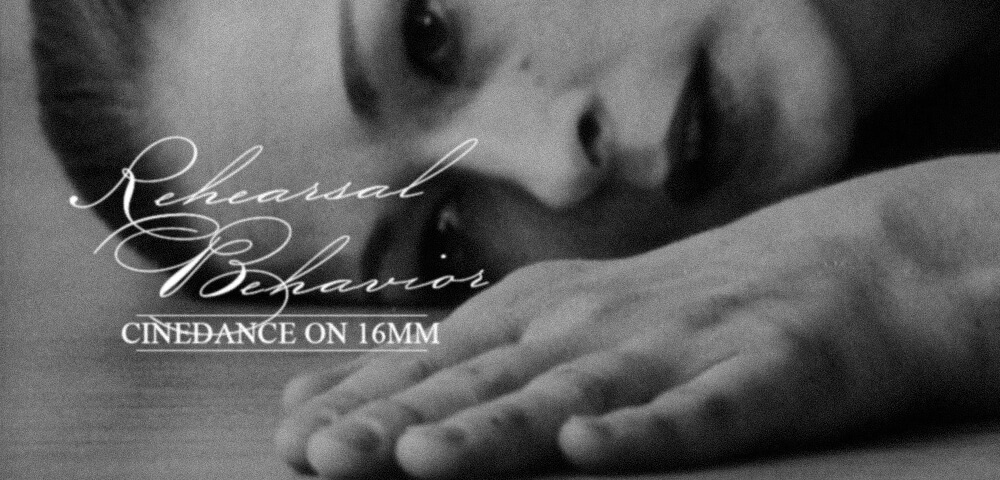
Rehearsal Behavior is a screening series tracing a capacious lineage of choreographic moving-image works: From the dance-for-film pioneers of the 1940s–60s, to experimental video of the late 1970s, ’80s, and ’90s, to contemporary acts of self-expression through direct camera performance.
This screening presents an interrelated grouping of foundational 16mm Cinedance experiments spanning from 1941 to 1973. Featured artists inspire, reference, and collaborate with one another, evidencing the accumulative effect of intergenerational exchange on the lineage of this hybrid form.
Rehearsal Behavior takes its title from a phrase of Rainer’s own coining as a choreographer in the early ‘70s. The phrase juxtaposed the generative looseness of the rehearsal space with the staunch hierarchy of directed live performance, as dancers’ spontaneous responses deliberately reshaped the work and, in the process, pushed toward a more democratic social structure.
Rehearsal Behavior runs from September 18-21. This screening at Spectacle, guest programmed by Charlotte Strange and Andrea Torres, is complemented by two screenings at e-flux (9/17, 7:00pm and 9/19, 3:00pm), and other venues to be announced.
SUNDAY, SEPTEMBER 20 – 7:30 PM
INTROSPECTION
Dir. Sara Kathryn Arledge, 1941-46
United States. 6 min.
16mm
Commonly described as the first abstract dance film made in the United States, Introspection depicts layered fragments of dancers’ bodies as they move in a void-like, black performance space. Arledge was a talented abstract painter and illustrator as well as filmmaker; the artist uses her camera, production techniques including color gels, and editing to abstract the dancers’ figures, treating them as compositional elements within the moving frame. Of her approach to filmmaking, Arledge said: “My plan was to extend the nature of painting to include time.” Production on Introspection paused while most of the crew was drafted during World War II, finally completed after the war’s formal conclusion.
NINE VARIATIONS ON A DANCE THEME
Dir. Hilary Harris, 1967
United States. 13 min.
16mm
Harris deftly wields his camera to depict dancer Bettie de Jong, a longtime member of the Paul Taylor Dance Company, repeatedly performing a single dance movement. Slow pan shots encircle de Jong’s body as she spins from a standing position to the floor and back, generating an intimate view of her performance accessible by camera alone. Harris and de Jong shot the piece across twenty-five filming sessions over the course of one year, reflective of Harris’s expertise as an early innovator of time-lapse photography. A documentary filmmaker by trade, Harris collaborated with Amy Greenfield as a cinematographer on numerous pieces including Element (1973) and Tides (1982).
ELEMENT
Dir. Amy Greenfield, 1973
United States. 12 min.
16mm
In Element, dancer, choreographer, and filmmaker Amy Greenfield performs undulating movements in a bed of clay-like mud. The piece represents an early iteration of Greenfield’s filmic and choreographic investigations into the entanglements between womanhood, the human form, and nature, which would develop throughout her career. The mud at once highlights the contours of Greenfield’s figure as protruding areas glisten in the sun, and at other points makes her body indistinguishable from its surroundings. Greenfield’s choreography accentuates the physicality of the mud, displaying a powerful sensuality while treating the landscape as an animate dance partner. Avoiding purely romantic notions of the power of nature, Element hints at the capacity of ecological forces to enact violence while taking up the mantle of representing a woman’s body in pleasure and struggle. Element is the cinematic counterpart of Greenfield’s later work Tides (1982), also filmed by Hilary Harris, which draws from Maya Deren’s script for the unfilmed passages of Ritual in Transfigured Time (1946).
RITUAL IN TRANSFIGURED TIME
Dir. Maya Deren, 1946
United States. 15 min.
16mm
Like much of Deren’s work, Ritual in Transfigured Time meditates on the temporality of movement. Dancer Rita Christiani drifts into an apartment where Maya Deren winds wool around her hands as the film’s innovative editing slows the gesture into something incantatory. While Anaïs Nin looks on from the doorway, Christiani gathers the yarn into a ball, until, with a gust of wind, Deren vanishes. At a crowded party, frames freeze and shots recur in hypnotic repetition as Christiani, veiled in black, threads her way past a beckoning crowd until she embraces Frank Westbrook. Outdoors, amongst a garden’s Greco-Roman ruins and statues and blue skies, they dance. He begins chasing her in leaping strides, then her as Deren, until he catches her. Deren wades into the sea as the film dissolves into negative, transfiguring the black mourning veil into bridal white.
For Deren, ritual and dance were one and the same, each seeking the realization of its purpose through the exercise of form. Dreamlike and foreboding, Deren stages a meditation on control and surrender, on what she called the “deference of personality in possessed states of being.”