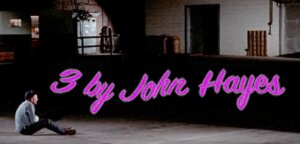
Born into a working-class Irish-American family in New York, John Hayes’ career in movies began auspiciously with the short film “The Kiss” (1958), a chronicle of loneliness and frustration in the big city that earned him an Academy Award nomination. This would prove to be Hayes’ first and last flirtation with the mainstream of American cinema, as he quickly headed for the depths of the B-movie gutter to get his start directing features.
The first of these emerged from his romantic and professional relationship with none other than Rue McClanahan, with whom he made three seamy hothouse melodramas in the early 1960s. The sexual revolution of the later ‘60s and the subsequent proliferation of nudity on the silver screen allowed Hayes to make a natural move into softcore-adjacent exploitation fare, where he created some of the genre’s most enduring and underappreciated offerings.
While Hayes is probably best remembered today for a trio of low-budget ‘70s horror flicks (Dream No Evil, Garden of the Dead and the David Chase-penned Grave of the Vampire), this series focuses on the sexploitation films on which Hayes built his modest reputation as a purveyor of artful trash. Despite their tawdry appeal, these films reveal Hayes as a key contributor to the underbelly of American movies – a poet of the push and pull of desire and shame, a friend to losers and outcasts everywhere, and a deceptively ambitious artist who integrated a wide range of outside influences in locating the real pain at the heart of his seedy narratives.
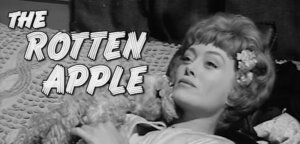
THE ROTTEN APPLE (aka FIVE MINUTES TO LOVE)
Dir. John Hayes, 1963.
US. 80 min.
In English.
THURSDAY, SEPTEMBER 3 – 10 PM
MONDAY, SEPTEMBER 14 – 10 PM
SATURDAY, SEPTEMBER 19 – MIDNIGHT
THURSDAY, SEPTEMBER 24 – 7:30 PM
This gloriously no-budget melodrama was the last of three films Hayes made with Rue McClanahan, before her refusal of his offer of marriage brought their collaboration to a close. The film follows straight-laced newlyweds Ben and Edna (Will Gregory and Gaye Gordon), who happen upon a junkyard in Nowheresville, USA after their car breaks down.
From this familiar premise – the innocents unknowingly walking into a den of vice – Hayes crafts a powerful chamber piece that plays like Tennessee Williams dragged into a (literal) trash heap. Brash, abusive junkyard owner Harry (Paul Leder, giving a manic performance that must be seen to be believed) quickly tries to implicate Ben in his shady dealings, while Harry’s beautiful but broken kept woman Poochie (McClanahan) tries her best to shake the foundations of his middle-class morality. Meanwhile, Edna finds herself pursued by Harry’s disturbed employee Blowhard (King Moody), while tortured poet/car thief Floyd (Norman Hartweg) muses on Freud and Nietzsche.
While the movie is rough and unpolished even by Hayes’ standards, all of his virtues as a filmmaker are here. The director’s empathy for the downtrodden, his non-judgmental portrayal of sex as the driving force behind all human interaction, and his facility with stylized, theatrical dialogue result in a film just as ambitious but far more truthful than the Williams adaptations, big business in Hollywood at the time, that wore their sleaze like a Halloween costume. Rest assured, The Rotten Apple is the real deal.
Courtesy of Something Weird Video.
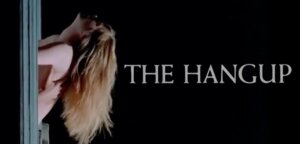
THE HANG-UP
Dir. John Hayes, 1969.
US. 75 min.
In English.
SATURDAY, SEPTEMBER 5 – 10 PM
THURSDAY, SEPTEMBER 10 – 7:30 PM
TUESDAY, SEPTEMBER 15 – 10 PM
FRIDAY, SEPTEMBER 18 – MIDNIGHT
It would be a crime to give away the brilliant bait-and-switch that opens The Hang-Up, so suffice to say that it quickly establishes the world of betrayals, con games and role reversals that Hayes’ film moves through.
After hard-nosed, queer-hating vice cop Walsh (Glenn Ford look-alike Tony Vorno) raids a brothel, he offers to help young sex worker Angel (Sharon Matt) get back on her feet. It doesn’t take long before his paternal instincts turn to lust, kicking off an affair with Angel that shatters his world of black-and-white morality. Before he knows it, Walsh finds himself blackmailed into a series of impossible decisions taking him far beyond the scope of the law.
Hayes’ cleverly plotted screenplay further destabilizes the reactionary cop’s identity with every twist and turn, offering an unsparing depiction of the psychology behind the violence of the state. Far from a moralistic tale of succumbing to temptation, Hayes approaches the film’s sexual neuroses with his typical lack of distance or judgment – and with plenty of nudity.
CW: this film contains a graphic scene of sexual assault. Viewer discretion is advised.
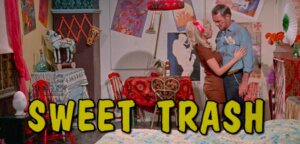
SWEET TRASH
Dir. John Hayes, 1970.
US. 79 min.
In English.
SATURDAY, SEPTEMBER 5 – MIDNIGHT
FRIDAY, SEPTEMBER 11 – MIDNIGHT
THURSDAY, SEPTEMBER 17 – 10 PM
WEDNESDAY, SEPTEMBER 30 – 10 PM
Sweet Trash expands The Hang-Up’s series of honeypots and shadowy operators into a vast world of conspiracy just beyond the edges of the frame, one in which true control no longer even lies with human beings.
In need of a payday for his bosses in the mob, small-time New York City loan shark McGuire (William Conners) decides to lean on his childhood friend, alcoholic longshoreman Michael Donovan (Duncan McLeod), who’s in deep to him for $4,000. What McGuire and Donovan don’t realize is that their fate has already been decided: in the film’s most surprising and forward-looking twist, it turns out the mob has given their decision-making over to a mysterious supercomputer, the dictates of which they must follow to the letter.
Sweet Trash is perhaps Hayes’ most personal film, digging painfully deep into the Irish Catholic background the director shared with his protagonist. Donovan’s flight from his mob pursuers takes him through the seediest corners of early ‘70s New York, captured with vivid location shooting and culminating in a hallucinatory psychic breakdown. From its soul-baring depths of emotion to the sci-fi element that eerily predicts our current AI predicament, Sweet Trash is one of the most memorable exploitation films of its era.