What was 9/11? It depends who you ask. A news anchor would tell you it was a national tragedy; a conspiracist, an inside job; a leftist, an empire’s comeuppance; a film critic, the year’s biggest blockbuster; and your cousin, a meme. In his typically blasé fashion, Baudrillard called it “the absolute event,” while the renowned German composer Karlheinz Stockhausen controversially called the attacks “the greatest work of art imaginable for the whole cosmos.” A pattern emerges: from the moment American Airlines Flight 11 was piloted into the North Tower, it has been remarkably difficult to comprehensively define 9/11.
The attacks were encoded in the national memory over seemingly endless minutes, hours, days, weeks, and months of media coverage. A quarter of a century later, it is tempting to think of 9/11 as a media event announcing material reality’s final, total subordination to the image—as Baudrillard said, “They did it. We wished it.” Yet to conceive of 9/11 in only these terms would be to overlook the lived horrors of the day and the insidious reverberations of a nationwide psychic trauma. From our historical vantage, the events of September 11 seem as fundamental to our current reality as the air we breathe. In recognition of the twenty-fifth anniversary of September 11, 2001, Spectacle presents a selection of films that confront the phenomenal and psychic impact of the attacks, and the indelible scar they left on the world. There was before, and this is after.
Program 1: REICHSTAG 9/11 & DISINEGRATION LOOP 1.1
REICHSTAG 9/11
Dir. Ken Jacobs, 2016.
United States. 38 min.
Silent.
“The Eternalism is a method of making images more real. … Time and space are monumentalized.”
—Ken Jacobs
“I fear cruelty, despise it, and it exists. It exists. It’s often called patriotism.”
—Ken Jacobs
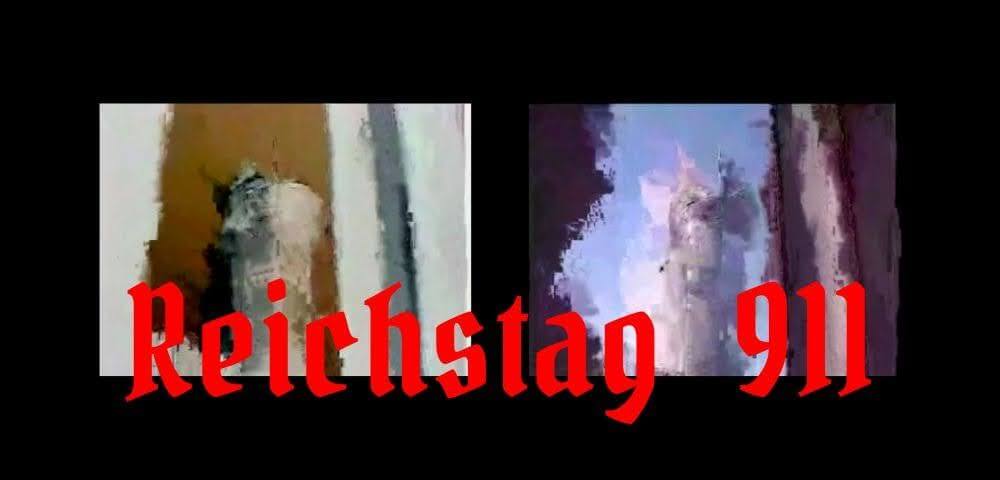
With Reichstag 9/11, Jacobs applies his Eternalism method to heavily distorted witness-recorded footage of the September 11 attacks. Here, the metaphysical qualities of the method assume a mournful tone—as we watch the towers repeatedly collapse, we simultaneously watch them rebuild themselves. It is as if Jacobs still sees them and their occupants there, as if the space itself wore a scar. The title alludes to the burning of the Reichstag in 1933, suggesting a similar exploitation of a population’s fear and anger by an imperial power seeking to expand its reach.
WARNING: This film contains sequences of intense strobing effects.
Special thanks to Azazel Jacobs.
screening with
DISINTEGRATION LOOP 1.1
Dir. William Basinski, 2001.
United States. 62 min.
“All of a sudden the world had changed. It had taken on new meaning. As the days and months went by, people just cascaded into their own disintegration loops of fear, terror and anxiety. But also there was a rethinking going on about what had value. There was a lot of compassion in the public sphere amongst New Yorkers.”
—William Basinski
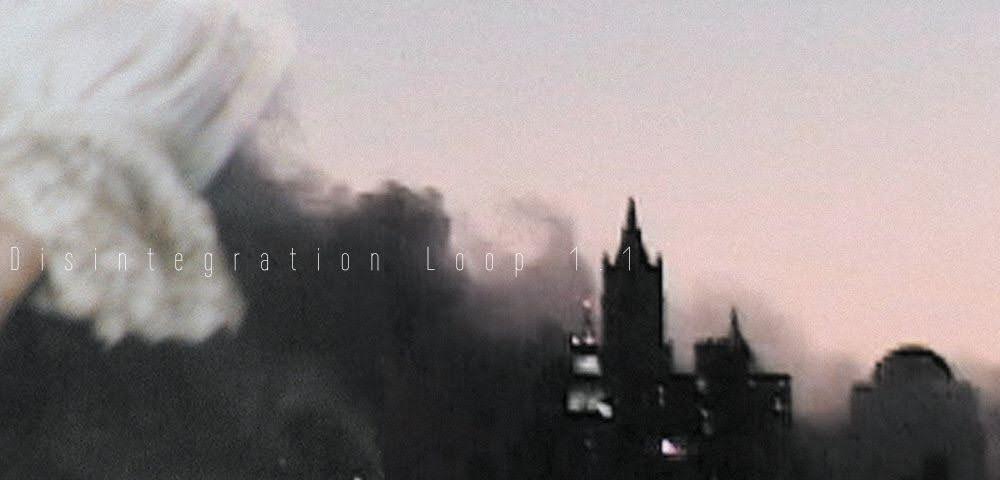
August of 2001 found William Basinski, uninspired and unemployed, at a personal nadir. Rummaging through his old work for inspiration, he rediscovered some loops of slowed-down muzak he had recorded on tape in the 1980s. He began digitizing the recordings, intending to use them for a new piece. In the process of rerecording the loops, the ferric oxide coating the tapes began to flake away, the fidelity of the recordings decreasing with each loop. The Disintegration Loops are thus a record of Basinski’s real-time capture of information disappearing into nothingness. Basinski completed his rerecording process on the morning of September 11, 2001, a few hours before he was scheduled to interview for a job at the World Trade Center.
That evening, from the rooftop of his Williamsburg loft on North 11th Street, Basinski played the loops and watched the smoke plumes from lower Manhattan billow out over the Upper Bay. He borrowed a friend’s video camera and recorded the last hour of the day’s light, until the black plume of smoke was indistinguishable from the night sky. He later set the loops to this footage. A landmark of twenty-first century avant-garde process music, The Disintegration Loops are considered one of the most significant works of art related to 9/11.
We will be time-syncing our September 11, 2026 screening to play exactly 25 years later as the sun sets over Spectacle, blocks from where Basinski made the loops.
Special thanks to William Basinski and Jeremy deVine.
FRIDAY, SEPTEMBER 11 – 7:10PM
SATURDAY, SEPTEMBER 12 – 5PM
WEDNESDAY, SEPTEMBER 16 – 10PM
Program 2: THE UNRECOVERED
THE UNRECOVERED
Dir. Roger Copeland, 2007.
United States. 130 min.
In English.
SATURDAY, SEPTEMBER 12 – 7PM; w Q&A (This event will be $10.)
SUNDAY, SEPTEMBER 13 – 7PM; w Q&A (This event will be $10.)
FRIDAY, SEPTEMBER 18 – 5PM
WEDNESDAY, SEPTEMBER 23 – 10PM
“Were there two towers because there was too much meaning on September 11th to be contained in just one tower?”
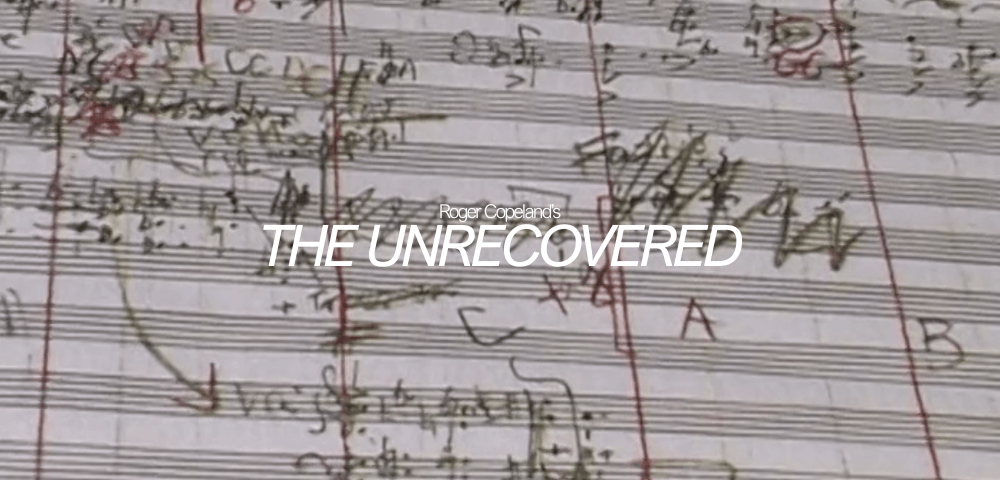
So asks the Artist, one of three intertwined paranoiacs in Roger Copeland’s sprawling post-9/11, DIY, Brechtian fever dream. Proposing a twist on the axiom that the urge to destroy is also a creative urge, Copeland’s film suggests that all creativity is paranoid, and all paranoia is creative. It depicts a world that exists in “a state of semiotic arousal, a horniness for meaning.” Taking place in October of 2001, the film cuts between the story of a young girl who thinks the father that walked out on her family might be among the unrecovered dead at Ground Zero; the self-proclaimed BioEvangelist, who, in between compulsively consuming media coverage of the attacks’ aftermath in his basement chemistry lab, plans his own epistolary reckoning; and the aforementioned Artist, who monologues (livestreams?) from his studio about the ways the “death artists” have put art on the defensive.
To an audience in 2026, its diagnoses might seem rather obvious, its degree of sincerity inscrutable; but to an audience in 2007, The Unrecovered offered a proto-experience of a world that would not fully mature for nearly two more decades. Guided by an overtly didactic montage, it recalls the works of Sergei Eisenstein and Adam Curtis, while its Spalding Gray–like monologues of semiotic analysis-paralysis and its sometimes clunky, low-fidelity computer graphics presage more ironic, contemporary aesthetics as seen in media by personalities like Brad Troemel and Conner O’Malley (try to keep track of the number of times Fight Club is mentioned—you can’t). Truth be told, The Unrecovered might be well described as “What if Godard directed Loose Change?”
“Copeland knows how to tease the maximum meaning out of images and juxtapose them to achieve magic realism. He turns the instructional video of a flight attendant demonstrating safety procedures into a ribbon of grief, and gets tone poems out of a backyard swing, construction cranes (and) skeins of branches against a winter sky….Haunting, gut-punching, brainy, and gutsy…”
—James Walcott, Vanity Fair
“I was knocked out. Really gets under your skin… A grand tour of some very difficult stuff.”
—Eric Bogosian
Special thanks to Roger Copeland.
Program 3: CIRCLING ZERO
CIRCLING ZERO: WE SEE ABSENCE
Dir. Ken Jacobs, 2002.
United States. 110 min.
In English.
MONDAY, SEPTEMBER 7 – 10PM
MONDAY, SEPTEMBER 14 – 7:30PM
SATURDAY, SEPTEMBER 19 – 5PM
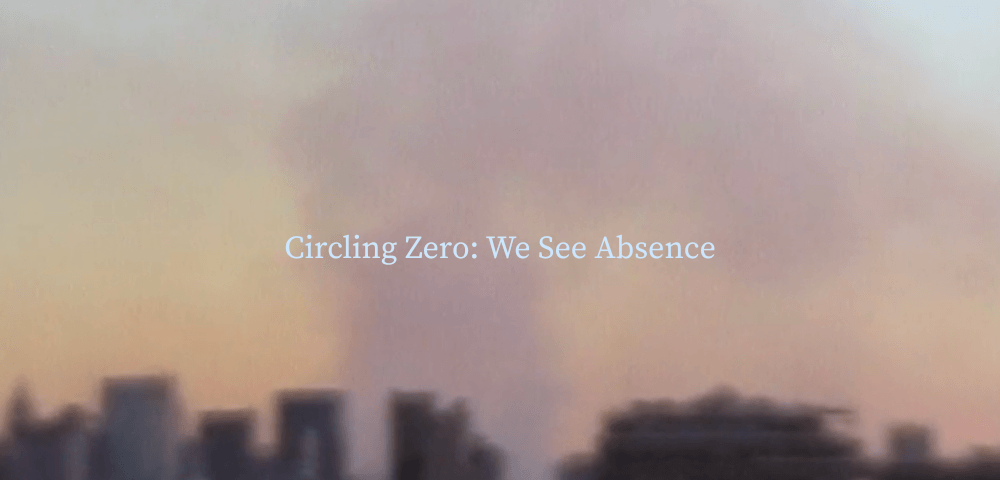
The primary image of Circling Zero is of lower Manhattan’s disfigured skyline. A slowly dissipating column of smoke indicates where the towers once stood, looming over the city like a ghost. The film is a verité documentary of the few weeks following September 11; Jacobs himself described it as “not so much a work as a sampling of the ongoing actuality.” His camera captures the élan vital of the city as it adapts to a changed environment, steadfastly incorporating this new reality into the familiar routines of daily life.
Special thanks to Azazel Jacobs.
Program 4: THE TIME WE KILLED
THE TIME WE KILLED
Dir. Jennifer Reeves, 2004.
United States. 94 mins.
In English.
SATURDAY, SEPTEMBER 5 – 7:30PM (This event is $10.)
FRIDAY, SEPTEMBER 25 – 7:30PM (This event is $10.)
Soon, I realized the citizens are as vicious and self-involved as ever. And me, I wondered if I could perform such a spectacular suicide.
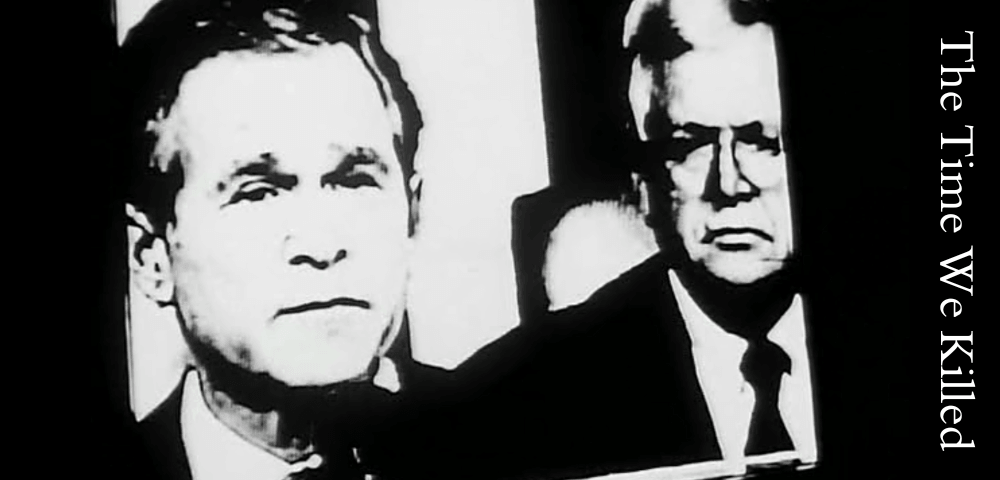
Like The Unrecovered, Jennifer Reeves’s The Time We Killed is concerned, above all, with the psychic fallout of the attacks. While The Unrecovered pursues a manic immediacy, Reeves numbly and associatively follows the reverberations of the day’s events as they lead into the Bush administration’s echo chamber of lies and jingoism conceived to justify the 2003 invasion of Iraq.
Robin is an agoraphobic writer, unable to leave her apartment for three years following the September 11 attacks. The film is a poetic, black-and-white collage of high-contrast images and similarly binary thinking; in constant voiceover Robin either ponders death or laments a past lust for life, evinced by her recollection of once-passionate but long since ended love affairs. In what could be considered a spiritual forebear to the anhedonic monologuing of Ottessa Moshgfegh’s My Year of Rest and Relaxation, Reeves condenses a certain posture of the post-9/11 national psyche into an amnesiac individual, one who is trying to remember—yet also willing to forget—how things might once have been.
16mm print courtesy of The Film-Makers’ Cooperative.
screening with
THE SKY IS CLEAR AND BLUE TODAY
Dir. Ricky D’Ambrose, 2019.
United States. 16 mins.
In English and German with English subtitles.
Ricky D’Ambrose’s short film centers on a German filmmaker who has been hired to recreate the infamous photograph taken by Thomas Hoepker of five young, hip New Yorkers posed on the Brooklyn waterfront, seemingly relaxed and unbothered by the wreckage of the Twin Towers smoldering across the river. D’Ambrose’s typically dispassionate, Bressonian approach uses the image as a jumping-off point to investigate the (f)utility of the sort of interpretive gamesmanship that surrounded this and other images of the attacks.