
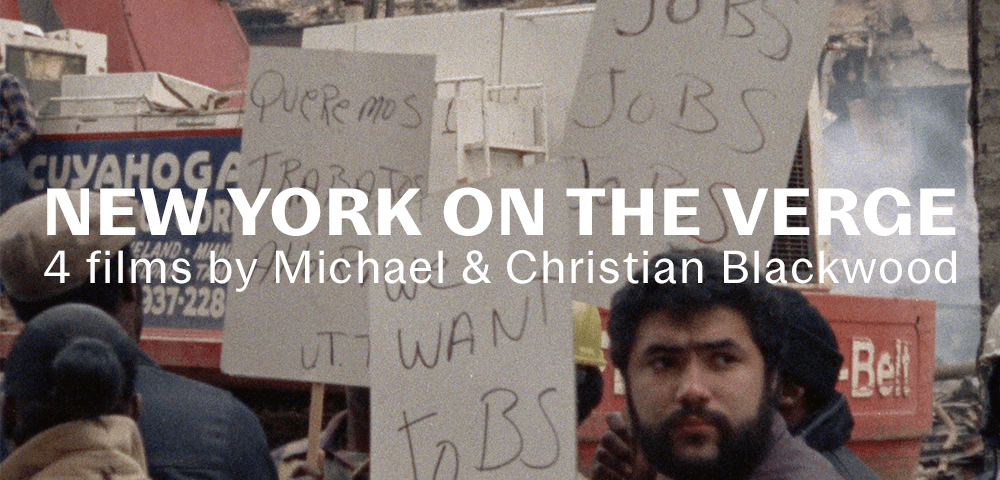
Michael Blackwood directed and produced over 150 films beginning in the 1960s and continuing through the 2010s, while his brother Christian directed and produced around 50 additional films himself. The largest and most well known portions of both bodies of work focused on the artist, including dozens of profiles with painters, musicians, dancers, and other artists, as well as surveys of contemporary cultural movements such as postmodern architecture, jazz, abstract expressionism, modern dance, modern sculpture, and pop art. In 1966, Michael Blackwood created Blackwood Productions with a commitment “to making films about art, music, and the cultural landscape in New York City,” but went on to produce films around the world. Christian Blackwood, Michael’s younger brother by eight years, made films alongside his brother for many years before venturing out on his own.
While most of the Blackwoods’ films remain underseen, the four films in this series about New York have never before screened theatrically in the city that inspired them. Each is unique in style – experimental, vérité, essay film, “expository” – but they are all inherently city films. They were made at three major turning points in New York City’s turbulent twentieth century: the dawn of the 60s, the onset of the 70s, and the watershed of the mid 1980s. These four films highlight the Blackwoods’ love for the city and its people and are full of new views of our great, messy, corrupt, beloved city.
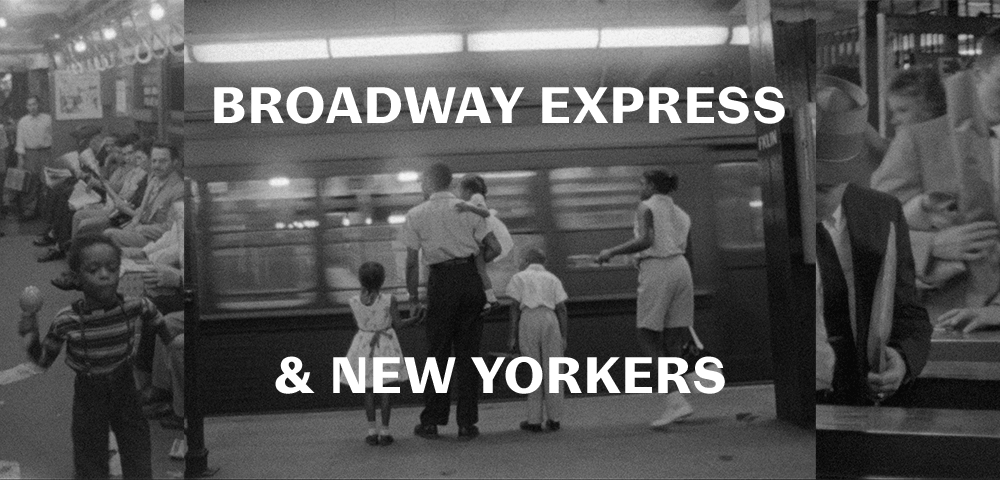
BROADWAY EXPRESS + NEW YORKERS (48 minutes)
MONDAY, APRIL 6 – 10 PM (following the 7:30pm screening of SUMMER IN THE CITY)
WEDNESDAY, APRIL 29 – 7:30 PM
BROADWAY EXPRESS
Dir. Michael Blackwood, 1959
United States. 19 min.
In 1957, the vérité documentarian D.A. Pennebaker released his first film: at just over five minutes, DAYBREAK EXPRESS borrows its name from the Duke Ellington song to which Pennebaker set his romantic, avant-garde view of New York’s elevated subway line. Just two years later, Michael Blackwood made his debut with an homage to Pennebaker’s. In BROADWAY EXPRESS, also shot on silent 16mm film and set to an original jazz score by Howard Gilbert, Blackwood takes his camera underground and in the evening hours for a more internal view of both the city’s subway system and the New Yorkers who ride it. Following BROADWAY EXPRESS, Blackwood began his career in the footsteps of Pennebaker and other experimental documentarians of the 60s before refining his own approach to portrait films with more substantial use of voiceover narration and interviews.
NEW YORKERS
Dirs. Michael Blackwood, Lana Jokel, Philip Miller, and Roger Murphy, 1971.
United States. 29 min.
In English.
In NEW YORKERS, the camera floats around the Upper East Side, inviting shop owners and workers, neighborhood idlers and scurriers, mothers and children toward it with an air of joyfulness. A collaboration among Michael Blackwood and three additional co-directors, this open-ended exploration of a neighborhood seems to follow the inspiration of several observers and stays with characters unique to the time and the place, including the owner of a novel type of storefront for bike repairs.
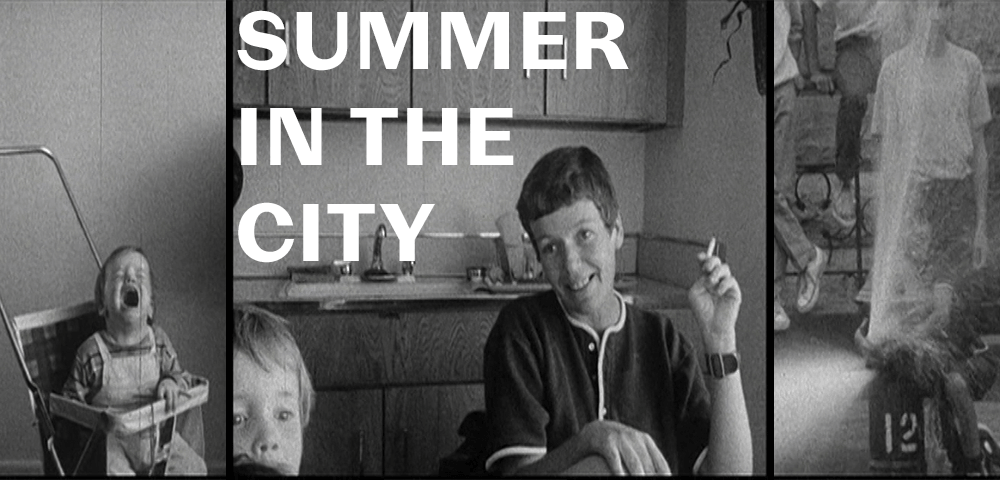
SUMMER IN THE CITY
Dirs. Christian Blackwood and Robert Leacock, 1970.
Germany. 89 min.
In German and English with English subtitles.
MONDAY, APRIL 6 – 7:30 PM
FRIDAY, APRIL 10 – 5 PM
SUNDAY, APRIL 19 – 5 PM
SATURDAY, APRIL 25 – 10 PM
SUMMER IN THE CITY is a stunning document of Christian Blackwood’s sensibilities as a cinematographer and a rich portrait of Manhattan at the precipice of its most notoriously troubled decade. It focuses on everyday New Yorkers caught in a moment between fading hope, trust, and promise and looming confusion, outrage, and desperation. The film is composed in vérité style but does not purport to be a fly on the wall as its subjects scowl at, question, and laugh with the cameraman, who is always in motion. The narration, written and read by Uwe Johnson, is at times lyrical and others abrasive. Johnson hides behind his words no less than Christian behind the camera, working out his feelings about New York and its inhabitants and leaving us each moved, delighted, conflicted, and provoked.
The project originated from the German writer, who lived on the Upper West Side in the 1960s:
“In 1968 German Television agreed to coproduce a film with us in which Uwe Johnson would, on-camera, introduce and question the various characters with whom he exchanges news and opinions on his wanderings on the Upper West Side. We proposed to him that he participate in the documentary. Being essentially introverted he was not interested in the on-camera concept, but was willing to make a list of places and situations that he felt should be included in the film. Christian Blackwood took charge of the project. Johnson wrote the narration once the film was edited. It was broadcast in Germany at the time.”
Content warning: Extensive portrayal of heroin use
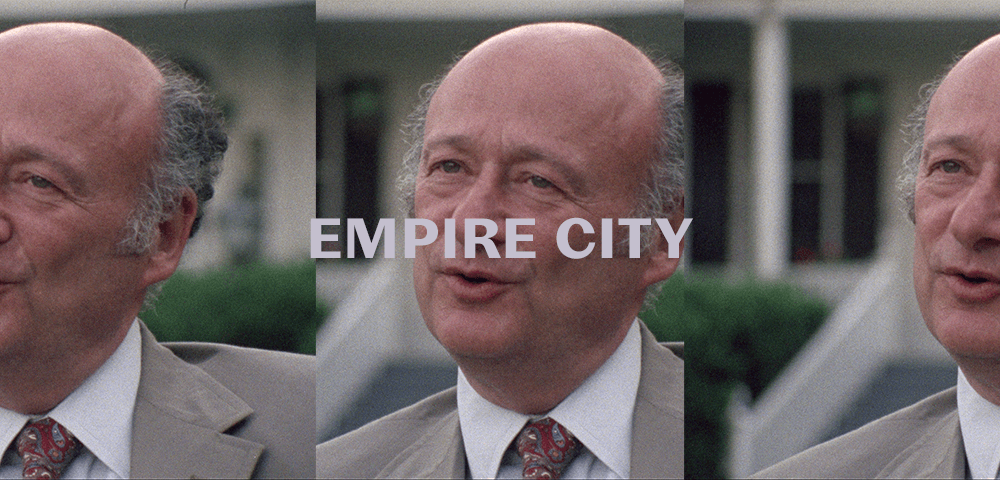
EMPIRE CITY
Dir. Michael Blackwood, 1985.
United States. 89 min.
In English.
THURSDAY, APRIL 2 – 7:30 PM
WEDNESDAY, APRIL 8 – 10 PM
SATURDAY, APRIL 25 – 5 PM
EMPIRE CITY is a straightforward documentary with a long-form joke underneath its surface. The film begins with notable access to the rich and powerful, and may appear to join in on the praise of the rapid development and new economic growth for which the ruling wealthy class gleefully takes responsibility. Free market enthusiasts could get lulled into the film only to be taken for a ride through Michael Blackwood’s exploration of class dynamics within the built environment of (mostly) Manhattan.
The film focuses on the history of New York City during its “golden age” of 1830-1930 told from the vantage point of the mid 1980s. As politicians, real estate developers, and business leaders celebrate the rebound of New York’s economy, Blackwood begins to expose the dark side of its new economic engine. This hardly-seen documentary contains an abundance of footage, soundbites, and context from this pivotal time.
Special thanks to Ben Blackwood.